

Fifty commons and uncommons built around Repair, the one keyword Blue genuinely owns.
Some links below are affiliate links. If you buy through them, Geeky Domain may earn a small commission at no extra cost to you.
The Short Version
Blue is not the counterspell colour in the Gundam Card Game. Blue is the Repair colour — of the 19 cards printed with Repair, 15 are Blue (79%), and Repair is the keyword that heals a damaged Unit at the end of your turn. This deck is 50 cards, every one of them a common or uncommon, built around four Repair bodies — Delta Plus (Waverider Mode) at 2 cost with Repair 2, Stark Jegan, Psycho Gundam (MA Mode) and Asshimar — plus Andrew Waldfeld, a 1-cost Pilot who hands Repair 2 to anything he links with. The support package rests enemy Units and then punishes them, because almost every piece of Blue removal at this rarity only works on a rested target. Be honest with yourself about the ceiling: this deck grinds out fair midrange decks, and it struggles badly against a wide board it cannot rest.
In This Guide
- → Blue Is the Repair Colour, Not the Counterspell Colour
- → The Repair Core: Four Units That Refuse to Die
- → Pilots That Turn Repair Into Pressure
- → Rest, Then Punish: The Support Package
- → The 50-Card Decklist
- → How the Deck Actually Wins
- → Honest Weaknesses and Flex Slots
- → Frequently Asked Questions
Blue Is the Repair Colour, Not the Counterspell Colour
Ask a new player what Blue does in this game and you will usually get an answer imported from a different card game entirely: counters, card draw, bounce. It is a reasonable guess and it is wrong. We parsed all 536 cards in Bandai's official database, and the complete keyword vocabulary of the Gundam Card Game is seven words long — Blocker, Breach, Repair, First Strike, High-Maneuver, Suppression and Support. That is the whole list. Blue's share of it is Repair, and it is not close.
Repair reads: "(At the end of your turn, this Unit recovers the specified number of HP.)" Damage sticks to a Unit between turns, which is why chip damage normally accumulates until something dies. Repair deletes that accumulation once per turn cycle. It does not prevent damage and does nothing on your opponent's turn; it simply erases the bruises you took, over and over, until your opponent runs out of patience. The numbers behind that live in our combat math guide, and turn structure in the beginner's guide to playing.
Here is how the seven keywords actually distribute across the game's five colours — White, Blue, Green, Red and Purple. (Yes, Purple is real; it is 80 cards and it is not a rumour.)
| Keyword | Printings | Which colour owns it |
|---|---|---|
| Blocker | 65 | White — 23 of 44 cards (52%) |
| Breach | 41 | Green — 21 of 35 cards (60%) |
| Repair | 23 | Blue — 15 of 19 cards (79%) |
| First Strike | 16 | Nobody — Red 4, Green 3, White 3 |
| High-Maneuver | 16 | Nobody — Green 4, Blue 3, Purple 3 |
| Suppression | 13 | No single owner in our count |
| Support | 11 | Red — 8 of 9 cards (89%) |
Two things fall out of that table. First, Blue's identity is durability, not disruption. Second — and this is the part that stings — Blue at common and uncommon has almost no card draw. In the entire budget Blue pool there is exactly one proactive draw spell worth a slot, A Show of Resolve (GD01-100), a 3-cost Command that reads "【Main】Draw 2." Everything else that draws is stapled to a Burst trigger you only see when a Shield breaks, or to a Link you had to pay for first. So if someone tells you to build Blue as a draw-go control deck on a budget, they are describing a deck the card pool cannot supply. Build the attrition deck instead, because the attrition deck is what Bandai actually printed. Our Blocker keyword breakdown shows what the defensive colour looks like when it goes all-in on interception; Blue does something different, and cheaper.
The Repair Core: Four Units That Refuse to Die
Be clear-eyed about the size of the budget Repair pool. Across the commons and uncommons available to a mono-Blue builder, exactly four Units carry Repair natively. That is the whole engine. The deck plays every one of them, in as many copies as the curve allows, because a Repair deck with six Repair bodies is just a bad midrange deck.
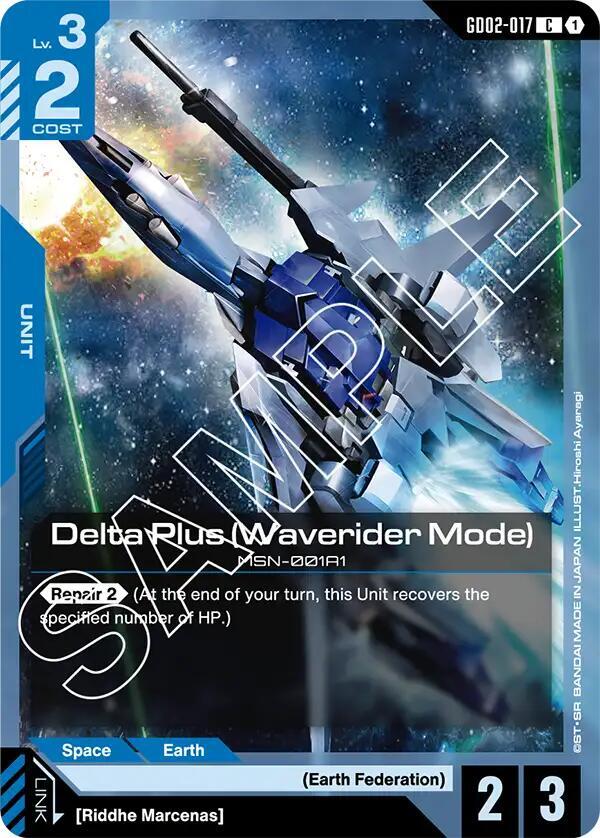
Delta Plus (Waverider Mode) (GD02-017) is the best card in the deck and it is a common. Two cost, Lv.3, AP 2 / HP 3, trait (Earth Federation), and the entire text box is "
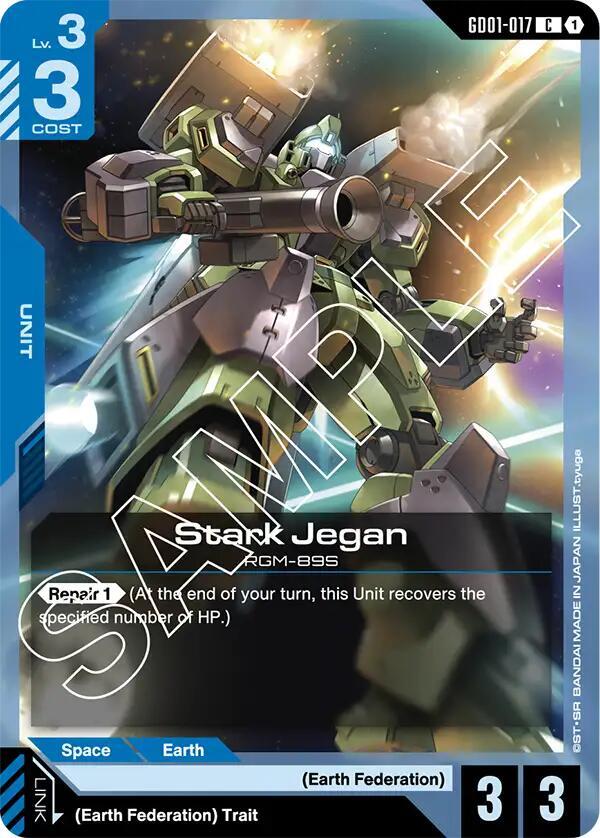
Stark Jegan (GD01-017) is the same idea with the numbers reversed: 3 cost, Lv.3, AP 3 / HP 3, (Earth Federation), with "
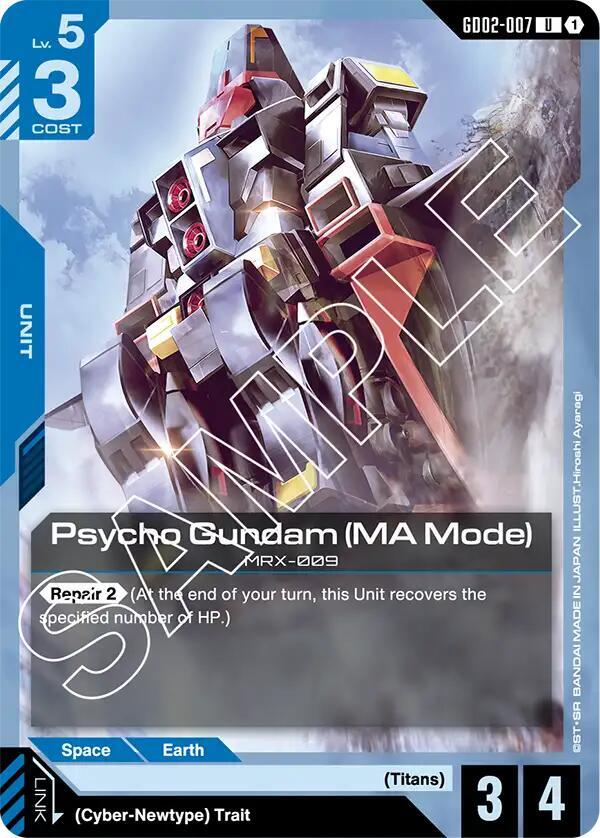
Psycho Gundam (MA Mode) (GD02-007) is the top of the curve at 3 cost, Lv.5, AP 3 / HP 4, (Titans), with "
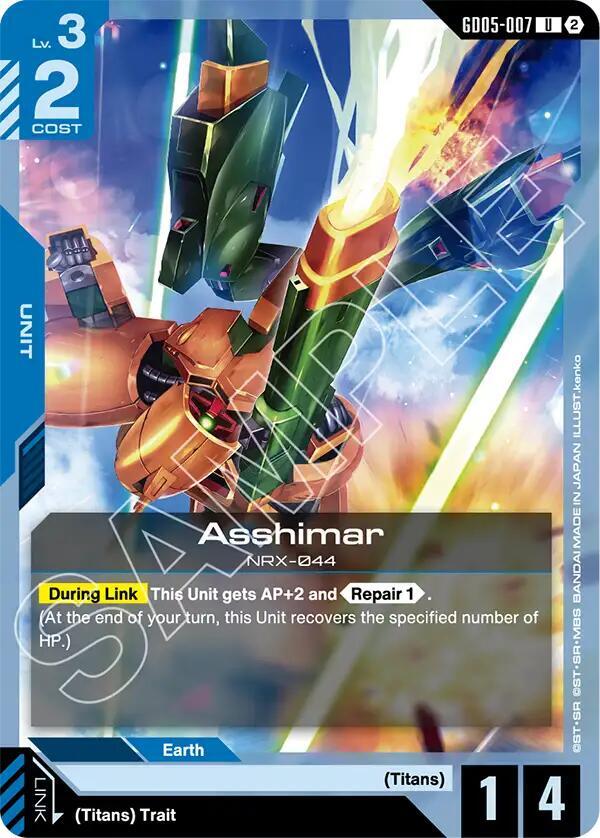
Asshimar (GD05-007) is the strange one and needs a warning attached. It is 2 cost, Lv.3, AP 1 / HP 4, (Titans), and its text is "【During Link】This Unit gets AP+2 and
Pilots That Turn Repair Into Pressure
Four Repair Units is a thin engine. Three Pilots widen it, and two of them exist specifically to reward you for building this way.
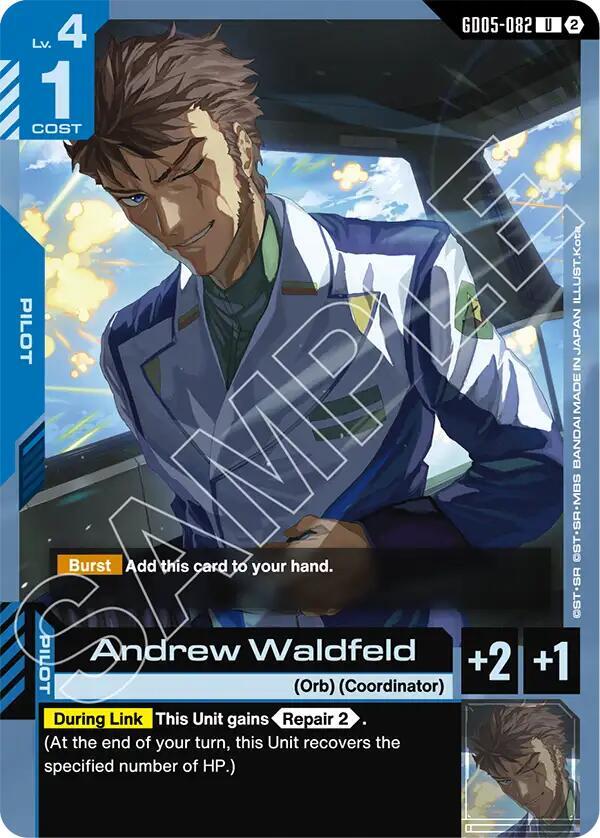
Andrew Waldfeld (GD05-082) is the card that makes the deck a deck rather than a pile of four good commons. One cost, Lv.4, AP+2 / HP+1, trait (Orb) (Coordinator), and the text is "【Burst】Add this card to your hand. 【During Link】This Unit gains
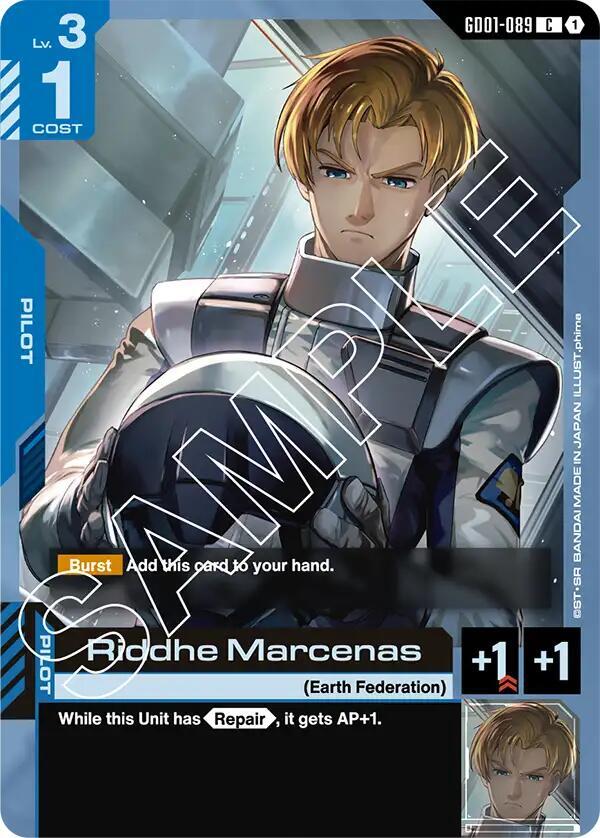
Riddhe Marcenas (GD01-089) is the payoff Pilot: 1 cost, Lv.3, AP+1 / HP+1, (Earth Federation), reading "【Burst】Add this card to your hand. While this Unit has
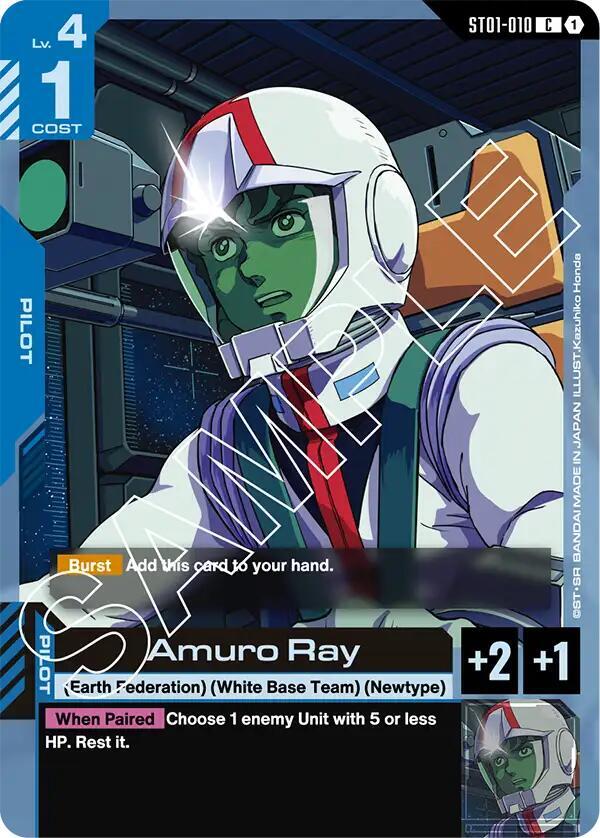
Amuro Ray (ST01-010) earns two slots for a different reason. He is 1 cost, Lv.4, AP+2 / HP+1, with "【When Paired】Choose 1 enemy Unit with 5 or less HP. Rest it." Resting is the hinge of this entire deck, as the next section explains, and Amuro is the only Pilot in the budget pool that rests something for free while also being a fine stat line. All three Pilots also carry "【Burst】Add this card to your hand," which means a broken Shield never gives you nothing — a mechanic worth understanding properly via our Shield and Burst trigger guide.
Rest, Then Punish: The Support Package
Blue at common and uncommon has essentially no unconditional removal. What it has instead is a two-step loop: rest an enemy Unit, then hit the rested Unit. Read the effect text of the cheap Blue interaction and you will see the word "rested" over and over. Once you notice it, the deckbuilding gets much easier — you are not playing removal spells, you are playing a combo where both halves have to show up.
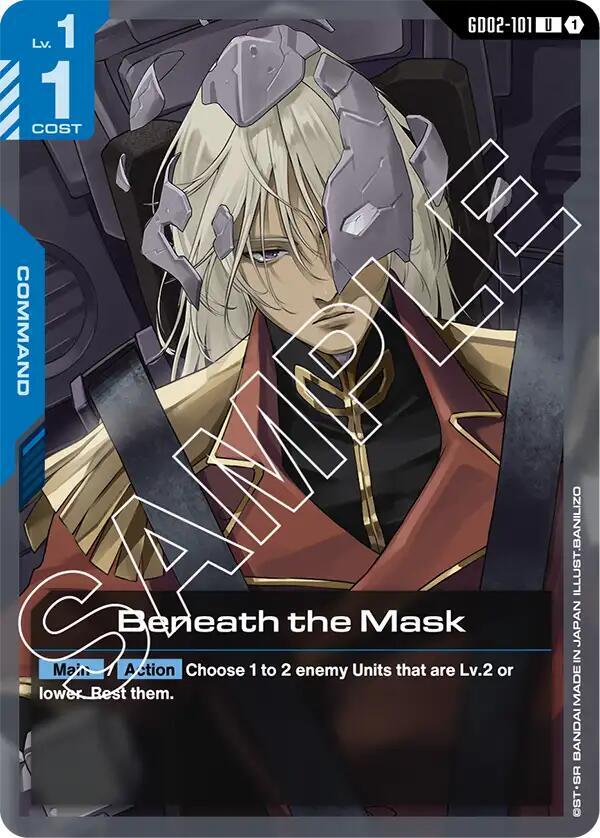
The resting half is Beneath the Mask (GD02-101) and Amuro Ray. Beneath the Mask is a 1-cost Command reading "【Main】/【Action】Choose 1 to 2 enemy Units that are Lv.2 or lower. Rest them." Action speed is the important word — you can cast it during your opponent's turn. A rested Unit cannot pay the cost of Blocker, which is "(Rest this Unit to change the attack target to it.)" so Beneath the Mask is also a one-resource answer to two blockers mid-combat. Its ceiling is capped by the Lv.2 clause, which means it is dead against the biggest threats, and you should accept that rather than pretend otherwise.
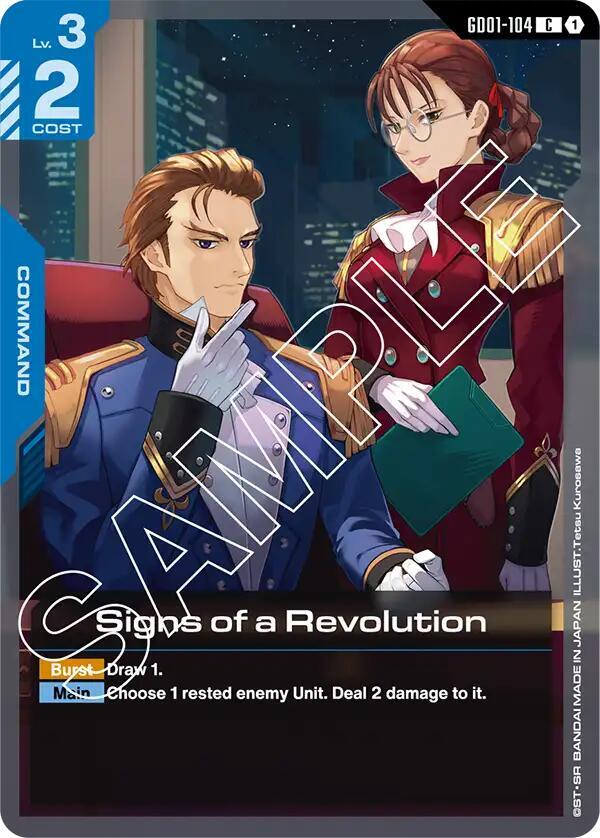
The punishing half is Signs of a Revolution (GD01-104), a 2-cost Command with "【Burst】Draw 1. 【Main】Choose 1 rested enemy Unit. Deal 2 damage to it," backed by Anksha (GD01-020) and Guntank (GD01-008), whose Deploy effects both read "Choose 1 rested enemy Unit. Deal 1 damage to it." Every Unit that has attacked is rested, so the natural line is: let your opponent attack, survive with Repair bodies, then spend your turn punishing the rested board. Anksha is a 2-cost Lv.4 / AP 3 / HP 3 body that happens to ping something; Guntank is a 1-cost Lv.2 / AP 1 / HP 2 that fills a curve hole and finishes off a damaged attacker.
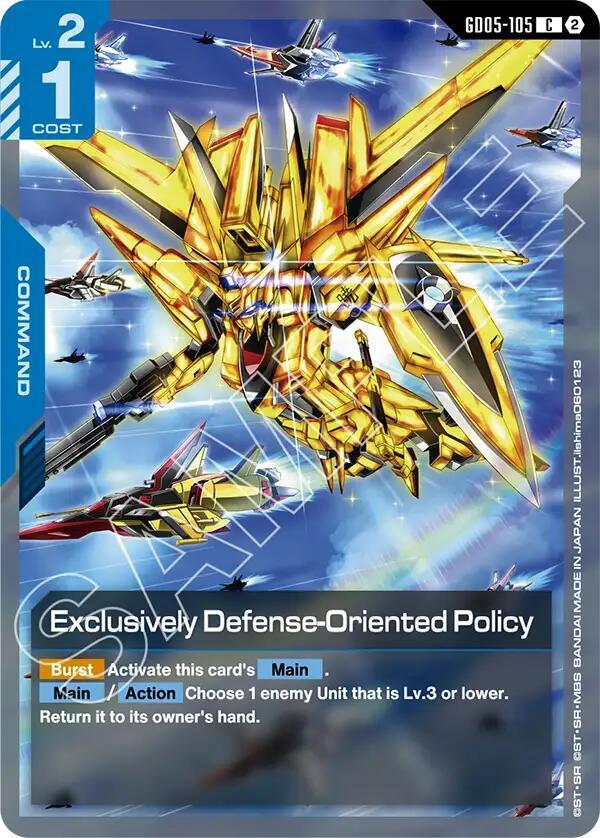
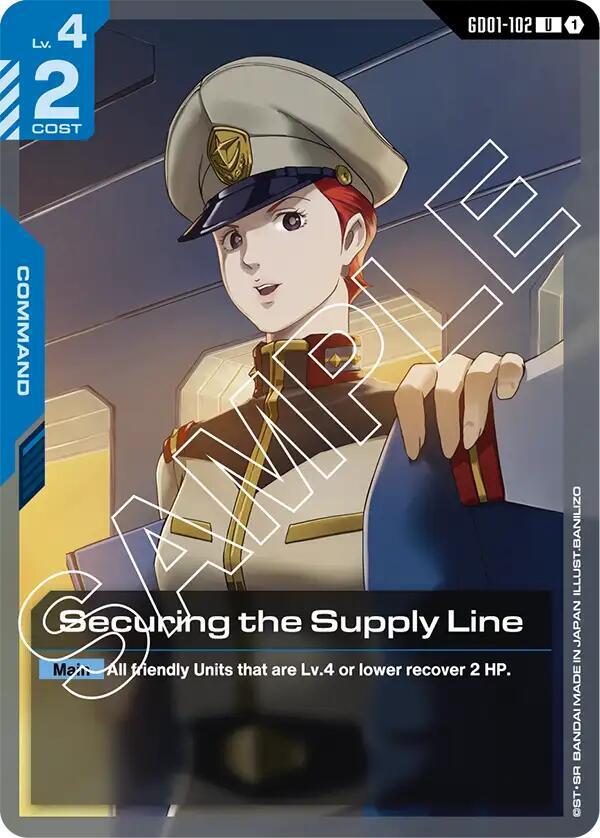
Two more Commands round it out. Exclusively Defense-Oriented Policy (GD05-105) is the deck's only true answer to a resolved threat: 1 cost, "【Burst】Activate this card's 【Main】. 【Main】/【Action】Choose 1 enemy Unit that is Lv.3 or lower. Return it to its owner's hand." It bounces rather than destroys, and it caps at Lv.3, but at one resource and with a live Burst trigger it is the best rate available. Securing the Supply Line (GD01-102) is 2 cost for "【Main】All friendly Units that are Lv.4 or lower recover 2 HP" — a board-wide reset that resolves immediately instead of waiting for end of turn, which is exactly what Repair cannot do. Note the Lv.4 clause excludes Psycho Gundam (MA Mode); it heals itself anyway. If you want to see how a colour with real removal builds interaction by comparison, the aggressive keyword guide is the other side of this coin.
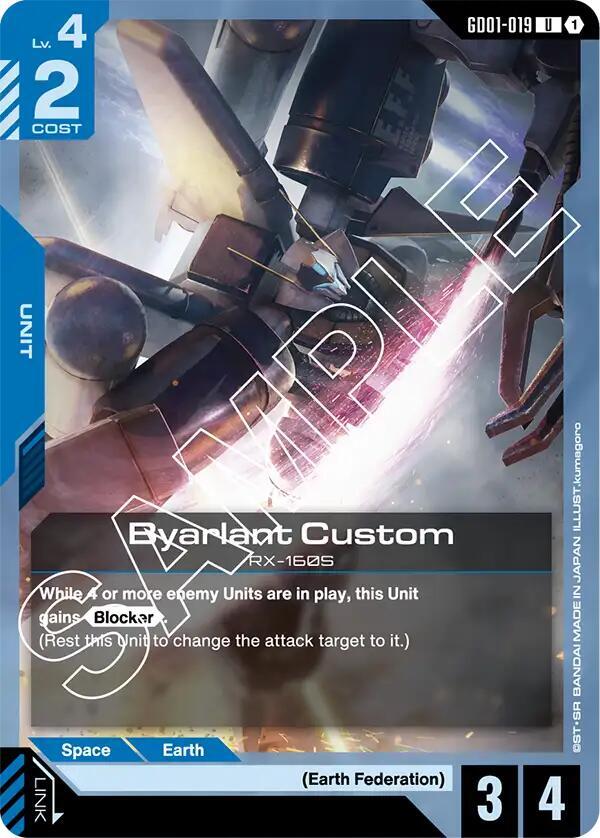
The non-Repair bodies are there to hold ground while the engine assembles. Byarlant Custom (GD01-019) is 2 cost, Lv.4, AP 3 / HP 4 with "While 4 or more enemy Units are in play, this Unit gains
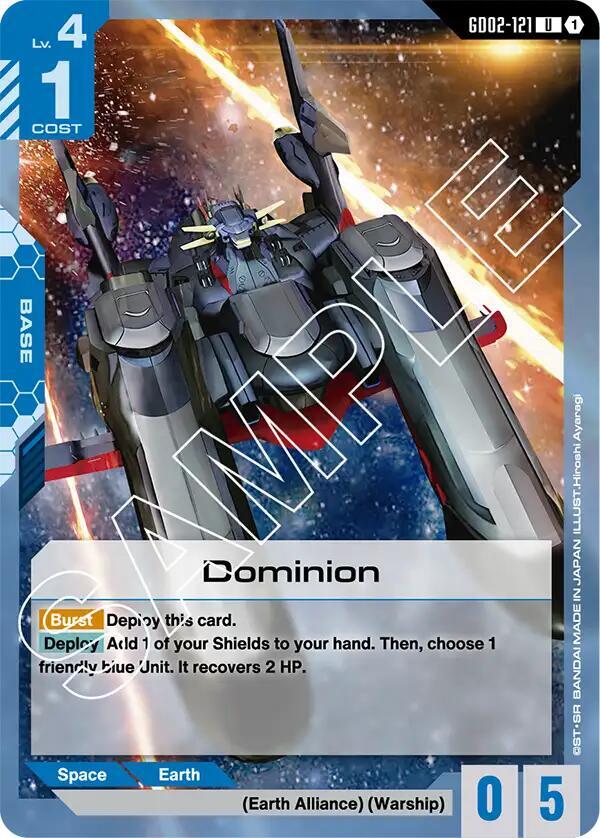
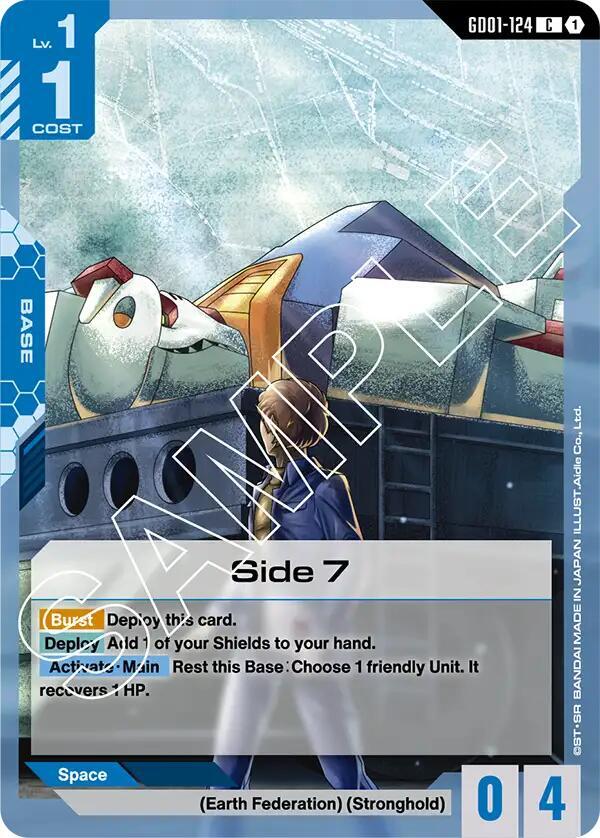
The Bases matter more than their card count suggests. Dominion (GD02-121) costs 1 for a Lv.4 Base with HP 5 and reads "【Burst】Deploy this card. 【Deploy】Add 1 of your Shields to your hand. Then, choose 1 friendly blue Unit. It recovers 2 HP." Mono-Blue means that second clause never misses. Side 7 (GD01-124) is a 1-cost Lv.1 Base with HP 4 whose "【Activate・Main】Rest this Base:Choose 1 friendly Unit. It recovers 1 HP" is a free extra point of healing every single turn — small, repeatable, and exactly the kind of edge an attrition deck is built on. Both add a Shield to your hand on deploy, which converts a defensive resource into a card you can actually play; if the Shield and resource economy is still fuzzy for you, start with the EX Base and EX Resource token explainer.
The 50-Card Decklist
Fifty cards in the main deck, a separate 10-card resource deck, maximum four copies of any card, one colour. Every card below is a common or an uncommon. The curve stops at 3, which is deliberate: this deck wants to deploy a body and hold up Beneath the Mask or Exclusively Defense-Oriented Policy in the same turn, and it cannot do that with a 4-drop clogging the top. If this is your first attempt at assembling something from scratch, read it alongside our first deck construction walkthrough.
| Card | Code | Cost | Copies | Role |
|---|---|---|---|---|
| Units — 26 | ||||
| Delta Plus (Waverider Mode) | GD02-017 | 2 | 4 | Core Repair 2 body, 2/3 |
| Asshimar | GD05-007 | 2 | 4 | 1/4 wall, 3/4 with Repair 1 when Linked |
| Byarlant Custom | GD01-019 | 2 | 4 | 3/4 beater, conditional Blocker vs wide boards |
| Stark Jegan | GD01-017 | 3 | 4 | 3/3 Repair 1, the attacking Repair body |
| Psycho Gundam (MA Mode) | GD02-007 | 3 | 3 | 3/4 Repair 2, Lv.5 dodges "Lv.4 or lower" |
| Guncannon | ST01-003 | 2 | 3 | Vanilla 2/4, cheap durable ground-holder |
| Anksha | GD01-020 | 2 | 2 | 3/3 with Deploy: 1 damage to a rested enemy |
| Guntank | GD01-008 | 1 | 2 | 1-drop, Deploy: 1 damage to a rested enemy |
| Pilots — 9 | ||||
| Andrew Waldfeld | GD05-082 | 1 | 4 | +2/+1 and grants Repair 2 to any Link |
| Riddhe Marcenas | GD01-089 | 1 | 3 | +1/+1, plus AP+1 while the Unit has Repair |
| Amuro Ray | ST01-010 | 1 | 2 | +2/+1, When Paired rests a 5-or-less-HP enemy |
| Commands — 10 | ||||
| Beneath the Mask | GD02-101 | 1 | 3 | Action-speed: rest 1-2 enemy Lv.2 or lower |
| Signs of a Revolution | GD01-104 | 2 | 3 | 2 damage to a rested enemy; Burst draws 1 |
| Exclusively Defense-Oriented Policy | GD05-105 | 1 | 2 | Bounce an enemy Lv.3 or lower; live Burst |
| Securing the Supply Line | GD01-102 | 2 | 2 | Team-wide 2 HP recovery, Lv.4 or lower |
| Bases — 5 | ||||
| Dominion | GD02-121 | 1 | 3 | HP 5 Base, Shield to hand, heals a blue Unit 2 |
| Side 7 | GD01-124 | 1 | 2 | HP 4 Base, repeatable 1 HP recovery each turn |
That is 21 cards at cost 1, 22 at cost 2 and 7 at cost 3. Nothing in the list is rarer than uncommon, which is the entire point — you can assemble this from bulk and starter product rather than chasing singles, and the rarity guide explains why that gap between uncommon and the higher rarities is where budget deck ceilings really live. Buying the missing pieces means the cheapest tier of singles on TCGplayer or eBay.
How the Deck Actually Wins
The win condition is not a big turn. It is your opponent running out of ways to profitably attack. Every turn they spend hitting a Repair 2 Unit for 2 damage is a turn they did nothing, and the deck is built to make that their least-bad option.
Turn one, you deploy a Base. Dominion or Side 7 at 1 cost both add a Shield to your hand on deploy, which is card advantage disguised as defence, and both leave a 4-or-5 HP object in front of you that your opponent has to chew through. Turn two, you deploy Delta Plus (Waverider Mode) or Byarlant Custom. Turn three, ideally, you Link a Pilot onto the Repair body rather than deploying a second Unit — Delta Plus with Andrew Waldfeld is a 4 AP / 4 HP Unit healing 4 damage at the end of every turn, and that does more work than two separate 2/3s, because the deck's defensive maths reward concentrating HP into bodies that heal.
From turn four the pattern is: attack with whatever survives combat, hold one resource for Beneath the Mask, and use your Repair bodies as blockers only when the trade is clean. Remember that attacking rests your Unit and a rested Unit cannot pay Blocker's cost, so every attack you make is a defensive decision too. That tension is the real skill of the deck: when in doubt on a close board, hold the Repair 2 body back, let it heal, and win the long game.
The removal loop deserves rehearsing before you sleeve up. Your opponent attacks with two Units; both are now rested. On your turn, deploy Anksha for 1 damage to one of them, cast Signs of a Revolution for 2 damage to the other, and you have killed or nearly killed two threats for three resources. Alternatively, Amuro Ray links onto a Unit and rests an enemy with 5 or less HP, which turns your own Deploy pings into removal on your terms rather than waiting for your opponent to attack into you. Beneath the Mask does the same during their turn against Lv.2 or lower targets, and resting two blockers before your attack step is the deck's best single play.
Your Shields are a resource, not a life total to be hoarded. All three Pilots and several Commands have Burst text, so letting a Shield break is often genuinely fine — Signs of a Revolution and Exclusively Defense-Oriented Policy both do real work off a broken Shield, and the healing package makes that lost Shield cheaper for you than for a deck holding everything back.
Honest Weaknesses and Flex Slots
This is a good budget deck. It is not a hidden tier-one deck, and pretending otherwise would waste your money. Three problems are structural.
First, the Repair numbers are small. Repair 1 and Repair 2 beat chip damage and lose to real damage. A single big attacker with 5 or more AP kills a Delta Plus outright and the heal never happens. Repair is insurance against attrition, not against burst; a deck built to attack in one enormous swing runs you over before the engine matters.
Second, the removal is conditional twice over: it needs a rested target, and most of it caps at Lv.2 or Lv.3. Against an active Lv.5 Unit this deck has no answer at all — it can only wall up and hope.
Third, mono-colour costs you coverage. White owns Blocker — 23 of the 44 cards that carry it — and Blue's budget pool has only a handful, so a wide board can attack around your two or three healthy Units; Byarlant Custom's conditional Blocker is a patch, not a fix. The obvious next step is splashing a second colour — our two-colour deckbuilding guide covers the resource maths, and the First Strike and Support breakdown explains what Red actually adds if you go that direction.
For flex slots, most candidates cost one. Spiritual Support (GD04-103) reads "【Main】Choose 1 of your Units. It gains
Frequently Asked Questions
Does Repair trigger on my opponent's turn? No. The reminder text is specific: "(At the end of your turn, this Unit recovers the specified number of HP.)" It fires once per turn cycle, at the end of your own turn only. A Unit damaged during your opponent's turn carries that damage until your next end step, which is why you should never block on the assumption that the heal will save you.
What happens if a Unit has Repair from two sources? They are two separate instances of the ability and each one resolves, so Delta Plus (Waverider Mode) with Repair 2 printed on it, plus Repair 2 granted by Andrew Waldfeld's Link, recovers 4 HP at the end of your turn. On a 4 HP body that is a full reset every turn. It is worth confirming with your judge at a competitive event, but the plainest reading of the card text is that both trigger.
Why is Asshimar in the deck if it is a 1 AP Unit? Because "【During Link】This Unit gets AP+2 and
Can I build this with only one starter deck plus singles? Partly. Amuro Ray, Guncannon and Kai's Resolve come from ST01 product, but the Repair core is spread across GD01, GD02, GD04 and GD05, so you will be buying singles regardless. Every card in the list is a common or an uncommon, so the singles bill is small. Our product buyer's guide covers which sealed products are worth opening if you would rather crack packs.
Is there any way to make the removal unconditional? Not in Blue at this rarity, no. Blue's cheap interaction almost universally requires a rested target or a level cap. The closest thing to unconditional is Exclusively Defense-Oriented Policy bouncing an enemy Lv.3 or lower, and even that returns the card to hand rather than removing it. Accept the constraint and build the rest-then-punish loop properly instead of hoping for a removal spell that does not exist.
How do I use the 10-card resource deck with this list? It is separate from your 50 and does not change with your colour choice, so there is nothing to build there. What changes is your habits: this deck deploys a Base on turn one far more often than most, and Base deployment feeds directly into your Shield economy.
What should I practise first? Blocking decisions. The deck's core skill is deciding whether a Repair Unit attacks or stays home, and that decision reverses depending on whether you can heal back past the damage you will take. Play ten games where you never attack with your Repair 2 body and ten where you always do; the right line is in between, and finding it is worth more than any card swap. The meta primer will tell you which decks you are likely to be making those decisions against.
The cheapest way to learn how attrition wins games.
This is fifty commons and uncommons that punish an opponent for attacking into you, built on the one keyword Blue genuinely owns rather than on a colour identity borrowed from another game. It will beat fair midrange decks and lose to boards it cannot rest, and it teaches better habits than any budget list that just curves out. Start with the four Delta Plus and four Andrew Waldfeld — everything else in the deck is supporting that pairing.
© GEEKYDOMAIN.COM | Strategy Powered by Data