

How to Play the Gundam Card Game: The 2026 Master Guide
Pilot your deck to victory. A 20-part breakdown of the board, the combat system, and the strategic fundamentals of Bandai's newest TCG.
The Bandai Gundam Card Game has brought one of the most rewarding combat systems in the modern TCG space. Instead of straightforward creature trading, Gundam asks you to juggle a growing resource economy, pair Pilots onto your Mobile Suits, and defend a stack of Shields that doubles as your life total. Heading into the 2026 season, getting these fundamentals right is the baseline for competitive play.
If you're coming from Magic: The Gathering, Pokémon, or Yu-Gi-Oh!, a few things will need rewiring. Gundam funds your plays from a separate Resource Deck rather than your main deck, units fight using two stats (AP and HP) instead of a single power number, and the signature Link Unit mechanic lets a freshly deployed Mobile Suit attack the turn it lands. A sloppy early game routinely snowballs into an unrecoverable board by turn four.
This guide walks the whole thing end to end. Over the next 20 sections we'll break down the anatomy of a deck, the rigid turn sequence, and the math you need to evaluate trades, protect your Shields, and ultimately break through your opponent's defenses.
The Core Loop in 30 Seconds
Each turn you add one Resource from your 10-card Resource Deck, "rest" Resources to pay for cards by their Level, deploy Units (Mobile Suits) and pair Pilots onto them, then attack. You win by destroying all six of your opponent's Shields and landing one more hit — or by emptying their deck. Everything below expands on that loop.
The 20-Part Architecture
- → 1. The Core Objective: Breaking Shields
- → 2. Zone Architecture: Reading the Board
- → 3. Deck Limits: The 50-Card Deck & Resource Deck
- → 4. Card Anatomy: Level, AP, and HP
- → 5. Mobile Suits: The Primary Vanguard
- → 6. Pilots: Enhancing the Chassis
- → 7. Command Cards: Tactical Spells
- → 8. The Base Card: Guarding Your Shields
- → 9. Setup & The Redraw (Mulligan)
- → 10. The Turn Sequence: A Macro View
- → 11. The Resource Phase: Building the Engine
- → 12. The Main Phase: Deployment Logistics
- → 13. Combat Math: AP, HP & Shields
- → 14. The Defense Step: Blocking and Actions
- → 15. Damage Resolution: Breaking the Shields
- → 16. The Link Unit: The Signature Mechanic
- → 17. Keyword Glossary: Blocker, Breach & More
- → 18. Removal and Over-Extension
- → 19. 2026 Starter Decks: Which Should You Buy?
- → 20. Next Steps: Entering the Local Meta
1. The Core Objective: Breaking Shields
Unlike Magic: The Gathering, where players have an abstract life total, or Pokémon, where you race to take Prize Cards, the Gundam Card Game gives you a tangible life system you can see and attack: your Shields. Every match is a siege on that stack.
At the start of the game, each player takes the top 6 cards of their deck and places them face-down as Shields. Each Shield has 1 HP. When an attack gets through, it destroys the top Shield — and the card is flipped over, sometimes triggering a 【Burst】 effect (more on that later). There is no central "Base" with a 20–30 HP pool to grind down; the Shields are the clock.
There are two ways to win. The primary one is Shield Break: destroy all six of your opponent's Shields, then land one more point of battle damage while they have none left. The second is the Deck-Out: if your opponent ever has to draw from an empty deck, they lose on the spot. Most games are decided by Shield Break, but a grindy control deck can absolutely mill the clock and win on the deck-out.
2. Zone Architecture: Reading the Board
Bandai TCGs are strict about where cards live. You can't just scatter them across the table; the board is divided into specific zones, and misplacing a card can create an illegal game state. Here's the layout you'll set up before every match.
The Primary Zones
- Deck & Trash: Your 50-card main deck sits face-down. Next to it is the Trash, where destroyed Units and used Command cards go face-up.
- Resource Deck & Resource Area: Your separate 10-card Resource Deck lives here. Each turn you move one Resource into the Resource Area, where you "rest" (turn sideways) Resources to pay card costs.
- Battle Area: The frontline. This is where your Units (Mobile Suits) deploy, with their paired Pilots tucked beneath them. You can have no more than 6 Units here at once.
- Shield Area: Holds your 6 face-down Shields plus a single Base section. You start with a free EX Base token here, and you may have at most 1 Base deployed at a time.
- Hand: Standard, but capped — if you end your turn holding more than 10 cards, you discard down to 10.
3. Deck Limits: The 50-Card Deck & Resource Deck
Before you shuffle up, your deck has to pass construction legality. An illegal list will get you a deck-check penalty at a sanctioned event, so nail this down early.
A legal build is two decks: a main deck of exactly 50 cards and a separate Resource Deck of exactly 10 cards. The 50-card main deck is your mix of Units, Pilots, Commands, and Bases. You may include up to 2 colors (chosen from Blue, Green, Red, White, and — newer — Purple), and no more than 4 cards sharing the same card number.
Because Resources come from their own dedicated deck, you never have to dilute your main deck with "lands" or worry about resource screw the way you would in Magic. That makes ratios in the main 50 cleaner: a typical curve runs heavy on Units (your board presence), a handful of Pilots to create Link Units, and a tuned package of Commands for removal and tricks. Balance these so you reliably have something to do on your early turns.
4. Card Anatomy: Level, AP, and HP
To play well you need to read a card at a glance. Every card uses a standardized layout that tells you its cost and its combat stats instantly.
Level (The Cost)
A card's Level (Lv) is what you pay to play it. You can play a card if you have Resources equal to or greater than its Level, and you pay by resting that many Resources. Since your Resource count climbs by only one per turn, your Level curve is the backbone of your early-game tempo.
AP and HP (The Combat Stats)
Units carry two numbers: AP (Attack Power), the damage they deal, and HP, the damage they can absorb before being destroyed. A Unit is destroyed once it has taken damage equal to or above its HP. Both numbers are small (think single digits), and pairing a Pilot adds the Pilot's AP and HP on top.
Cards also carry Traits like "Earth Federation," "Zeon," or "Newtype." Traits have no rules on their own, but plenty of cards search for or buff specific traits, which is what makes themed deck-building rewarding.
5. Mobile Suits: The Primary Vanguard
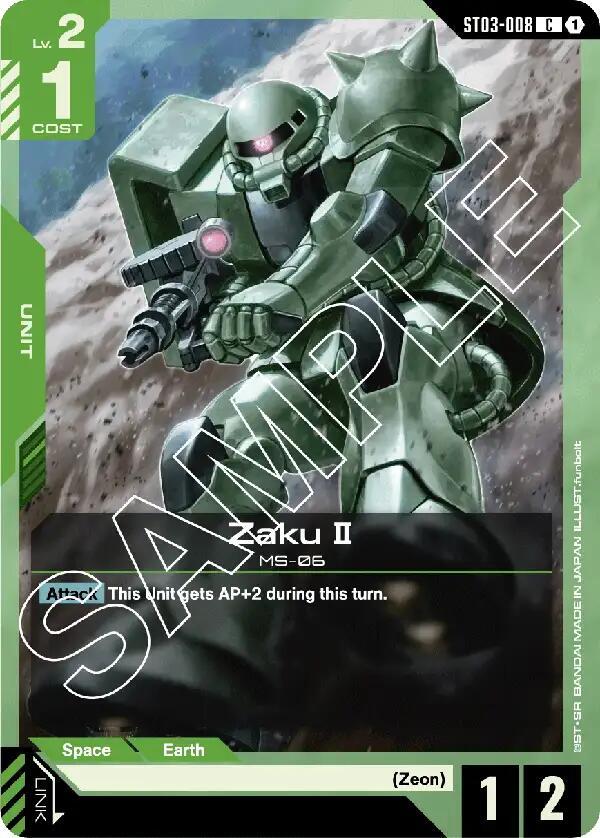
Units — the Mobile Suits — are the heart of every deck. They're what you deploy to the Battle Area to attack your opponent's Shields and to defend your own. Almost every turn revolves around getting the right Units down at the right time.
A key timing rule trips up newcomers: a Unit cannot attack on the turn it's deployed. It has to survive a full rotation before it can swing — which is exactly why the Link Unit mechanic (Section 16) is so powerful, since it bypasses that restriction. Until then, a freshly played Mobile Suit is there to threaten next turn and to block this one.
Remember the Battle Area caps at 6 Units. That ceiling matters: you can't just keep flooding the board indefinitely, so every deployment slot should earn its place. A wall of cheap defensive Units buys time for control decks, while aggressive decks want efficient attackers that pressure Shields before the opponent stabilizes.
6. Pilots: Enhancing the Chassis
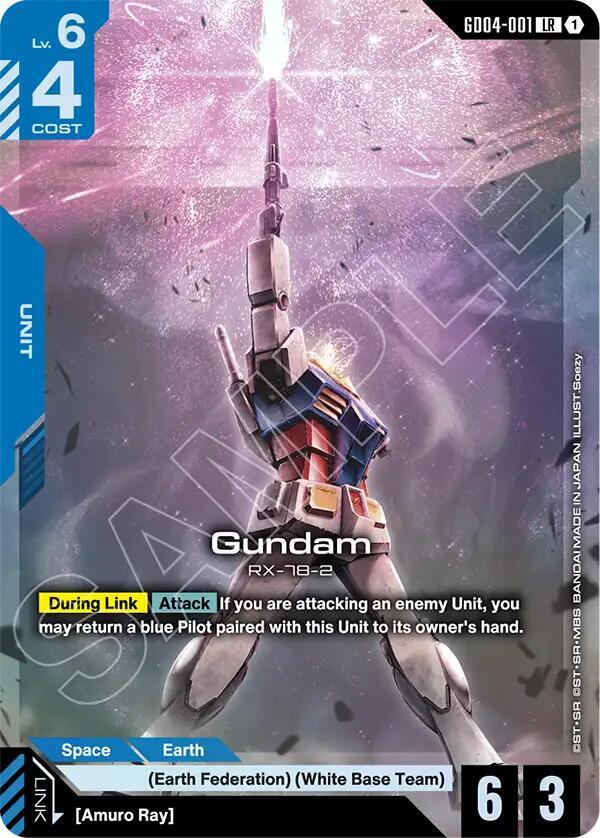
A Mobile Suit on its own is just a chassis. To unlock a deck's real potential you pair Pilot cards onto your Units. The relationship between Mobile Suits and Pilots is the defining feature of the game and the source of its biggest tempo swings.
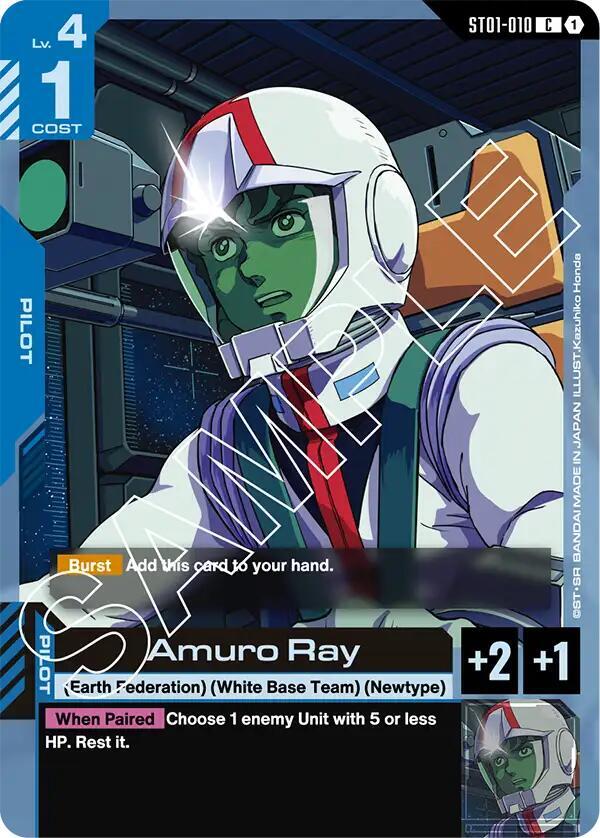
You pair a Pilot by placing it face-up beneath a Unit in the Battle Area (one Pilot per Unit). The Unit gains the Pilot's AP and HP, plus the Pilot's listed ability. So pairing a 1 AP / 1 HP Pilot onto a 2 AP / 3 HP Mobile Suit gives you a 3 AP / 4 HP threat that can now win fights it previously would have lost — and a Pilot can pair with any Unit, with the Link bonus (Section 16) being the part that carries requirements.
Pilot Abilities & Flexibility
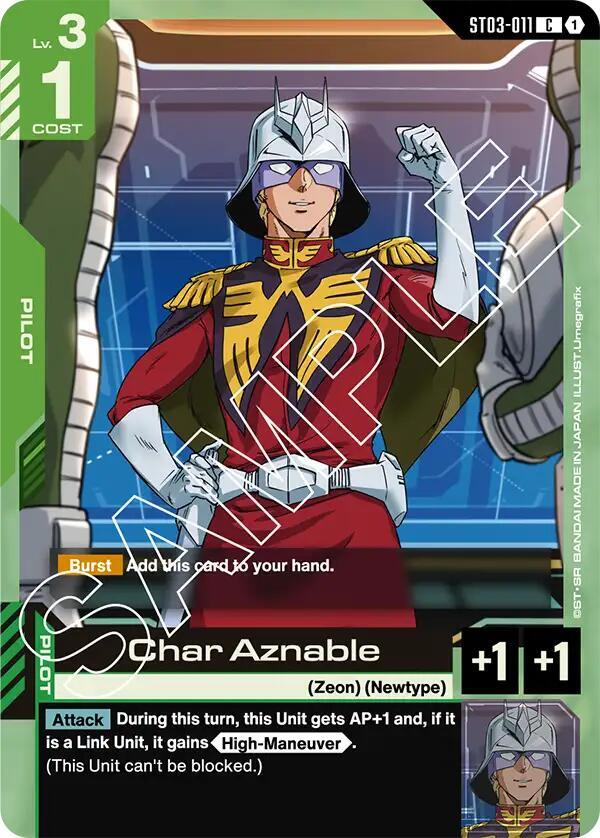
Beyond raw stats, Pilots grant the Unit their keyword and triggered abilities — and many trigger 【When Paired】 effects the moment they attach. A strong Pilot like Amuro Ray or Char Aznable can transform what the attached Mobile Suit does. Note too that some Command cards carry a 【Pilot】 effect, meaning the same card can be played either as a tactical Command or paired onto a Unit as a Pilot — a flexibility worth planning around.
7. Command Cards: Tactical Spells
Command cards are the Gundam equivalent of "spells" or "instants." Unlike Units and Pilots, which stick around on the board, Commands are single-use: you pay the cost, resolve the effect, and send the card to the Trash.
-
Main-Phase Commands (Proactive):
Played on your own turn to advance your plan — card draw, searching, AP buffs, and removal effects that destroy an opposing Unit before combat starts. -
【Action】 Commands (Reactive):
The dangerous ones. Cards with 【Action】 timing can be played during your opponent's turn — including in the middle of combat — making them the game's true "instants." Keeping enough Resources active to threaten an 【Action】 Command forces your opponent to attack cautiously. A well-timed combat trick that pumps your defender's AP can flip a fight and swing the whole tempo of the game.
8. The Base Card: Guarding Your Shields
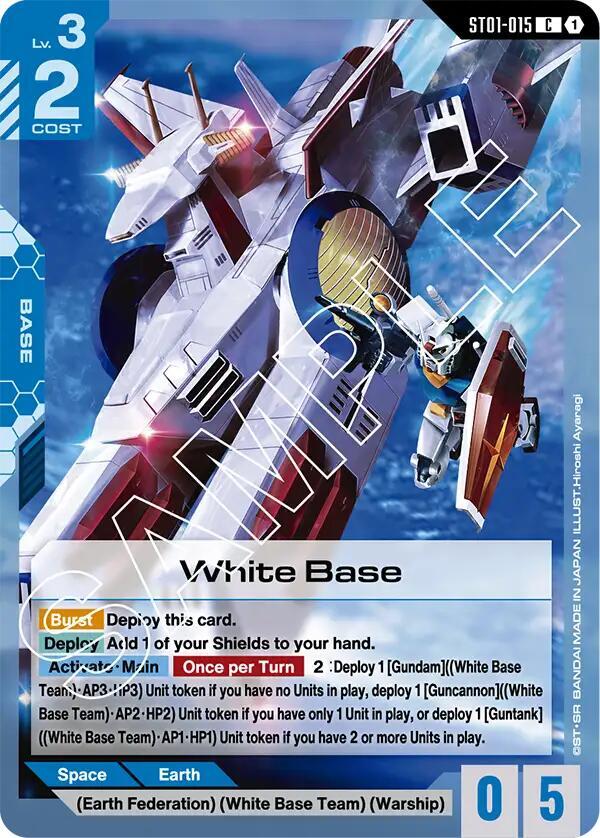
A Base is a defensive card that sits in the Base section of your Shield Area, in front of your Shields. You can have at most one out at a time, and every game starts with a free EX Base token already deployed (0 AP, 3 HP).
How Bases Actually Protect You
They take the hit first. When a Unit attacks you directly, it strikes your Base before any Shields. A Base has its own HP, and damage beyond that HP does not spill over onto a Shield — so even a humble 3 HP EX Base can soak an attack or two and buy you a turn.
They do more than block. Beyond absorbing damage, many Bases carry passive abilities that support your strategy. Deploying a stronger Base over your starting EX Base can mean extra resilience plus a useful ongoing effect — just remember you only get one Base slot, so the choice matters.
9. Setup & The Redraw (Mulligan)
Games are often decided before the first card is played. After you set up your Shields and Base and shuffle, you draw an opening hand of 5 cards, then decide whether to keep it.
If the hand is unworkable, you may redraw once: return your whole hand to the bottom of the deck and draw a fresh 5. That new hand is final. Knowing when to keep and when to ship is the first real test of skill.
When to Keep
You're not looking for resources — those come from your separate Resource Deck — so a keepable hand is about your curve. You want at least one low-Level Unit to contest the board early and a follow-up play for the turns after. If you can map out your first two or three turns, keep it.
When to Redraw
If your hand is all high-Level Units you can't afford for several turns, ship it. An aggressive opponent will deploy cheap attackers and start chipping your Shields while you sit there unable to act. Never keep a hand that doesn't "turn on" until turn four.
10. The Turn Sequence: A Macro View
The Gundam Card Game runs on a strict five-phase structure. You move through the phases in order, and once you've passed a phase you can't go back. Here's a full turn cycle:
- Start Phase: Set all your rested (sideways) cards back to active (upright) — Units, Pilots, and Resources are refreshed for the new turn.
- Draw Phase: Draw one card from your main deck. (Unlike many TCGs, even the player going first draws on turn one — going second is instead compensated with the EX Resource.)
- Resource Phase: Draw one card from your Resource Deck and place it into your Resource Area, growing your economy by one.
- Main Phase: The operational core. Rest Resources to deploy Units, pair Pilots, play Command cards, and declare attacks — in any order you like.
- End Phase: End-of-turn effects resolve, you discard down to 10 cards if needed, and the turn passes to your opponent.
11. The Resource Phase: Building the Engine
The Resource Phase is the economic heartbeat of your turn, and it works differently from most TCGs. Rather than drawing "lands" from your main deck (Magic) or pitching cards from your hand, you build a dedicated 10-card Resource Deck during deckbuilding and draw one Resource from it every turn. That design eliminates resource screw entirely — you reliably gain one Resource per turn, every turn.
To pay for a card, you rest Resources equal to its Level. Resources refresh (untap) at the start of each turn, so a turn with four active Resources lets you spend up to four Levels' worth of cards — or hold some back for an 【Action】 Command on your opponent's turn.
There's a small but important wrinkle for the player going second: you place one extra EX Resource token at the start of the game to offset the disadvantage of acting second. It funds a cost like any Resource, but it's a one-time boost — once used to pay, it's removed from the game — so spend it deliberately rather than burning it on turn one out of habit.
12. The Main Phase: Deployment Logistics
The Main Phase is where the game happens. It's the only window to deploy Units, pair Pilots, play proactive Commands, and declare attacks — and you can interleave those actions in any order, as long as you have the active Resources to pay for them.
The Sequencing Advantage
Because you can attack, then deploy, then act again, sequencing is everything. Newer players dump their whole hand onto the board first, rest all their Resources, and then attack. That's a tactical error: you've shown your opponent your entire plan and left no Resources open for an 【Action】 Command during combat.
The pro line: attack first with the Units you established on previous turns (remember, anything you deploy this turn can't attack yet unless it's a Link Unit). Apply your pressure while you still hold Resources active, and only deploy your new Units afterward — leaving your opponent guessing the whole way through.
13. Combat Math: AP, HP & Shields
Combat is deliberate. To attack, you rest your attacking Unit and declare a target. You may target the opponent's Shield Area, or one of their rested Units — you cannot attack an active, upright Unit unless your attacker has a keyword that allows it.
When two Units battle, they deal damage to each other simultaneously, each dealing its AP. A Unit is destroyed when the damage it has taken meets or exceeds its HP — so a hard-hitting attacker can still die on the swing if the defender hits back hard enough. This is the crucial difference from "highest power wins": both sides can trade, both can die, and HP totals decide who survives.
The printed numbers are rarely the final ones. Support abilities, Pilot pairings, and 【Action】 Commands all let both players adjust AP mid-fight, so declaring an attack you'd "lose" on paper can be perfectly correct if you have a trick to win the math. The keyword First Strike bends the rule further: a Unit with it deals its damage before the enemy — meaning it can destroy a defender outright and take none back.
14. The Defense Step: Blocking and Actions
Once an attack is declared, the defender gets to respond. Combat resolves through a short sequence of steps, and a prepared defender has two main tools: blocking and 【Action】 plays.
The Block Step
If you have an active Unit with the Blocker keyword, you may rest it to redirect the attack onto itself, protecting your Shields or another Unit. The attacker is then forced to battle the Blocker instead. A wall of sturdy Blockers is how slow, control-oriented decks survive an early rush.
The Action Step
After blocks, the game opens an Action Step where the defender acts first, then the attacker, alternating until both pass. This is your window to play 【Action】 Commands or activate Action abilities — pumping a defender's AP, removing the attacker, or otherwise rewriting the math before damage is dealt. If you held Resources open, this is where they earn their keep.
15. Damage Resolution: Breaking the Shields
If the defense fails, damage resolves. If the target was a Unit, any Unit at or above its HP in damage is moved to the Trash. If the attack went at the player, the game's win mechanic comes into play.
An attack on the player hits the Base first (if one is deployed), then the top card of the Shield Area. Each Shield has 1 HP, so it's destroyed by a single point of battle damage. Keywords can amplify this: Suppression damages the first two Shields at once, and Breach chips a Shield when your attacking Unit destroys an enemy Unit.
The comeback wrinkle (【Burst】): when a Shield is destroyed it gets flipped face-up, and if it has a 【Burst】 effect, that effect triggers immediately for the defender — free value like deploying a Unit or removing an attacker. That makes recklessly breaking Shields a double-edged sword: you're advancing your clock, but you might be handing your opponent exactly the answer they needed. Pace your aggression accordingly.
16. The Link Unit: The Signature Mechanic
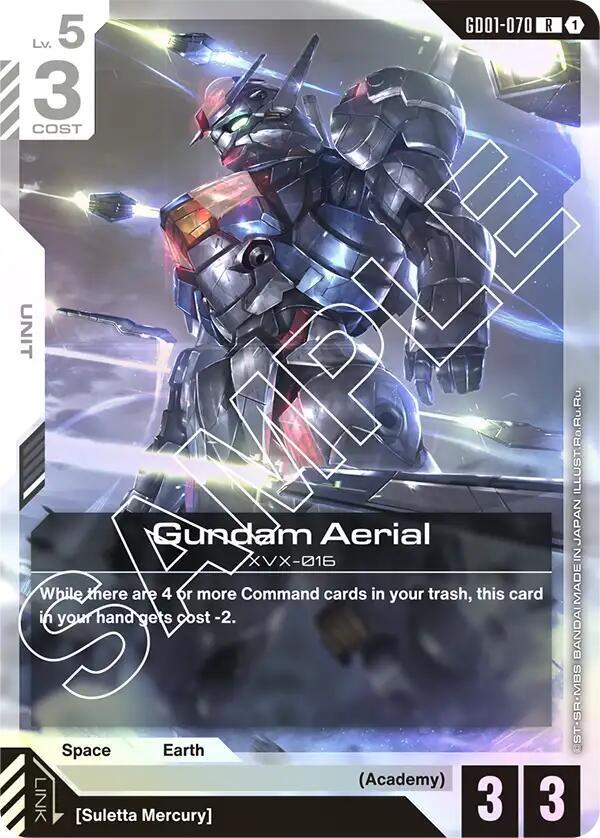
Here's the mechanic that gives the Gundam Card Game its identity. Normally a Unit can't attack the turn it's deployed — but when you pair a Pilot onto a Unit and the pairing meets that card's Link requirement, the Unit becomes a Link Unit and can attack immediately, the same turn it hits the board.
That single exception drives most of the game's biggest tempo swings. A Link Unit lets you develop and apply pressure in the same turn, ambush a rested attacker your opponent thought was safe, or close out a game a full turn earlier than the board state suggests. Building toward consistent Link pairings — having the right Pilots for your Units — is what separates a pile of strong cards from an actual deck.
Reading the board matters just as much on defense. Pay attention to how many Resources your opponent leaves active at the end of their turn: if they pass with several untapped, you should assume an 【Action】 Command is waiting and sequence your own attacks to play around it rather than walking into the trap.
17. Keyword Glossary: Blocker, Breach & More
The game condenses a lot of rules into single-word keywords printed on Units and Pilots. Misreading how these interact during combat will cost you games. Here are the keywords you'll meet most often:
Blocker
Rest this Unit to change an attack's target to it, intercepting a hit aimed at your Shields or another Unit. The backbone of defensive play.
High-Maneuver
This Unit can't be blocked. When it attacks, no Blocker can intercept, so the hit goes exactly where you sent it — straight to a Shield or your chosen target.
Breach X
When this Unit's attack destroys an enemy Unit, deal X damage to the first card in the opponent's Shield Area — letting you trade and chip the clock at once.
First Strike
This Unit deals its battle damage before the enemy does. If that's enough to destroy the other Unit, your attacker takes nothing back.
Repair X
At the end of your turn, this Unit recovers X HP, healing off chip damage. A defensive staple, found mostly on Blue cards.
Support X
Rest this Unit to give another friendly Unit +X AP for the turn. It works the turn it's played, so it's a great way to ambush your opponent's combat math. Common on Red cards.
Two more worth knowing: Suppression, which deals damage to the first two Shields simultaneously when its Unit connects, and 【Burst】, the Shield-trigger effect from Section 15 that rewards the defender when a Shield is destroyed.
18. Removal and Over-Extension
New players love to "over-extend." Because the resource system lets you deploy several Units in a turn if you can afford them, it's tempting to empty your hand onto the board for a big army. Against a patient control player, that's how you hand them the game.
The game has Command cards and Unit abilities that wipe or remove multiple Units at once. If you commit five Units and your opponent answers with a single sweeping removal, you've lost a five-for-one in card advantage — and with the Battle Area capped at six Units anyway, there's rarely a reason to dump everything. You usually won't recover from a trade that lopsided.
The mitigation: deploy only what you need to threaten Shields or hold the line, and keep your most valuable Units and Pilots in hand until your opponent has shown (or used) their removal. Bait with your less important pieces, then commit your real win conditions once the coast is clear.
19. 2026 Starter Decks: Which Should You Buy?
The best way to learn everything above is to buy an official Bandai Starter Deck. Unlike random boosters, these ready-to-play 50-card decks are balanced out of the box. Two starters make the cleanest entry points, and they teach opposite halves of the game:
-
ST01 Heroic Beginnings (Blue/White — Defensive):
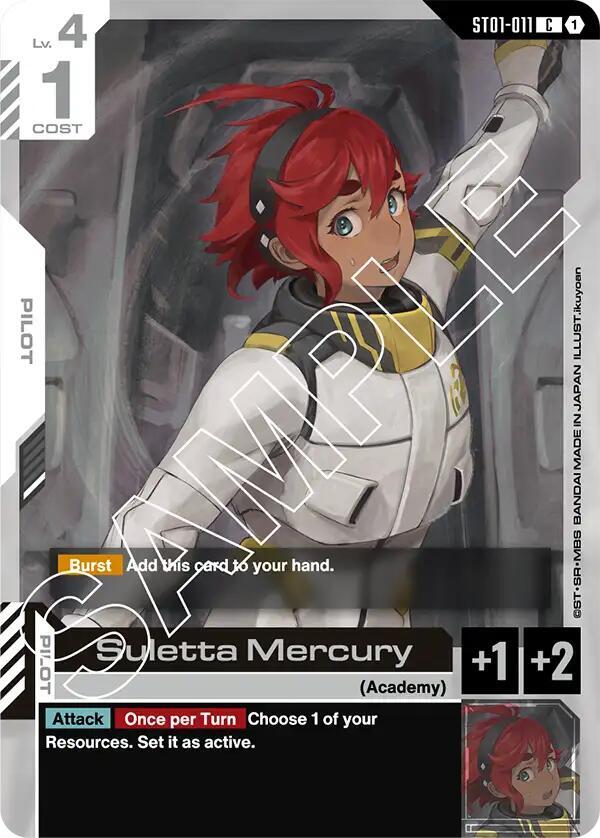
Built around Amuro Ray and Suletta Mercury, this is the recommended first deck. Blue and White lean on Repair and Blocker, so it teaches you to defend your Shields, manage Resources, and hold 【Action】 Commands in reserve. It's the calmest way to learn the game's pacing. -
ST03 Zeon's Rush (Red/Green — Aggressive):
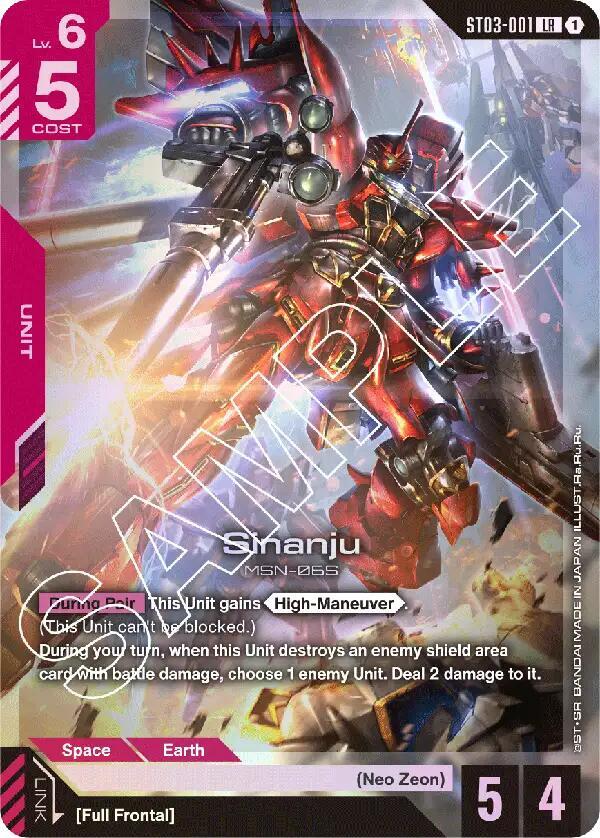
Led by Char Aznable and Full Frontal, this is the aggressive counterpart. Red brings raw AP and Support, while Green supplies Breach and High-Maneuver pressure, so it teaches relentless combat math: when to chip Shields, when to pair a Pilot, and when to swing through. A great pick if you'd rather attack than defend.
Pick Up ST01 or ST03
If the defensive plan sounds right, start with ST01 Heroic Beginnings; if you'd rather be the one attacking, take ST03 Zeon's Rush. Both are ready to play out of the box — add a pack of standard-size (66×91mm) matte sleeves before you take one to a local store. Bandai print runs go out of stock at retail, so if neither starter shows up, eBay is where sealed copies usually resurface.
As an Amazon Associate, Geeky Domain earns from qualifying purchases. eBay links are affiliate links; Geeky Domain may earn a commission at no extra cost to you.
20. Next Steps: Entering the Local Meta
Standby for Launch.
The Gundam Card Game rewards precision and patience. The gap between a casual player and a tournament regular usually isn't card rarity — it's mastery of the turn sequence, the Resource economy, and the Link Unit timing that everything else hangs on.
Your next step is practical: grab a Starter Deck, sleeve it in standard-size mattes, and sit down at your local game store. Track your Shields, watch your opponent's open Resources before you attack, and look for the Link pairings that let you strike a turn early. The battlefield is waiting.
© GEEKYDOMAIN.COM | Strategy Powered by Data