

Best Gundam Card Game Products for Beginners
A buyer's guide to the decks, boxes, and packs actually worth buying when you're just starting out.
Some links below are affiliate links. If you buy through them, Geeky Domain may earn a small commission at no extra cost to you.
The Gundam Card Game has grown a lot since its worldwide launch in July 2025. There are now five main booster sets, a handful of starter decks, and — as of August 2026 — a dedicated deckbuilding box aimed squarely at new players. That's good news for the game's long-term health, but it also means the "just tell me what to buy" question has gotten more complicated than it used to be.
This guide skips the deep dives into rarities, tier lists, and chase-card values — we cover all of that elsewhere on the site — and focuses on one thing: if you've never opened a pack of Gundam Card Game and want to start playing, what should the first purchase actually be? We'll walk through starter decks, the new Deck Build Box, booster packs and boxes (including the current newest set, Freedom Ascension GD05), and point you to our dedicated guides for the buildable-model-kit side of the hobby and for sleeves and playmats.
The Short Version
If you already know you want to play, the Deck Build Box (SC01) is the best single purchase right now — it packs 125 curated reprints across all five colors plus 8 Freedom Ascension (GD05) booster packs for around $99.99 MSRP. If you're still deciding whether the game is for you, one or two ST01A–ST04A starter decks are the cheapest, lowest-commitment on-ramp, and two of them give you a complete game to learn with. Booster packs run $4.99 for 12 cards and a 24-pack box works out to roughly $119.76 at MSRP, but real GD05 listings have run past $200 since the set released on July 24, 2026. Treat boosters as a follow-up purchase once you know which colors you like, not as your first buy. And Gunpla model kits are a separate hobby — you don't need any of them to play the card game.
In This Guide
- → Starter Decks: The Cheapest, Fastest On-Ramp (ST01A–ST04A)
- → The Deck Build Box (SC01): The Strongest Current Beginner Pick
- → Booster Packs and Boxes, Including Freedom Ascension (GD05)
- → What About Gunpla Model Kits?
- → Don't Forget Sleeves and Playmats
- → Which Should You Buy First?
- → Common Beginner Mistakes to Avoid
- → FAQ
Starter Decks: The Cheapest, Fastest On-Ramp (ST01A–ST04A)
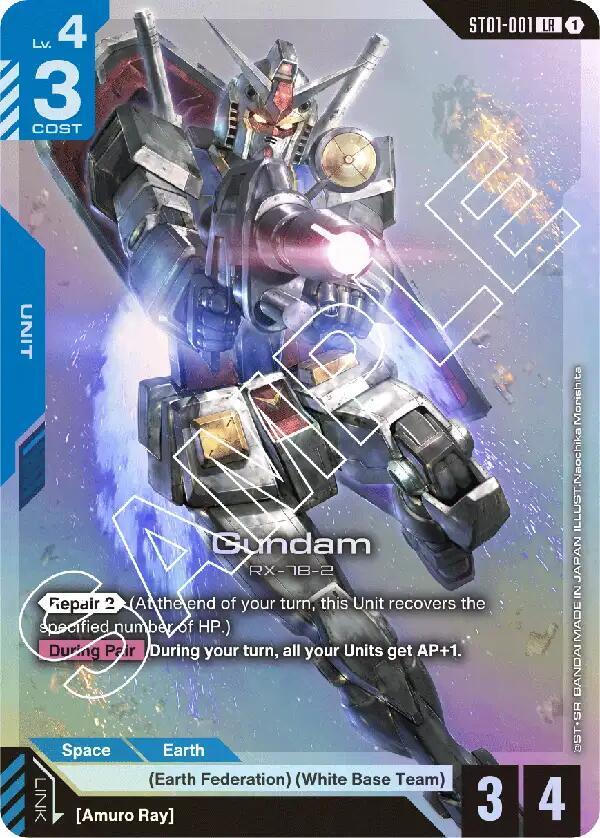
If you want to know whether you actually enjoy the Gundam Card Game before spending much money on it, a starter deck is still the right call. The ST01A through ST04A line has been Bandai's standard entry point since the game launched, and as of this writing it remains the current starter deck lineup — there's no need to wait for or hunt down anything beyond it.
Each deck in the line is built around a single color and comes ready to play straight out of the box, with no deckbuilding decisions required on day one. That's the whole point: instead of guessing which random cards from a booster pack might work together, you get a coherent, functional deck immediately, which means you can be playing your first real game within minutes of opening the box.
The practical way most new players use starter decks is to buy two — either the same one twice, or two different colors — so there's an opponent's deck on the table as well as your own. That gives you and a friend (or you and yourself, learning both sides) a complete, balanced way to learn turn structure, combat, and resource management without the randomness of booster pulls getting in the way. Starter decks are also the cheapest way to get playing pieces like resource and token cards into your collection, which you'll need regardless of what else you buy later.
The Deck Build Box (SC01): The Strongest Current Beginner Pick
The newest product built with beginners in mind is the Deck Build Box, or SC01, which released on July 24, 2026 alongside Freedom Ascension GD05 as part of the game's 1st-anniversary celebration. It's the single best-value beginner product currently on the market, and it's worth understanding exactly why.
Inside the box is a curated pool of 125 reprinted cards — 25 cards in each of the game's five colors — put together so that a buyer can pick any two colors, combine them, and have a real, playable deck immediately, without needing to know which cards work well together yet. On top of that reprint pool, the box also includes 8 packs of Freedom Ascension GD05 boosters, giving you a stack of the newest set's cards to fold into your deck or start a collection with. Rounding it out are resource cards, token cards, a playsheet, and a half-storage box to keep everything organized, plus a bonus pack containing one of three random "EX Base" card types as a little extra on top.
Bandai has positioned the Deck Build Box as suitable for both brand-new players and existing players who want to jump straight into deckbuilding with the new set, and that dual pitch is accurate — the 125-card reprint pool gives you enough raw material to actually build around instead of just following a pre-set list, while the 8 included GD05 packs mean you're not starting your collection from zero on the current set either. US retailers have listed it around $99.99 MSRP, though regional pricing has varied (some European listings have run lower), so treat that as a ballpark figure rather than a fixed number when you're comparing listings.
125 curated reprints across all five colors, plus 8 Freedom Ascension GD05 packs, resource and token cards, and a playsheet — everything you need to build a deck and start collecting the newest set in one purchase.
As an Amazon Associate and eBay Partner Network affiliate, Geeky Domain earns from qualifying purchases.
Booster Packs and Boxes, Including Freedom Ascension (GD05)
Booster packs are the randomized product at the center of the game, and they're where most ongoing collecting and deck refinement happens once you're past the "am I going to keep playing this" stage. Unlike starter decks, a booster pack doesn't guarantee you a usable strategy — you're opening a mix of commons, uncommons, rares, and higher-rarity chase cards, and what you get is down to chance. That randomness is part of the appeal for a lot of players, but it's also why we don't generally recommend booster boxes as an absolute first purchase for someone who hasn't played a single game yet.
The current newest set is Freedom Ascension, GD05 — released July 24, 2026 as the game's official 1st-anniversary set, in a globally synchronized launch marking one year since the Gundam Card Game debuted worldwide in July 2025. It's been out for about five weeks now, and it's the set you'll see on shelves and in most current listings. A single booster pack carries an MSRP of $4.99 and contains 12 cards. A full booster box holds 24 packs, which works out to roughly $119.76 at MSRP.
Real-world pricing is where things get less tidy. In the weeks immediately after release, booster box listings varied widely — from close to that MSRP-equivalent figure up past $200 a box in some cases — driven by launch-week sellouts and anniversary-set demand. There isn't one single "the price" for a GD05 booster box right now, so if you're shopping, it's worth comparing several listings rather than assuming the first price you see is representative. Prices on a newly released, high-demand set like this tend to settle down over time as initial demand cools and supply catches up.
Part of why GD05 has generated so much buzz is what Bandai packed into it for the anniversary. The set introduced several firsts for the game: a brand-new "Link Rare" parallel tier featuring combined Unit-and-Pilot artwork, the first-ever SP-treatment EX Resource cards, eight Pilot SP cards for popular characters, and a record-high five LR++ cards — the most any set has shipped with so far. Those five LR++ cards anchor four anime series making their Gundam Card Game debut in this set: Mobile Suit Gundam SEED Destiny, Mobile Fighter G Gundam, Mobile Suit Gundam Wing: Endless Waltz, and Mobile Suit Gundam Char's Counterattack. None of that changes the buying advice for a beginner — you don't need to chase any of it to learn the game — but it does explain why box prices have run hot, and why GD05 in particular has been drawing collectors as well as players. If you want the full rundown on those chase cards and what they've been trading for, we cover that in detail in our evergreen most-valuable-chase-cards guide.
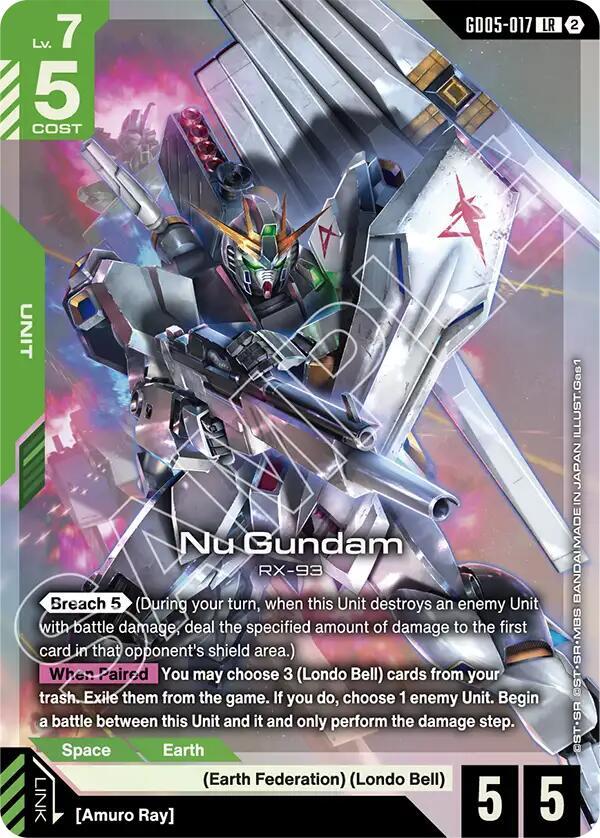
Packs run $4.99 MSRP for 12 cards; a box is 24 packs. Real-world prices have run above MSRP since launch, so compare a few listings before you buy.
As an Amazon Associate and eBay Partner Network affiliate, Geeky Domain earns from qualifying purchases.
If GD05 feels like a lot to take in for a first booster purchase, know that it isn't the only set on shelves. Four earlier sets — Newtype Rising, Dual Impact, Steel Requiem, and Phantom Aria — are still around and generally cost less to chase since they've been out longer and the initial-release price spikes have settled. We compare all five sets side by side, including how their rarities and pack structures work, in our full set comparison guide, and we break the card pool down by anime series (useful if you're picking a set based on which Gundam show you actually like) in our by-series player's guide.
What About Gunpla Model Kits?
One thing worth clearing up early: buildable Gundam model kits (Gunpla) and the Gundam Card Game are two separate hobbies that happen to share a name and a universe. You don't need to own or build any model kits to play the card game, and none of the products covered in this guide include model kits. If the snap-together, display-quality side of the hobby is part of what drew you in, that's a different buying decision with its own set of products, price points, and skill levels to consider — we've put together a dedicated guide to that side of things in our Assemble Sets & Sealed Value Guide, which is worth a look if building kits is on your radar alongside the card game.
Don't Forget Sleeves and Playmats
This guide is focused on decks, boxes, and packs, but it's worth flagging that accessories aren't optional once you're actually playing on a regular basis. Cards that get shuffled and handled bare will show wear quickly, and a decent playmat makes games easier to track and your cards easier to protect on whatever surface you're playing on. We've put together a full breakdown of what to look for in sleeves and mats specifically for this game in our Gundam Card Game accessories guide — it's a quick add-on purchase once you've settled on which deck or box you're starting with.
Which Should You Buy First?
There's no single right answer here — it depends on how sure you already are that you'll enjoy the game, and how much you want to spend to find out.
The One-Line Test
If you're not sure yet whether you'll like the game, start with one or two ST01A–ST04A starter decks. If you're already sure and want the best value for building an actual deck plus current-set cards in one box, get the Deck Build Box (SC01).
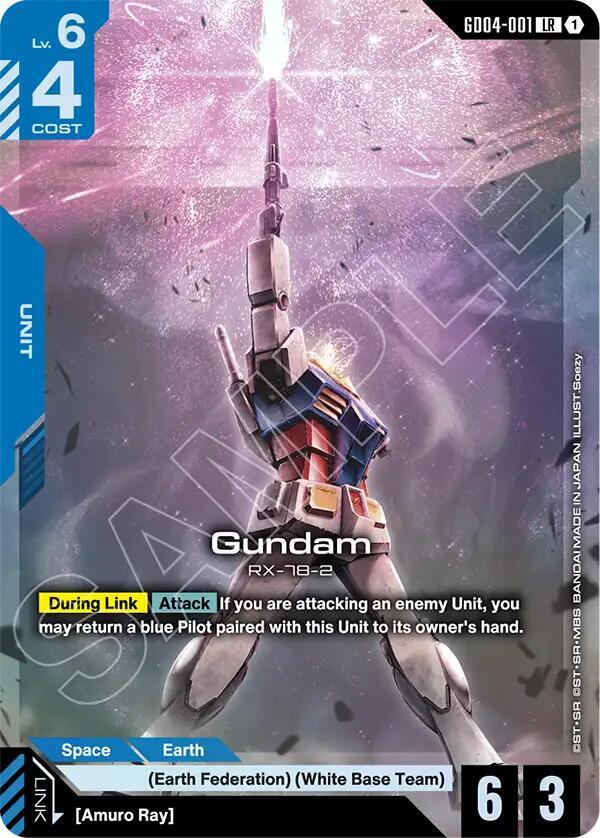
A single starter deck is the lowest-commitment option by a wide margin — it's a complete, playable deck with no randomness involved, and pairing two of them (the same one twice, or two different colors) gives you a full game to learn the rules with a friend. It's the right choice if you're still deciding whether this hobby is for you.
The Deck Build Box is the right choice once you already know you want to play and want to get the most out of a single purchase. Between the 125-card reprint pool spanning all five colors and the 8 included GD05 packs, it gives you far more raw material to build with than a starter deck alone, plus a stack of current-set cards to start a collection with.
Booster packs and boxes — GD05 or otherwise — are best thought of as a follow-up purchase rather than a first one. They're the right move once you know which colors or archetypes you like and you're ready to chase specific cards, rather than as the very first thing you buy before you've played a game.
Common Beginner Mistakes to Avoid
A few patterns show up over and over with new players, and they're easy to avoid once you know to watch for them:
Buying a booster box as your very first purchase. It's tempting, especially with a set as hyped as GD05, but a box of randomized packs won't teach you the rules or give you a coherent deck the way a starter deck or the Deck Build Box will. Save the box for after you know you're hooked.
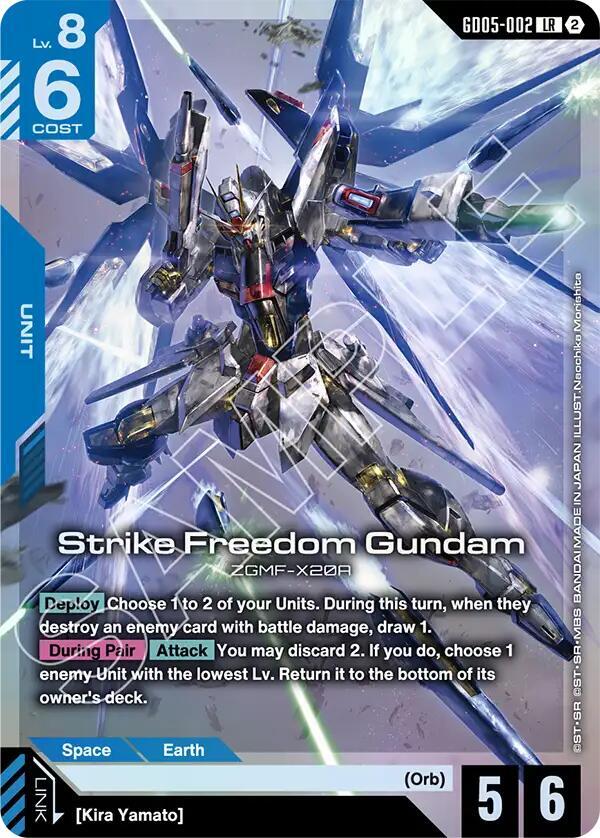
Assuming one listed price is "the" price for a GD05 booster box. Real-world listings have run anywhere from close to MSRP-equivalent up past $200 in the weeks after launch. Shop around before you commit to one listing.
Confusing starter decks with booster packs. Starter decks (ST01A–ST04A) are fixed, ready-to-play, no randomness. Booster packs are randomized and don't guarantee a working deck on their own — they're a different kind of purchase for a different stage of the hobby.
Treating Gunpla model kits and the card game as the same purchase. They're separate product lines and separate hobbies that just share a universe. See our Assemble Sets & Sealed guide if buildable kits are also on your list.
Skipping sleeves entirely. It's an easy thing to put off, but cards handled and shuffled without protection wear faster than most new players expect. It doesn't need to be your first purchase, but don't forget it for long.
FAQ
What's the single best Gundam Card Game product for a total beginner?
For most people, the Deck Build Box (SC01) offers the best overall value right now — a large curated reprint pool across all five colors plus 8 Freedom Ascension GD05 packs in one purchase. If budget is the tightest constraint, a single ST01A–ST04A starter deck is the cheaper way to find out if you like the game first.
Are ST01A–ST04A still the right starter decks to buy?
Yes. As of today, they remain the current, standard starter deck line for the game — there's nothing newer in that line available yet.
Should I buy a Freedom Ascension (GD05) booster box as my very first purchase?
We'd generally steer a first-time buyer toward a starter deck or the Deck Build Box instead. Booster boxes are randomized, won't guarantee you a working strategy, and GD05 boxes in particular have carried a real price premium over MSRP since launch. It's a great follow-up purchase once you know you're playing regularly.
Do I need Gunpla model kits to play the card game?
No. The card game and buildable model kits are separate product lines and separate hobbies — you can play the card game without ever touching a model kit. If the kits interest you too, see our Assemble Sets & Sealed guide.
What accessories do I actually need starting out?
Sleeves are the one accessory worth prioritizing early, since unprotected cards wear down with regular play. A playmat is a nice-to-have rather than a must-have on day one. Our accessories guide covers what to look for in both.
Start With a Starter Deck, or Buy the Deck Build Box and Skip Ahead.
If you're still deciding whether the Gundam Card Game is for you, one or two ST01A–ST04A starter decks are the cheapest way to find out, and a pair of them gives you a complete game to learn with. If you already know you want to play, the Deck Build Box (SC01) is the best-value single purchase on the market right now. Either way, leave booster boxes for later — they're a follow-up buy once you know which colors you actually want to build around.
Keep Learning
- → Gundam TCG Strategy Hub
- → GD05 Products & Deck Build Box: What to Buy
- → Gundam Card Game Sets Compared — GD01 to GD04
- → Gundam Card Game by Anime Series
- → Building Your First 50-Card Deck
- → The Most Valuable Gundam Card Game Cards
- → How to Play the Gundam Card Game
- → Gundam Card Game Accessories: Sleeves, Mats & Deck Boxes
© GEEKYDOMAIN.COM | Strategy Powered by Data