

Why Reserved List Cards Cost $3,000: cEDH Staples Explained
Two Magic lands, a 1996 promise Wizards of the Coast still keeps, and a price floor set by a supply that can never grow, no matter how fast Commander demand grows around it.
Some links below are affiliate links. If you buy through them, Geeky Domain may earn a small commission at no extra cost to you.
→ Short Version
Mishra's Workshop and The Tabernacle at Pendrell Vale are both on Magic: The Gathering's Reserved List, a 1996 Wizards of the Coast policy promising a specific group of cards will never be reprinted. As of an August 8, 2026 pricing snapshot pulled from Scryfall market data by krakenthemeta, the cheapest available copy of Mishra's Workshop ran approximately $3,000.97, and the cheapest available copy of The Tabernacle at Pendrell Vale ran approximately $2,899.99. Both cards are prized cEDH (competitive Commander) staples with no legal path to a reprint, which is why demand from a growing competitive format keeps pressing against a supply that can never expand. This is market education, not investment advice — prices move, and you should always verify current figures before buying.
→ Related Reading
- MTG Strategy Hub
- Building a $50 Commander Deck Blueprint -- the opposite end of the budget spectrum
- MTG Finance: Surviving a Reprint Crash -- what happens to cards that AREN'T protected from reprints
In This Guide
- → What Is the Reserved List, and Why Does It Exist?
- → Mishra's Workshop: The $3,000 Land
- → The Tabernacle at Pendrell Vale: Taxing Creatures, Taxing Wallets
- → Why cEDH Demand Keeps These Prices Elevated
- → What "Cheapest Available Printing" Actually Means
- → How to Approach Buying Reserved List Cards
- → Verdict
What Is the Reserved List, and Why Does It Exist?
To understand why a single Magic: The Gathering card can cost as much as a used car, you have to start with a policy, not a card. In 1996, Wizards of the Coast introduced the Reserved List: a fixed, publicly published list of specific Magic cards the company committed to never reprinting in a functionally identical form. The idea was straightforward. Early Magic sets — Alpha, Beta, Unlimited, Arabian Nights, Antiquities, and others from the game's first few years — had produced cards in relatively small quantities. Players and collectors who had bought into the game early, sometimes spending real money on packs and singles when Magic was a brand-new hobby with an uncertain future, were understandably nervous that Wizards might one day flood the market with reprints of those same cards and erase the value of what they already owned. The Reserved List was the company's answer: a formal promise that a defined set of cards would remain permanently, artificially scarce, no matter how large Magic eventually grew.
That distinction matters enormously once you introduce a modern, still-growing format that happens to want some of those cards for competitive reasons. Which is exactly what has happened with two specific pieces of vintage-era artifact and land design: Mishra's Workshop and The Tabernacle at Pendrell Vale.
That promise is what makes the Reserved List fundamentally different from ordinary "out of print" scarcity. Almost every other card in Magic's history is out of print in the sense that its original set isn't sold in stores anymore, but that scarcity is soft — Wizards can, and regularly does, bring old cards back through Commander preconstructed decks, Secret Lair drops, remastered sets, and other supplemental products. A card that's merely old and hard to find can still see its price fall overnight if a reprint announcement lands. A Reserved List card carries no such risk. Short of Wizards reversing a three-decade-old public commitment — something the company has consistently declined to do, even as the policy has drawn criticism over the years — the supply of a Reserved List card is locked at whatever quantity was printed decades ago and will never increase.
Mishra's Workshop: The $3,000 Land
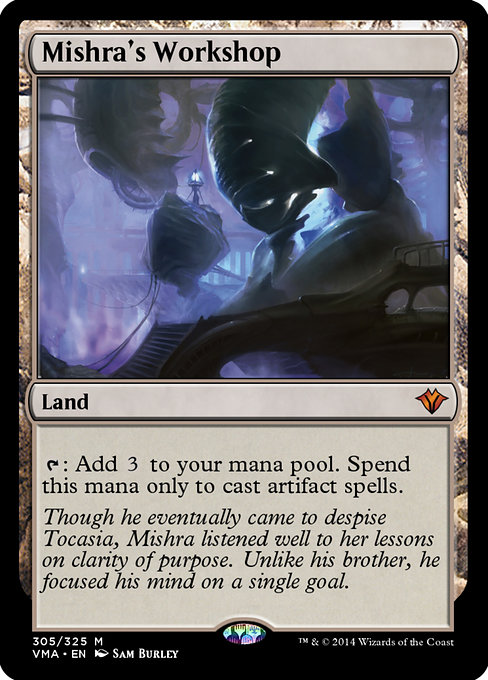
Mishra's Workshop is an artifact-focused fast-mana land — it taps for a substantial amount of mana, but that mana can only be spent on artifact spells. On paper, that restriction sounds like a real limitation. In practice, it's a build-around engine for any deck leaning heavily on artifacts, and Magic has never lacked for powerful, cheap-to-cast artifacts. A land that can bankroll an artifact-heavy opening turn — powering out mana rocks, fast-mana pieces, or combo enablers well ahead of what a normal land base would allow — is exactly the kind of asymmetric advantage that competitive Commander (cEDH) decks are built to exploit. In formats where games are frequently decided in the first few turns, a land that effectively cheats mana into play for the right strategy is a genuine structural edge, not a cute rules interaction.
That strategic pull, combined with a supply that has been frozen since Mishra's Workshop's original printing, is reflected directly in the card's price. As of an August 8, 2026 pricing snapshot compiled by krakenthemeta from Scryfall market data, the cheapest available printing of Mishra's Workshop — meaning the least expensive copy of the card in any condition or printing that could be found on the market at that time — was priced at approximately $3,000.97. It's worth sitting with what "cheapest available" implies here: this isn't a premium, mint-condition, graded price. It's the floor. There is no budget-friendly version of Mishra's Workshop, because there is no version of Mishra's Workshop that Wizards of the Coast is legally free to print more of. Every copy that will ever exist already exists.
The Tabernacle at Pendrell Vale: Taxing Creatures, Taxing Wallets
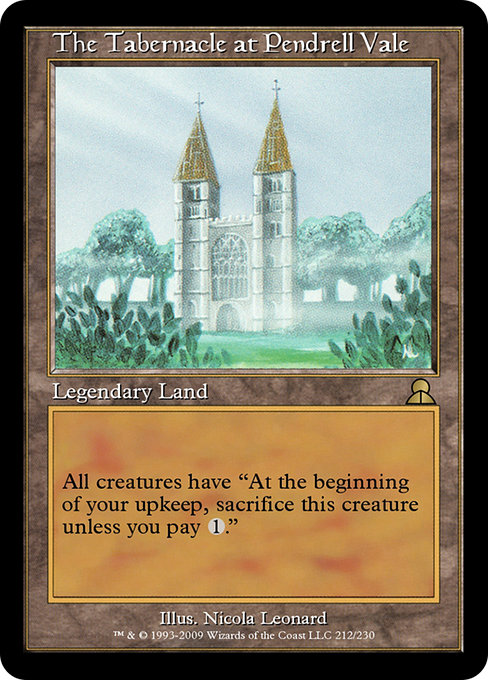
The Tabernacle at Pendrell Vale takes a different approach to the same problem — dominating a competitive table — and it does so through taxation rather than acceleration. The card imposes an ongoing upkeep cost on every creature in play, including the caster's own — but a deck built around few or no creatures pays that tax in name only, while every creature-reliant opponent at the table has to pay a recurring cost just to keep their board intact. That built-in asymmetry is what makes it a stax-style, hatebear-adjacent tool rather than just an annoyance: the fewer creatures your own deck runs, the more one-sided the tax becomes in your favor. In the multiplayer, resource-attrition-heavy environment of competitive Commander, a single card that can slow down an entire table at once — every turn, for the rest of the game — is exactly the kind of high-leverage stax piece that cEDH decks are built to seek out.
Like Mishra's Workshop, The Tabernacle at Pendrell Vale is on the Reserved List, and its price reflects the same fixed-supply dynamic. In that same August 8, 2026 snapshot, the cheapest available printing of The Tabernacle at Pendrell Vale was priced at approximately $2,899.99. That's a card whose entire function is a single, permanent, table-wide tax effect — no combo, no flashy rules text, just a relentless drain that a fixed number of copies will ever exist to provide.
Shopping for Reserved List Staples?
Mishra's Workshop and The Tabernacle at Pendrell Vale both trade across a wide range of listed conditions and price points. Compare current listings before you buy.
Search Mishra's Workshop on Amazon Search The Tabernacle on eBayWhy cEDH Demand Keeps These Prices Elevated
Competitive Commander, usually shortened to cEDH, is a distinct subset of the broader Commander format — one built around speed, resilience, and disruption rather than the more casual, social pacing that most Commander tables play at. It's a smaller community than Commander as a whole, but a dedicated and consistently growing one, and it draws heavily on Magic's deepest card pool, including vintage-era pieces that were never designed with a 100-card, multiplayer, singleton format in mind. Mishra's Workshop and The Tabernacle at Pendrell Vale both happen to provide exactly the kind of asymmetric, table-warping effects that cEDH decks prize, and there's no recent equivalent Wizards can print to take the pressure off — new sets add new tools to the format, but they don't replace what these two specific cards do.
That's the mechanism worth sitting with: demand for these effects is tied to how many people are playing competitive Commander, and that number has generally trended upward as Commander itself has become one of Magic's most popular ways to play. Supply, meanwhile, was locked in place before Commander existed as a named format at all. Compare that to a card printed in, say, the last several years that also happens to be a strong cEDH staple — Wizards can address rising demand for that card directly, reprinting it in a Commander precon, a Secret Lair, or a straight-up reprint set, and the price typically settles back down as new copies enter circulation. Reserved List cards have no such release valve. Every increment of new demand has to be absorbed entirely by a supply that cannot grow, which is the whole reason a decades-old land with a narrow, specific function can carry a price tag that rivals a used car.
It's also worth being precise about scale here. Mishra's Workshop and The Tabernacle at Pendrell Vale are, per this pricing pass, among the most expensive Reserved List cards commonly played in cEDH — not the most expensive Magic cards in existence, full stop. That distinction matters. Ultra-rare, effectively one-of-a-kind items — an Alpha-era Black Lotus in an exceptional grade, individual Power Nine cards sold at auction, or unique art or proof prints — can and do sell for figures well beyond what's discussed here, but those are collectibles-market, auction-house situations rather than the price floor for a playable, tournament-legal staple. This piece is specifically about that price floor: what it costs to actually own a legal, playable copy of a card your deck wants to run, not what a singular grail item might fetch at auction.
What "Cheapest Available Printing" Actually Means
The figures cited in this piece — approximately $3,000.97 for Mishra's Workshop and approximately $2,899.99 for The Tabernacle at Pendrell Vale — both come from an August 8, 2026 pricing snapshot compiled by krakenthemeta, sourced from Scryfall's market pricing data in US dollars. It's worth being clear about exactly what that figure represents. "Cheapest available printing" means the lowest-priced copy of the card, across whatever printings and conditions were listed on the market at the moment the data was pulled — not an average price, and not a price for a pristine, graded, or premium-condition copy. It's the floor: the least you could expect to pay for a legitimate copy of the card at that specific moment.
That's an important distinction because it means these numbers are a snapshot, not a permanent appraisal. MTG secondary-market prices move continuously, driven by factors like shifts in the competitive metagame, broader collectible-card-market sentiment, seasonal demand cycles, and even unconfirmed reprint speculation — even a false rumor that a Reserved List policy change might be coming can move prices before anything is officially announced. None of that has happened here; the Reserved List remains in force as a long-standing, official Wizards of the Coast policy, and these prices reflect ordinary market dynamics around a fixed-supply card, not any pending change. But treat the exact dollar figures in this article as a dated observation rather than a fixed appraisal, and always check current listings before assuming a price quoted here still holds.
How to Approach Buying Reserved List Cards
None of this is investment advice, and it shouldn't be read that way — this is market education about why a specific pair of cards costs what it costs, not a recommendation to buy them as a financial position. If you are considering picking up a copy of Mishra's Workshop or The Tabernacle at Pendrell Vale to actually play, a few practical points are worth keeping in mind given the price levels involved.
First, verify authenticity carefully. At price points in the thousands of dollars, counterfeit and altered cards are a real risk in the secondary market, and buying from established, reputable sellers with clear return and authentication policies is worth the extra diligence. Second, remember that "cheapest available printing" is a floor, not a fixed price — condition, specific printing, and seller all move the number at the margins, so comparing current listings before committing is always worthwhile. Third, if your actual goal is to test a cEDH deck's power level or play patterns before committing real money to a card at this price point, some players test expensive strategies with proxies before buying in — check what your own group allows before assuming a genuine copy is the only way to try it. Above all, treat any price quoted here or anywhere else as something to reverify at the moment you're actually buying, not as a locked-in number.
Verdict
The Reserved List creates something unusual in Magic: The Gathering — a small, permanent class of cards whose price is set almost entirely by a decades-old supply promise rather than by ordinary print-run economics. Mishra's Workshop and The Tabernacle at Pendrell Vale are the clearest examples of what happens when that fixed-supply guarantee collides with a competitive format, cEDH, that genuinely needs what those specific cards do and has no substitute Wizards can print to relieve the pressure. As of the August 8, 2026 pricing pull referenced throughout this piece, that collision priced the cheapest available Mishra's Workshop at roughly $3,000.97 and the cheapest available Tabernacle at Pendrell Vale at roughly $2,899.99 — and as long as the Reserved List stays in force and competitive Commander keeps growing, expect that price floor to keep moving in one direction only, since supply, by policy, never will.
A Price Floor Set by Policy, Not by Demand Alone.
The Reserved List guarantees these two lands can never get cheaper through a reprint — only pricier through demand. That's market education worth having before you ever price out a cEDH deck seriously.
© GEEKYDOMAIN.COM | Strategy Powered by Data