

One Piece TCG Set History: OP-01 Through OP-17 Explained
A plain-language map of every numbered One Piece Card Game booster set, from the foundational Romance Dawn release to August 2026's The World's Strongest Warriors.
Some links below are affiliate links. If you buy through them, Geeky Domain may earn a small commission at no extra cost to you.
→ Short Version
Bandai numbers the main line of One Piece Card Game boosters sequentially with an "OP" prefix, starting at OP-01 Romance Dawn and running, as of this writing, through OP-17 The World's Strongest Warriors (released August 28, 2026). Each set is a standalone booster release built around a slice of the story rather than a strict retelling of the manga in order, and the numbering climbs by one every time regardless of which arc a set draws from. Alongside the main OP-XX line, Bandai also releases Extra Booster sets (EB-01 through EB-03) and Premium Booster sets (PRB-01/02) that sit outside the core numbering entirely. This guide walks through what each stretch of sets did for the game and how to use the numbering when you're shopping, trading, or trying to figure out what a listing means.
→ Related Reading
In This Guide
- → What the OP-XX Numbers Actually Mean
- → OP-01 Romance Dawn: Where It All Started
- → OP-02 Through OP-05: The Early Expansion Sets
- → OP-06 Through OP-10: The Game Matures
- → OP-11 Through OP-14: The Refinement Era
- → OP-15 Through OP-17: The Current Frontier
- → Where Extra Boosters and Premium Boosters Fit In
- → How to Use Set Numbers When Buying, Trading, or Searching
If you've spent any time in a card shop or scrolling singles listings for the One Piece Card Game, you've run into the shorthand: "OP-09 alt art," "an OP-04 reprint," "still looking for an EB-02 copy." The letters and numbers look cryptic until you realize they're just a release index — Bandai's way of tagging every main-line booster set in the order it came out. Once you know how the system works, decoding any listing takes about five seconds. This guide breaks the whole run down, set by set, without pretending to know release dates we haven't confirmed for the earlier sets — we'll stick to what's actually documented and focus on what each stretch of the game's history actually did.
We're treating this as a reference piece, not a hype piece. If you're brand new to the game entirely, it's worth backing up first to our how to play guide before diving into set history — the numbering will make a lot more sense once you've seen a game played out.
What the OP-XX Numbers Actually Mean
"OP" stands for One Piece, and the number after it is simply the release sequence for the main-line booster sets — OP-01 came first, OP-02 came second, and so on up through the current OP-17. That's the entire system. Unlike some trading card games that split numbering by block, format, or region, the One Piece Card Game has kept this one clean, sequential line running since launch. There's no OP-01a or OP-01.5 to worry about, and no separate numbering track for the main sets themselves splitting off midway through.
Each OP-XX release is a full booster set, typically built around a particular arc, cast, or corner of the One Piece world rather than a strict chapter-by-chapter retelling of the manga. Alongside most main sets, Bandai also ships companion Starter Decks (numbered separately with an ST prefix) that give new Leaders a home outside the booster lottery — our breakdown of the ST-31 through ST-36 starter decks covers how those fit alongside the numbered boosters if you'd rather buy a complete deck than chase singles.
One thing worth flagging up front: we don't have confirmed, specific release dates for OP-01 through OP-16 to hand you here, and we'd rather say that plainly than guess. What we can walk through with confidence is the progression — the order sets released in, and the broad role each one played as the card pool grew. If you need exact release-week dates for older sets, your best bet is checking current retailer listings, since those tend to stay accurate long after the fact.
OP-01 Romance Dawn: Where It All Started
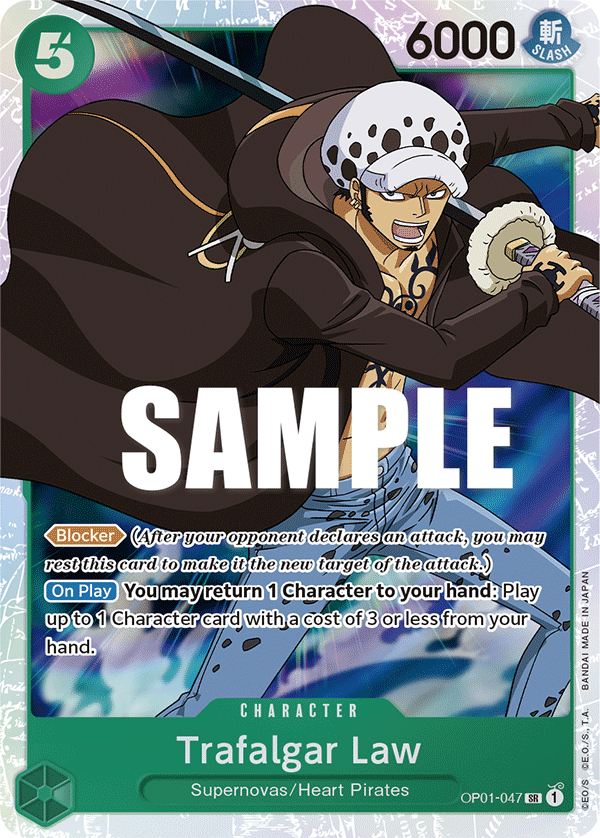
OP-01 Romance Dawn is the set everything else in this game builds on. As the very first main-line booster, it had to do double duty: introduce the card types and resource system the whole format runs on, and put a wide enough spread of Leaders and factions into circulation that day-one players actually had decks to build. Romance Dawn is the set most new collectors end up handling first, whether because it's the cheapest entry point into vintage cards or simply because it's the one every subsequent set gets compared against.
Because it's the foundational release, Romance Dawn also set the template for how rarity works across the whole game — the Leader, Common, Uncommon, Rare, Super Rare, Secret Rare ladder that every set since has followed in some form. If the difference between those tiers is still fuzzy, our rarity and chase card guide breaks down what separates a bulk common from a set's headline pull, and that same ladder is the lens worth applying to every set covered below.
OP-02 Through OP-05: The Early Expansion Sets
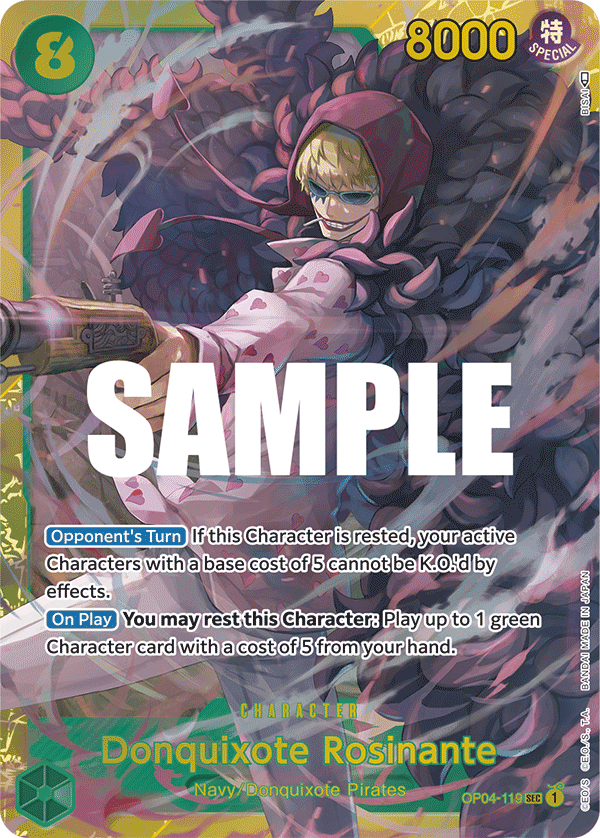
The next four sets released earlier in the game's run, moving the card pool from "one foundational set" to "an actual format with history." OP-02 Paramount War, OP-03 Pillars of Strength, OP-04 Kingdoms of Intrigue, and OP-05 Awakening of the New Era each pulled from a different corner of the story, giving the game room to add Leaders and mechanics that Romance Dawn simply didn't have space for.
This is also where some real structural changes landed, not just new faces. OP-02 Paramount War introduced Black as a playable card color for the first time, alongside the game's earliest Leaders built from two colors instead of one. OP-04 Kingdoms of Intrigue pushed that idea further and made it the whole set's identity: all six of its Leaders — Nefertari Vivi, Donquixote Doflamingo, Issho, Rebecca, Queen, and Crocodile — are dual-color, with most of that cast pulled from the Alabasta and Dressrosa arcs. If you're assembling a vintage collection and working backward from OP-17, this block of four sets is usually where the jump in card density and mechanical complexity becomes obvious.
It's also worth thinking about storage and handling once you're juggling cards from four or five different sets instead of one. Print runs, card stock, and even sleeve fit can vary slightly release to release, and our guide to sleeves, deck boxes, and playmats is a reasonable place to start if your OP-01 through OP-05 cards are still loose in a shoebox.
OP-06 Through OP-10: The Game Matures
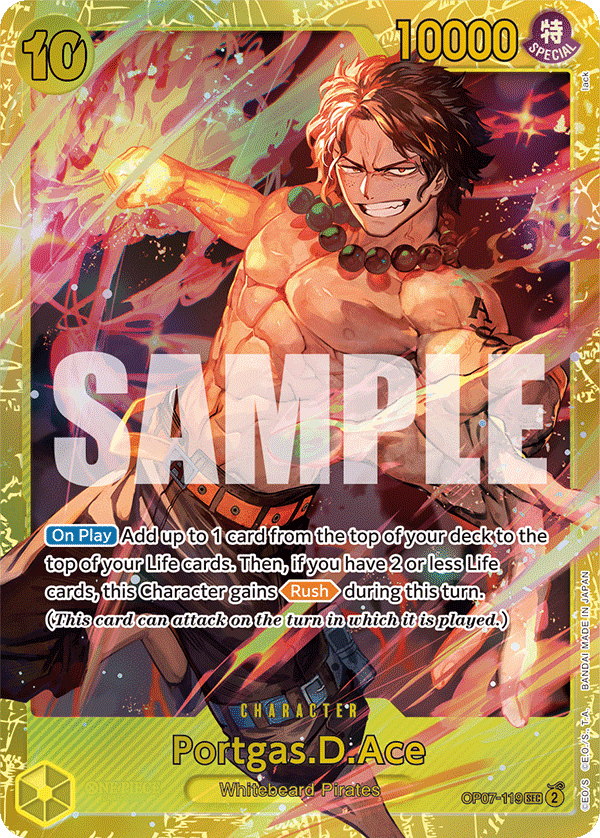
OP-06 Wings of the Captain, OP-07 500 Years in the Future, OP-08 Two Legends, OP-09 Emperors in the New World, and OP-10 Royal Blood cover the middle stretch of the game's run, and it's a genuine five-set arc rather than a handful of one-off releases. OP-06 gave the game its first Leader built around a One Piece film rather than the manga: Uta's kit revolves around trashing {FILM}-type cards from hand for a power swing during battle. OP-07 then shifted focus to the Egghead arc and put a red Monkey D. Dragon Leader in the Revolutionary Army's hands.
This is also roughly when pull economics started mattering more to the buying decision, not just deck strategy. As the number of chase-worthy alternate arts per set grew, so did the gap between what a booster box costs and what it's actually likely to return. If you've ever wondered how case hits, box mapping, and pull rates get talked about for this game specifically, our piece on Bandai TCG pull rates and box mapping is written with sets from exactly this era in mind, since it's where box-opening content really took off around this game.
OP-09 and OP-10 are where this run's identity really sharpens. OP-09 Emperors in the New World gave Marshall D. Teach — Blackbeard — his own Leader, built around negating On Play effects, his own and his opponent's, in exchange for trashing a card, which forced deckbuilding conversations to start accounting for a Leader ability directly rather than just racing past it. OP-10 Royal Blood followed with a run of dual-color Leaders like Smoker and Caesar Clown built around Navy and Punk Hazard synergies — a five-set middle run is usually enough for a card game to settle into whatever identity it's going to have, and this block is where that happened here.
OP-11 Through OP-14: The Refinement Era
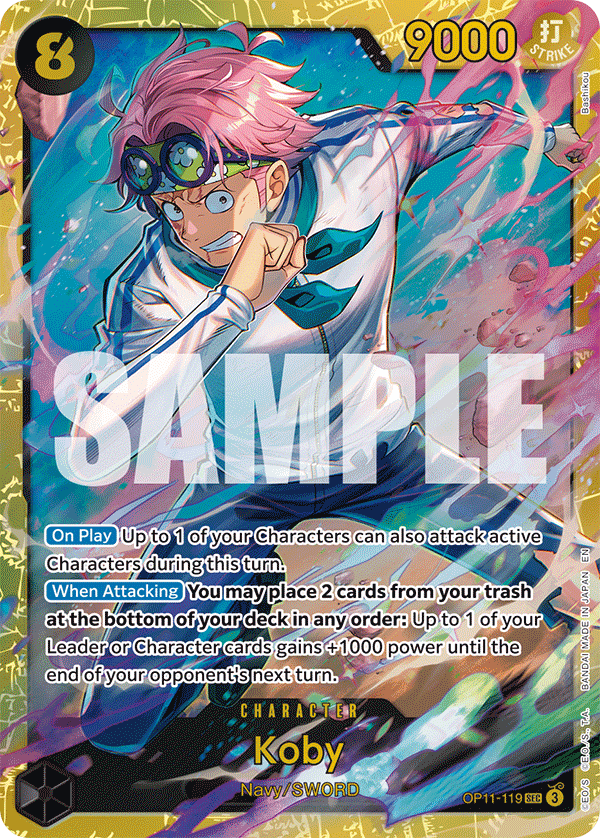
OP-11 A Fist of Divine Speed, OP-12 Legacy of the Master, OP-13 Carrying On His Will, and OP-14 The Azure Sea's Seven make up the next block, and this is where the game starts feeling less like it's expanding outward and more like it's tightening up what's already there. OP-12 leaned directly into that shift, built around master-and-disciple pairings like Sanji and Zeff. OP-13 went further still: it's the game's official third-anniversary set, and it marks Gol D. Roger's debut as a playable Leader card — he'd only existed as a Character card in earlier sets — carrying a base power of 7,000, the first Leader in the game to reach that number, releasing alongside Luffy, Ace, and Sabo returning together as new Leaders built around the three sworn brothers.
From a competitive standpoint, this era is also when the metagame conversation got noticeably more granular. With ten-plus sets' worth of Leaders and support cards to pull from by this point, deck archetypes started splitting into sub-variants rather than just "the green deck" or "the purple deck." Our meta tier list is the place to check where things stand today, but the OP-11 through OP-14 stretch is genuinely where that level of nuance became necessary to track in the first place — OP-14's Trafalgar Law Leader is a good example, with an ability that swaps the base power values of two Supernovas or Heart Pirates characters already in play, the kind of narrow, synergy-dependent tool a two-color-Leader metagame wasn't really building toward a few sets earlier.
If you're building on a budget and picking through this era for value, it's worth remembering that "refinement era" sets often support cheaper, tighter decklists than the newest release does — our Green Mihawk budget deck guide leans on exactly this kind of card pool depth to keep costs down while still fielding something competitive.
OP-15 Through OP-17: The Current Frontier
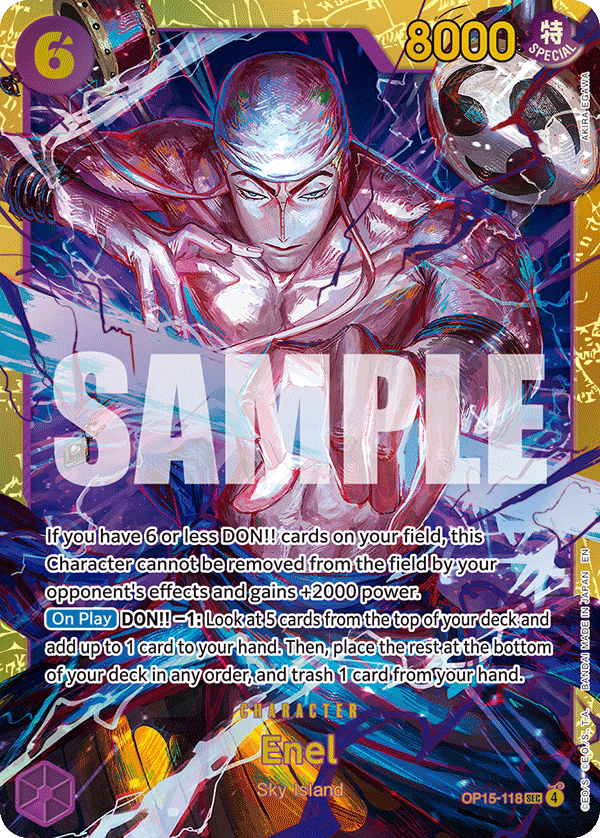
This is the stretch most players reading a set-history piece in late 2026 actually care about. OP-15 Adventure on Kami's Island and OP-16 The Time of Battle carried the format into its current shape, and OP-17 The World's Strongest Warriors is the newest main-line release, having come out on August 28, 2026. If you've been away from the game for a while and are trying to figure out how far the card pool has moved since you last opened a pack, these three sets are the gap you need to close.
Because OP-17 is brand new, it's also the set with the most actionable buying information available right now. We've covered it from a few different angles: a full set review for anyone deciding whether to buy in at all, a breakdown of the chase cards and early price guide for collectors, and a straight-up what to buy right now piece for players who just want the format-relevant singles without wading through everything else in the set.
One practical note: the newer a set is, the more its early singles prices move around as the format settles and supply catches up to demand. That's normal for any set in this three-set window, not just OP-17, so treat week-one pricing on Adventure on Kami's Island or The Time of Battle cards the same way — a snapshot, not a ceiling.
Where Extra Boosters and Premium Boosters Fit In
Not everything in the game carries an OP-XX number, and this is where a lot of the confusion in listings comes from. Bandai also releases Extra Booster sets — EB-01 Memorial Collection, EB-02 Anime 25th Collection, and EB-03 One Piece Heroines Edition — which sit on their own numbering track rather than slotting into the main sequence. These tend to be reprint- and celebration-focused releases, gathering fan-favorite cards or themed art rather than pushing the competitive card pool forward the way a numbered OP set does.
There's also a Premium Booster line — PRB-01 and PRB-02, both released under "The Best-" branding — which functions similarly: a curated, higher-end release outside the main numbering, generally aimed more at collectors than at players hunting for the next competitive tech card. If you're cataloging a collection that spans both the main OP line and these side releases, it's worth keeping them mentally (and physically) separate, since an "EB-02" card and an "OP-02" card are not related just because the second character matches.
That separation matters for storage, too. Mixing main-set commons in with Extra Booster alternate arts in the same box gets messy fast, and it's part of why we generally point collectors toward keeping sets segregated — see our binders vs. boxes organization guide for a system that scales as the number of side-releases keeps growing alongside the main line.
How to Use Set Numbers When Buying, Trading, or Searching
Now that you have the full run laid out, the practical payoff is simple: set numbers are the fastest way to confirm you're getting exactly the card you think you're getting. A listing that just says "Luffy" could mean a dozen different printings across a dozen different sets — but "OP-01 Luffy" or "OP-17 Luffy" narrows it down to one specific print, which matters a lot once price and rarity are on the line.
This is especially worth doing before you buy anything above bulk pricing. If a card's value hinges on which set it's from, cross-check the listing against the set number before paying a premium — our collection value guide and running list of the most valuable One Piece cards of 2026 both organize entries by set for exactly this reason.
Set numbers also come in handy the moment you start thinking about grading or authenticity. Knowing which set a card belongs to lets you check it against the correct reference images and expected print details for that specific release — a step our guide to spotting fake cards walks through in more detail, and one that becomes more important the higher up the rarity ladder you're shopping. The same logic applies if you're planning to send a card off for grading: our PSA, CGC, and BGS grading guide assumes you already know exactly which set and printing you're submitting, since that's part of what determines expected value once it comes back slabbed.
Finally, if you're new enough to the game that all seventeen sets still blur together, that's completely normal — it happens in every trading card game once the release count climbs into double digits. Our general beginner's guide to starting any TCG covers how to approach a deep back catalog like this one without feeling like you need to own all seventeen sets to participate.
OP-17 Is the Newest Chapter, Not the Only One Worth Knowing
Seventeen main-line sets plus a handful of Extra and Premium Boosters is a lot of history to hold in your head, but the numbering itself is the easy part — it's just a sequential release order, nothing more cryptic than that. The harder part is deciding where to actually spend your time and money, and that answer depends on whether you're building a competitive deck around the newest release or filling in gaps in a collection that stretches back to Romance Dawn.