

One Piece TCG Meta Tier List
Purple Enel has surged into the most-represented spot in recent decklists, Green Mihawk remains the tracker-rated deck to beat, Rocks D. Xebec made an immediate first-week impression, and Sabo is pulling off a rare double act as both a starter-deck leader and an S-tier competitive one. Here's where the OP-17 format stands as fresh decklist data rolls in.
Some links below are affiliate links. If you buy through them, Geeky Domain may earn a small commission at no extra cost to you.
Updated August 31, 2026: This list originally launched two days after OP-17's release. We've since cross-checked it against real submitted-decklist frequency data from optcg.one, and it shows a genuine shift worth flagging — Purple Enel is now the most-represented leader in that dataset. We've added a full section on Enel below and adjusted the ranking language throughout, without touching the original findings on Green Mihawk, Rocks D. Xebec, Sabo, or the banned-pair ruling, which all remain accurate as reported.
One Piece TCG's competitive scene doesn't run on a single official tier list the way some other card games do. Instead, the picture of what's actually winning comes together from tournament-tracking sites like opmetagame.com and the tier lists onepiece.gg maintains, cross-referenced against a "best decks" roundup TCGplayer published in August 2026. Worth being upfront about what that means: these are community tracking sites and an editorial roundup, not centrally verified statistics — their rankings lean heavily on submitted-decklist volume and player-reported tournament results rather than any official Bandai count. Right now, with the format having just shifted under a brand-new set, that picture is still very much taking shape.
OP-17 released on August 28, 2026 — which means as of this writing, the format built around it is roughly three days old. Everything below is a snapshot of an extremely early environment, not a settled hierarchy. Deck lists are still being refined, new leaders are still being tested against the field, and the rankings here will almost certainly move as more tournament results come in over the following weeks. Treat this as a living document rather than gospel, and check back as the format matures.
That said, a days-old format isn't the same as a zero-data one. Trackers like these draw on a mix of early tournament finishes, high-profile online play, and pattern recognition from players who've been following the archetypes involved since before OP-17 dropped — a leader like Sabo, for instance, didn't appear out of nowhere; his standing builds on cards and support that were already understood. So while the specific rankings below should be read as provisional, the broad shape of "these five leaders are the ones to watch" is a reasonably informed early read rather than a guess.
Here's what's defining early competitive OP-17 play — including one distinctive ruling worth understanding on its own, since it changes how you read this game's banlist going forward.
→ Short Version
Purple Enel is now the format's most-represented deck — real submitted-decklist frequency data (optcg.one, checked August 31, 2026) puts it out in front of every other leader, though that's a different measurement than the tier-consensus calls below. Green Mihawk (Green) remains the tracker-rated benchmark — at least one tracker still names it the single strongest deck in the current format outright, and it lands second in the new decklist-frequency data too. Rocks D. Xebec (Blue) arrived brand-new in OP-17 and has already landed among the top-ranked leaders in the set's first week. Sabo (Red/Black) is doing something unusual: he's simultaneously rated S-tier by the trackers above and the headline leader of the ST-35 starter deck that released July 31, 2026 — meaning a brand-new player can buy directly into a top-tier archetype straight out of a starter box. Red Ace and Monkey D. Luffy decks round out the tracker-consensus top tier, also ranked among the format's top performers — and a Green/Yellow Luffy build shows up separately, in third place, in the new decklist-frequency top five. A distinctive banned-pair ruling is now in effect — OP07-115 and EB04-058 can't be run in the same deck, rather than either card being banned outright.
→ Related Reading
In This Guide
- → Purple Enel: The Format's Most-Represented Deck
- → Green Mihawk: The Early Benchmark
- → Rocks D. Xebec: OP-17's Brand-New Arrival
- → Sabo: Two Tiers at Once
- → Red Ace and Luffy: Rounding Out the Top
- → The Banned Pair: OP07-115 & EB04-058
- → Regionals Season 2 and the Road to Worlds
- → Where These Rankings Come From
- → FAQ
- → The Verdict
| Leader | Current Standing |
|---|---|
| Enel, "Purple Enel" (Purple) | New data point (added August 31, 2026): now the most-represented leader in recent submitted decklists — see the Purple Enel section below for how this metric differs from the tracker-consensus rows underneath it |
| Dracule Mihawk, "Green Mihawk" (Green) | Named the single strongest deck in the format by at least one major tracker; second most-represented leader in the new decklist-frequency data |
| Rocks D. Xebec (Blue) | Brand-new leader in OP-17; already ranked among the format's top performers in its first week |
| Sabo (Red/Black) | Ranked among the format's top performers — and simultaneously the headline leader of a current starter deck |
| "Red Ace" (Red) | Ranked among the format's top performers |
| Monkey D. Luffy (multiple builds) | Ranked among the format's top performers across trackers; a Green/Yellow build also lands third in the new decklist-frequency data |
Note: the Purple Enel and decklist-frequency callouts above come from a different measurement than the rest of this table — real submitted-decklist counts from optcg.one, checked August 31, 2026, rather than the tournament-tracker consensus (opmetagame.com, onepiece.gg, TCGplayer) behind everything else here. See "Where These Rankings Come From" further down for the distinction.
Leader Profiles
Purple Enel: The Format's Most-Represented Deck
Enel — "Purple Enel"
| Color | Purple |
| Leader Card | OP15-058 |
| Origin Set | OP-15 |
| Decklist-Frequency Standing | Most-represented leader across recent submitted decklists (optcg.one, checked August 31, 2026) |
| Tracker Consensus | Not yet reflected in the opmetagame.com / onepiece.gg / TCGplayer sources cited elsewhere in this piece as of this writing |
Every ranking above this section is built from the same handful of tournament-tracking sources described in more detail further down this page. On August 31, 2026, we cross-checked that picture against a genuinely different kind of data: real submitted-decklist counts from optcg.one, a decklist-frequency database rather than a win-rate or tournament-placement tracker. It's worth being precise about what that means — this isn't a percentage of games won, and it isn't an official Bandai statistic. It's simply a count of how often a given leader shows up among the decklists players are actually building and submitting right now.
By that measure, Enel — leader card OP15-058, from OP-15 — is currently the most-represented deck in the tracked pool, ahead of every other leader on this page, including Green Mihawk, which lands second. Rounding out that decklist-frequency top five: a Green/Yellow Luffy build sits third, a Blue/Yellow Marshall D. Teach build sits fourth, and a Blue/Yellow Nami build sits fifth. Notably, Rocks D. Xebec, Sabo, and "Red Ace" — all ranked among the format's top performers by the tracker-consensus sources elsewhere in this piece — don't currently appear in this particular top five. That's not a contradiction; it just means those three leaders aren't (yet) among the five most commonly built decks in this specific decklist dataset, even though they're rated highly by the tournament trackers described in the rest of this article.
It's worth sitting with what "most-represented" does and doesn't tell you. It's a real signal of what a large number of players are choosing to build right now, and rising raw representation like this often precedes bigger tournament results as a deck's pilots get more reps in — but it isn't the same claim as "strongest," and we're not going to overstate it into one. The "single strongest deck" call, per at least one major tracker, still currently belongs to Green Mihawk, discussed in full in the next section. Both things can be true simultaneously: Enel is what a lot of players are picking up right now, and Mihawk is what at least one tournament tracker still rates highest.
We don't yet have a verified image of Enel's OP15-058 leader card confirmed for this piece, so the spot below is held for it rather than filled with a guess.
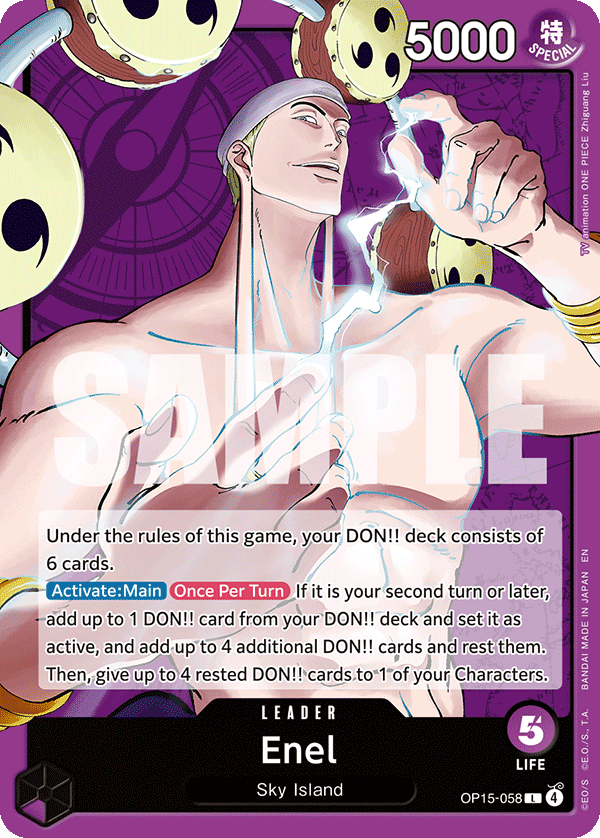
For the full breakdown of the deck itself — how it's built, what it's trying to do, and how it plays against the rest of this list — see the companion Purple Enel deck guide. And if a fresh OP-15 or OP-17 pull from your own boxes turns out to be a genuine chase card, it's worth knowing whether it's worth submitting before you do anything else with it — our grading guide comparing PSA, CGC, and BGS walks through that decision.
Green Mihawk: The Early Benchmark
Dracule Mihawk — "Green Mihawk"
| Color | Green |
| Leader Card | OP14-020 |
| Origin Set | OP-14, "The Azure Sea's Seven" |
| Tracker Consensus | Named the single strongest deck in the format by at least one major tracker |
"Green Mihawk" is the name the community has settled on for the Green-colored Dracule Mihawk leader deck, and right now it's the deck other builds are measured against. Multiple tournament-tracking sources have it near the very top of the OP-17 environment, and at least one tracker goes further, naming it the single strongest deck in the format outright.
Mihawk's leader card is OP14-020, printed in OP-14 "The Azure Sea's Seven." Because leader cards in this game generally aren't reprinted with new art the way character cards regularly are, this OP-14 print is the only Green Dracule Mihawk leader that exists — there's no newer or alternate-art version to chase if you're building the deck. That kind of scarcity is part of why leader prints for a tracker-rated benchmark deck like this one tend to show up on rundowns of the most valuable One Piece cards of 2026 — with no reprint risk, whatever copy exists today is the only version that will ever exist.
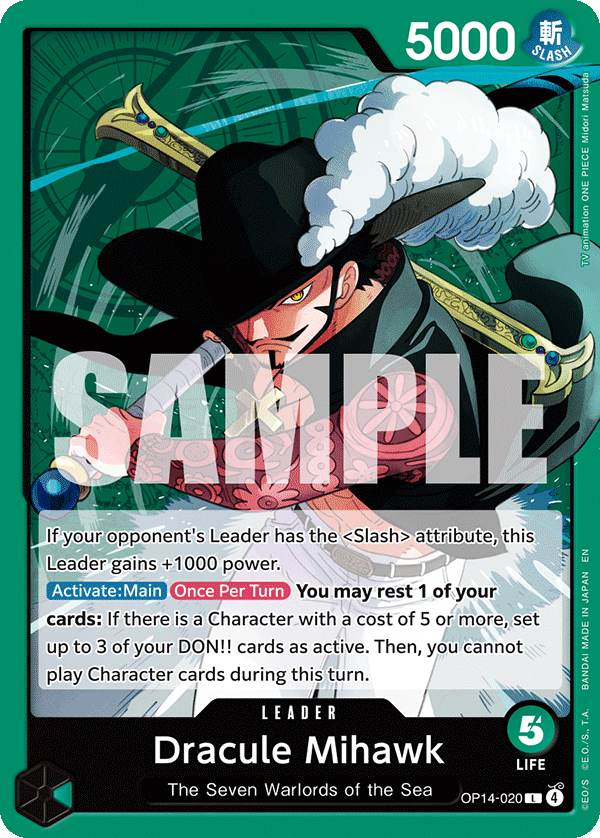
OP14-020 is Dracule Mihawk's only Green leader print, from OP-14 "The Azure Sea's Seven." If you're building around the format's current benchmark deck, that's the set to shop first.
Prices and stock change constantly — check the listing before you buy.
Rocks D. Xebec: OP-17's Brand-New Arrival
Rocks D. Xebec
| Color | Blue |
| Debut | Brand new in OP-17 (released August 28, 2026) |
| Leader Card Image | Not yet verified — see the companion OP-17 set review for his ability breakdown |
| Tracker Consensus | Ranked among the format's top performers in the set's first week |
Rocks D. Xebec is the newest name on this list — his leader debuted with OP-17 itself, so the deck has had only a few days to make an impression, and it's already landed among the format's top-ranked leaders across the trackers cited throughout this piece. That's a fast start for a brand-new leader in a format this young.
We don't yet have a verified image of Xebec's own leader card to show here, so the shot below is Loki, a Secret Rare pulled from OP-17 itself — not Xebec's card, but a real image from the same brand-new set, included as a visual anchor for just how fresh this format currently is.
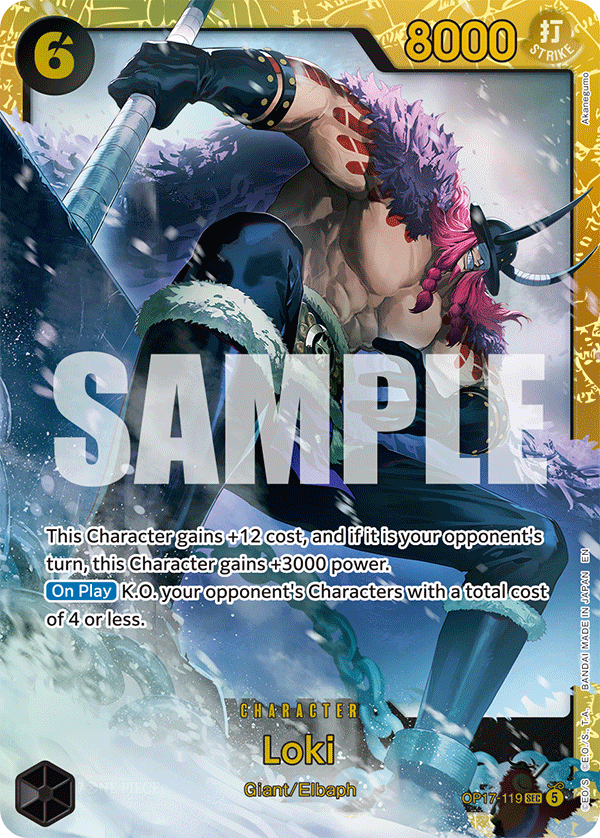
For a full breakdown of what Xebec's leader ability actually does, see the companion OP-17 set review — this tier list is focused on where the deck currently stands in the rankings, not the mechanics of how it gets there.
Sabo: Two Tiers at Once
Sabo
| Color | Red/Black |
| Leader Card | Sabo's ST-series starter deck leader (ST-35) — the specific leader-card number hasn't been independently confirmed for this piece |
| Origin Set | Not yet verified — presumed tied to the ST-35 starter deck given Sabo's dual starter/competitive status, but not independently confirmed for this piece |
| Tracker Consensus | S-tier competitive leader per the trackers cited throughout this list |
| Also Available As | Headline leader of the ST-35 starter deck (released July 31, 2026) |
Sabo occupies a genuinely unusual spot in the current format: he's rated as an S-tier competitive leader by the same trackers driving every other ranking on this list, and he's also the headline leader of the ST-35 starter deck, which released July 31, 2026. That's not a coincidence worth glossing over — it's a real overlap between two categories that almost never intersect this cleanly.
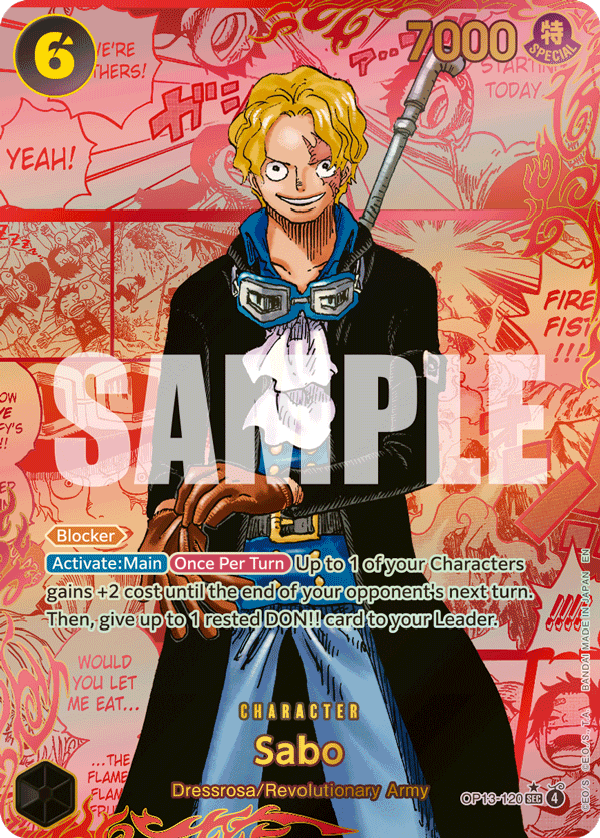
Starter decks in most trading card games — including this one, most of the time — are built to teach new players the rules, not to compete at the top of a format. Sabo breaks that pattern. A brand-new player who picks up ST-35 off the shelf is buying directly into a top-tier archetype, not a beginner-tier deck they'll need to fully replace once they start taking the game seriously.
That doesn't mean the exact list inside ST-35 is tournament-ready without any changes at all — starter decks typically benefit from some tuning to reach their full competitive ceiling, and we're not going to guess at specifics here that haven't been confirmed. But the gap between "starter deck" and "S-tier deck" is about as small as it gets in this game's current format, which is worth knowing whether you're a new player choosing a first deck or a returning player deciding where to jump back in. For the full rundown of how ST-35 stacks up against the rest of the current starter deck lineup, see the companion ST31–36 ranked article. And if you're weighing options beyond just this most recent wave, our broader guide to picking a starter deck for beginners covers the full current lineup, not just ST31–36.
Released July 31, 2026, ST-35 is the rare starter deck that doubles as a genuine top-tier entry point — good for brand-new players and anyone who wants Sabo's pieces without hunting singles.
Prices and stock change constantly — check the listing before you buy.
Red Ace and Luffy: Rounding Out the Top
Rounding out the current top tier, Red Ace and Monkey D. Luffy decks are both ranked among the format's top performers by the same tracking sources cited throughout this list. Ace's deck follows the same color-first naming shorthand as Green Mihawk — "Red Ace" signaling the Red-colored build of the character — while Luffy's top-performing results span more than one build, so treat "Luffy" here as covering multiple placements rather than a single decklist.
Neither deck has been singled out as the single strongest option the way Green Mihawk has been by at least one tracker, but both show up consistently enough across sources to earn a place in the format's current top tier. As with everything else on this list, that standing is worth re-checking as more OP-17 tournament results roll in over the coming weeks.
It's also worth noting what separates these two spots from the three above them: Green Mihawk, Rocks D. Xebec, and Sabo each have something specific driving their placement — a tracker calling Mihawk the outright strongest deck, Xebec's immediate first-week showing, Sabo's starter-deck overlap. Red Ace and Luffy don't have that same singular hook in the sources available right now; they're simply consistent top-tier performers without a standout storyline attached. That's not a knock on either deck — consistency across multiple trackers is its own kind of signal — but it does mean there's less to say about why they're here beyond the fact that they keep showing up.
The Banned Pair: OP07-115 & EB04-058
Most trading card games ban single cards when something gets out of hand. Right now, One Piece TCG has banned a pair.
→ Banned Pair Ruling
OP07-115 "I Re-Quasar Helllp!!" cannot be run in the same deck as EB04-058 Borsalino, per Bandai's ruling as reported by community tournament-tracking sources — effective April 10, 2026 in Japan, and May 1, 2026 across NA, EU, LATAM, and OC, according to those same trackers rather than a Bandai press release we've independently verified. This is a banned-pair ruling, not a ban on either card individually — both cards remain legal on their own, just not together in the same deck.
The reasoning behind the ruling, as reported by those same community trackers rather than a direct Bandai statement, is straightforward: the OP07-115/EB04-058 combo was appearing across more decks than expected — especially Yellow decks — and was making games run noticeably longer than intended. Rather than banning either card outright and removing it from every deck that might otherwise reasonably want it, the ruling targeted the specific combination causing the problem.
It's a distinctive approach worth understanding even outside the specific cards involved, because it changes how you should read this game's banlist going forward — a card sitting fully legal doesn't automatically mean it's free to pair with everything else. As of this writing, this OP07-115/EB04-058 pairing is the only banned pairing in the format; no cards are currently banned outright or restricted to reduced copy counts.
Regionals Season 2 and the Road to Worlds
The competitive calendar matters as much as the tier list itself right now. Championship 26–27 Regionals Season 2 is running now, spanning August through December 2026, and this season is offline-only — meaning the results shaping trackers like opmetagame.com and onepiece.gg over the next several months will be coming out of in-person events rather than online play.
Those Regionals results feed into a newly standalone World Championship Finals, scheduled for March 2027. That's a structural change worth knowing about if you're following the competitive scene closely: the World Championship Finals is being run as its own separate event this cycle, which is part of why the results coming out of this Regionals season carry extra weight for anyone reading the tea leaves on where the format is headed.
Combine that with OP-17 having landed just days ago, and you get a competitive environment that's unusually fluid even by this game's normal standards: a brand-new format, feeding a season of high-stakes offline events, feeding a newly restructured World Championship. Expect the tier list above to move as that season plays out — and the Purple Enel section above is an early example of exactly that kind of movement.
Where These Rankings Come From
This list is built by triangulating a handful of sources rather than leaning on any single official ranking. opmetagame.com and the tier lists onepiece.gg maintains both track tournament results and community-submitted data on an ongoing basis, and a "best decks" article TCGplayer published in August 2026 adds another data point from a source that covers the competitive scene closely. None of these three should be read as an official, audited statistic — opmetagame.com and onepiece.gg both draw substantially on player-submitted results and community tracking rather than a centrally verified count, and the TCGplayer piece reflects an editorial call rather than a formal ranking. Where those sources agree — as they currently do on Green Mihawk sitting at or near the top — that agreement carries real weight. Where a single source goes further than the others, as with the tracker that names Green Mihawk the single strongest deck outright, we've flagged that it's one source's call rather than a unanimous one.
As of August 31, 2026, we've added a fourth source to that mix: real submitted-decklist frequency data from optcg.one. It's a genuinely different kind of measurement than the three sources above — it counts how often a leader appears among the decklists players are actually building and submitting, rather than tracking tournament placements or compiling an editorial "best decks" call. We've kept it clearly separate throughout this piece rather than folding it into the same "tracker consensus" language used for Green Mihawk, Rocks D. Xebec, Sabo, Red Ace, and Luffy, because it isn't measuring the same thing. Where it points in the same direction as the tracker-consensus sources — as it does with Green Mihawk landing near the top of both — that agreement is worth noting. Where it surfaces something the tracker-consensus sources haven't caught up to yet, as with Purple Enel, we've flagged that distinction rather than presenting it as a unanimous call.
None of this is a substitute for an official Bandai tier list, because Bandai doesn't publish one. It's also worth remembering that OP-17 is only days old as of this writing — the sample size behind every ranking here is small by definition, and it will only get more reliable as more Regionals Season 2 events get played out under the new format.
FAQ
Is Purple Enel actually the best deck in the format now?
Not necessarily — "most-represented" and "strongest" aren't the same claim. The August 31, 2026 decklist-frequency data from optcg.one shows Enel out in front of every other leader in raw submitted-decklist counts, which is a real signal of what players are choosing to build right now. But that's a different metric than the tournament-tracker consensus described above, which still names Green Mihawk the single strongest deck per at least one source. Both can be true at once: Enel is what a lot of players are currently playing, and Mihawk is what at least one tracker still rates highest. See our companion Purple Enel deck guide for the deep dive on the deck itself.
How settled is this tier list?
Not very, and that's by design — we published this within days of OP-17's release specifically to give an early read, rather than waiting for a "finished" picture that won't exist for weeks, and we've already updated it once (August 31, 2026) to reflect new decklist-frequency data on Purple Enel. Expect further movement as Regionals Season 2 events play out under the new format.
Is Sabo actually good for new players, or just competitively strong?
Both, which is the unusual part. Sabo is rated S-tier by the same trackers driving the rest of this list, and he's also the headline leader of the ST-35 starter deck released July 31, 2026 — so a new player buying that starter deck is buying into a top-tier archetype, not one they'll outgrow immediately. See the companion ST31–36 ranked article for how ST-35 compares to the rest of that starter deck lineup.
What exactly does the banned-pair ruling do?
It stops OP07-115 "I Re-Quasar Helllp!!" and EB04-058 Borsalino from being run in the same deck — effective April 10, 2026 in Japan, and May 1, 2026 across NA, EU, LATAM, and OC, per Bandai's ruling as reported by community tournament-tracking sources. Both cards are still legal individually — they just can't be paired together, which is different from either card being banned outright.
Is anything else banned or restricted right now?
Not as of this writing. The OP07-115/EB04-058 pairing is currently the only banned pairing in the format, and no cards are banned outright or restricted to reduced copy counts.
Where's the image of Rocks D. Xebec's own leader card?
We don't have a verified image of Xebec's leader card to show yet, so this article uses Loki — a real Secret Rare pull from OP-17 itself — as a visual stand-in for the set. For a breakdown of what Xebec's ability actually does, see the companion OP-17 set review.
An Early Format, Already Taking Shape — and Already Shifting.
Days into OP-17, Green Mihawk remains the tracker-rated deck to beat, Rocks D. Xebec has made an immediate impression on his debut, and Sabo is pulling off the rare trick of being both a starter-deck leader and a competitive S-tier one at the same time. Red Ace and Luffy round out a tracker-consensus top tier that's still very much being tested in real time — and as of the August 31, 2026 update, Purple Enel has emerged as the single most-represented deck in real submitted-decklist data, a genuinely different signal worth tracking alongside everything else here.
The banned-pair ruling on OP07-115 and EB04-058 is worth internalizing on its own, separate from the tier list — it's a reminder that this game's approach to balance doesn't always look like a typical banlist, and it's the kind of ruling that can reshape which decks are viable in ways a simple power-level ranking won't capture.
Use this list as a starting point for understanding what you're likely to face at Regionals Season 2 events this year, not as a final word. Check back as OP-17 matures, as more offline results come in, and as the road to the newly standalone World Championship Finals in March 2027 continues.
© GEEKYDOMAIN.COM | Strategy Powered by Data