

Purple Enel Deck Guide: One Piece TCG's Top Meta Leader
A DON!!-deck-manipulation leader that's become one of the format's most-played leaders right now — here's what makes Enel tick and how to think about building around him.
Some links below are affiliate links. If you buy through them, Geeky Domain may earn a small commission at no extra cost to you.
→ Short Version
Purple Enel (OP15-058) is currently running essentially neck-and-neck with Green/Yellow Luffy for the most-submitted leader by decklist count on tournament trackers like optcg.one, with both well clear of the next tier, which includes Green Dracule Mihawk. That's based on recent decklist-submission volume, not an official win-rate stat, but it's a strong signal of where the format's attention is right now. Enel's leader ability lets you manipulate a separate 6-card DON!! deck to generate extra DON!! and pile it onto a single Character, turning one threat into a DON!!-stacked finisher. This guide walks through the ability, what it actually rewards when you build around it, and how Enel stacks up against the other top leaders in the format.
→ Related Reading
In This Guide
- → Why Purple Enel Is One of One Piece TCG's Top Leaders Right Now
- → The Leader Ability, Explained
- → The DON!! Deck: A Mechanic Most Leaders Don't Have
- → How Purple Enel Compares to Green Mihawk and Luffy
- → Building a Purple Enel Deck: What the Ability Rewards
- → Strengths and Weaknesses to Know Before You Build
- → Where to Buy Cards and Gear for This Deck
- → Is Purple Enel Worth Building Right Now?
Why Purple Enel Is One of One Piece TCG's Top Leaders Right Now
If you've spent any time browsing decklists lately, you've probably noticed one leader showing up almost as much as any other in the format: Enel (OP15-058), the Purple leader from OP-15, Adventure on Kami's Island. As covered above, he's currently sitting essentially even with Green/Yellow Luffy at the very top of the format's decklist counts — a meaningful signal about where deckbuilders are putting their attention right now, even if it's a decklist-volume count rather than an official win-rate stat.
Part of what's driving that attention is that Enel isn't just a strong stat line — Life 5 and Power 5000 are solid but not exceptional numbers by themselves. What sets him apart is a genuinely unusual leader ability built around DON!!, the resource system that powers attacks and effects throughout the game. If you're still getting comfortable with how DON!! works in the first place, our full rules guide covers the basics before you dive into a leader this mechanically dense. For everyone else, the short version is that Enel doesn't just use DON!! the way every other leader does — he manipulates an entirely separate, customizable pool of it, and that's the whole reason he's climbing decklist counts right now.
It's also worth noting where Enel sits in the format's timeline. OP-15 isn't the newest set on shelves — if you want the full picture of how the card pool has evolved from the earliest sets through the current one, our set history guide lays that out. The fact that a leader from an older release is still holding that spot near the top of the format, months after its own set has come and gone, says a lot about how well this particular ability has aged, and it's exactly the kind of shift our meta tier list tracks as the format moves.
The Leader Ability, Explained
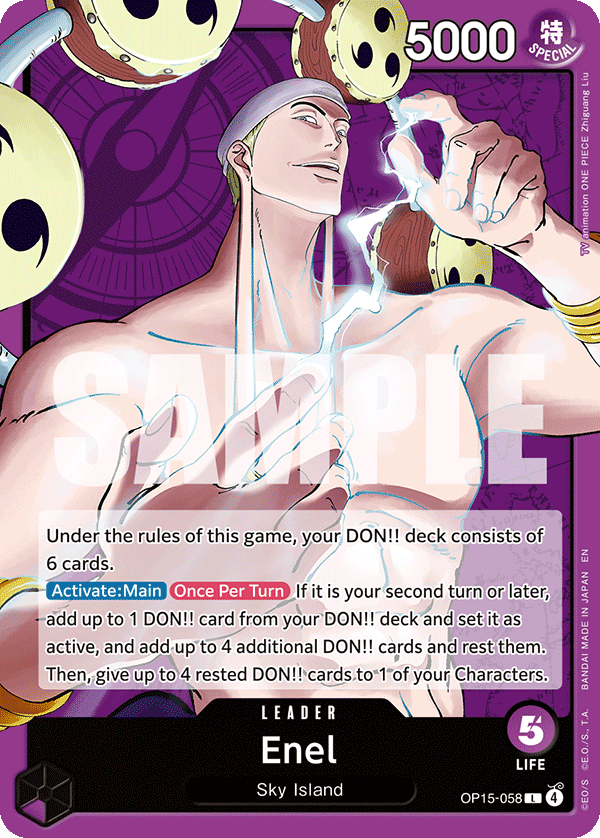
Enel's ability is dense enough that it's worth reading slowly. Here's how it reads, per card database records (optcgapi.com's official card-text listing): "Under the rules of this game, your DON!! deck consists of 6 cards. [Activate: Main] [Once Per Turn] If it is your second turn or later, add up to 1 DON!! card from your DON!! deck and set it as active, and add up to 4 additional DON!! cards and rest them. Then, give up to 4 rested DON!! cards to 1 of your Characters."
Breaking that down piece by piece: first, the ability redefines your DON!! deck's size outright, dropping it to a 6-card pool instead of the standard setup. Second, it's an Activate: Main ability, meaning you use it during your main phase, and it's capped at once per turn. Third, the timing restriction — "if it is your second turn or later" — means this doesn't come online on your very first turn of the game. From turn two onward, though, you can pull up to 1 DON!! card from that 6-card deck and set it active (meaning it's immediately usable that turn), plus pull up to 4 more and set them rested. Finally, and this is the part that makes Enel distinctive, you then hand up to 4 of those rested DON!! cards directly to one of your Characters, boosting that Character's power for the turn.
In practice, that's a lot of extra DON!! flowing into the game from a source most leaders simply don't have access to, and all of it can be aimed at a single Character rather than spread thin. That's the core engine this leader runs on, and it's why deckbuilders who want to understand the mechanics behind a leader before committing to one should start with our strategy hub, which covers how DON!! timing and resource commitment shape matchups across the format generally.
The DON!! Deck: A Mechanic Most Leaders Don't Have
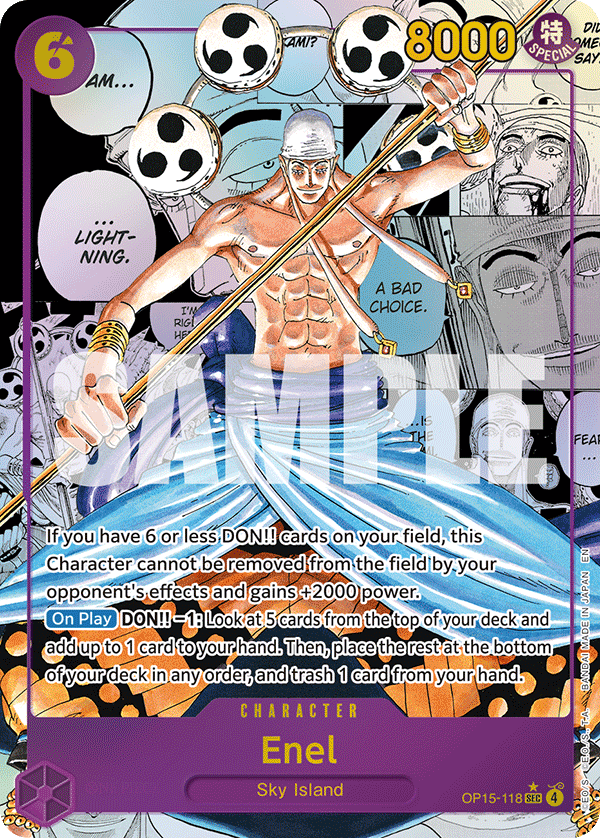
To appreciate why this is such a big deal, it helps to know that DON!! decks aren't normally something you build or interact with at all — for the overwhelming majority of leaders, the DON!! deck is just a fixed pile you draw from mechanically, with no deckbuilding decisions attached to it. Enel throws that out. His ability explicitly shrinks his DON!! deck to 6 cards and then gives him a repeatable way to reach into it, activate part of it, and redirect it toward whatever Character he wants to turn into a threat that turn. That's a real, distinctive mechanic in the current card pool, not a minor variant on something other leaders already do.
The practical effect is that Enel decks aren't trying to win through wide boards or a dozen small attackers pecking away at your opponent's Life. They're trying to funnel resources into one Character until that Character is powerful enough to punch through blockers and counters on its own. If you've read about "go-tall" or single-threat strategies in other trading card games, this is the One Piece TCG version of that idea, and it changes what you're looking for when you evaluate cards for the deck — a topic we cover in more general terms in our first competitive deck guide, which is a good primer if this is your first time building around a resource-manipulation leader rather than a straightforward stat-and-keyword one.
How Purple Enel Compares to Green Mihawk and Luffy
Enel isn't playing in a vacuum. As covered above, Luffy sits essentially even with him at the top of the decklist counts (again, by submission volume, not a win-rate stat), with Mihawk close behind in the next tier — all three are established, well-supported leaders in their own right. Mihawk in particular has a dedicated budget-focused build already covered in our Green Mihawk budget deck guide, and it's a useful comparison point precisely because the two leaders reward very different approaches to a game. Where Enel is about concentrating DON!! into a single overwhelming Character, Mihawk-style Green strategies in this format tend to lean on a more conventional board-and-tempo plan.
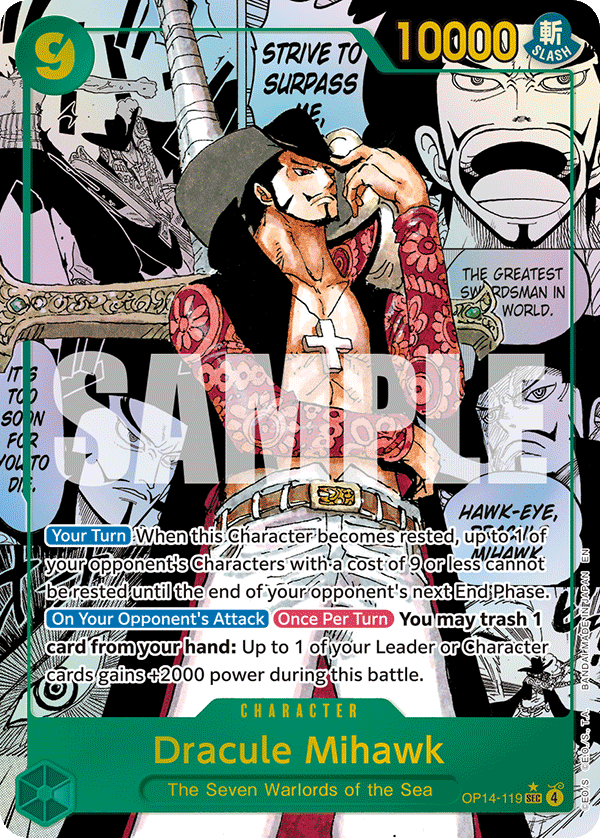
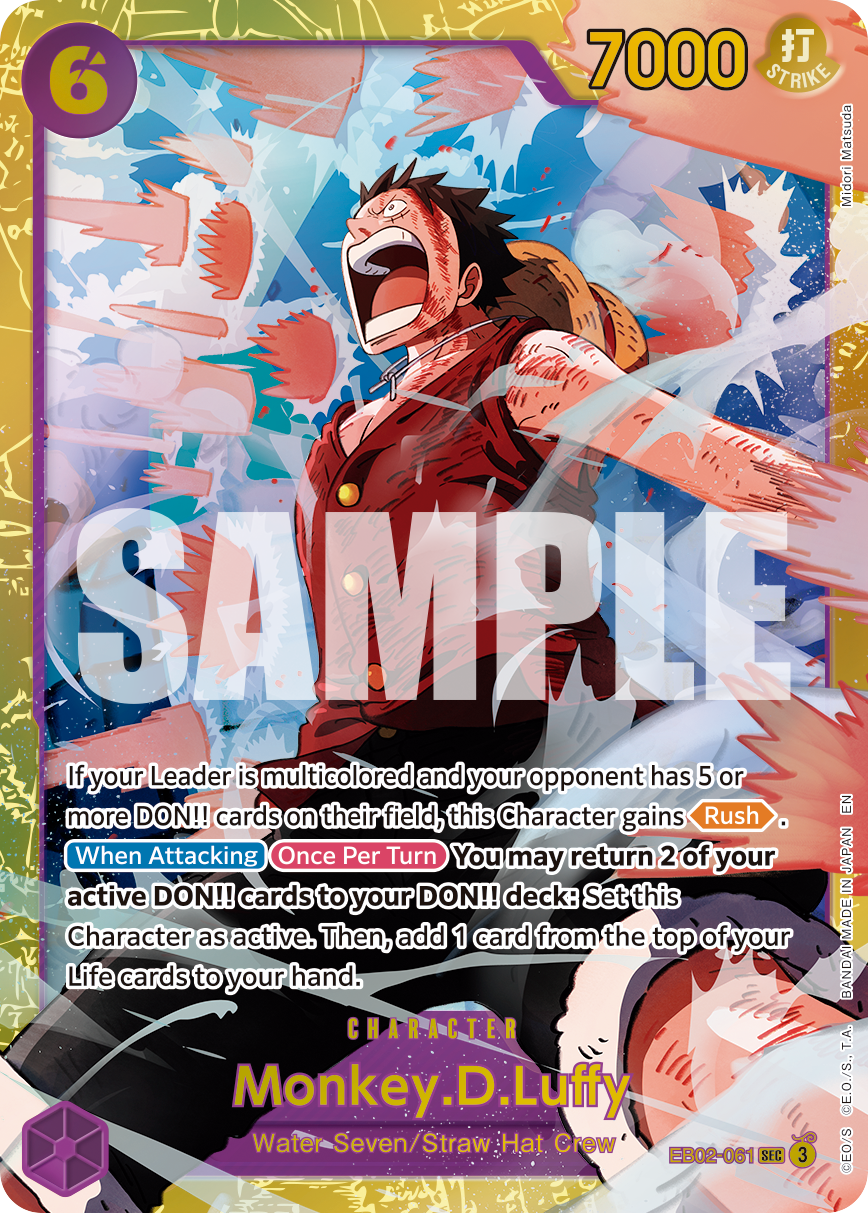
That rough ordering — Enel and Luffy at the front, Mihawk close behind — is a reasonable proxy for "these are the three archetypes the format is currently built around." That doesn't mean every other leader is unplayable, and it doesn't mean this ranking is fixed — decklist counts shift as new sets release and as players react to what's winning locally. But if you're deciding what to build next and you want a leader with genuine staying power and a deep enough player base that you'll always find matchup information and sleeved decklists to learn from, starting your comparison with these three is the sensible move. Our meta tier list keeps a running view of how these rankings move over time, so it's worth checking back there rather than treating any single snapshot as permanent.
Building a Purple Enel Deck: What the Ability Rewards
We're not going to hand you a fabricated 60-card list here — a specific decklist with names and counts attached deserves to be built from confirmed tournament results and current pricing, not guesswork, and we'd rather point you toward that kind of verified list once it exists than invent one that looks precise but isn't. What we can do is walk through what Enel's ability actually rewards, so you know what to look for as you build or evaluate a list yourself.
First, the ability is explicitly about pushing DON!! onto one Character, up to 4 rested DON!! cards per activation. That means the deck wants Characters whose power or effects scale well when they're sitting under a large pile of DON!!, and it wants enough of them that your opponent can't simply remove your one obvious target and shut the plan down. Second, because the ability only turns on "if it is your second turn or later," the deck needs a way to survive its first couple of turns without falling behind on board, since the DON!! engine isn't contributing anything on turn one. That usually means valuing early defensive tools and efficient blockers more than a deck that's already ramping from turn one would. Third, because you're committing a lot of DON!! to a single Character each turn, the deck is naturally light on DON!! for other uses that same turn — Life-cost triggers, counters, and other Character abilities that also want DON!! — so sequencing and knowing when to activate the ability versus hold back becomes a real skill question rather than an automatic play. If you want a broader framework for thinking through those kinds of resource tradeoffs before you commit real money to a build, our first competitive deck guide is the right starting point, and our rarity and chase card guide will help you tell which pieces of a list are worth prioritizing when your budget is limited.
Strengths and Weaknesses to Know Before You Build
The clearest strength here is inevitability. A leader that can repeatedly generate extra DON!! from its own dedicated 6-card pool and direct it at a single threat, every turn from turn two onward, is going to keep producing bigger and bigger swings as the game goes long. If your opponent doesn't have an answer for the Character currently holding all that DON!!, the game can get out of hand quickly. The DON!! deck manipulation is also a mechanic that's genuinely uncommon in the current card pool, which means opponents who haven't played against Enel specifically may not immediately understand how much power is coming their way or how to time their removal around it.
The honest weaknesses are just as clear once you read the ability text closely. The turn-one dead zone is real — "if it is your second turn or later" is not a minor caveat, it's a hard gate on when the engine turns on, and a deck that can't do anything with its signature mechanic until turn two needs to be built with that gap in mind. Concentrating resources onto a single Character also creates a single point of failure: removal, action-cards, or any effect that neutralizes your one loaded-up threat can undo an entire turn's worth of DON!! investment in one move, which is a real risk any opponent scouting this leader will be looking to exploit. And because we don't have confirmed matchup data or tournament win rates for this leader yet — only the decklist-frequency count — it's worth treating "most-played" and "best" as related but different claims. A leader can be the most popular build in the format because it's powerful, because it's flashy, or simply because it was recently spotlighted; decklist volume alone doesn't settle which of those is driving Enel's numbers.
Where to Buy Cards and Gear for This Deck
Because Enel comes from OP-15 rather than the current newest release, chasing him and his supporting cast usually means shopping singles rather than cracking the latest boxes. That said, it's still worth knowing what's actually on shelves right now before you decide where your budget goes — our breakdown of what to buy from the current OP17 release is a good gut check on whether newer product is worth mixing into your plans alongside older-set singles.
If you're newer to the game and deciding whether to start from a preconstructed starter rather than building from scratch, our starter deck rankings and our dedicated best starter deck for beginners guide are both worth a look before you commit to singles-hunting for a leader this mechanically involved. And whatever direction you go, don't skip protection — a deck you're planning to sleeve up and actually pilot in local events deserves real card protection, which is exactly what our sleeves, deck boxes, and playmats guide walks through.
Is Purple Enel Worth Building Right Now?
If you're looking for a leader with a real mechanical identity, current relevance backed by actual decklist numbers, and enough of a player base that you'll never be short on opponents or matchup experience, Enel earns his current popularity. A leader that can repeatedly reach into a customized DON!! deck and stack a threat higher than almost anything else in the format has genuine staying power, and holding that spot near the top of the decklist counts (as covered above) in a card pool this size is not a small thing.
That said, this isn't a leader to pick up purely because the numbers look good on paper. The turn-one gap and the single-point-of-failure risk are real design tradeoffs, not minor footnotes, and they'll shape every game you play with this deck. If you're already tracking your collection's value as you build toward a leader like this, our collection value guide and our roundup of the most valuable One Piece cards right now are both worth bookmarking as you decide how much of your budget this particular leader deserves.
Enel earns its spot at the top through mechanics, not hype
Purple Enel's run to the top of the format's decklist counts comes from a genuinely unusual ability, not marketing: a customizable 6-card DON!! deck that lets you generate and redirect extra DON!! onto a single Character every turn from turn two on. Weigh the real tradeoffs (a dead first turn, a single-target risk) against that upside before you commit, and keep an eye on Luffy and Green Mihawk as the format's other proven top-tier options.