

Hit fast, hit cheap, and force the game to end before your opponent can ramp into theirs. The breakout aggro archetype — built from a single starter.
Some links below are affiliate links. If you buy through them, Geeky Domain may earn a small commission at no extra cost to you. We only recommend cards and products we believe offer real value to players.
Blue/Red Aegis Aggro is the breakout aggro archetype of the format — the deck that took first, second, and fourth at a recent major regional after barely registering before. Aggro decks are usually transparent and easy to play around once people learn the matchup, but Aegis sidesteps that by pairing Red's aggressive bodies with Blue's draw and tempo tools. The result is a deck that hits hard, refills its hand, and applies pressure on a clock the slower decks in the format can't match.
The best news for a budget builder: the deck's spine sits inside the ST04 "SEED Strike" starter — an officially White/Red starter that includes the entire Aegis Gundam + Athrun Zala Link Unit package. Strip the White, swap in cheap Blue commons for the draw engine, and you have a functional Blue/Red Aegis shell for the price of a starter and a handful of singles. The chase cards from GD01–GD02 are upgrades, not requirements.
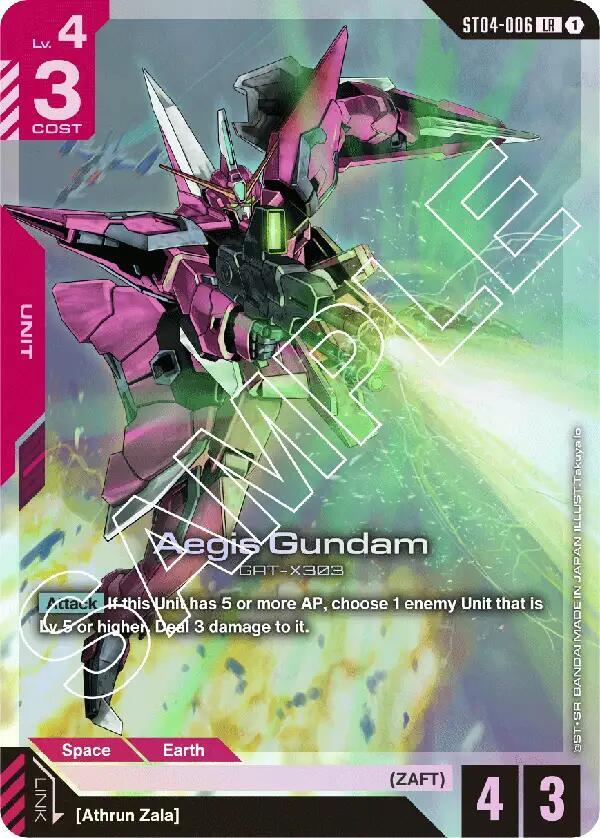
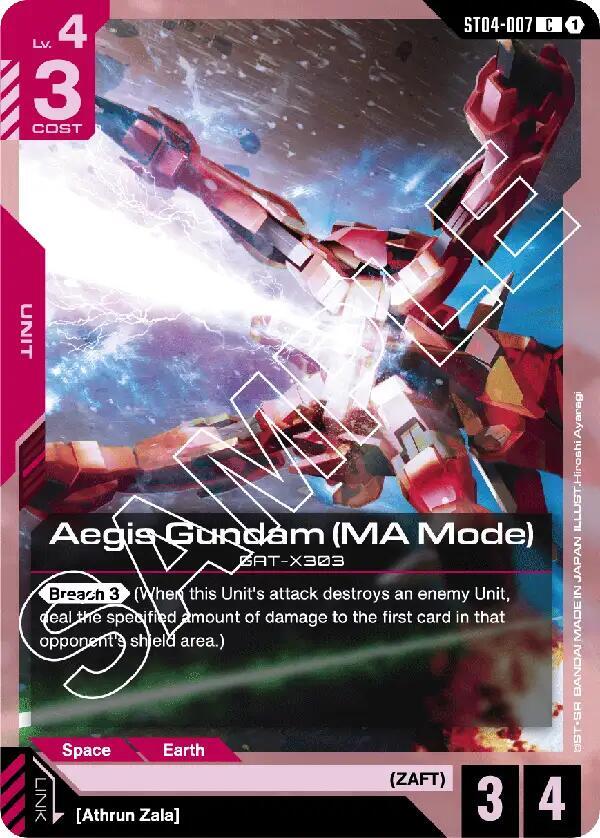
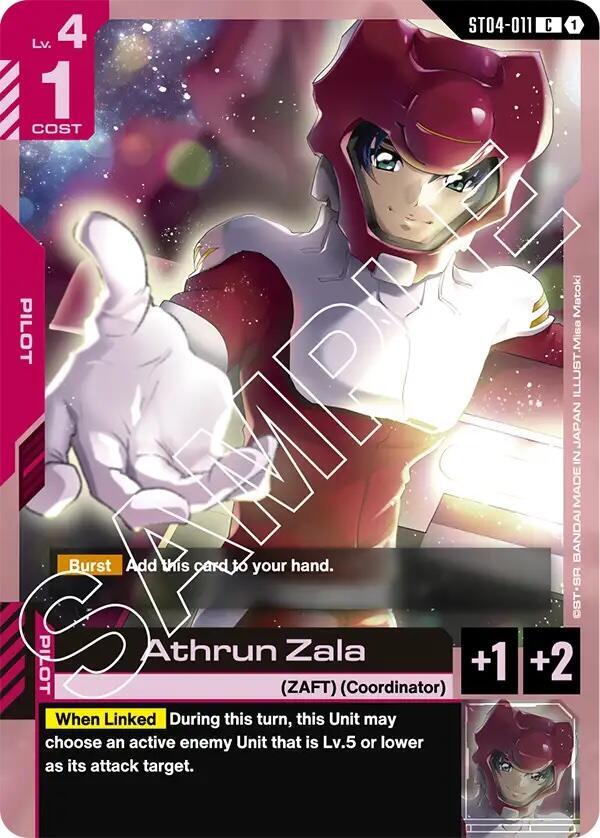
This guide covers how aggro actually wins, the cheap Aegis-and-Blue core that powers the budget shell, the honest weakness every aggro deck lives with, the piloting habits that separate good aggro from bad, and the upgrade path toward a full tournament list. No fabricated cards, no chase-rare paywall disguised as a budget deck.
→ Short Version
Blue/Red Aegis Aggro is the breakout aggro deck of the format — tier two but with real upside. Start from the ST04 "SEED Strike" starter for the Red half: it contains Aegis Gundam, the MA Mode variant, and Athrun Zala for the Link Unit. Replace the starter's White cards with cheap Blue draw and tempo commons. The shell costs a starter plus a stack of singles; premium top-end like Gundam Virsago is an upgrade, not a requirement. The honest catch: aggro decks lose to good defensive blockers and any deck that stabilizes after turn five. Win or lose, you'll know by turn six.
→ More Reading
In This Guide
The Game Plan: Force a Six-Turn Game
Every aggro deck in every card game has the same job: end the game before the opponent's deck reaches the point where it's better than yours. Blue/Red Aegis Aggro is no exception. Red supplies the aggressive bodies and the keywords (Breach, High-Maneuver) that punch through blockers. Blue supplies the draw and tempo tools that keep the pressure unbroken — the difference between an aggro deck that stalls on turn four with an empty hand and one that keeps the pressure on through turn six.
The win condition is straightforward: damage every turn, starting on turn one, with as many simultaneous threats as possible. The opponent's Shields are a clock. You're racing that clock against their setup turns — their Bases, their ramp, their late-game payoffs. If you get them to zero Shields before they stabilize, you win. If they stabilize first, you almost certainly lose. There is very little in between, and the cleanest aggro players are the ones who accept that and play accordingly.
The Core Idea
Aggro doesn't ask "how do I survive this turn?" It asks "how do I deal damage this turn?" — and trusts that if it keeps answering that question correctly, the game ends before survival matters. Card advantage and board control are luxuries you spend Shields to skip; you're trading durability for tempo, and tempo is what wins the game.
The Aggro Damage Clock
Cumulative pressure by turn — what aggro stacks on the opponent before they can stabilize:
Illustrative figures — exact damage depends on blockers and Shield Burst draws. The point is the slope: if you're still applying pressure on turn five, most decks haven't stabilized yet. Stop applying pressure for a single turn, and the slope flattens out exactly where they want it to.
The Three Phases of an Aggro Game
An aggro game has a sharp rhythm. Each phase asks for exactly one thing, and switching phases at the wrong time is the most common way the deck loses winnable games.
From Opening Salvo to Lethal Window
The most common new-player mistake is treating the mid-game like a stabilization phase, trading Units instead of attacking Shields. Aggro doesn't stabilize. Aggro presses. If you stop pressing, the opponent draws back into the game, and the deck you brought isn't built for that game.
The Cheap Core: ST04 + Blue Singles
The cheapest path into Aegis Aggro is one copy of the ST04 "SEED Strike" starter, which contains the Red half of the deck — including the Aegis Gundam + Athrun Zala Link package — plus a stack of cheap Blue commons from the GD-set boosters. ST04 is officially a White/Red starter; the White half is what you'll be cutting to make room for Blue. The Red half is exactly what the competitive deck wants.
-
The Aegis Gundam + Athrun Zala Link (from ST04)
The signature Link Unit of the archetype. Aegis Gundam and its MA Mode variant are the deck's mid-game threats, and Athrun Zala is the Pilot that completes the Link Unit pairing. Linked, the Aegis Gundam gains stat bonuses that make it substantially more efficient than the same Unit played plain. The pairing is the named core of the competitive shell and you own all three pieces from a single starter purchase. -
The Red aggressive curve (from ST04 + boosters)
Red's identity is cheap, aggressive bodies and the attacking keywords (Breach, High-Maneuver) that punch damage through blockers. ST04 supplies the curve from Level 1 up through Aegis at Level 4; cheap Red commons from GD01 and GD02 fill out the playsets. This is the Red half — the damage half — and almost every piece of it is a common. -
A Blue tempo shell (from cheap singles)
This is what you build around the ST04 base. Blue brings cheap draw Commands that refill your hand mid-attack — the difference between aggro that stalls and aggro that finishes — and the tempo tools (resting and bouncing) that punch holes in defensive boards. Blue commons from GD01–GD04 are inexpensive on singles marketplaces; you don't need any chase rares to build a functional version.
Chase Cards Are Optional — At First
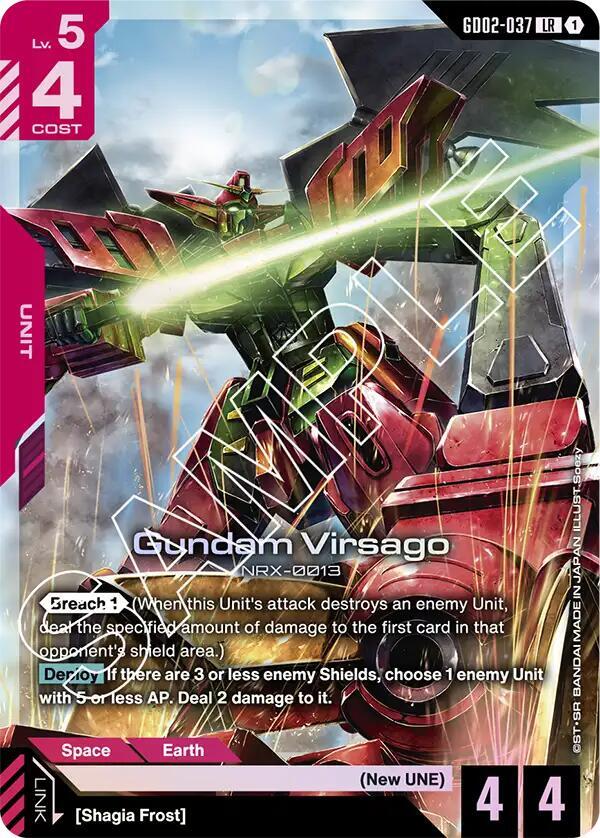
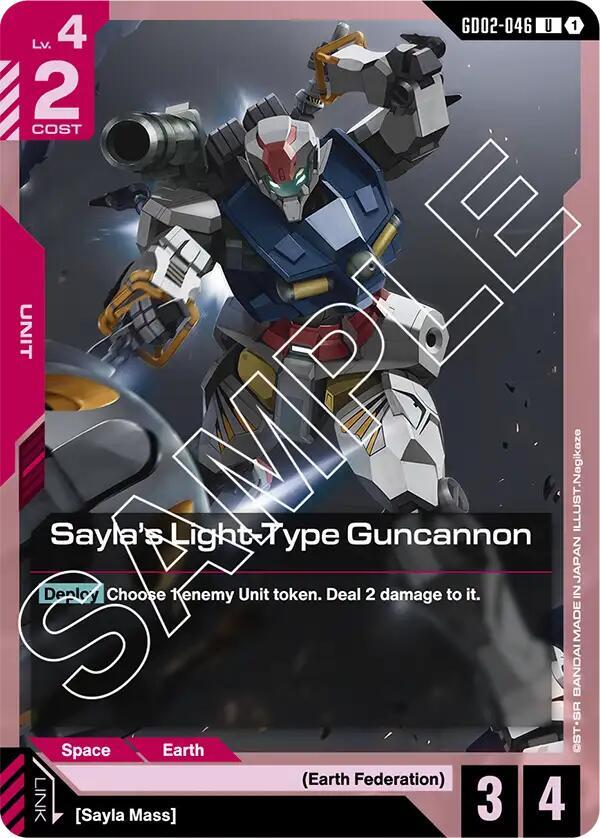
The competitive tournament lists top out with premium threats like Gundam Virsago (GD02-037) — a Legend Rare that deploys at Lv.5 for cost 4 with 4 AP / 4 HP and Breach 1 — alongside cheap GD02 filler such as Sayla's Light-Type Guncannon (GD02-046), an uncommon Lv.3 body whose Deploy only pings an enemy Unit token. Neither is a requirement. The deck functions on the ST04 Aegis package plus Blue draw — the Tier 2 build was designed around that exact spine. Save the chase rares for after you've learned the matchups and want to push toward a full tournament list.
The Honest Weakness: Stabilizing Blockers
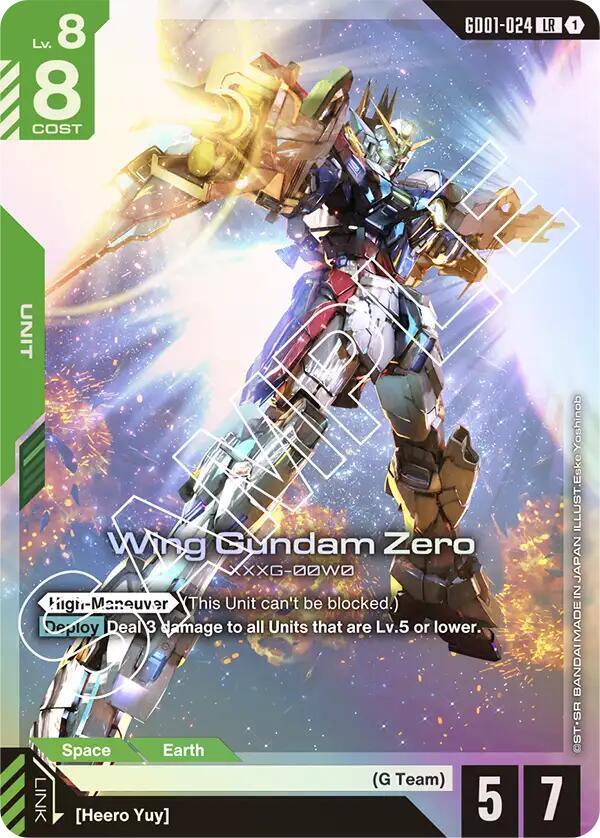
Every aggro deck in every card game lives with the same fundamental weakness: any opponent who reaches turn six with their game plan intact is now playing a deck better than yours. Aegis Aggro is no exception. Green/White Wing Zero — the format's top ramp deck — and the various Blue/White control builds are designed specifically to outlast aggressive starts. Against a defensive pilot who knows what they're doing, you'll occasionally lose to a wall of high-HP blockers no matter how perfectly you play.
This is the price of the deck's power ceiling. A well-piloted aggro deck beats anything that opens slow; a poorly piloted one loses to anything that opens with a Base and a blocker. The good news is that the matchup spread is favorable against most of the format — midrange, slow combo, and starter-deck builds all get rolled by an aggressive start — and even the bad matchups are winnable when the opponent's draw isn't perfect. You're trading a small handful of hard matchups for fast, decisive games against everything else.
Two skills carry most of the weight against defensive decks, and both have dedicated guides worth reading: knowing the exact outcome of a fight before you commit (our combat math guide), and reading Shield Burst triggers — the cards your opponent might be revealing as you swing into their Shields. Aggro decks win the games where they correctly read which attacks are safe and which aren't.
Piloting: Pressure Over Trades
A few habits separate a winning Aegis pilot from one whose pressure stalls out:
-
Mulligan for a one-drop, every time.
An opening hand without a turn-one Unit is an opening hand that doesn't apply pressure on turn one. The whole deck's clock starts late if you can't deploy on the first turn. Ship any hand without a Level 1 or Level 2 Red Unit. Our mulligan guide covers the redraw decision. -
Attack Shields, not Units.
Trading your aggressive bodies for their blockers feels productive but it isn't — you're not racing their Units, you're racing their Shields. Swing at Shields unless the trade kills a blocker that would otherwise stop a kill swing. Combat math, not instinct. -
Cast Blue draw mid-attack.
Blue's draw Commands are what stop an aggro deck from running out of fuel on turn four. Cast them aggressively — you want to be the player with more threats every single turn. A drawn-out hand is how aggro loses to mid-game stabilization. -
Find lethal, don't wait for it.
The cleanest aggro players win one turn earlier than other players would. The moment the math gives you lethal — even a fragile lethal that requires a Shield Burst to not whiff — take it. The opponent's next draw step is the most dangerous thing in the game; don't let them have one if you don't have to.
Matchup Snapshot
Versus ramp (Green/White Wing Zero, Green/Blue): the favorable matchup. Their first two turns are spent ramping instead of defending — that's your damage window. Mulligan for a fast hand and punish the setup turns. If you reach turn four with them under five Shields, they're in serious trouble. If they stabilize on a White wall, the game tilts the other way.
Versus control (Blue/White, Banshee Norn): the hard matchup. Their durable blockers and healing are explicitly designed to outlast aggressive starts. Don't trade Units — attack Shields exclusively and trust the clock. Win the games where you draw a fast curve; lose the games where you don't. The matchup spread is closer than it looks if you play it correctly.
Versus other aggro (Red/Green Zeon Rush): the coin-flip matchup. Both decks have the same plan, so the game comes down to who lands more damage per turn. The Aegis Link Unit is the differentiator — once it comes down, your damage curve outpaces theirs. Play to the Link.
The Upgrade Path: Shell to Tournament List
The cheapest entry is one ST04 starter plus a stack of Blue commons. From there, the upgrades that move you toward the Tier 2 tournament list, in priority order:
- 1. Playsets of your best draw and one-drops. Extra copies of the cheap Blue draw Commands and the strongest Level 1–2 Red Units are the biggest consistency gains. The deck wants a turn-one play in every opening hand — playsets make that happen.
- 2. A second Pilot for the Link redundancy. Additional copies of Athrun Zala (or Athrun-compatible Pilots) make the Aegis Link Unit show up consistently, not just when the one copy comes off the top.
-
3. Premium top-end (Gundam Virsago), plus cheap GD02 Red filler. Gundam Virsago is the real finisher out of GD02 Dual Impact: a Legend Rare that deploys at Lv.5 for cost 4 with 4 AP / 4 HP and Breach 1, so killing a blocker still burns a Shield. Sayla's Light-Type Guncannon (GD02-046) is the opposite kind of pickup — an uncommon Lv.3 / cost 4 body at 3 AP / 4 HP whose Deploy only hits an enemy Unit token for 2, so treat it as inexpensive curve filler rather than a finisher. The top-end is what pushes the deck from "functional Tier 2" to "exactly the Tier 2 list that won Orlando."
- 4. Tournament-grade tuning. Once the core is finished, the optimization is the most efficient Blue interaction Commands from the latest sets and Pilot redundancy for both Link colors. This is where the actual tournament list pulls ahead of the budget shell.
Why This Deck Right Now
Aegis Aggro is the format's newest Tier 2 archetype — the deck most opponents haven't fully learned how to play against yet. That window of unfamiliarity is a real edge on top of the deck's raw power; you'll catch opponents trading Units when they should be defending Shields, holding blockers when they should be deploying them. Build now and you're playing a deck on the rise rather than one the meta has already adapted to.
Where to Buy
Aegis Aggro's budget shell starts with the ST04 "SEED Strike" starter for the Red half and cheap Blue commons from singles marketplaces. Save Gundam Virsago and the other GD02 premium top-end for last — the deck plays without them. These searches are a good starting point; compare current listings before you commit, since prices move with new set releases.
Shop the ST04 SEED Strike Starter on Amazon Search Aegis Gundam & Blue Singles on TCGplayer Browse Aegis & Blue Singles on eBayPrices move with new set releases, so check current listings before buying playsets. For a deck built on a starter plus cheap singles, marketplaces almost always beat chasing cards in sealed product.
Hit Before They Land.
Blue/Red Aegis Aggro is the format's breakout archetype, and the entire core spine sits in a single sub-$20 starter. The ST04 "SEED Strike" deck gives you the Aegis Gundam + Athrun Zala Link package — the named centerpiece of the competitive shell — and cheap Blue commons finish the build. The Tier 2 tournament list is mostly the same deck with a handful of premium GD02 support cards layered on top; you can start playing the archetype today and upgrade in the order that matches your budget.
Press from turn one, refill mid-attack, and find lethal one turn earlier than feels comfortable. The cleanest aggro players win the games where everyone else would have traded. This is the deck to learn that on.
Build Your Gundam Arsenal:
© GEEKYDOMAIN.COM | Strategy Powered by Data