

Mega Chandelure ex Deck Guide: Pitch Black's Retreat-Cost Punisher
A two-card combo that taxes your opponent's retreat cost, then charges them extra damage for it.
Some links below are affiliate links. If you buy through them, Geeky Domain may earn a small commission at no extra cost to you.
→ Short Version
Mega Chandelure ex is one of the headline pulls from Pitch Black (released July 17, 2026), and its two card-text abilities are built to work together on purpose. The ability Binding Flame taxes your opponent's Active Pokémon's Retreat Cost by one Colorless energy, and the attack Phantom Maze deals 130 damage plus 50 more for every Colorless in that same Retreat Cost — meaning the ability directly inflates the number the attack scales off of. It's printed across Double Rare, Ultra Rare, and Special Illustration Rare printings. This isn't a generic attacker; it's a lock-and-punish piece that wants your opponent stuck behind a single expensive-to-retreat threat.
Pitch Black landed on July 17, 2026, and if you've cracked even a handful of packs from it — or just watched the pull videos — you've probably already seen the card everyone's asking about. We covered the set as a whole in our Pitch Black set buying guide, but Mega Chandelure ex deserves its own breakdown, because unlike a lot of "big number on a Pokémon card" pulls, this one has a genuinely clever piece of design behind it. Two separate pieces of card text were clearly written to interact with each other, and once you see how, the deck-building direction more or less writes itself.
This guide walks through what that combo does, what the card looks like across rarities, and how to think about building around it — without pretending we have a finished 60-card list or tournament win rates to hand you, because we don't. What we do have is the card's ability and attack text, per card database records, and that's enough to explain why this Pokémon is worth understanding even if you never play a single game with it.
It's also worth saying up front why this matters beyond one card. Pitch Black is a new set, which means the community's read on it is still forming in real time — pull videos and early hot takes move faster than verified information does. Our approach here is to stick to what's actually printed on the card and what can be reasonably reasoned out from that text, rather than repeating secondhand claims about win rates or decklists that nobody has actually verified yet. That's a slower way to write about a new set, but it's the only way to write about one accurately this early.
In This Guide
- → What Is Mega Chandelure ex, and Why Is Everyone Talking About It
- → The Combo Explained: How Binding Flame Powers Phantom Maze
- → Rarities, Print Runs, and What You're Actually Pulling
- → Building a Deck Around the Retreat-Cost Lock
- → What This Deck Wants to Play Against (and What Gives It Trouble)
- → Collecting Considerations: Should You Chase This Card in Pitch Black
→ Related Reading
What Is Mega Chandelure ex, and Why Is Everyone Talking About It
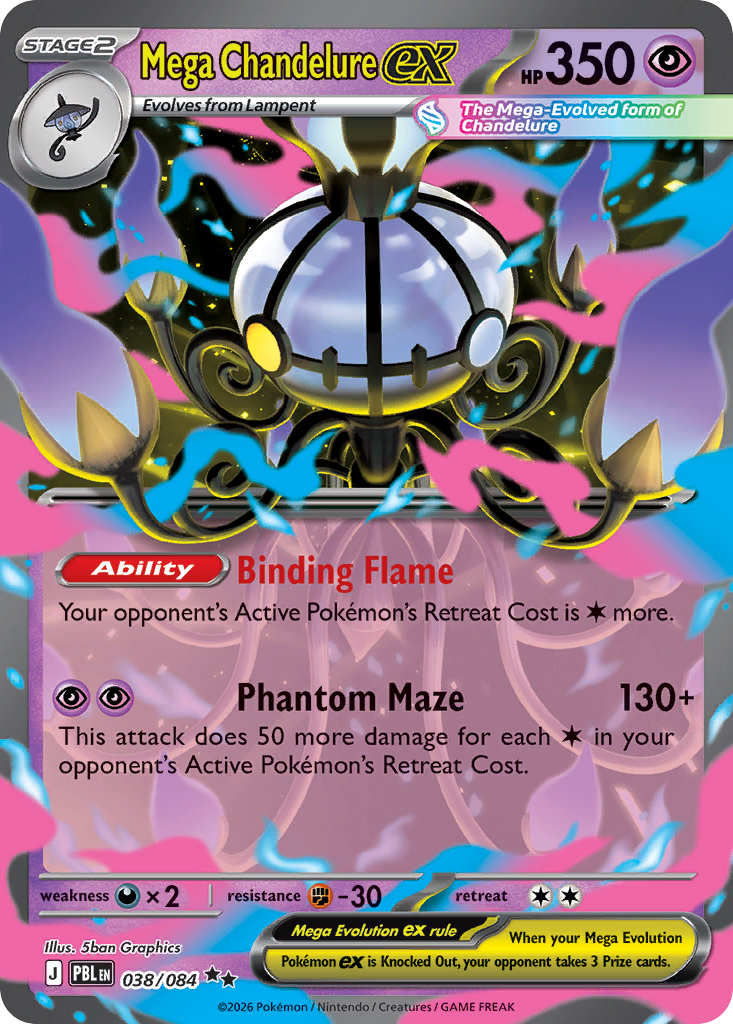
Mega Chandelure ex is a real card released in Pitch Black, and it carries two pieces of card text that were clearly designed as a matched set rather than two unrelated lines of flavor. Its attack, Phantom Maze, runs on a two-Psychic energy cost, which points to this being a Psychic-type attacker in practice. The ability is called Binding Flame, and here's its wording: "Your opponent's Active Pokémon's Retreat Cost is Colorless more." (Exact wording as recorded in the Pokemon TCG API (pokemontcg.io) — the phrasing reads a little unusual, but that's how it's printed.) Phantom Maze itself does 130 damage as its base, with an additional effect that reads: "This attack does 50 more damage for each Colorless in your opponent's Active Pokémon's Retreat Cost."
If you're newer to the game and those two terms — Retreat Cost and Colorless — aren't second nature yet, our Pokémon TCG glossary walks through exactly what they mean and how they show up on a card. The short version: Retreat Cost is the number of energy cards (shown as Colorless energy symbols) you have to discard to swap your Active Pokémon out for one on your bench, and it's normally a fixed, printed number that doesn't change unless something on the battlefield says otherwise. Mega Chandelure ex is one of those "something else says otherwise" cards, and that's the whole point.
The Combo Explained: How Binding Flame Powers Phantom Maze
Here's the interaction in plain terms. Binding Flame is an ability, not an attack, which in Pokémon TCG design terms generally means it does its work automatically simply by being on the battlefield rather than requiring you to spend a turn using it — you're not choosing to activate it each turn, it's just true as long as Mega Chandelure ex is in play. What it does is add one Colorless energy to whatever your opponent's Active Pokémon's Retreat Cost already is. A Pokémon that would normally cost one energy to retreat now costs two. One that normally costs two now costs three.
Phantom Maze then reads that exact same number back as damage. The attack's base is 130, and it adds 50 more damage for every Colorless in the opponent's Active Pokémon's Retreat Cost — after Binding Flame has already inflated it. So using purely illustrative numbers to show how the formula scales: if the opponent's Active Pokémon has a Retreat Cost of 1 before the tax, Binding Flame pushes it to 2, and Phantom Maze deals 130 plus 100, for 230 damage. If the Retreat Cost was already 2 before the tax, Binding Flame pushes it to 3, and the attack deals 130 plus 150, for 280 damage. The ability isn't just annoying utility on the side — it's a direct damage multiplier for the deck's main attack, and the higher the opponent's Pokémon's retreat cost already runs, the harder this card punishes them for it.
That's the elegant part of the design: Mega Chandelure ex doesn't just want any Active Pokémon across from it, it specifically wants a big, awkward, expensive-to-retreat Active Pokémon — the kind of card a deck often can't afford to bench once it's already committed energy and setup to it. Trap that kind of threat in the Active slot, and Phantom Maze turns it into a countdown clock. If you want the fuller rulebook context on how retreating, Active slots, and ability timing actually function turn to turn, our complete rules guide covers the mechanics this combo is built on top of.
It's worth sitting with why this specific pairing feels different from a generic "big attacker" card. A lot of high-damage attacks in the Pokémon TCG scale off something the attacking player controls — energy attached, cards in the discard pile, Prize cards taken. Phantom Maze instead scales off a number that belongs to the opponent's Pokémon, and Binding Flame exists purely to make that number bigger before the attack ever reads it. Neither piece of text does much of anything in isolation. Binding Flame alone is a mild annoyance that slows an opponent's retreating. Phantom Maze alone would still hit reasonably hard, but nowhere near as hard without something inflating the number it keys off of. Put the two on the same card, and the ability becomes the setup for the attack's own damage formula — that's the whole reason this card is getting attention beyond just being a shiny new pull.
Rarities, Print Runs, and What You're Actually Pulling
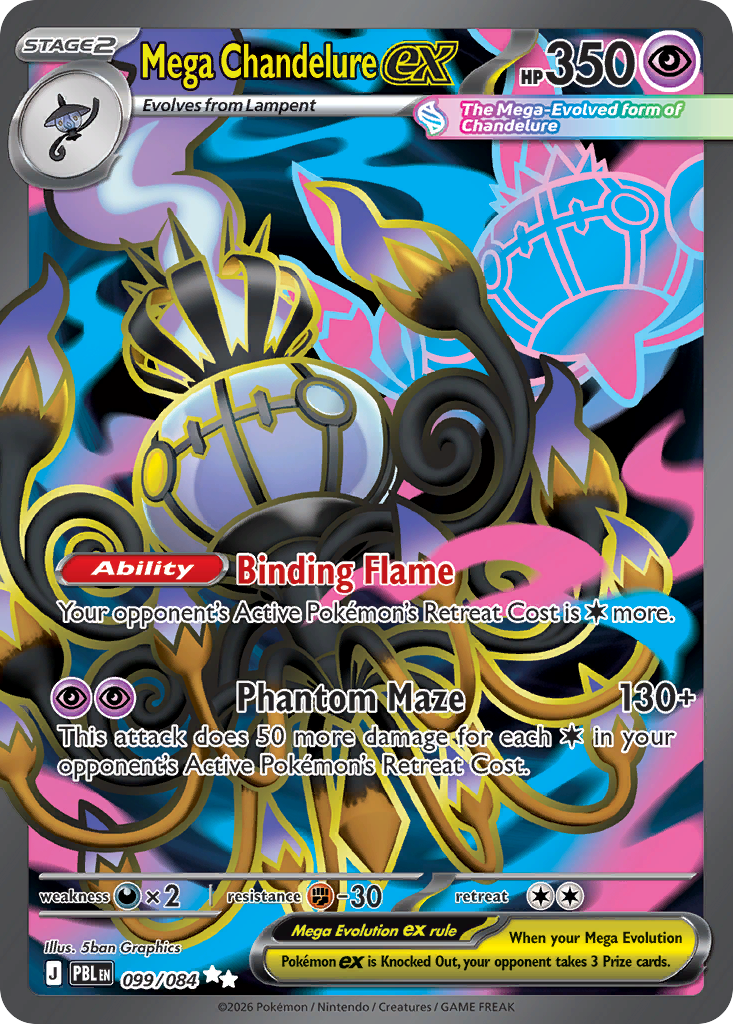
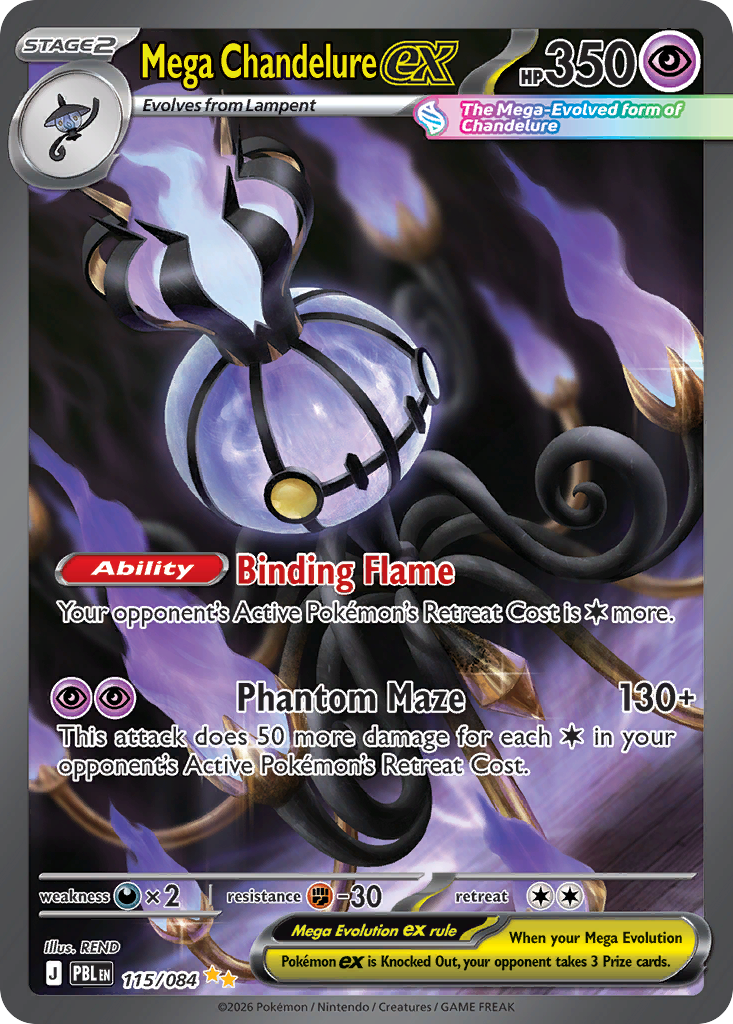
Mega Chandelure ex is available across at least three rarity tiers in Pitch Black: Double Rare, Ultra Rare, and Special Illustration Rare. That spread is fairly typical of how recent sets have handled their headline ex-Pokémon — a more common, playable-copy version aimed at people who just want the card for a deck, alongside progressively rarer alternate-art and full-art treatments aimed at collectors chasing the nicest possible copy. If you're not sure how those rarity tiers stack up against each other or which one is realistically worth chasing versus which one is worth just buying as a single, our pull rates and finance guide is the place to start.
We don't have exact per-box pull-rate percentages to hand you here, and we'd rather say that plainly than make up a number that sounds authoritative. What we can say with confidence is that a card sitting at Special Illustration Rare in a set this new, with a combo this easy to explain in a thirty-second pull video, is going to be one of the more heavily chased singles out of Pitch Black — which affects both how hard it is to find and what it costs if you'd rather skip the packs and just buy the card you want.
Building a Deck Around the Retreat-Cost Lock
We're not going to hand you a finished 60-card list here — we don't have one to verify, and inventing specific support cards or exact counts would be doing you a disservice. What we can walk through is how the combo itself should shape your deck-building priorities, which is genuinely useful even before a settled competitive list exists. If you've never built a deck from scratch before, it's worth reading our guide to building your first competitive deck alongside this section, since the general principles apply here too.
Phantom Maze's energy cost — two Psychic — is genuinely cheap for an attack that can realistically clear 200-plus damage once Binding Flame is doing its job. That means this deck isn't desperate for heavy energy acceleration the way some big-attack strategies are; the harder problem to solve is consistency getting Mega Chandelure ex itself online and into the Active slot as early as possible, since neither piece of the combo does anything from the bench. As with any Mega Evolution Pokémon, you'll want to build your evolution line and setup speed around getting it there reliably — our rules guide is worth checking for the current mechanics around how Mega Evolution works turn to turn, since that's foundational to how fast this deck can actually come online.
Once it's set up, the deck's other priority is protecting that Active-slot commitment. Binding Flame and Phantom Maze both lose their teeth the moment your opponent finds a way to get their threatened Pokémon out of the Active slot without paying the inflated retreat cost — whether that's a free switch effect, a healing-and-retreat combo, or simply knocking Mega Chandelure ex out before it gets a swing in. Building in resilience around keeping your own Active Pokémon in place, and disruption that discourages your opponent from finding a cheap way out, matters just as much as the raw damage math.
None of this requires a radically different deck-building approach than any other attacker-focused strategy in the current format — the fundamentals of consistency, draw support, and having a plan for your opponent's disruption still apply the same way they do everywhere else. What's different here is what you're optimizing toward: most attackers just want more energy or more damage modifiers, while this one wants you to think about the opponent's board state as much as your own, since the size of the punishment is quite literally read off their card, not yours.
What This Deck Wants to Play Against (and What Gives It Trouble)
We don't have confirmed matchup win rates to share, and this early into a set's life, anyone claiming to have solved the metagame around a card this new should be treated with some skepticism. What we can talk about is archetype logic rather than specific results. Mega Chandelure ex is built to punish decks whose game plan revolves around a single large attacker that's already awkward to retreat — the kind of Pokémon that costs a lot to set up and that its own pilot doesn't want to bench. The more a deck's strategy depends on one big threat staying Active turn after turn, the harder Binding Flame and Phantom Maze work against it.
Conversely, decks built around cheap, easily-swapped attackers, or ones that rotate multiple low-retreat-cost Pokémon through the Active slot, give this combo less to work with — a Retreat Cost of zero taxed up to one Colorless is a much smaller damage swing than taxing an already-expensive threat. Mega Chandelure ex isn't confirmed to be a format-defining answer to any specific deck currently sitting at the top of competitive play, including whatever's dominating discussion after Worlds — if you want the current competitive landscape for context on what's actually being played right now, our Worlds 2026 recap and our breakdown of the current Standard rotation are both worth a read before you assume this card slots neatly into any particular matchup.
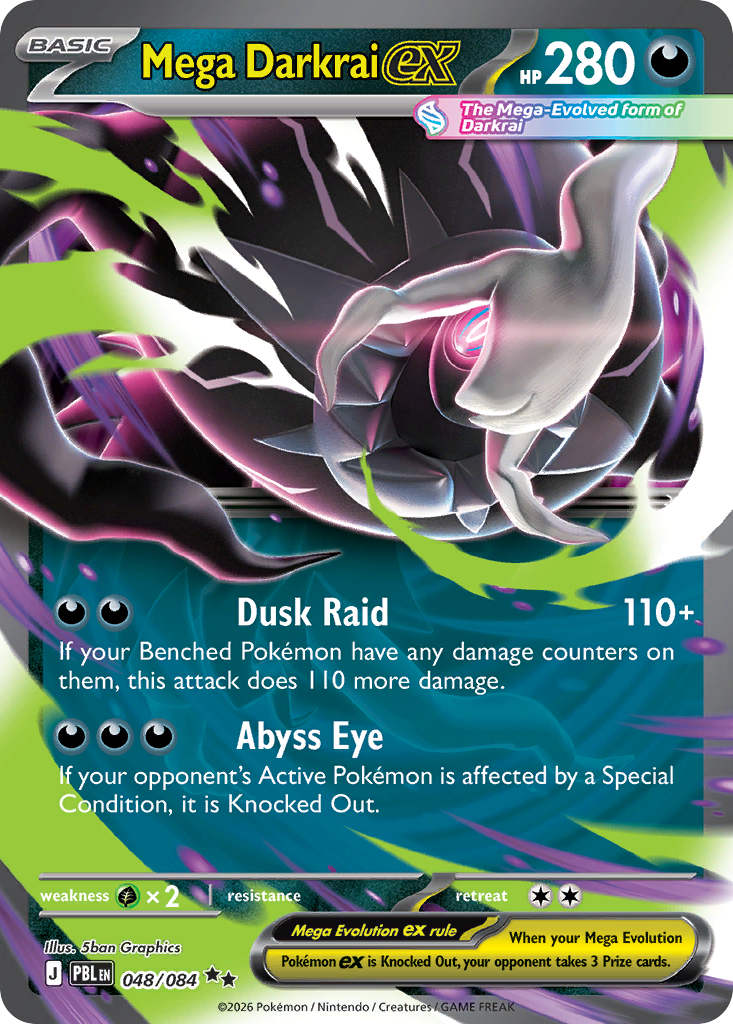
It's also worth noting that Mega Chandelure ex isn't Pitch Black's only headline Mega Evolution — the set's other big pull, Mega Darkrai ex, plays a fundamentally different kind of game, and the two aren't competing for the same deck slot. If you're comparing the set's two marquee Mega ex Pokémon to decide which one better fits how you like to play, our separate Mega Darkrai ex deck guide covers that card's approach in the same amount of detail as this one.
Collecting Considerations: Should You Chase This Card in Pitch Black
Even setting the gameplay combo aside entirely, Mega Chandelure ex is shaping up to be one of the cards collectors specifically ask about from this set, which is worth knowing whether you're opening packs yourself or buying finished product. If you're trying to decide whether it makes more sense to chase this card through boxes or just pick up the printing you want as a single, our ETB versus booster box breakdown walks through that math in more general terms and applies just as well here.
If you do end up pulling — or buying — a copy, especially at the Special Illustration Rare tier, it's worth handling it like the chase card it is from the moment it comes out of the pack. A quality sleeve, a rigid toploader, and eventually a proper storage solution matter a lot more for a card people are actively going to want years from now; our accessories guide covers what's actually worth buying for that. And if you're weighing whether to keep it, play with it, or eventually sell a duplicate, our most valuable modern cards roundup and our guide on how to trade or sell Pokémon cards safely are both worth reading before you move anything.
A combo card first, a chase pull second
Mega Chandelure ex earns its hype honestly — Binding Flame and Phantom Maze are two pieces of card text that were clearly designed to work together, and the math behind that interaction is drawn straight from the card's own printed text, per the Pokemon TCG API (pokemontcg.io), not marketing spin. Whether it becomes a genuine tournament fixture is still an open question the format hasn't answered yet, but as a piece of design and a Pitch Black pull worth understanding, it's earned the attention.