

Mega Darkrai ex Deck Guide: Pitch Black's Special Conditions Powerhouse
How one attack turns Sleep and Poison from stall tactics into knockouts -- and what that means for the card's four rarities and your next Standard build.
Some links below are affiliate links. If you buy through them, Geeky Domain may earn a small commission at no extra cost to you.
→ Short Version
Mega Darkrai ex is the headline attacker out of Pitch Black (released July 17, 2026), and its whole identity is built around Special Conditions: its Abyss Eye attack knocks out any Active Pokemon that's already affected by a Special Condition, which turns Sleep- and Poison-inflicting support into genuine removal instead of a stalling tool. It's printed across four confirmed rarities -- Double Rare, Ultra Rare, Special Illustration Rare, and Mega Hyper Rare -- so your buy-in depends entirely on which version you're after. As a deck, it wants consistent status-inflicting support more than raw damage, and it's arriving into a Standard format that already has established top decks rather than an empty format waiting for it.
→ Related Reading
In This Guide
- → What Mega Darkrai ex Actually Does
- → Why Special Conditions Change the Math
- → The Card's Rarities and What They Mean for Your Wallet
- → Building Around Abyss Eye: What the Deck Wants
- → Where Mega Darkrai ex Fits in the Current Standard Meta
- → Mega Darkrai ex vs. Other Status-Based Strategies
- → Buying Guide: Which Rarity Should You Actually Chase
- → Common Mistakes New Pilots Make
What Mega Darkrai ex Actually Does
When Pitch Black released on July 17, 2026, it did what a lot of headline sets do: it printed one card that the entire release is going to be remembered for. That card is Mega Darkrai ex. It carries the Mega designation the set reintroduces, evolving out of Darkrai the way older Mega Evolution Pokemon have always worked, and like every other ex-mechanic card since the start of the Scarlet & Violet era, an opponent takes extra Prize cards when it goes down. That last part matters more than usual here, because Mega Darkrai ex is built to end games in one specific, unusual way.
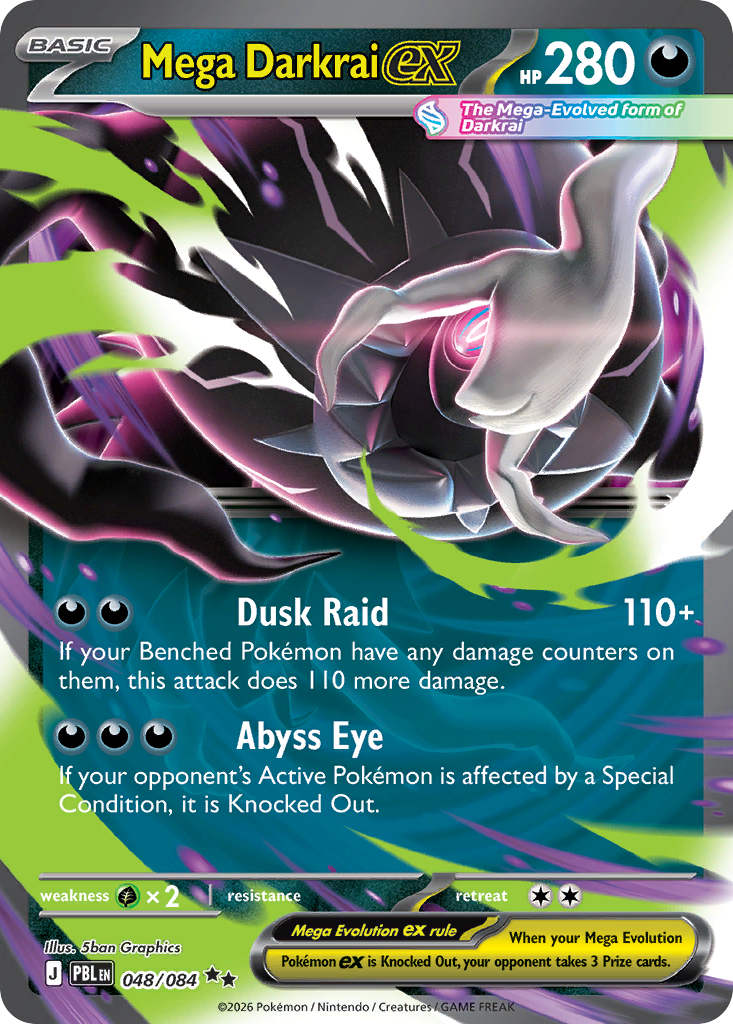
The card's signature attack is Abyss Eye, and its effect is the entire reason people are talking about this card. Abyss Eye knocks out any Active Pokemon that is currently affected by a Special Condition -- Asleep, Poisoned, Paralyzed, Confused, or Burned. We haven't seen the card's verbatim attack text or its exact energy cost, so this guide won't pretend to quote damage numbers or energy requirements it doesn't have confirmed. What's confirmed is the effect itself, and that effect alone is enough to explain why this card reshapes how a deck built around it wants to play.
In practice, that means Mega Darkrai ex isn't a damage-race attacker in the way most Standard-format ex Pokemon are. It's a finisher that depends on setup. If your opponent's Active Pokemon isn't affected by a Special Condition when you swing, Abyss Eye simply doesn't have anything to knock out. That's a meaningfully different design space than the straightforward "attach energy, deal damage" pattern most players are used to, and it's worth understanding the rules around Special Conditions before you build around it -- our complete rules guide covers how those conditions are applied and checked if you need a refresher.
Why Special Conditions Change the Math
Special Conditions have existed in the Pokemon TCG since the very beginning, but they've almost always been a secondary tool. Sleep might skip an opponent's attack for a turn if they're unlucky on the coin flip. Poison chips off a small amount of damage between turns. Paralysis strands a Pokemon in the Active Spot. None of that is nothing, but none of it has traditionally been a way to remove a Pokemon outright -- it's tempo, not removal. A Pokemon sitting there Poisoned still has all its HP; it's just ticking down slowly, and a well-timed Switch or a full heal effect undoes the whole plan.
Mega Darkrai ex breaks that pattern completely. Because Abyss Eye's knockout condition is simply "is this Pokemon affected by a Special Condition," it doesn't matter whether the target has taken a single point of damage yet. A full-HP Pokemon that got Poisoned on the previous turn is just as dead to Abyss Eye as one sitting on a sliver of health. That's what elevates Sleep- and Poison-inflicting cards from a stalling tool into something closer to a kill condition -- the Special Condition itself becomes the removal, and Mega Darkrai ex is just the trigger that cashes it in. It's a genuinely different way to think about deckbuilding compared to most of what's currently playable in Standard, and it's part of why the card generated so much conversation the moment Pitch Black's rarities and card pool were confirmed.
The Card's Rarities and What They Mean for Your Wallet
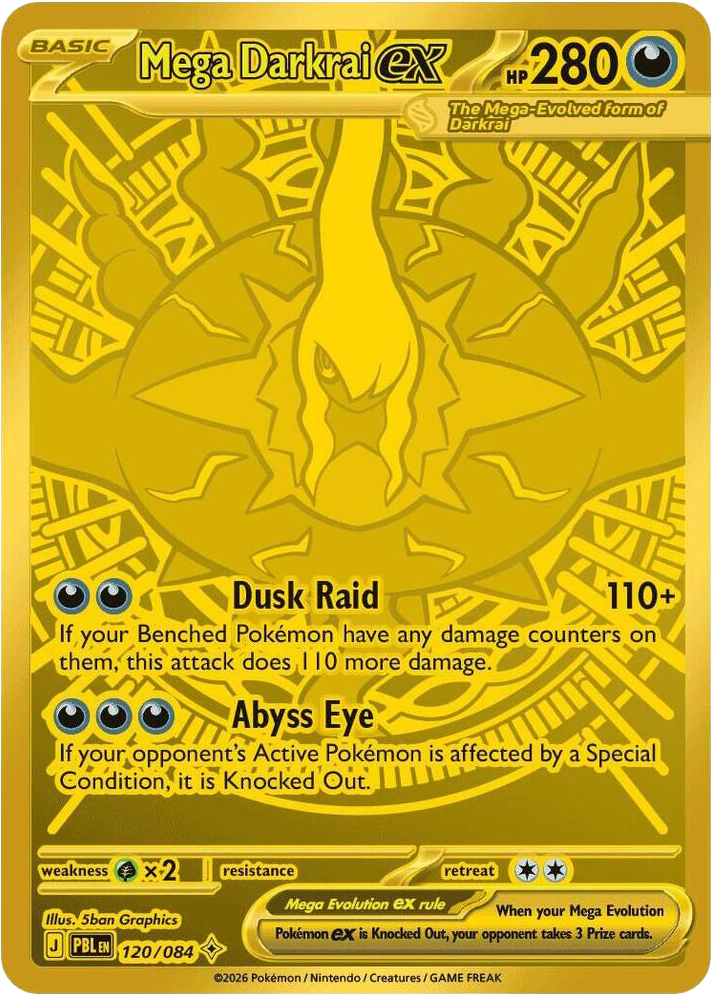
Mega Darkrai ex is confirmed across four rarities: Double Rare, Ultra Rare, Special Illustration Rare, and Mega Hyper Rare. If you've followed a modern Scarlet & Violet-era set before, that tier structure will look familiar, and it's worth being upfront that we don't have this specific card's verified pull rates or print-run figures to hand you -- rarity odds for individual cards within a set aren't something we're going to invent, so treat any specific percentage you see elsewhere with some skepticism until it's sourced from an official rate card.
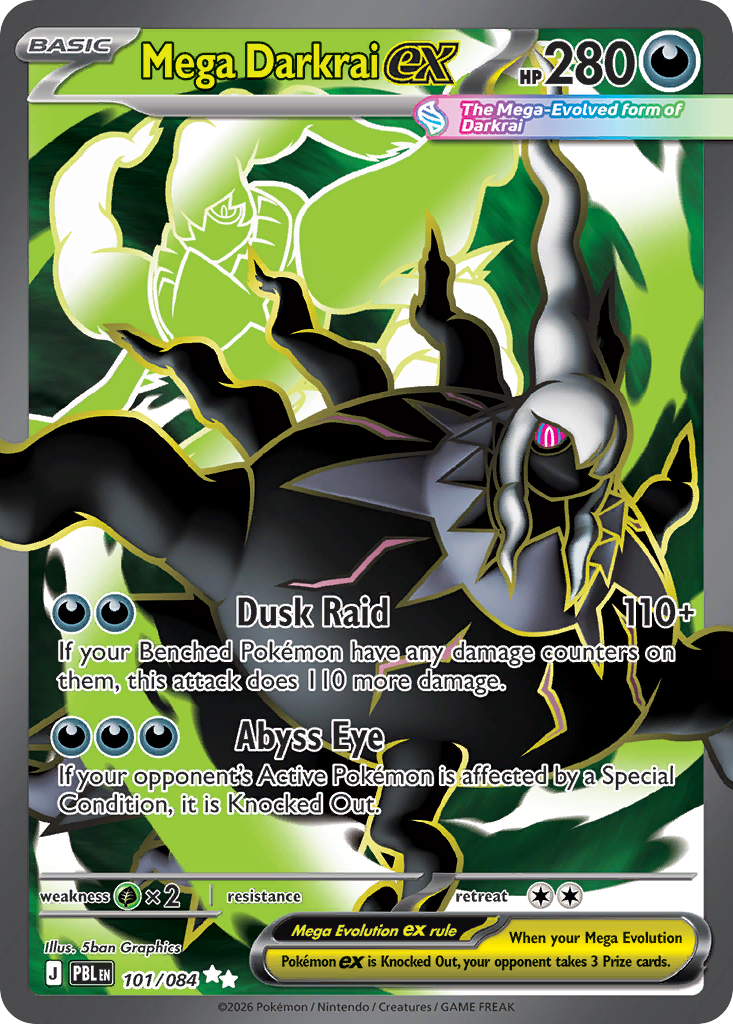
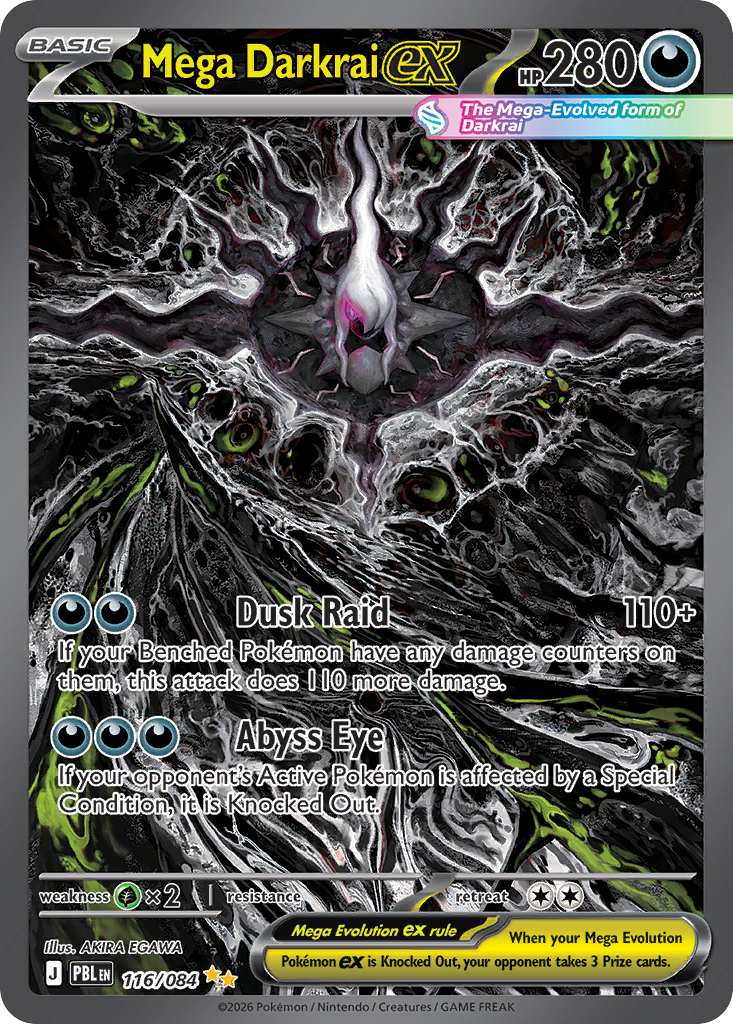
What we can say with confidence is what these four tiers generally represent in current-era Pokemon TCG products, based on how this rarity structure has behaved across other recent sets. Double Rare is typically the "base" competitive printing -- the one that shows up most often relative to the others and the one most tournament players are actually sleeving up. Ultra Rare usually denotes a full-art style treatment. Special Illustration Rare is generally the alternate-art chase pull that collectors and case-crackers are hunting for, and Mega Hyper Rare -- as the name suggests, and consistent with how "Hyper Rare" tiers have worked in prior sets -- sits at the very top of the rarity ladder as the rarest print of the card. If you're chasing any of these for collection value rather than deck value, our pull rates and card finance guide walks through how these tiers tend to hold or lose value over a set's life.
Building Around Abyss Eye: What the Deck Wants
We're not going to hand you a full 60-card list here, and honestly, anyone who does right now -- this early into the card's life -- is guessing more than they're reporting. What we can talk about is the shape the deck wants, conceptually, based on what Abyss Eye actually does. As covered above, this is a setup-and-sequencing deck rather than a damage racer, and that reframes what "good support" means for it.
The deck wants consistent access to effects that inflict Sleep or Poison on the opponent's Active Pokemon -- ideally more than one redundant way to do it, since a one-shot source of a Special Condition is easy for an opponent to play around once they've seen it. It wants ways to keep a Pokemon locked in the Active Spot once it's afflicted, since a Switch effect or a retreat undoes your setup instantly. And like basically every competitive deck in the current format, it wants the draw and search consistency that any serious Standard build needs regardless of strategy -- if you're new to that side of deckbuilding, our guide to building your first competitive deck covers the consistency math that applies to any archetype, not just this one.
It's worth contrasting that against a deck like the budget Dragapult ex builds that have been circulating -- our budget Dragapult ex under $100 guide is a good example of a deck philosophy built entirely around raw speed and damage output. Mega Darkrai ex asks for something closer to a control mindset: get the condition on board, protect it, then close. That's a real strategic identity, but it also means the deck's floor depends heavily on how consistent your Special-Condition sources actually are, which is exactly the kind of thing that only becomes clear once players have had a full set's worth of games with it.
Where Mega Darkrai ex Fits in the Current Standard Meta
Mega Darkrai ex isn't arriving into an empty format. Standard already has established decks with real tournament pedigree, and a set releasing in mid-July doesn't automatically overwrite six-plus months of metagame development by mid-week. Dragapult ex, for instance, was one of the defining decks of the season -- if you want the full context on how it performed at the highest level, our Worlds 2026 recap covers that in detail. Charizard ex has also remained a consistent presence across budget and competitive lists alike, which our Charizard ex deck tech breaks down.
What Mega Darkrai ex brings to that landscape isn't a replacement for those decks so much as a genuinely different answer to them. A deck that wins by threatening a guaranteed knockout regardless of remaining HP is, by nature, a check against strategies that lean on precise HP math and damage-output racing -- which describes a meaningful chunk of the current top tier. Whether that translates into actual tournament results is something we'll only know with time and real Swiss-round data; it's simply too early in the card's life for us to report finished results as if they already exist. What we can say is that the strategic identity is different enough from anything else in the format right now that it's worth watching regardless of where it lands competitively.
Mega Darkrai ex vs. Other Status-Based Strategies
Status-based strategies aren't new to the Pokemon TCG -- Sleep and Poison decks have existed in some form across nearly every era of the game, usually as a stall or tempo plan rather than a way to close games outright. What's historically held those decks back is exactly the gap we described earlier: inflicting a Special Condition has never, by itself, removed a Pokemon from the board, and a patient opponent with any way to switch out or cure the condition could usually play around it.
Mega Darkrai ex is unusual precisely because it collapses that gap. It doesn't ask you to grind a Poisoned Pokemon down over several turns -- it turns the condition itself into the finishing blow the moment you're ready to swing. That's a meaningfully different risk profile than a traditional stall deck: your win condition is faster once it's online, but it's also more binary, since a single Special Condition-curing effect or well-timed retreat can take your entire turn's setup away in one move. Anyone building this deck should go in expecting games to swing hard on exactly that interaction, rather than assuming Special Conditions will simply stick once applied.
Buying Guide: Which Rarity Should You Actually Chase
This is the part where your goal actually matters, because the four rarities don't play any differently from each other. Abyss Eye does the same thing on a Double Rare copy as it does on a Mega Hyper Rare copy -- the artwork and rarity stamp change, the attack doesn't. If your only goal is to have a legal, playable copy in your deck, the Double Rare is the obvious pickup: it's almost always the cheapest of the four and it does everything the deck needs it to do.
If you're chasing the Ultra Rare, Special Illustration Rare, or Mega Hyper Rare, you're shopping as a collector, not a player, and that's a completely valid reason to buy -- just go in knowing you're paying for scarcity and artwork rather than any competitive edge. Whether you're better off ripping packs or a box to chase the pull yourself versus just buying the specific card as a single is a real question worth thinking through before you spend, and our ETB vs. booster box guide lays out that math in more general terms that apply here too. And if you do land a Special Illustration Rare or Mega Hyper Rare copy, it's worth protecting immediately rather than letting it ride loose in a binder page -- our sleeves, binders, and toploaders guide covers what's actually worth buying for a card at that level.
One more thing worth flagging honestly: it's still very early to know where Mega Darkrai ex's chase rarities will settle in value relative to the rest of the set, or relative to other modern chase cards more broadly. If you want the wider context on what's actually moved the needle for modern cards recently, our most valuable modern Pokemon cards guide is a useful baseline, but treat any specific price talk about this particular card right now as early and unsettled rather than established.
Common Mistakes New Pilots Make
The single biggest mistake we'd expect new pilots to make is treating Mega Darkrai ex like a normal attacker and swinging with it before a Special Condition is actually in play -- Abyss Eye only knocks out a Pokemon that's already affected, it doesn't inflict the condition itself. If your setup piece whiffed, got Knocked Out, or simply hasn't resolved yet, attacking that turn accomplishes nothing. As covered above, this is a sequencing deck, not a damage racer, and losing sight of that defeats the point of running it.
The second mistake is underestimating how easily an opponent can undo your setup. Special Condition-curing effects and Switch-style escape options have been a standing part of the Pokemon TCG's toolkit for a long time, and any deck that leans on Special Conditions sticking needs to plan for opponents who are actively trying to remove them. Don't assume a condition you land is a condition that survives to your next turn.
And the third, more of a wallet mistake than a gameplay one: don't feel like you need the Mega Hyper Rare or Special Illustration Rare copy to actually play this deck competitively. The Double Rare does the exact same job in a Standard match. Save the chase-rarity spending for when you're buying it as a collector piece, not because you think it plays better.
A genuinely different win condition, if you can keep it locked in
Mega Darkrai ex is one of the more conceptually interesting cards to hit Standard in a while precisely because it doesn't play like the rest of the format's top decks -- it wins through setup and lockdown rather than raw damage output. That makes it exciting to build around, but it also means its ceiling depends entirely on how consistently you can land and protect a Special Condition, something that's still being worked out across the format in real time.