

Every number, symbol, and zone on a Dragon Ball Super Card Game Fusion World card — explained in plain language, so a fresh card never confuses you again.
Pick up a Fusion World card for the first time and it can feel like a wall of numbers. There's a big power figure, a smaller number tucked along one edge, a cost, a color band, a row of traits, and a block of skill text — and the game expects you to know which is which the moment you start playing. The good news: once you learn what each region means, every card in the game reads the same way, and the layout starts working for you instead of against you.
This guide walks through every part of a Fusion World card — Leader, Battle, and Extra — using a clean labeled diagram so you can see exactly where each value lives. We'll spend extra time on the one distinction that trips up almost every new player: the difference between a card's Power and its Combo Power. Get that one right and half the game clicks into place.
Everything here is checked against the official Fusion World rule manual. Let's read some cardboard.
The Short Version
A Fusion World card shows, at a glance: its Cost (energy to play it), its Power (its strength in battle — the big number), its Combo Power (the smaller number on the left edge, added to an attacker when you throw this card into a combo), its Color, its Characteristics (traits like Saiyan or Frieza Clan), and its Skill text. The single biggest beginner mistake is confusing Power with Combo Power — they're different numbers that do different jobs. Leaders have no Cost and flip to an awakened back side; Extra cards are one-and-done effects.
→ More Fusion World Guides
In This Guide
The Three Card Types
Every card in Fusion World is one of three types, and each has a slightly different layout. Knowing which type you're holding tells you immediately what to look for:
-
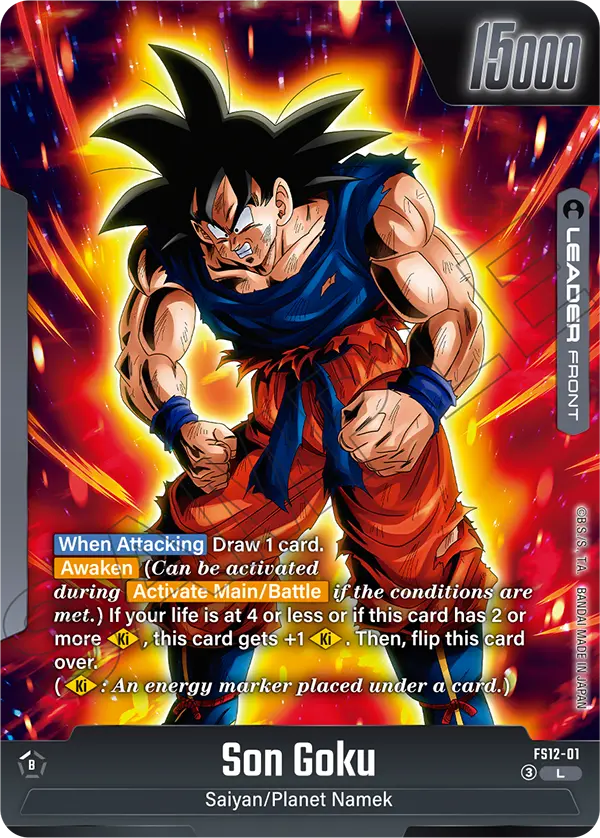
Leader Card. The heart of your deck — one per deck, it sits in the Leader Area the entire game. It has Power, a Color, Characteristics, and a Skill, but no cost. Uniquely, it's double-sided: flip it to its awakened back when your life drops to half.
-
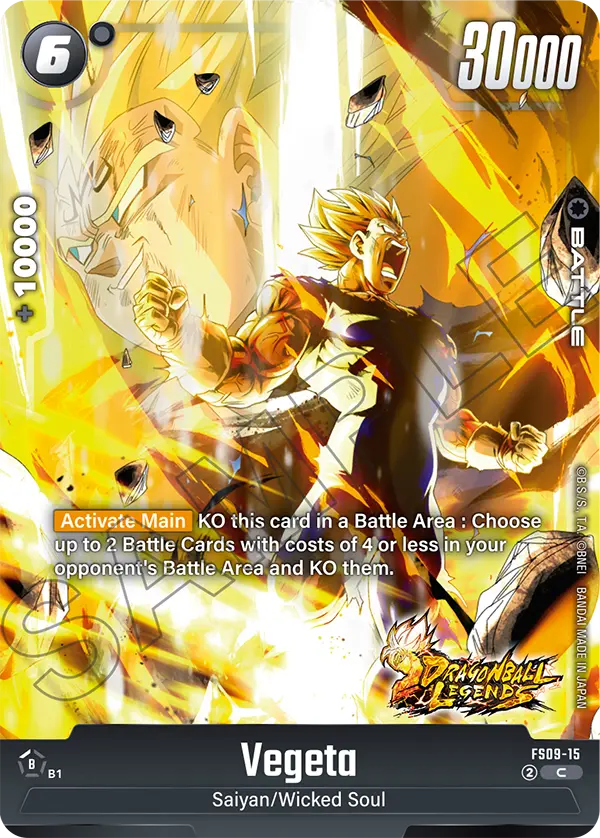
Battle Card. Your workhorses — the characters you play from hand to fight, block, and feed into combos. These carry the full set of numbers: Cost, Power, and the all-important Combo Power. Most of your deck is Battle Cards.
-
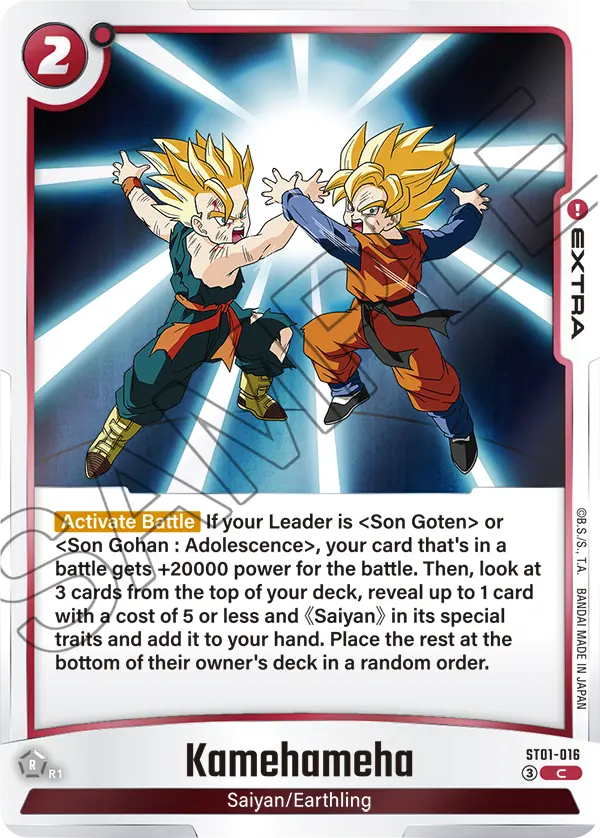
Extra Card. One-shot effects — you pay their cost, the effect happens, and they go to the Drop Area. They have a Cost, Color, Characteristics, and Skill, but no Power or Combo Power, since they never sit on the battlefield.
The Battle Card is where all the numbers live, so that's where we'll start — learn it, and the other two are easy.
Anatomy of a Battle Card
Here's a labeled diagram of a typical Battle Card. The art is a generic placeholder — what matters is where each value sits, and that's consistent on every card in the game.
A generic Battle Card schematic — every Fusion World card places these regions in the same spots.
Reading clockwise from the top, here's what each region is:
- Cost (top-left circle). How much energy you rest to play the card. A cost-4 card needs four energy. This is your main curve consideration when deckbuilding.
- Color (top-right band). Red, Blue, Green, Yellow (and Black in later sets). Your deck can only run cards matching your Leader's color.
- Combo Power (left edge). The smaller number in the colored tab — usually 5000 or 10000. This is what the card adds to an attacker when you send it into a combo. More on this next, because it's the big one.
- Power (upper-right, large). The card's strength in battle. When it attacks or defends, this is the number that gets compared. The biggest, boldest figure on the card.
- Characteristics (near the name). Traits like Saiyan, Frieza Clan, or Android. Skills frequently care about these, so they matter more than they look.
- Skill text + Card ID (bottom). The card's abilities, plus its set number and rarity. We'll cover skill keywords below.
Power vs. Combo Power: The One That Trips Everyone
If you remember one thing from this guide, make it this. A Battle Card has two numbers that look like strength, and new players constantly mix them up:
Power (the big number)
This is the card's actual strength when it's on the battlefield attacking or defending. A 20000-power card hits and blocks at 20000. This is the number that matters when the card itself is fighting.
Combo Power (the edge number)
This is what the card adds to a different attacker when you discard it into a combo from your hand or battle area. A 10000 combo value boosts whoever is currently fighting by 10000 — then that combo card is used up.
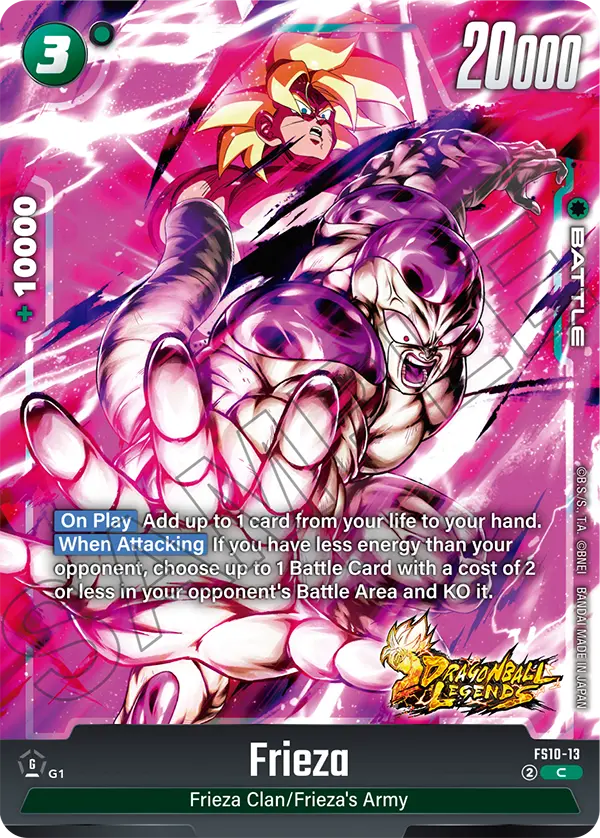
Here's the mental model: Power is what a card does when it fights. Combo Power is what it sacrifices to make another card fight harder. A single card can do either job — play it to battle and use its Power, or throw it into a combo and use its Combo Power — but not both at once.
Watch out: a high-Power card often has a modest combo value, and vice versa. When you're deciding whether to commit a card to the board or burn it for a combo, you're really choosing which of its two numbers you want to use this turn. That decision is the beating heart of Fusion World — our combo system guide goes deep on the timing.
The Leader Card & Awakening
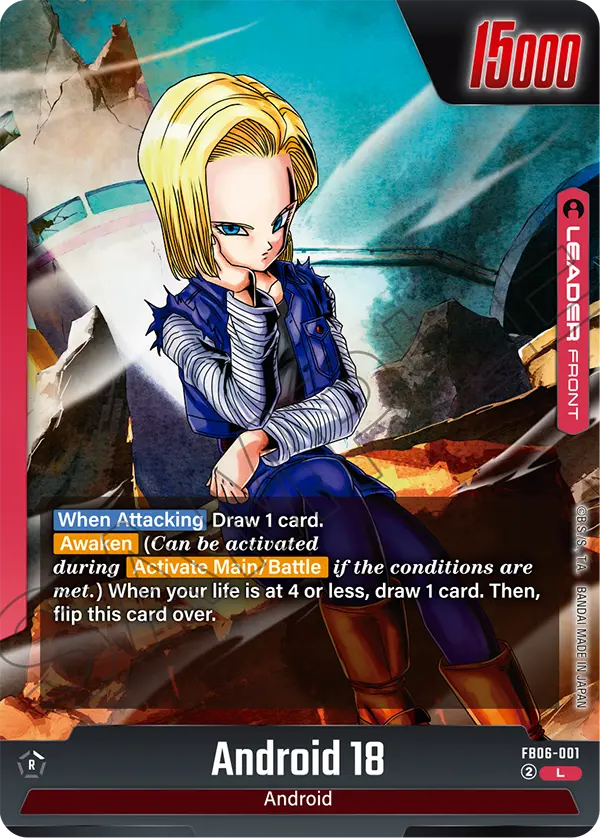
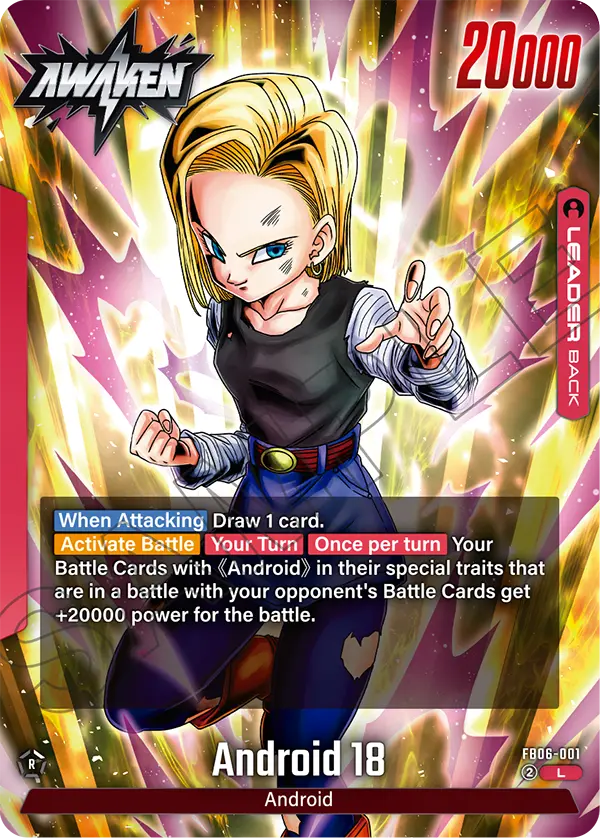
The Leader Card looks similar but reads differently in two key ways: it has no cost (you don't pay to put your leader down — it starts in play), and it's double-sided. Here's the labeled layout:
Front (base) flips to the awakened back when your life drops to half.
The Leader carries a Power value (it can attack and defend like any card) and starts the game face-up on its front side. Once your life falls to half or less, you flip it to the awakened back — usually higher Power and a stronger skill. That comeback mechanic is core to the game's "the longer it goes, the bigger it gets" feel. For which leaders awaken best, see our leader awakening guide.
Note: your Leader also defines your deck's color identity. Every other card you run must share one of the Leader's colors — so the Leader you pick decides what the rest of your 50–60 cards can be.
The Extra Card
Extra Cards are the simplest to read because they have the fewest numbers. Think of them like an instant or a spell in other games: you pay the cost, the effect happens, and the card goes straight to the Drop Area.
An Extra Card shows a Cost (energy to play it), its Color, its Characteristics, and its Skill text — but crucially no Power and no Combo Power, because it never stays on the battlefield to fight or sit in a combo. If you see a card with a cost but no big power number and no left-edge combo tab, you're holding an Extra Card.
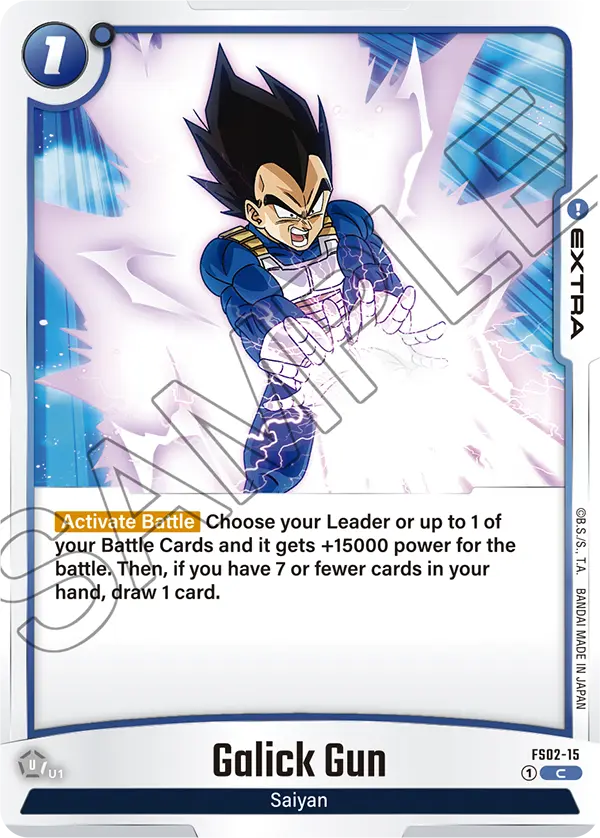
Quick tell: Battle Card = has Power and Combo Power. Extra Card = has neither. Leader = has Power but no Cost. Those three checks identify any card in the game instantly.
Color, Characteristics & Skills
Three more regions round out a card, and they shape deckbuilding more than their small size suggests.
Color. Fusion World launched with four colors — Red, Blue, Green, and Yellow — with Black added in later sets. Color isn't just flavor: your deck can only include cards that share a color with your Leader. A Red leader means a Red deck. Each color has a personality (Red is aggressive, Blue is control-leaning, and so on), which our 5 colors guide breaks down in full.
Characteristics. These are the trait tags near the card name — Saiyan, Frieza Clan, Android, and many more. On their own they do nothing, but skills constantly reference them ("for each Saiyan you have…"), so a deck built around a shared characteristic can unlock powerful synergies.
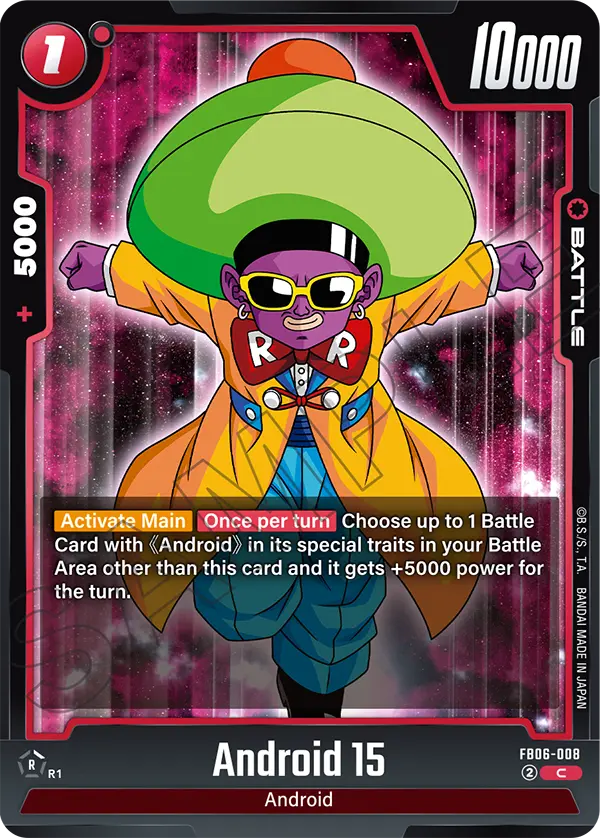
Skills. The text box holds the card's abilities, usually tagged with a timing keyword. The common ones you'll see:
- [Auto] Triggers on its own when a condition is met (for example, when the card attacks or enters play).
- [Activate: Main] You choose to use it during your main phase.
- [Activate: Battle] Usable during combat, often to swing a fight.
- [Permanent] Always on while the card is in play — no activation needed.
You'll also meet combat keywords like Blocker (rest the card to redirect an attack onto it) and Critical (deals an extra point of life damage). When you hit an unfamiliar keyword, our how-to-play guide is the place to look it up.
Reading a Card in Three Seconds
Once the regions are familiar, you won't read a card top-to-bottom anymore — you'll scan it in a fixed order, the same way experienced players do. Here's the sequence that gets you the most useful information fastest:
- 1. Cost first. Can you even afford it this turn? The top-left number tells you instantly whether the card is a play now or a play later.
- 2. Power next. How does its strength compare to what's across the table? This tells you whether it attacks profitably, trades, or just blocks.
- 3. Combo Power on the edge. If you're not playing it to the board, what's it worth thrown into a combo? A 10000 combo value is a meaningful boost held in reserve.
- 4. Skill text last. Now read the box for the wrinkle — the trigger, the keyword, the condition that makes this card more than just its numbers.
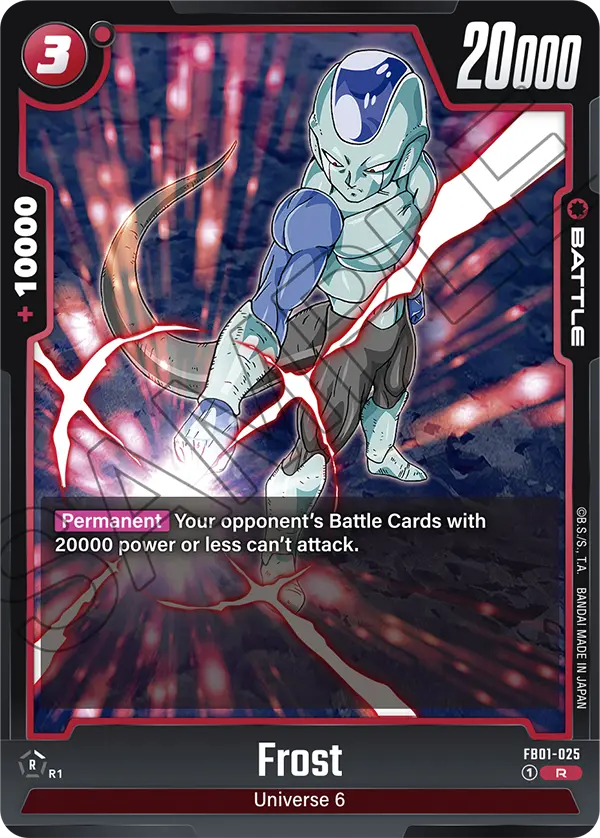
That order — cost, power, combo, skill — is how you evaluate a hand quickly during a real game, and it's why learning the anatomy matters: you stop reading cards and start assessing them. The numbers become a language you speak rather than a puzzle you solve.
Card-Reading FAQ
Which number is the card's "attack"?
The large Power figure. Fusion World uses a single power value for both attacking and defending — there's no separate attack and defense stat. Combat is simply power versus power.
Why do some cards have a small number on the left edge?
That's the Combo Power — the value the card adds to an attacker when you commit it to a combo. It's separate from the card's own Power. Almost every Battle Card has one.
Why doesn't my Leader have a cost?
Leaders aren't played from your hand — your Leader starts the game in the Leader Area and stays there. Cost only applies to cards you play during the game, which means Battle Cards and Extra Cards.
How do I tell a Battle Card from an Extra Card at a glance?
Look for Power and Combo Power. Battle Cards have both; Extra Cards have neither (just a cost and a skill). If it can sit on the field and fight, it's a Battle Card.
What's the number in the bottom corner?
That's the card's set ID and rarity (like FB02-013, SR). It identifies the exact card and printing — useful for deck lists and for the 4-copy deckbuilding limit, which counts by card number.
Now Every Card Reads the Same.
The layout that looked like a wall of numbers is really just six or seven labeled regions that never move. Cost to play it, Power to fight with, Combo Power to fuel an attack, Color and Characteristics for deckbuilding, and a skill box that tells you the rest. Once Power versus Combo Power clicks, you can pick up any card in the game — from any set — and know exactly what it does before you've read a word of rules text.
From here, the natural next step is putting those cards together. Learn how combos actually win games, then build your first deck.
Keep Learning Fusion World:
© GEEKYDOMAIN.COM | Strategy Powered by Data