

The guild of "have fun, hurt people." Sacrifice engines, premier removal, and damage payoffs — the black-red staples that turn cruelty into card advantage, all under $5.
Some links below are affiliate links. If you buy through them, we may earn a small commission at no extra cost to you. We only recommend cards we'd run ourselves.
The Short Version
Every card that defines the Rakdos archetype is under $5 — you can build an oppressive 99 without touching the chase mythics. Removal is Rakdos's superpower — Terminate, Dreadbore, and Rakdos Charm answer almost anything for pennies. The sacrifice engine is the win condition (Judith, Mayhem Devil, Falkenrath Aristocrat). The closers come from value engines (Kolaghan's Command, Mahadi, Murderous Redcap). Skip the chase mythics — Korvold and Olivia, Crimson Bride blew past $5 long ago, and you don't need them to win.
In This Guide
Rakdos is the guild of consequences. Black trades resources for power; red trades patience for damage. Together they make the format's most aggressive, sacrificial, and openly chaotic color pair — a deck that wins by extracting value from every dying creature, every discard trigger, every burn spell pointed at a face. It's also one of the most beginner-friendly archetypes to build on a budget, because its best multicolor cards are some of the cheapest in the format.
The reputation that Rakdos needs Korvold, Olivia Crimson Bride, or Anhelo to actually function is mostly a story the secondary market tells itself. The cards that do the work — the cleanest removal in the game, a modal four-mode command, an under-$5 sacrifice god, and a Treasure-machine commander — are heavily reprinted commons, uncommons, and budget rares. You can build an oppressive 99 without touching the chase mythics.
What follows isn't a "proxy this if you can't afford the real thing" list. These are the actual best-performing budget cards in their slots, full stop — they just happen to also be cheap. Prices move constantly, so sanity-check before you buy, but the picks below have long sat comfortably in budget range.
The Top 3 Removal Staples

Rakdos's real flex is that it gets the cleanest creature kill in the game (black) plus the cleanest non-creature destruction (red), at the same color identity. These three are the under-$5 staples that cover almost every threat.
Terminate
{B}{R} — Instant. Heavily reprinted, so reliably one of the cheapest staples in the game.
Why it wins: Two mana, destroy any creature, can't be regenerated. No conditions, no riders, no flavor tax. The cleanest two-mana kill spell ever printed, reprinted into the ground, which is exactly why it's cheap. For more options at every mana cost, see our budget removal by color guide. Hold it up against the table's scariest commander and you'll never regret it; the only real skill is knowing when to wait for a bigger target.
Dreadbore
{B}{R} — Sorcery. Inexpensive and easy to find.
Why it wins: Destroy any creature or planeswalker. The planeswalker mode is the real value — black's hardest weakness in Commander is planeswalkers running away with the game, and Rakdos solves it for two mana on the cheapest possible card. The sorcery speed is the only drawback, and against a planeswalker that just landed, it's not a drawback at all.
Rakdos Charm
{B}{R} — Instant. About as cheap as a card gets.
Why it wins: Three modes for two mana — exile a graveyard, destroy an artifact, or deal one damage to each creature's controller for each creature they control. The third mode is the surprise win condition: against a wide token board (Krenko, Edgar Markov, anyone's elf deck), it ends the game. Modal interaction this flexible at this price is the whole reason charms exist.
The Top 3 Sacrifice Engines
The Rakdos win condition is rarely "attack with creatures." It's "sacrifice creatures, trigger payoffs, deal damage." These three are the multicolor pieces that turn a sacrifice deck into a real archetype.
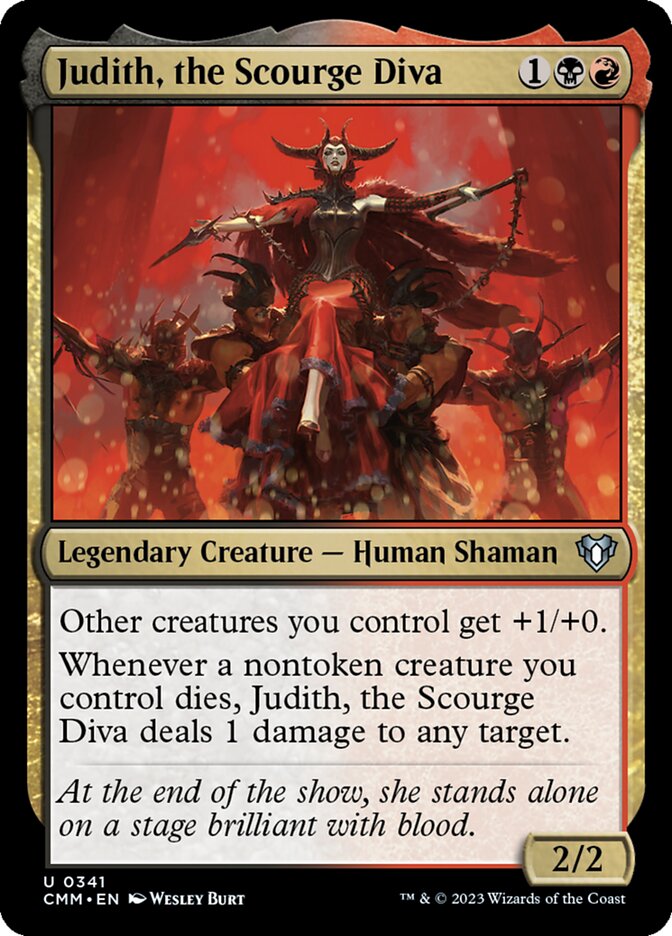
Judith, the Scourge Diva
{1}{B}{R} — Legendary Creature. Cheap and abundant.
Why it wins: A three-mana anthem that pings any target when one of your other nontoken creatures dies. In a sacrifice deck, Judith turns each nontoken death into a free point of removal or face damage — sacrifice a creature, kill a small creature; sacrifice three, kill the planeswalker. As a commander, she's the cheapest dedicated Rakdos sacrifice deck the format has. As a 99 card, she's an engine that compounds every turn.
Mayhem Devil
{1}{B}{R} — Creature. Inexpensive.
Why it wins: Whenever you or a permanent you control sacrifices a permanent, deal one damage to any target. Treasures, tokens, food, blood — every sacrifice-adjacent mechanic in Magic triggers Mayhem Devil, and a wide sacrifice board makes him a game-ending ping engine. The card that turns "I have a Treasure" into "I have a Treasure and you take three damage."
Falkenrath Aristocrat
{2}{B}{R} — Creature. Cheap.
Why it wins: A 4/1 flying haste with indestructible — sacrifice a creature for a +1/+1 counter and indestructibility through end of turn. The body is already a clock; the activated ability turns every spare token into another swing through everything. The cleanest single-card threat-and-sacrifice-outlet a budget Rakdos deck runs.
The Top 3 Closers & Value
A Rakdos deck without closers stalls out after the early removal exchange. These three engines provide the recurring value that converts a board lead into a game-ending one.
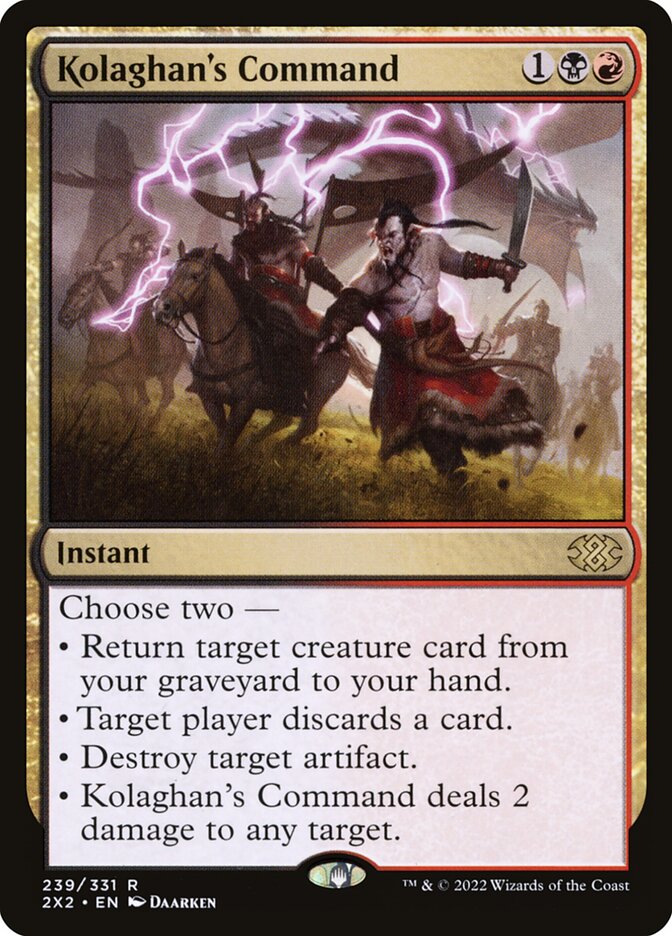
Kolaghan's Command
{1}{B}{R} — Instant. Cheap after multiple reprints.
Why it wins: Choose two: return a creature from your graveyard to your hand, discard a card (opponent discards), deal two damage, or destroy an artifact. Two-for-one at instant speed for three mana — one of the most efficient modal cards in the format, and the kind of "always relevant" card that earns its slot in every Rakdos deck regardless of archetype. Our interaction guide covers what makes modal spells so strong.
Mahadi, Emporium Master
{2}{B}{R} — Legendary Creature. Inexpensive.
Why it wins: When a non-token creature dies, you create a Treasure token. In a sacrifice deck, that's a Treasure every turn you sacrifice a real creature — ramp on death. Pair Mahadi with Mayhem Devil and the Treasure cracking itself becomes another sacrifice trigger, another ping, more value. The card that turns "my creatures keep dying" into "my mana base keeps growing."
Murderous Redcap
{2}{B}{R} — Creature. Cheap.
Why it wins: Two damage on ETB, persist (returns from graveyard with a -1/-1 counter when it dies). In a deck with sacrifice outlets and -1/-1 counter removal, Redcap becomes an infinite damage source — a budget combo piece that doesn't require chase rares to assemble. Even without combo, it's a recurring damage engine that punishes the opponent for blocking.
The Budget Picture: Slots vs Cost
A common worry: "Doesn't every Rakdos deck need Korvold, Olivia Crimson Bride, or Bedevil to actually function?" The honest answer is that it doesn't — the budget options below cover the same slots. The deck loses some explosive top-end without the premium cards, but the floor it builds to is genuinely strong.
Budget vs Premium, By Slot
Each row shows the slot, the budget pick from this guide, and what the premium upgrade would replace it with. The point isn't that premium is wrong — it's that the gap is smaller than the price gap suggests.
Illustrative pricing — secondary market moves with reprints and demand. The budget shell does the same jobs as the premium one, with a slightly different angle on each. Rakdos is one of the most price-friendly guilds in the format because so many of its best cards have been reprinted multiple times.
Terminate, Dreadbore, Judith and Mayhem Devil are all cheap, heavily reprinted singles — bulk Rakdos lots and sealed Commander precons are the fastest way to pick up several at once.
As an Amazon Associate, Geeky Domain earns from qualifying purchases. eBay links are affiliate links; Geeky Domain may earn a commission at no extra cost to you.
Budget Rakdos Commanders
If you're building around the guild, three budget commanders headline the strategies these staples support — pick the angle that excites you and lean into it.
Judith, the Scourge Diva
{B}{R} — Legendary Creature. Inexpensive.
Why it wins: Listed above as a payoff — she also doubles as the format's cheapest dedicated sacrifice commander. A two-mana commander with an anthem and a ping engine attached is an outrageous rate; built around tokens, treasures, and sacrifice outlets, Judith is one of the strongest budget commanders period.
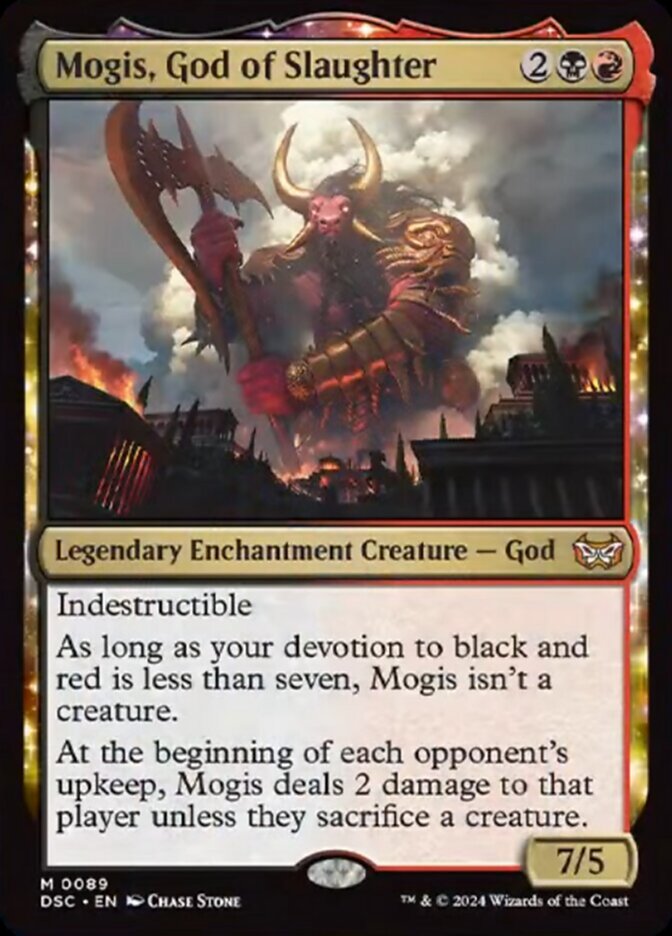
Mogis, God of Slaughter
{2}{B}{R} — Legendary Enchantment Creature. Cheap.
Why it wins: At the beginning of each opponent's upkeep, that opponent sacrifices a creature or loses two life. As an indestructible, often-not-a-creature commander, Mogis is incredibly hard to remove — and three opponents losing two life every round adds up to 24 damage by turn five. The budget group-slug commander.
Kardur, Doomscourge
{2}{B}{R} — Legendary Creature. Inexpensive.
Why it wins: When Kardur enters, each opponent's creatures attack each other player this turn. A single ETB trigger creates an opening turn where everyone's board attacks everyone else's. Pair Kardur with a blink shell and the table dismantles itself. A spicy budget pick that wins games by making the rest of the table fight.
Honorable Mentions
A few more multicolor Rakdos cards worth a slot in the right build, but that didn't quite make the top tier:
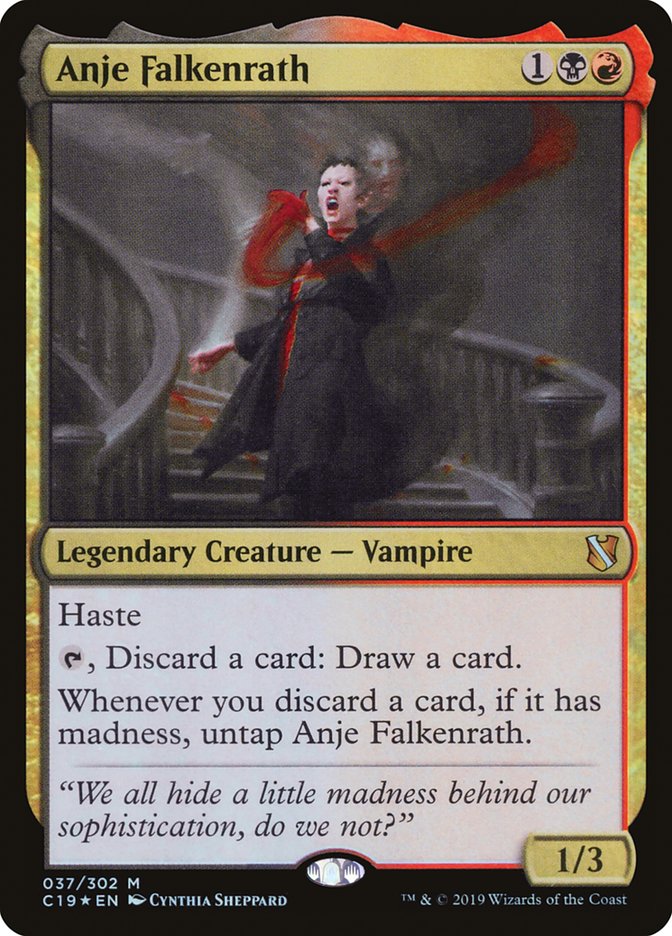
- Anje Falkenrath. A three-mana vampire commander with haste and a tap-to-loot ability that untaps from any madness payoff in the deck. The premier budget Madness commander, and a fantastic engine for graveyard shells. Pairs well with black's discard staples.
- Garna, Bloodfist of Keld. A four-mana commander that gives your team haste and turns death triggers into draw triggers. The cheapest Rakdos "go-wide with menace and draw cards" engine the format has access to.
- Olivia Voldaren. A four-mana vampire that pings creatures, gives them a +1/+1 counter, and steals them if their toughness reaches zero. The Rakdos toolbox creature that doubles as a removal piece and a finisher.
Common Mistakes
Playing a sacrifice deck without sacrifice outlets.
Judith and Mayhem Devil only work if you have free, repeatable ways to sacrifice creatures — otherwise their triggers don't fire. A budget Rakdos sacrifice deck wants four-to-six dedicated outlets (Viscera Seer, Falkenrath Aristocrat, Carrion Feeder) so the engine can run on every turn, not just the turns the opponent kills your stuff.

Treating Bedevil as a budget staple.
It isn't, reliably — Bedevil floats between $5 and $10 depending on reprint cycles, and Terminate plus Dreadbore cover the same role for a quarter of the price. Save the slot for Bedevil after you've graduated past the budget tier.
Going all-in on burn at the multiplayer table.
A two-damage Bolt looks great in 1v1 Magic; in Commander, you need to deal 120 damage across four life totals. Burn-only Rakdos decks run out of gas. The sacrifice and value engines on this list compound damage across the whole game, which is what Commander-scale damage actually requires. Our $50 deck blueprint covers how to balance threats and interaction in a tight budget.
Where to Buy the Pieces
Rakdos is built from singles, so a singles marketplace is the way to assemble it affordably. TCGplayer and Card Kingdom are the go-to stops for the cheap commons and uncommons that make up this list — buy the removal and Judith first, since they're inexpensive and define the deck's game plan. eBay is useful for bulk Rakdos lots, and Amazon carries sealed precons that often include several of these staples. Prices vary between sellers, so compare carts before checking out.
Rakdos Budget FAQ
Is Rakdos beginner-friendly? One of the most, yes. Aggro and sacrifice archetypes have clear game plans (kill stuff, deal damage), and the cards on this list are heavily reprinted commons and uncommons. The hardest part is sequencing sacrifices for maximum trigger value, not affording the cards. The mana curve guide helps with the sequencing side.
Do I need Korvold? No. Judith covers the same archetype (sacrifice payoff commander) for about a tenth the price. Korvold is a powerful upgrade once you've outgrown budget — but he's not the floor of a Rakdos deck.
What should I prioritize first? Removal and a sacrifice engine, in that order. Terminate, Dreadbore, and Judith are the cheapest possible foundation, and the deck functions on those three plus an outlet (Viscera Seer at 25 cents). Build outward from there.
Will I get hated out at the table? Mogis-style group-slug commanders attract focus quickly — that's the cost of slugging the whole table at once. Judith and Kardur read as less threatening early, even though they end games similarly. Pick your political profile.
Have Fun. Hurt People. Stay Budget.
Rakdos is the guild that turns every dying creature, every discarded card, every wasted Treasure into damage. The removal is the cleanest in the format. The sacrifice engines turn token decks into ping decks. The closers chain death triggers into Treasures into more death triggers into a finished game. And almost every multicolor card that defines the archetype is under $5.
Build the engine, pick a commander, and let the table watch their boards turn into your mana and their life totals turn into your win. Rakdos is the deck that rewards aggression without punishing your wallet.
© GEEKYDOMAIN.COM | Strategy Powered by Data