

The PSA Grading Scale, Explained
A plain-English walk through what every PSA number from 1 to 10 actually means, straight from PSA's own published grading standards.
Some links below are affiliate links. If you buy through them, Geeky Domain may earn a small commission at no extra cost to you.
The Short Version
PSA grades cards on a 1-to-10 scale, with PSA 10 (Gem Mint) reserved for cards that are "virtually perfect" and PSA 1 (Poor) covering cards whose eye appeal has "nearly vanished." Half-point grades exist between PSA 2 and PSA 9, but there is no PSA 9.5 — 10 is the only step above a 9. Centering standards tighten as the grade climbs: a PSA 10 needs roughly 55/45 or better on the front and 75/25 or better on the back. Cards PSA won't assign a number to either come back slabbed as Authentic or Authentic Altered instead of a numeric grade, or come back unencapsulated with one of PSA's No Grade reason codes, and a handful of letter codes (MK, MC, OC, ST) flag specific issues on an otherwise-numbered label.
In This Guide
- → What A PSA Grade Actually Means
- → The Full PSA 1-10 Scale At A Glance
- → PSA 10 and PSA 9: Gem Mint and Mint
- → PSA 8 Through PSA 6: Still Elite, Starting To Show It
- → PSA 5 Through PSA 1: Played, Worn, and Poor
- → Half Grades, Authentic, and the No-Grade Codes
- → The Qualifiers: MK, MC, OC, ST — and Two More
- → FAQ & Quick Reference
What A PSA Grade Actually Means
In July 2021, Logan Paul bought a PSA 10-graded 1998 Pikachu Illustrator card in a private sale reported at $5.275 million — a figure Guinness World Records certified in April 2022 as the most expensive Pokemon trading card sold at a private sale. In February 2026 that same card sold through Goldin for $16,492,000, a new record for the most expensive trading card ever sold at auction. That number wasn't about the artwork, the set, or the rarity of the print run; those were fixed decades earlier, the moment the card was printed. What actually moved the price was the small plastic slab the card is sealed inside, and the single digit printed on its label.
That's the whole point of a grading company: to look at a card under controlled conditions and assign it a number that means the same thing on every card, from every seller, every time. This guide is not about choosing between grading companies — if you're trying to decide whether to send a card to PSA, BGS, or CGC, or specifically want a vintage-Pokemon angle on that decision, our PSA vs. BGS vs. CGC comparison and our CGC vs. PSA for vintage Pokemon breakdown cover that decision directly. This guide is narrower and, frankly, more useful once you've already got a PSA-graded card in hand or a raw card you're considering submitting: what does the number on the label actually promise you about the condition of the card underneath it?
If you're still deciding whether third-party grading is worth the cost and wait at all for a given card, that's a separate question we cover in is card grading worth it. Here, we're assuming you already know you want a PSA number — and want to know what that number is actually certifying, tier by tier, straight from PSA's own published grading standards rather than a paraphrase of a paraphrase.
The Full PSA 1-10 Scale At A Glance
Here's the full numeric scale in one place, with PSA's own short description for each grade and the centering tolerance that grade requires. Centering is expressed as the worst-case percentage split between the two opposing borders — 55/45 means the wider border can take up no more than 55% of the combined border width on that axis, leaving at least 45% on the opposite side, measured at the most off-center point on the card.
| Grade | Name | What It Means | Centering (Front / Back) |
|---|---|---|---|
| 10 | Gem Mint | Virtually perfect: four sharp corners, sharp focus, full original gloss, free of staining; a slight printing imperfection may be allowed if it doesn't hurt eye appeal. | ~55/45 or better / ~75/25 or better |
| 9 | Mint | Superb, with at most one minor flaw: a very slight wax stain on the back, a minor printing imperfection, or slightly off-white borders. | ~60/40 or better / ~90/10 or better |
| 8 | NM-MT | Looks like a 9 at first glance; close inspection may reveal a very slight wax stain on back, the slightest fraying at one or two corners, a minor printing imperfection, and/or slightly off-white borders. | ~65/35 or better / ~90/10 or better |
| 7 | NM | Slight surface wear visible on close inspection; slight fraying on some corners; focus may be slightly out of register; a minor printing blemish and slight wax staining on the back only are acceptable. | ~70/30 or better / ~90/10 or better |
| 6 | EX-MT | Visible surface wear or a printing defect; a very light scratch detectable only on close inspection; corners may show slightly graduated fraying; borders may show some off-whiteness. | 80/20 or better / 90/10 or better |
| 5 | EX | Very minor rounding of the corners becoming evident; surface wear or printing defects more visible; several light scratches may show on close inspection without hurting overall appeal. | 85/15 or better / 90/10 or better |
| 4 | VG-EX | Corners may be slightly rounded; surface wear is noticeable but modest; light scuffing or light scratches; a light crease may be visible. | ~85/15 or better front / 90/10 or better back |
| 3 | VG | Some rounding of the corners, though not extreme; much (not all) of the original gloss is lost; a crease may be visible; wax staining on the back may be more prominent. | 90/10 or better (front and back) |
| 2 | Good | Corners show accelerated rounding and surface wear is starting to become obvious; may have scratching, scuffing, light staining, or chipping of enamel; may show several creases; original gloss may be completely absent. | 90/10 or better (front and back) |
| 1.5 | Fair | Corners show extreme wear, possibly affecting the framing of the picture; surface shows advanced wear including scuffing, scratching, pitting, chipping, and staining; may have one or more heavy creases. The card must still be fully intact, with no missing solid pieces. | ~90/10 or better (front and back) |
| 1 | Poor | Shares many Fair-grade qualities, but defects have advanced further and eye appeal has nearly vanished; may be missing one or two small pieces, show major creasing that nearly breaks through all layers, extreme discoloration or dirtiness, or noticeable warping. | Not separately specified by PSA |
Two things to notice right away. First, the centering requirement gets dramatically looser as the grade drops — a PSA 10 has to be almost dead-center on the front, while a PSA 3 through PSA 2 only needs to clear 90/10. Second, the back of the card gets much more centering leeway than the front at every high grade; PSA cares far more about how the front looks than the back, which lines up with how the two sides are actually presented and photographed.
PSA 10 and PSA 9: Gem Mint and Mint
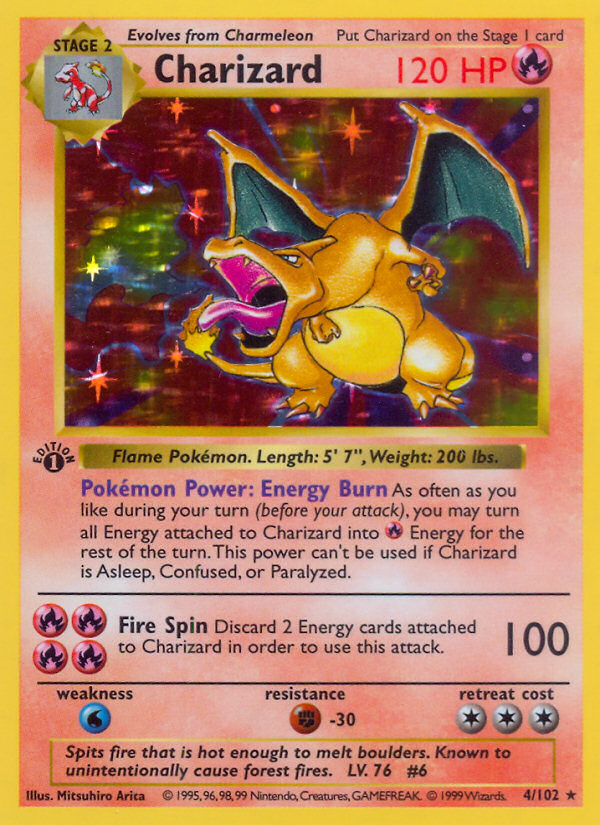
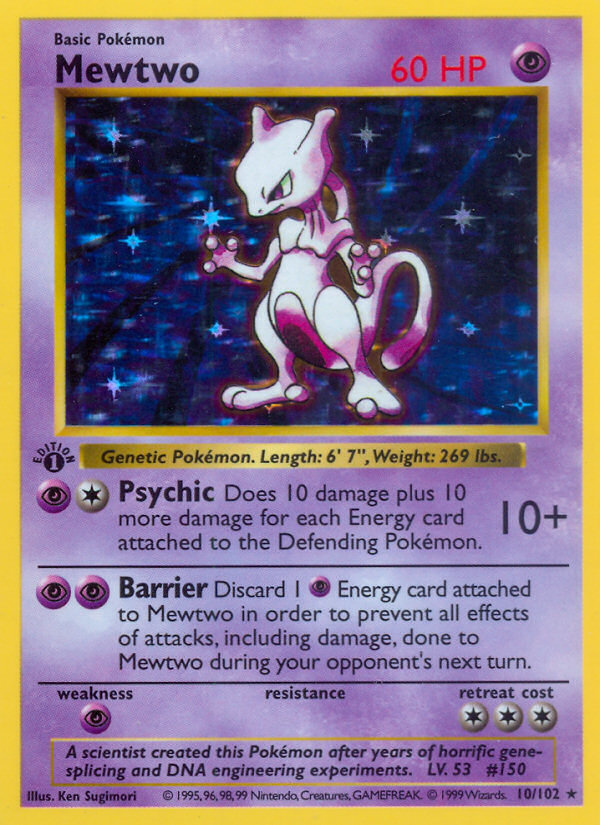
A PSA 10 is described by PSA as "a virtually perfect card." Four sharp corners, sharp focus, full original gloss, and no staining of any kind — PSA does allow a slight printing imperfection at this grade if it doesn't hurt the card's overall appeal, but that's the only flaw category with any wiggle room at all. Everything else on a Gem Mint card has to be essentially flawless, and the front centering tolerance (roughly 55/45 or better) is the tightest on the entire scale. This is the grade cards like a Base Set Charizard or a well-preserved 1st Edition Base Set Mewtwo chase, and it's the grade that separates a card worth a meaningful premium from a card that's merely nice.
A PSA 9 is "a superb condition card" that's allowed exactly one minor flaw from a short, specific list: a very slight wax stain on the back, a minor printing imperfection, or slightly off-white borders. Not two of those — one. Centering loosens slightly to roughly 60/40 or better on the front and 90/10 or better on the back, which is actually the same back-centering standard that carries all the way down through PSA 7. In practice, the jump from 9 to 10 is often less about any single visible flaw and more about centering and gloss holding up under a loupe — which is also why, as covered below, there's no half-step between them.
PSA 8 Through PSA 6: Still Elite, Starting To Show It
A PSA 8 (Near Mint-Mint) is PSA's way of describing a card that "appears Mint 9 at first glance," but doesn't quite hold up on closer inspection. The allowed flaws expand a little at this tier: a very slight wax stain on the back, the slightest fraying at one or two corners, a minor printing imperfection, and/or slightly off-white borders — notably, more than one of these can be present at once, unlike at PSA 9. Front centering eases to roughly 65/35 or better.
A PSA 7 (Near Mint) allows slight surface wear that's visible on close inspection, slight fraying on some corners, and picture focus that may be slightly out of register. A minor printing blemish is acceptable, and slight wax staining is acceptable — but only on the back of the card. Front centering loosens further to roughly 70/30 or better. If you've spent time with raw, ungraded cards and the language of condition tiers like Near Mint and Excellent already sounds familiar, that's not a coincidence — our raw card condition guide (NM, LP, MP, HP, DMG) covers the seller-side version of this same vocabulary, though the two systems aren't a direct one-to-one match.
A PSA 6 (Excellent-Mint) is where wear stops being something you have to hunt for. PSA's own language says the card "may have visible surface wear or a printing defect," and "a very light scratch may be detected only upon close inspection." Corners "may have slightly graduated fraying," and the card "may show some off-whiteness on borders." Front centering opens up to 80/20 or better, with the back holding at 90/10 or better — the same back standard shared by PSA 7 and PSA 5, and again at PSA 3. PSA 4 actually follows the same back standard as PSA 7, PSA 6, PSA 5, and PSA 3 — 90/10 or better; its front centering matches PSA 5's at 85/15 rather than loosening further.
Cards submitted for grading are typically shipped in a semi-rigid sleeve inside a top-loader, not loose in a binder page or a soft penny sleeve alone. These are the two things worth having on hand before you package a submission.
As an Amazon Associate, Geeky Domain earns from qualifying purchases. eBay links are affiliate links; Geeky Domain may earn a commission at no extra cost to you.
PSA 5 Through PSA 1: Played, Worn, and Poor
A PSA 5 (Excellent) is the grade where PSA's own description starts using the word "becoming" a lot: "very minor rounding of the corners is becoming evident," and surface wear or printing defects "are more visible." Several light scratches may be visible on close inspection without hurting the card's overall appeal. Front centering loosens to 85/15 or better. A PSA 4 (Very Good-Excellent) holds the front centering standard at 85/15 or better, the same as a PSA 5, with the back staying at 90/10 or better — while allowing corners that "may be slightly rounded," surface wear that's "noticeable but modest," light scuffing or light scratches, and even a light crease.
A PSA 3 (Very Good) is where original gloss really starts to disappear: PSA notes that "much, but not all, of the card's original gloss will be lost," a crease may be visible, and wax staining on the reverse may be more prominent. A PSA 2 (Good) pushes further — corners "show accelerated rounding," surface wear "is starting to become obvious," and the card may have scratching, scuffing, light staining, or chipping of enamel, with several creases and original gloss possibly gone entirely. Both PSA 3 and PSA 2 require centering of 90/10 or better on front and back, the loosest centering standard PSA specifies anywhere on the numeric scale.
Below Good sits PSA 1.5 (Fair), a distinct named tier rather than a half-point bump: corners "will show extreme wear, possibly affecting framing of the picture," the surface shows "advanced stages of wear, including scuffing, scratching, pitting, chipping and staining," and the card may have one or more heavy creases. Critically, a Fair card still has to be fully intact — PSA is explicit that it cannot be missing solid pieces, like a full corner or the back layer, no matter how worn it looks otherwise. Below that is PSA 1 (Poor), the last numeric grade on the scale, where PSA's language shifts from "worn" to genuinely damaged: a Poor card "may be missing one or two small pieces," may show "major creasing that nearly breaks through all the layers of cardboard," extreme discoloration or dirtiness, or noticeable warping. If you're sorting through an old collection you didn't build yourself — a shoebox from a relative, say — a lot of what turns up will land somewhere in this lower half of the scale, and our guide to valuing an inherited Pokemon collection walks through what that actually means for value. It's also worth handling anything in this range with real care going forward; our sleeves, binders, and top-loaders guide covers the basics of not making a low grade worse.
Half Grades, Authentic, and the No-Grade Codes
PSA states that cards exhibiting high-end qualities within a particular grade, between PSA 2 and PSA 9, may achieve a half-point increase — 2.5, 3.5, 4.5, 5.5, 6.5, 7.5, and 8.5 all exist as real grades you'll see on labels. Centering gets specific weight in that decision; PSA describes graders giving "a clear focus on centering" when deciding whether a card clears the half-point bar. What doesn't exist is a 9.5 — the half-point mechanic runs from 2 up through 9, and 10 is the only step above a 9. PSA 1.5 (Fair) is a separate case: it's a distinct named tier below Good, not a half-point bump applied to a 1 or a 2.
Not every card that comes back from PSA carries a number at all. Authentic (coded N0) means PSA is only certifying that the card is genuine, without a numerical grade, because of an alteration, a major defect, or because the original submitter requested encapsulation without a grade. Authentic Altered (coded AA) is a related but distinct designation: PSA has confirmed the card is genuine but it shows evidence of trimming, recoloring, restoration, and/or cleaning, so it can't receive a numerical grade — and unlike plain Authentic, AA has to be specifically requested as the minimum grade on the submission form. For what it's worth to collectors thinking about resale value, PSA treats Authentic and Authentic Altered as equal in value to each other under its Financial Grade Guarantee, even though the two are certified for different reasons. If you're trying to work out whether a slab in front of you is legitimate in the first place, our guide to authenticating vintage Pokemon slabs and packs is the deeper resource on that specific problem.
Beyond Authentic and Authentic Altered, PSA also publishes a set of reason codes for cards that get no grade at all. N1 covers evidence of trimming, N2 evidence of restoration, N3 evidence of recoloration, and N4 questionable authenticity — a counterfeit card or a non-genuine autograph, which PSA says can never be encapsulated under any grade regardless of how the card otherwise looks. N5 is altered stock, covering things like crease or wrinkle pressing, scratch removal, enhanced gloss, or foreign substances applied to the card. N6 is a minimum size requirement failure — an undersized card relative to factory spec, and one of only three codes (alongside N8 and N9), which PSA notably doesn't charge a grading fee for. N7 is evidence of cleaning, such as whitened borders or removed wax, gum, or tobacco stains. N8 is miscut, and N9 simply means don't grade. If a card you're looking at has ever come back with an N4, that's PSA's own language for a counterfeit — a topic our how to spot counterfeit cards guide covers from the buyer's side before a card ever reaches a grader.
| Code | Reason |
|---|---|
| N1 | Evidence of Trimming |
| N2 | Evidence of Restoration |
| N3 | Evidence of Recoloration |
| N4 | Questionable Authenticity (counterfeit card or non-genuine autograph) |
| N5 | Altered Stock (crease/wrinkle pressing, scratch removal, enhanced gloss, foreign substances) |
| N6 | Minimum Size Requirement (undersized vs. factory spec; no grading fee charged) |
| N7 | Evidence of Cleaning (whitened borders, removed wax/gum/tobacco stains) |
| N8 | Miscut |
| N9 | Don't Grade |
The Qualifiers: MK, MC, OC, ST — and Two More
A few PSA labels carry a letter code alongside the number, and these are worth knowing separately from the grade itself. MK (Marks) applies to any card with writing, ink marks, pencil marks, or evidence of the impression left behind from writing. MC (Miscut) applies to a card that exhibits an atypical cut for the issue, which may mean part of the subject card is cut off or more than one card is visible on the same piece of cardboard. ST (Staining) applies to a stained card — PSA notes a stained card will either be designated ST outright or will receive a numerical grade that reflects the maximum staining allowed for that grade. Two more round out PSA's list: PD (Print Defect), for a card with a notable factory print defect such as an ink line or a registration error, and OF (Out of Focus), for a card that is excessively blurry or has focal issues.
OC (Off Center) works the same way as ST: an off-center card will either be designated OC or will receive a numerical grade that reflects the minimum centering allowed for that grade. PSA measures centering as the percent difference in border width at the most off-center point on the card, front and back, and it gives a 5% leeway on the front centering minimum for cards that otherwise meet the criteria for PSA 7 or better — meaning a card that measures 65/35 off-center on the front but meets every other PSA 9 criterion may still be deemed to meet PSA's front centering standard for a 9, provided the overall eye appeal is good. This is one of the clearer places PSA states outright that grading isn't purely mechanical: PSA is explicit that graders "reserve the right, based on the strength or weakness of the eye appeal, to make a judgment call on the grade of a particular card." Two cards with identical measurable flaws can land on different grades depending on how they actually look. This same subjectivity is part of why PSA won't grade cards showing evidence of trimming, recoloring, restoration, or other tampering, or cards of questionable authenticity — those fall under PSA's ungradable-cards policy and typically come back as a No Grade or an Authentic designation instead of a number. This standard applies the same way whether the card in the slab is a vintage Pokemon holo or a Lorcana Enchanted — our Lorcana grading guide for Enchanted cards applies this exact PSA scale to that game specifically.
FAQ & Quick Reference
What's the real difference between a PSA 10 and a PSA 9? Mostly centering and gloss. A PSA 10 needs roughly 55/45 or better centering on the front with no staining and full original gloss, while a PSA 9 allows one minor flaw from a short list (slight wax stain on back, minor printing imperfection, or slightly off-white borders) and a looser front centering standard of roughly 60/40 or better.
Does PSA give out a 9.5 grade? No. PSA's half-point system runs between PSA 2 and PSA 9 — you'll see 2.5 through 8.5 on labels — but there is no 9.5. A 10 is the only grade above a 9.
Is a PSA "Authentic" label a bad thing? Not necessarily. Authentic (N0) means PSA has confirmed the card is genuine but isn't assigning it a numerical grade, which can happen because of an alteration or major defect, or simply because the submitter requested that option. It's a different outcome from a low numeric grade, not automatically a worse one.
What's the difference between Authentic and Authentic Altered? Authentic Altered (AA) specifically means PSA found evidence of trimming, recoloring, restoration, and/or cleaning, and AA has to be requested as the minimum grade on the submission form. Plain Authentic covers other reasons a numeric grade wasn't assigned. PSA treats the two as equal in value to each other under its Financial Grade Guarantee.
What do the OC, ST, MK, and MC codes mean on a label? OC flags an off-center card, ST flags staining, MK flags writing or ink/pencil marks, and MC flags a miscut card where the print itself was cut incorrectly. Any of these can appear alongside a numeric grade.
How exactly does PSA measure centering? As the percent difference in border width at the most off-center point on the card, checked on both the front and the back. PSA also allows a 5% leeway on the front centering minimum for cards that otherwise meet the criteria for PSA 7 or better, so a card slightly outside the stated threshold can still clear the bar if its overall eye appeal holds up.
Does a PSA 10 always sell for way more than a PSA 9 of the same card? Directionally, yes — collectors and marketplaces widely report PSA 10 copies commanding a substantial premium over PSA 9s of the same card, and the Logan Paul Pikachu Illustrator sale above is an extreme example of how much a top grade can matter. But PSA itself doesn't publish a specific multiplier, and the real gap varies enormously by card, set, and how many PSA 10s of that exact card exist — check a live population report before assuming any fixed ratio.
Verdict: The Number Is a Checklist, Not a Vibe.
Every PSA grade from 1 to 10 maps to a specific, published set of criteria — corner sharpness, surface wear, gloss, staining, and a centering tolerance that gets stricter the higher you climb. Once you know what a 9 actually requires versus a 7, a label on a slab stops being an opaque number and starts being a short, readable description of exactly what's wrong (or right) with the card inside it.
© GEEKYDOMAIN.COM | Strategy Powered by Data