

The Final Fantasy Universes Beyond Set: What's Worth Owning
A buyer's guide to Magic's best-selling crossover ever — which precons, chase cards, and boosters are actually worth your money.
Some links below are affiliate links. If you buy through them, Geeky Domain may earn a small commission at no extra cost to you.
When Magic: The Gathering—FINAL FANTASY launched globally on June 13, 2025, it didn't just do well for a crossover set — it became the best-selling Magic set in the game's history before a single booster pack was even cracked. According to Hasbro CEO Chris Cocks, presales alone brought in roughly $200 million in a single day, a number that took the previous record-holder, the Lord of the Rings Universes Beyond set, about six months to reach. That's not hype talk. That's a Final Fantasy fandom and a Magic fandom colliding at exactly the right moment.
More than a year removed from launch, the set is still generating headlines, still moving sealed product at prices well above what a typical Standard-legal release commands, and still hiding at least one card that collectors are actively hunting for with real bounty money attached. But "Final Fantasy Magic cards" isn't one product — it's three: a main set, four Commander precon decks, and a bonus reprint sheet, each with its own reasons to buy in and its own traps for someone jumping in without a map.
This guide breaks down what's actually in the set, which of the four Commander precons fits which kind of player, which individual cards carry real long-term value, and what to watch out for before you spend money chasing a name you recognize from a JRPG rather than a card that's actually good at the table. Whether you're buying for gameplay, collecting, or both, here's what's worth owning. For the wider strategy picture, start with our MTG Strategy Hub.
The Short Version
Magic: The Gathering—FINAL FANTASY released June 13, 2025, as the main FIN set alongside four Final Fantasy Commander precons (Limit Break, Revival Trance, Counter Blitz, and Scions & Spellcraft) and a bonus reprint sheet called Final Fantasy: Through the Ages. For gameplay value, the precons are the safest buy — each ships with 25 cards new to Magic built around a specific mainline FF game. For chase-card value, look to Sephiroth, Fabled SOLDIER, the Buster Sword, and Vivi Ornitier, all Mythics with real premium-treatment demand. The single most coveted pull in the set is Traveling Chocobo, a gold-foil card serialized to just 1-of-77 worldwide — far scarcer than Wizards' usual 500-copy Headliner run — and one has sold for roughly $40,000. Presales alone made this the best-selling Magic set ever, at an estimated $200 million in a single day, and sealed product has continued to trade well above typical Standard-set pricing since.
In This Guide
- → What Is the Final Fantasy Universes Beyond Set?
- → The Four Commander Precons, Compared
- → The Chase Cards Worth Chasing
- → Traveling Chocobo: Magic's Rarest Recent Chase Card
- → Collector Boosters and Premium Treatments
- → Is Final Fantasy Still Worth Buying Now?
- → Common Mistakes to Avoid
- → FAQ & Quick Reference
What Is the Final Fantasy Universes Beyond Set?
Magic: The Gathering—FINAL FANTASY is a Universes Beyond crossover set that released globally on June 13, 2025. Universes Beyond is Wizards of the Coast's line of officially licensed Magic products built around outside intellectual property — Final Fantasy joins a lineup that has previously included franchises like Lord of the Rings. Unlike a lot of crossover product, this wasn't a side release; it launched as a full, standalone set with its own draft environment, its own Commander precons, and its own bonus content.
The release actually spans three distinct products, and understanding the difference matters before you spend a dollar. The main set, coded FIN, is the drafting and Standard-legal card pool — this is where you'll find individual legendary creatures, equipment, and spells representing characters and moments from across the Final Fantasy series. Separately, Final Fantasy Commander (set code FIC) is a line of four ready-to-play 100-card precon decks, each themed to a specific mainline Final Fantasy game. And rounding things out, Final Fantasy: Through the Ages (set code FCA) is a bonus reprint sheet found in Collector Boosters — classic, previously printed Magic cards reprinted with new Final-Fantasy-themed artwork, including a reimagined Lightning Bolt.
That three-part structure is the key to shopping smart here. If you want to play Commander out of the box, you're buying FIC. If you want individual chase cards or want to draft, you're buying FIN product. If you're a collector chasing alternate art on cards you already own, FCA pulls from Collector Boosters are what you're after. The rest of this guide walks through each in order of what most people actually want first: a deck to play.
The Four Commander Precons, Compared
The four Final Fantasy Commander decks are the most straightforward "worth owning" answer in this entire set. Each one ships with 25 cards new to Magic, plus reprints of existing Magic cards given new Final-Fantasy-themed art, all built around a commander (or commander pair) pulled from a specific mainline entry in the series. If you want to play Commander with a Final Fantasy theme right out of the box, this is the on-ramp. For how these four compare to the wider field, see our guide to which Commander precon to buy.
| Deck | Colors | Commander(s) | Source Game |
|---|---|---|---|
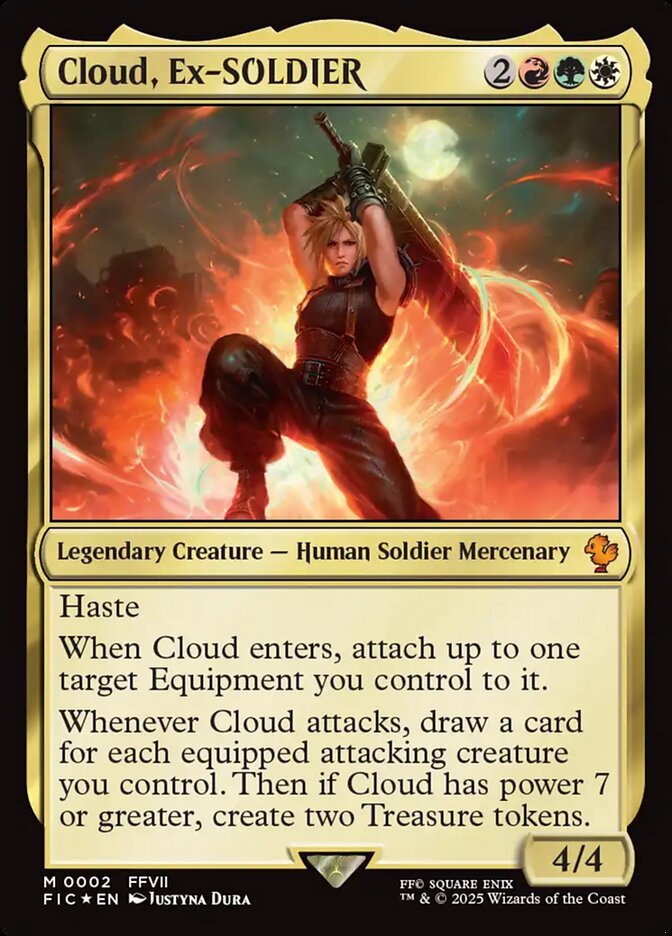
| Limit Break | Naya (RGW) | Cloud, Ex-SOLDIER | Final Fantasy VII |
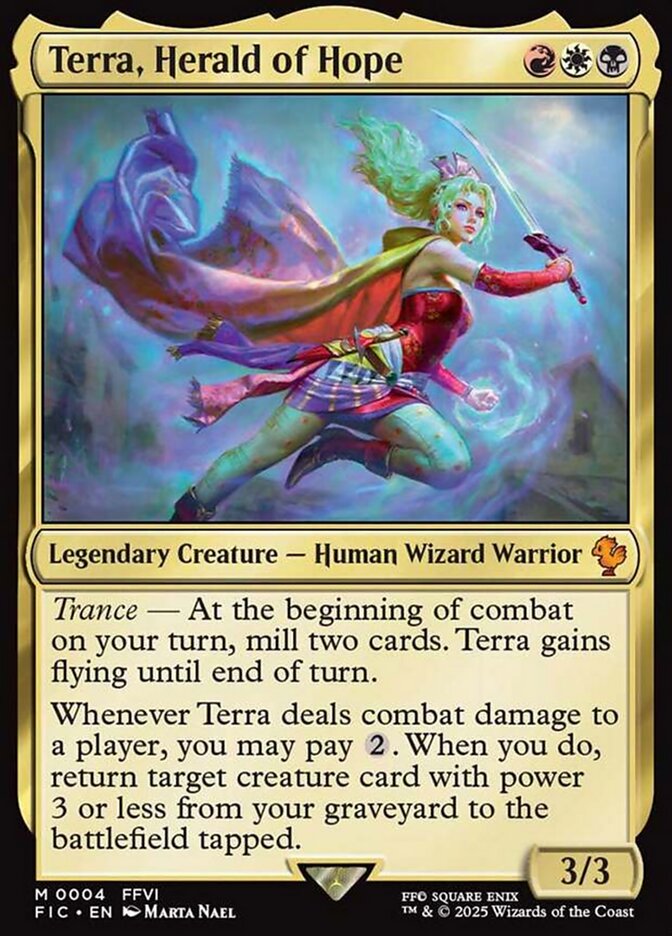
| Revival Trance | Mardu (RWB) | Terra, Herald of Hope | Final Fantasy VI |
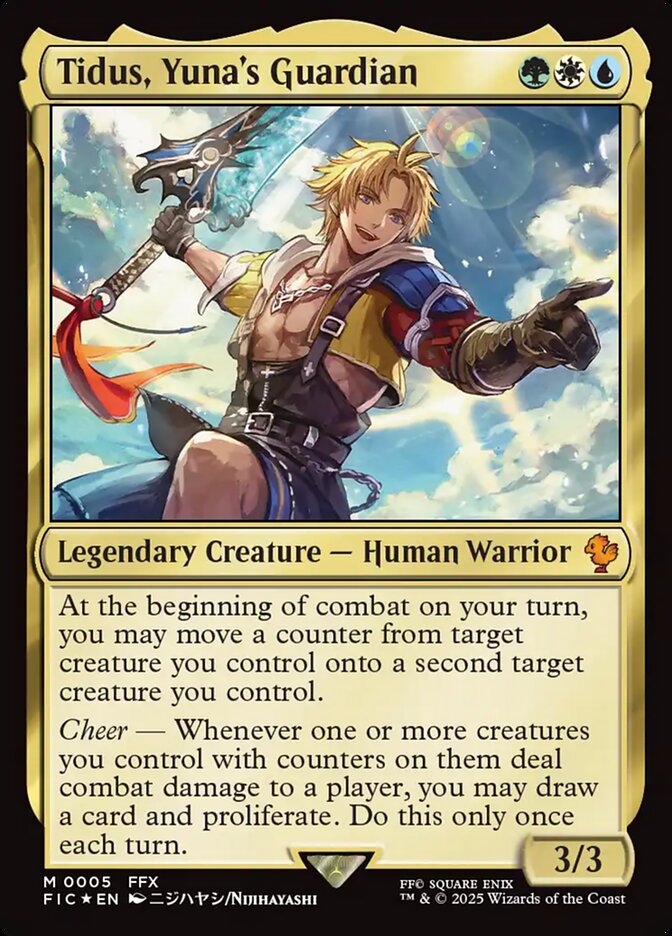
| Counter Blitz | Bant (GWU) | Tidus, Yuna's Guardian | Final Fantasy X |
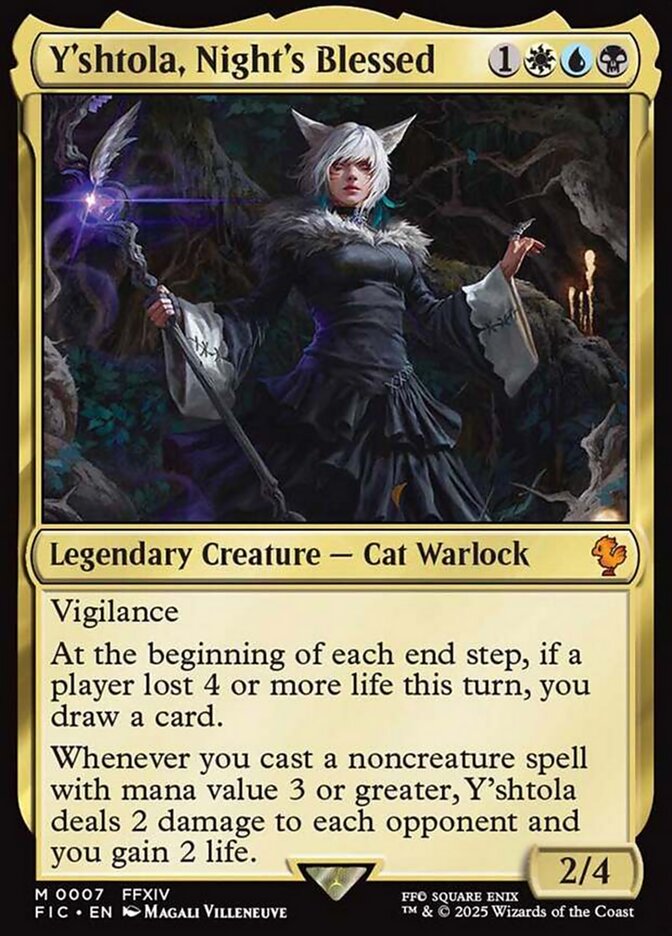
| Scions & Spellcraft | Esper (WUB) | Y'shtola, Night's Blessed & G'raha Tia, Scion Reborn | Final Fantasy XIV |
Limit Break is the aggressive, go-wide-then-swing option, led by Cloud, Ex-SOLDIER — a natural pick if you want a deck that plays out fast and rewards attacking. Revival Trance leans into a mill-and-reanimate game plan: Terra, Herald of Hope has a Trance ability tied to milling and flying, plus a reanimation trigger that fires off combat damage, which makes the deck feel like it's constantly refilling itself from the graveyard.
Counter Blitz is built around Tidus, Yuna's Guardian, whose kit revolves around moving counters and a "Cheer" trigger that draws cards and proliferates — a good fit if you enjoy +1/+1 counter synergy decks that reward keeping creatures alive rather than racing. Scions & Spellcraft is the control-leaning outlier of the four, pairing Y'shtola, Night's Blessed with G'raha Tia, Scion Reborn in a noncreature-spell drain-and-control shell — the deck to pick if you'd rather win through attrition and card advantage than combat. All four ship well under the power ceiling that would push a deck into a higher Commander bracket.
If you're only buying one, think about it in terms of pace: Limit Break for aggro, Revival Trance for graveyard value, Counter Blitz for counters-matter grindiness, and Scions & Spellcraft for control. None of these are objectively "the best" precon — they're built to feel distinct out of the box, and each holds up fine as a starting point for further upgrades using our mana curve and budget staples guides, and pairs well with our $50 Commander deck blueprint if you want to build one out further.
Check current availability across the main marketplaces before assuming a precon or chase card is gone for good.
As an Amazon Associate, Geeky Domain earns from qualifying purchases. eBay links are affiliate links; Geeky Domain may earn a commission at no extra cost to you.
The Chase Cards Worth Chasing
Outside the precons, the main FIN set has a handful of cards that stand out as the ones actually worth pursuing individually, either for how they play or for how collectible they've turned out to be.
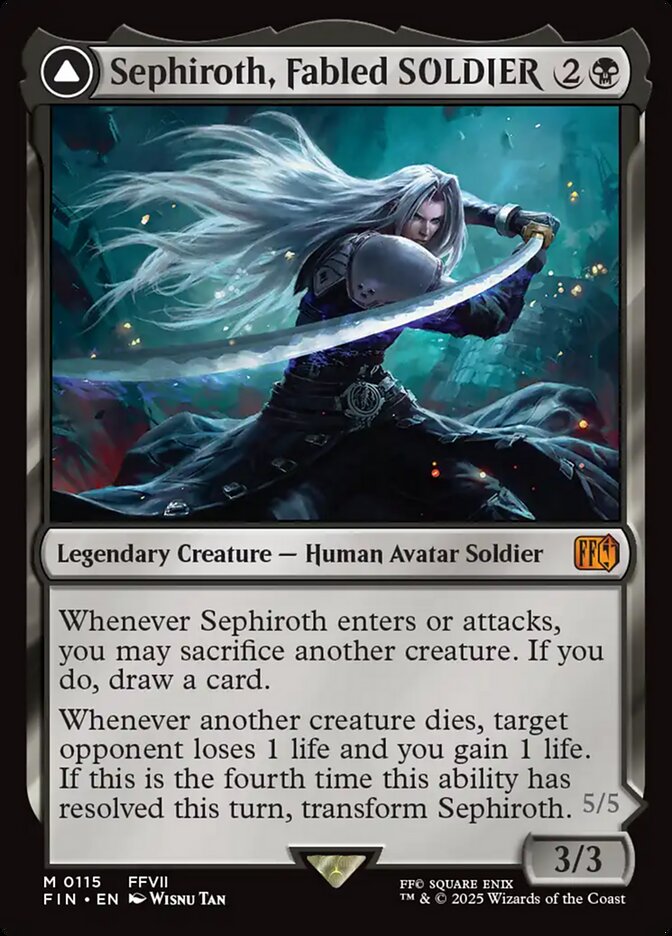
The clear headline card is Sephiroth, Fabled SOLDIER // Sephiroth, One-Winged Angel, a double-faced Mythic and one of the set's premier chase cards. Pricing on this card shows just how much premium treatments matter in this set: the regular version has traded around $32, foil around $41, Borderless Foil around $62, and the Borderless Surge Foil version has sold as high as roughly $836 ungraded, according to price-tracking sites like MTGGoldfish and MTGStocks. Those are snapshot figures that will have moved by the time you're reading this, but the spread itself tells the real story — on a card like this, the treatment can matter more than the card frame or rarity line alone. A separate card, Sephiroth, Planet's Heir, also exists in the set as a distinct printing.
The Buster Sword is the set's Mythic-rarity Equipment artifact — colorless, so it slots into any deck — and it's genuinely strong on top of being collectible. The equipped creature gets +3/+2, and combat damage triggers a card draw plus a free spell cast, which makes it a real value engine rather than just a stat boost. It's printed at two numbers in the set, a standard version and a borderless alternate art, so collectors have a reason to chase both.

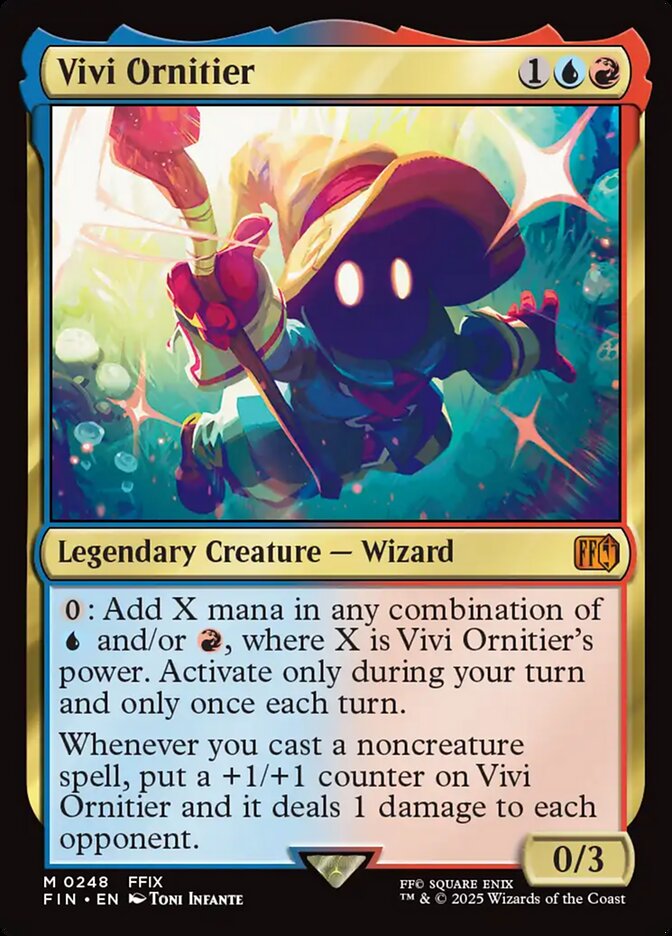
Vivi Ornitier rounds out the must-know Mythics — a {1}{U}{R} Wizard built around a spellslinger shell, gaining +1/+1 counters and dealing damage off noncreature spells. It's become a genuine fan-favorite pickup, with multiple premium printings including a Borderless Foil and an Art Series version giving collectors more than one way to own it. Worth knowing before buying for gameplay specifically: Vivi Ornitier is banned in Standard, so it's a Commander, Modern, and casual pickup rather than a Standard-legal one.
Outside the precon commanders, the regular set also includes standalone legendary Cloud cards — Cloud, Midgar Mercenary and Cloud, Planet's Champion — for players who want a Cloud Strife build outside the Limit Break precon shell. Just don't confuse either of those with Cloud of Darkness, a separate card in the set based on an entirely different character (an antagonist from Final Fantasy III) with no connection to Cloud Strife beyond a similar-sounding name.
Traveling Chocobo: Magic's Rarest Recent Chase Card
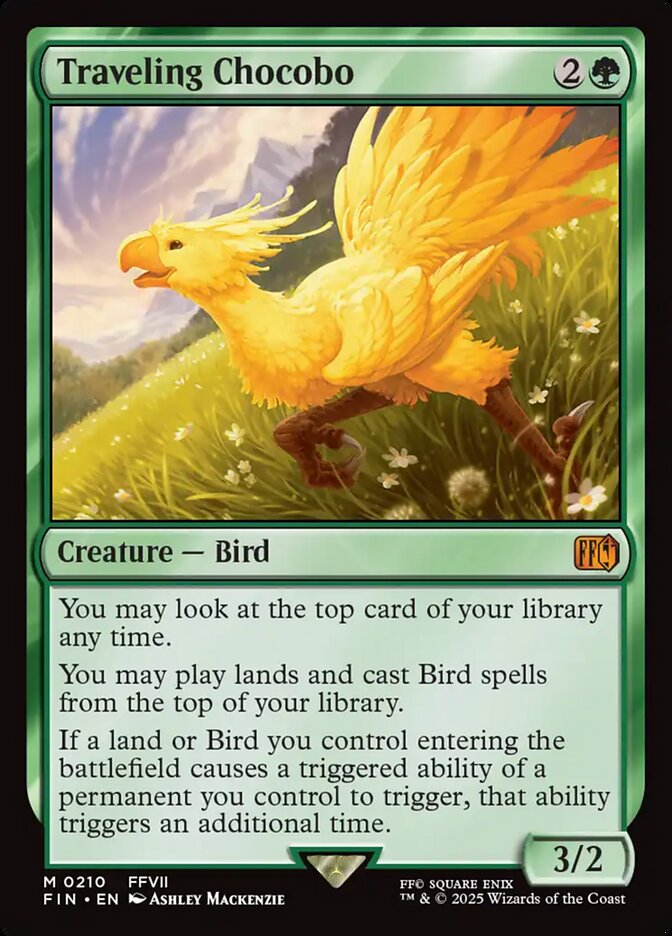
If Sephiroth is the set's headline Mythic, Traveling Chocobo is its white whale. It's a gold-foil, textless Mythic Headliner card — Wizards' term for a serialized chase card found only in Collector Boosters — and it's serialized to just 1-of-77 copies worldwide. To put that in perspective, Wizards' standard Headliner serialization since Innistrad Remastered in January 2025 has been 500 copies. Traveling Chocobo's 77-copy run is a deliberate, dramatic departure from that norm, and the number itself is a nod to Final Fantasy VII.
Only 77 copies of Traveling Chocobo exist in the entire world — and as of mid-2026, dozens of them still hadn't been found.
That scarcity has translated directly into price and into genuine treasure-hunt energy around the card. One serialized Traveling Chocobo sold on the secondary market for roughly $40,000, and coverage from outlets like Wargamer and MTGRocks reported that, well over a year after release, a large portion of the 77 copies remained unaccounted for — unopened, unfound, or simply not yet identified by whoever is sitting on them. One local game store even put up a bounty, reportedly around $22,000 USD (roughly $30,000 CAD), for anyone who surfaces one. Treat both of those dollar figures as illustrative snapshots rather than a live price — what they really communicate is just how coveted this single card has become, not what it's worth today.
Realistically, this isn't a card most players will ever pull, and it shouldn't factor into a normal buying decision — it's mentioned here because it's become part of the set's identity. If you're opening Collector Boosters purely hoping to hit it, go in knowing the odds are astronomically against you and buy for the rest of what's in the box, not for this one card.
Collector Boosters and Premium Treatments
Collector Boosters are where the set's "Booster Fun" premium treatments live, and there are more of them here than a casual buyer might expect. Beyond standard foil, Collector Boosters can contain Borderless Character cards, Borderless Lands, an Artist Series or Woodblock Rare treatment, and Extended Art versions of Legendary creatures. On top of that sits the Final Fantasy: Through the Ages bonus sheet — reprints of classic, previously existing Magic cards given entirely new Final-Fantasy-themed artwork, including a new-art version of Lightning Bolt.
Finish quality also varies. Both Traditional Foil and Surge Foil show up in this set's Collector Boosters — Surge Foil is a premium foil finish Wizards has used across several recent sets, not something exclusive to Final Fantasy, but it's part of what makes Collector Boosters worth the upcharge over Play Boosters if you're after shelf-appeal pulls rather than just playable cards.
For most players, the practical takeaway is this: if you're buying to build a deck, Play Boosters get you there for less money per playable card. If you're buying to collect — chasing alternate arts, foils, and the Through the Ages sheet — Collector Boosters are the only place those pulls live, and the price premium reflects that.
Is Final Fantasy Still Worth Buying Now?
The launch numbers alone made this an outlier release. Presales made Magic: The Gathering—FINAL FANTASY the best-selling Magic set of all time before it even hit shelves, with Hasbro CEO Chris Cocks stating the set earned roughly $200 million in a single day — compare that to the Lord of the Rings Universes Beyond set, the previous record-holder, which took about six months to reach a comparable figure.
What's more notable is that the demand hasn't just faded after launch the way it does with most Standard-legal sets. A mid-2026 check-in article from MTGStocks, checking sealed pricing roughly a year after release, found Collector Boxes trading in the neighborhood of $1,700 and booster boxes near $240 — both well above what a typical Standard set commands even at launch, let alone a year later. That sustained demand, rather than a one-time launch spike, is the strongest argument that this set has staying power beyond a single hype cycle.
A caveat on every price in this article: every dollar figure cited here — Sephiroth's treatment spread, Traveling Chocobo's sale price, Collector Box and booster box pricing — is a snapshot from a specific research or news article at a specific point in time. Sealed product and singles markets move constantly. Before buying anything based on a number you read online, including this article, check current listings on a live marketplace rather than treating any published figure as today's price.
Common Mistakes to Avoid
A few avoidable errors show up over and over when people shop this set for the first time:
Mixing up Cloud of Darkness with Cloud Strife. They're separate characters with similarly-named cards — Cloud of Darkness is a Final Fantasy III antagonist, not an alter ego or variant of Cloud Strife. Don't assume a card with "Cloud" in the name is part of the Limit Break lineup.
Buying a booster box expecting to hit a specific chase card. Cards like Traveling Chocobo are serialized to a handful of copies worldwide out of an enormous print run. Buy sealed product for the overall set value and the fun of opening it, not as a lottery ticket for one specific pull.
Treating a published price as a current price. As covered above, every figure in circulation for this set's cards and sealed product is a snapshot. Prices for Sephiroth's various treatments, Traveling Chocobo sales, and Collector Box values have all moved since they were first reported.
Picking a precon based on the character alone instead of the play style. Cloud might be the name you recognize, but Limit Break's aggressive Naya shell won't suit everyone. Match the deck's mechanics — mill-and-reanimate for Revival Trance, counters for Counter Blitz, control for Scions & Spellcraft — to how you actually like to play. Our list of the best Commander precons of all time is a good reference point for how these stack up more broadly.
Assuming every serialized card in the set follows the same numbering. Traveling Chocobo's 77-copy run is a deliberate exception to Wizards' standard 500-copy Headliner serialization, not the norm — don't assume every serialized pull in this set is equally scarce.
FAQ & Quick Reference
When did the Final Fantasy Universes Beyond set release? Magic: The Gathering—FINAL FANTASY released globally on June 13, 2025.
What are the three Final Fantasy Magic products? The main set (FIN, drafting and Standard-legal cards), Final Fantasy Commander (FIC, the four precon decks), and Final Fantasy: Through the Ages (FCA, a bonus reprint sheet found in Collector Boosters).
Which Commander precon should I buy first? It depends on play style: Limit Break (Cloud, Ex-SOLDIER) for aggro, Revival Trance (Terra, Herald of Hope) for mill-and-reanimate, Counter Blitz (Tidus, Yuna's Guardian) for +1/+1 counter synergy, and Scions & Spellcraft (Y'shtola, Night's Blessed and G'raha Tia, Scion Reborn) for control.
What is Traveling Chocobo and why is it so valuable? It's a gold-foil, textless Mythic serialized to only 1-of-77 copies worldwide — far scarcer than Wizards' usual 500-copy Headliner run — with the number 77 referencing Final Fantasy VII. One has sold for roughly $40,000, and as of mid-2026 many copies remained unfound.
Is Sephiroth, Fabled SOLDIER worth buying? It's the set's premier chase Mythic, a double-faced card with a wide price spread depending on treatment — regular copies have traded far below premium Borderless Surge Foil copies. Check current listings rather than relying on any single published price.
Is Final Fantasy still worth buying now, well after launch? Sealed product has continued trading at prices well above typical Standard-legal sets, based on mid-2026 secondary-market check-ins — a sign of sustained demand rather than a launch-only spike, though prices should always be verified against current listings before you buy.
A Crossover Built to Last, Not Just Sell Out.
The Final Fantasy Universes Beyond set earned its record-breaking sales with real playable depth, not just nostalgia — four distinct Commander precons, a stacked chase-card lineup, and one of the rarest serialized pulls Magic has ever printed. Start with the precon that matches how you like to play, then build out from there.
© GEEKYDOMAIN.COM | Strategy Powered by Data