

Gundam Tournament Format: Rules & Banlist Explained
Heading to your first Gundam Card Game tournament? Here's how the competitive format works, what the match structure looks like, and exactly what's on the banned and restricted list — including the game's first-ever ban and a brand-new rule category you haven't seen before.
Some links below are affiliate links. If you buy through them, Geeky Domain may earn a small commission at no extra cost to you.
The Gundam Card Game is young — it launched in mid-2025 — but its competitive scene has grown fast, and Bandai has built out organized play, official tournament rules, and an increasingly active banned and restricted system to manage the meta. If you're thinking about playing in a sanctioned event, whether that's a local store tournament or a regional championship, knowing the format rules ahead of time keeps you from showing up with an illegal deck or getting blindsided by a procedure you didn't expect.
For the first several months after the banlist launched, this was one of the most forgiving competitive environments around: a single restricted card, and nothing outright banned. That changed on July 24, 2026. A second banned-and-restricted revision landed alongside the GD05 Freedom Ascension set release, and it did two things at once: it handed the game its first-ever outright ban, and it introduced a brand-new banlist category — the Banned Pair — that simply didn't exist before. If the last thing you remember about this list is "zero bans," it's time for an update.
This guide walks through the constructed format rules, the match and tournament structure, how the banned and restricted system works (now with three moving parts instead of one), the full current list, and the practical things you need to know before your first event. As always with a fast-moving young game, treat specific list contents as a snapshot — we'll point you to the official source to confirm the current state before any event.
The Short Version
Competitive Gundam uses a constructed format: a 50-card main deck plus a separate 10-card Resource Deck, up to 4 copies of any card by card number (fewer if it's restricted, zero if it's banned), with a sideboard for between-game swaps. Matches are best two-out-of-three games, with single-elimination top cuts at larger events. The banned and restricted list was introduced in early 2026 and has now been revised twice. The first revision, effective April 1, 2026, restricted ST02-016 Corsica Base to 2 copies. The second, announced July 10 and effective July 24, 2026 (alongside the GD05 Freedom Ascension release), left that restriction untouched and banned GD01-020 Anksha outright — the game's first-ever ban. That same revision introduced a new category called a Banned Pair: two specific cards that can't both be included in the same deck, even though each remains legal on its own. The two confirmed Banned Pairs so far are Amuro Ray + Mikazuki Augus, and Guntank + M1 Astray Shrike. Bandai has also hinted, without giving specifics, that a deeper structural rule change may be coming. None of this makes tournament prep hard — it just means "check the current list" now actually matters.
→ More Gundam Guides
In This Guide
- → The Constructed Format Rules
- → The Sideboard
- → Match & Tournament Structure
- → How the Banlist System Works
- → The Current Banned & Restricted List
- → Why Corsica Base Got Hit
- → Why Anksha Got Banned
- → The New "Banned Pair" Category
- → The Starter Deck Exception
- → Preparing for Your First Event
- → Common Tournament Mistakes
- → FAQ & Quick Reference
The Constructed Format Rules
Sanctioned Gundam tournaments use the standard constructed format — the same deckbuilding rules you'd use in any competitive game, governed by the official Comprehensive Rules. Bandai updates these periodically alongside major announcements; most recently, official Best-of-3 Match Rules were published on July 3, 2026, formalizing procedures for the match structure covered further down. The core deck-construction requirements haven't changed:
- 50-card main deck. Your primary deck is exactly 50 cards, made up of Units, Pilots, Commands, and Bases. This is fixed — not a minimum, a precise count.
- 10-card Resource Deck. Separate from your main deck, you run a 10-card Resource Deck containing only Resource cards. These fuel your plays — you draw from this deck during the Resource Phase rather than placing resources from your hand. It's a distinctive feature of Gundam that trips up players coming from other games.
- Up to two colors. Your deck may use cards from up to two of the game's colors (Blue, Green, Red, White, Purple). This shapes the entire deckbuilding landscape — mono-color for consistency, two-color for flexibility.
- Maximum 4 copies per card number. You can include up to four copies of any card sharing the same card number — unless that card is restricted (which lowers the cap) or banned outright (which drops it to zero). This is where the banned and restricted list comes in, and as of mid-2026 it applies to more than just one card.
- Setup tokens are separate. The EX Base token (used by both players) and the EX Resource token (used by the player going second) are setup pieces, not part of either the main deck or Resource Deck. You don't build them in — they're provided as part of the game's starting setup.
The Sideboard
Like most competitive TCGs, sanctioned Gundam play uses a sideboard — a set of extra cards you can swap into your deck between games in a match. After losing or winning the first game, you may exchange cards from your sideboard into your main deck (and Resource Deck, where applicable) to adapt to what your opponent is doing.
The sideboard matters for the banlist in an important way: restricted and banned limits apply across your deck and sideboard combined. If a card is restricted to two copies, you can't run two in your main deck and two more in your sideboard — the total across both is capped at two. Likewise, a banned card can't appear in your sideboard either. The list also now includes a newer kind of entry — a Banned Pair — that isn't about copy counts at all; we'll walk through exactly how that one works a bit further down.
Sideboarding is one of the skills that separates casual play from tournament play. Knowing which cards to bring in against which matchups — and respecting the combined deck-plus-sideboard limits — is part of competitive preparation. If you're new to the concept, practice your sideboard plan before the event rather than improvising at the table.
Match & Tournament Structure
Gundam tournaments follow a familiar competitive structure. The key details based on official event rules:
- Best two-out-of-three games per match. A match isn't a single game — you play until one player wins two games. This is where the sideboard comes into play between games, and why a single unlucky opening doesn't end your match. Bandai formalized these procedures in a dedicated Best-of-3 Match Rules document published July 3, 2026, if you want the full procedural detail.
- Swiss rounds, then single-elimination top cut. Larger events typically run several Swiss rounds (where you keep playing regardless of losses, paired against players with similar records), followed by a single-elimination bracket for the top finishers. Grand finals and championship events use single-elimination top cuts.
- Time limits at most events (with exceptions). Preliminary rounds usually have a time limit per match; some high-level elimination rounds (like grand finals) may be played with no time limit. Always check the specific event's structure — time limits affect how you pace your games.
- A tiered penalty system. Official events use escalating penalties — cautions for minor issues, warnings for more significant ones, and forfeits or disqualification for serious or repeated violations. Foul play results in an immediate game loss; leaving your seat during a match can forfeit it. Electronic devices generally aren't permitted during matches.
- Provided sleeves at premier events. At top-tier events like championships, organizers may provide standard sleeves that all players must use, distributed at sign-in. This levels the playing field and prevents marked-card concerns. Local events usually let you use your own (unmarked) sleeves.
How the Banlist System Works
Bandai introduced Gundam's banned and restricted system in early 2026 — a sign the game's competitive meta had matured enough to need active management. Two revisions later, the system now runs on three designations instead of two:
Banned
A banned card cannot be included in your deck or your sideboard — not even a single copy. It's completely off-limits in sanctioned play. As of the July 24, 2026 revision, there is one banned card: GD01-020 Anksha, the first card in the game's history to receive this designation.
Restricted (N)
A restricted card may be included only up to the specified number of copies — across your deck and sideboard combined. "Restricted (2)" means a maximum of two copies total, down from the normal four.
Banned Pair
Brand new as of July 2026. A Banned Pair doesn't ban either card by itself — both stay fully legal on their own. What's illegal is running both cards from the same named pair in one deck at the same time.
Revised — But Not Always On a Six-Month Clock
Bandai originally said it expected to revise the banned and restricted list roughly once every six months. The first revision took effect April 1, 2026. The second, though, arrived faster than that guidance implied — announced July 10 and effective July 24, 2026, only about three and a half months later. That doesn't necessarily mean every future revision will come that quickly, but it's a reminder that "roughly six months" was a stated expectation, not a promise. Local tournament schedules can also shift the exact enactment date at your specific event. Confirm the current list before every event rather than counting months since the last update.
Separate from the banned and restricted list, Bandai also periodically issues errata — text corrections to how individual cards function, distinct from copy-count limits. Steel Requiem [GD03] received errata on January 30, 2026, and Phantom Aria [GD04] followed on April 10, 2026. Errata doesn't change how many copies of a card you can run; it clarifies or corrects what the card actually does. It's a different mechanism from the ban list this guide focuses on, but worth knowing exists if a card seems to behave differently than you remember.
Stock Up Before Your Next Event
Whether you're picking up the ST02 Wings of Advance starter deck to run exactly as it comes, or grabbing product from the new GD05 Freedom Ascension release, here's where to compare prices before you buy.
The Current Banned & Restricted List
As of the revision effective July 24, 2026, here's the complete list:
| Designation | Cards |
|---|---|
| Banned (0 copies) | GD01-020 Anksha |
| Restricted (2) | ST02-016 Corsica Base |
| Banned Pair | Amuro Ray + Mikazuki Augus (cannot both be in the same deck); Guntank + M1 Astray Shrike (cannot both be in the same deck) |
That's three separate things to check now instead of one: don't play Anksha at all, cap Corsica Base at 2 across your deck and sideboard, and make sure your deck doesn't combine either Banned Pair. Everything else in the game remains fully legal at the standard 4 copies.
This is still a short list for a competitive TCG — most cards in the game are unaffected — but it's no longer the near-nonexistent list the format had for most of its first year. If you last built a tournament deck before July 24, 2026, assume something on your list needs a second look.
Confirm before you go. This list reflects the revision effective July 24, 2026. Bandai's stated cadence is roughly every six months, but the second revision arrived faster than that guidance suggested — so don't assume the list is static just because your last event was recent. Always verify the current banned, restricted, and Banned Pair list on the official Gundam Card Game website before registering a deck.
Why Corsica Base Got Hit
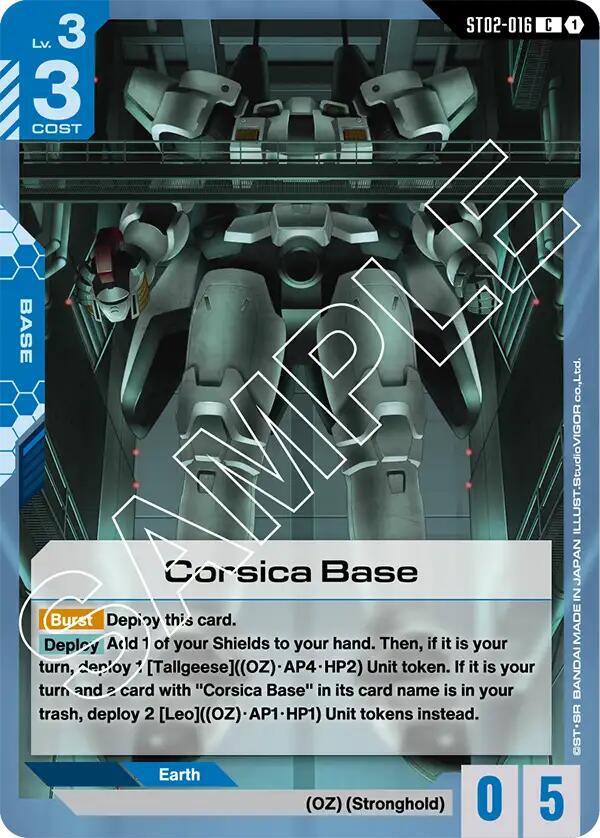
The reasoning Bandai gave for restricting Corsica Base is a useful window into how they think about the meta. Corsica Base was originally designed as a Base card that could deploy Unit tokens as attackers while protecting the player throughout the game — a defensive engine with offensive upside.
In practice, it exceeded expectations. According to Bandai's stated reasoning, Corsica Base appeared in a majority of decks using blue, and those decks posted a high win percentage — particularly faster blue-purple builds. When one card shows up in most decks of a color and correlates with winning, that's a textbook signal of an over-centralizing card: it narrows the meta because not running it puts you at a disadvantage.
Rather than ban it outright, Bandai restricted it to 2 copies. The goal, in their words, was to reduce its prevalence in fast decks and create more diversity in the meta — letting it still see play, but not as a guaranteed 4-of in every blue deck. It's a measured first move from a developer clearly trying to avoid heavy-handed bans on a young game.
That reasoning — and the resulting restriction — hasn't changed since. Bandai left Corsica Base exactly where it was when it revised the list again on July 24, 2026, even as it moved more decisively elsewhere in the format for the first time.
Why Anksha Got Banned
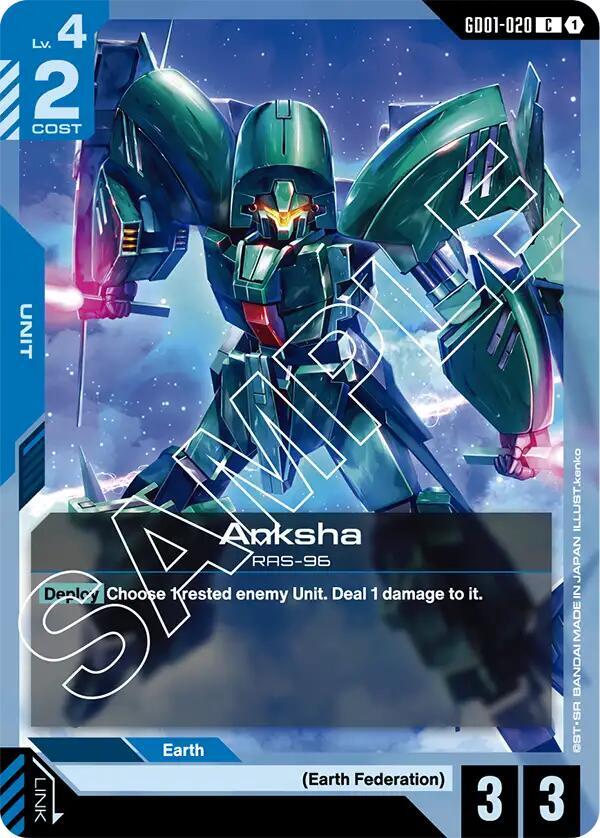
GD01-020 Anksha is the headline of the July 2026 revision — the first card ever removed outright from legal play in the Gundam Card Game. Unlike the Corsica Base case, Bandai hasn't published the same kind of detailed usage-rate breakdown to explain this one. As of this writing, the company's specific stated reasoning for singling out Anksha by name hasn't been laid out in public in that level of detail.
What's confirmed: the ban was announced July 10, 2026, and took effect July 24, 2026 — the same day GD05 Freedom Ascension released, putting a fresh wave of new cards into the format at the same moment Anksha left it. Bandai has also said, in the context of this same revision, that it's watching fast Blue/Purple and Blue/Green decks and weighing whether the game needs something more structural than banlist tweaks to address them (more on that in the next section). It's a reasonable inference — and only an inference, not a quoted Bandai justification — that Anksha's role in that speed-oriented part of the metagame factored into the decision. Treat that as informed speculation, not confirmed fact, until Bandai publishes more detail.
Practically, none of that changes what you need to do at the table: Anksha is banned, full stop. Zero copies, in your deck or your sideboard, regardless of the exact reasoning behind it.
The New "Banned Pair" Category
The July 24, 2026 revision didn't just add a ban — it added an entirely new kind of banlist entry that the Gundam Card Game had never used before: the Banned Pair.
A Banned Pair works differently from anything else on the list. It doesn't ban a card. Both cards in a Banned Pair remain individually legal — you can run either one, up to its normal copy limit, with no restriction on that card by itself. What's prohibited is combining both cards from the same named pair into a single deck. Include one, and you're fine. Include both, and your deck is illegal for sanctioned play.
As of the July 2026 revision, there are two confirmed Banned Pairs:
- Amuro Ray + Mikazuki Augus. These two cards cannot both be included in the same deck. Each is fully legal on its own.
- Guntank + M1 Astray Shrike. Same rule: these two cannot share a deck together, but neither is banned or restricted individually.
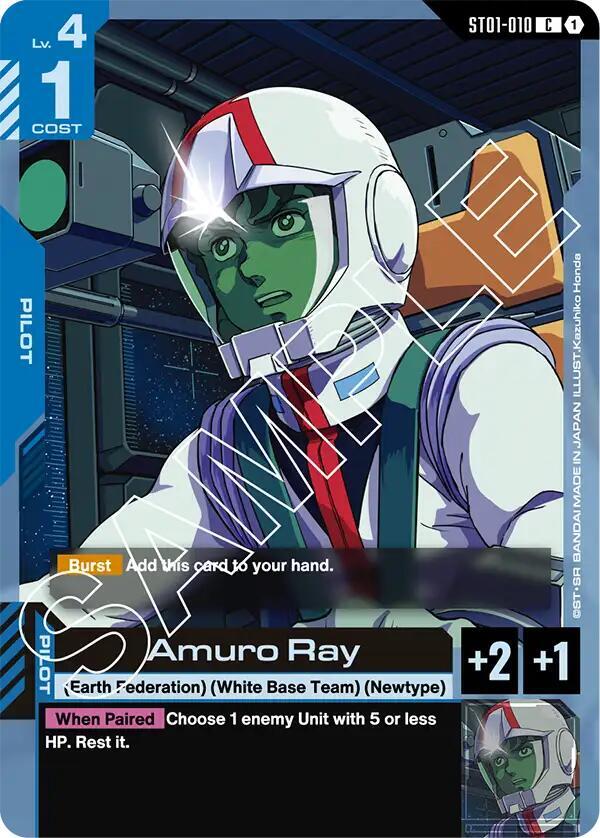
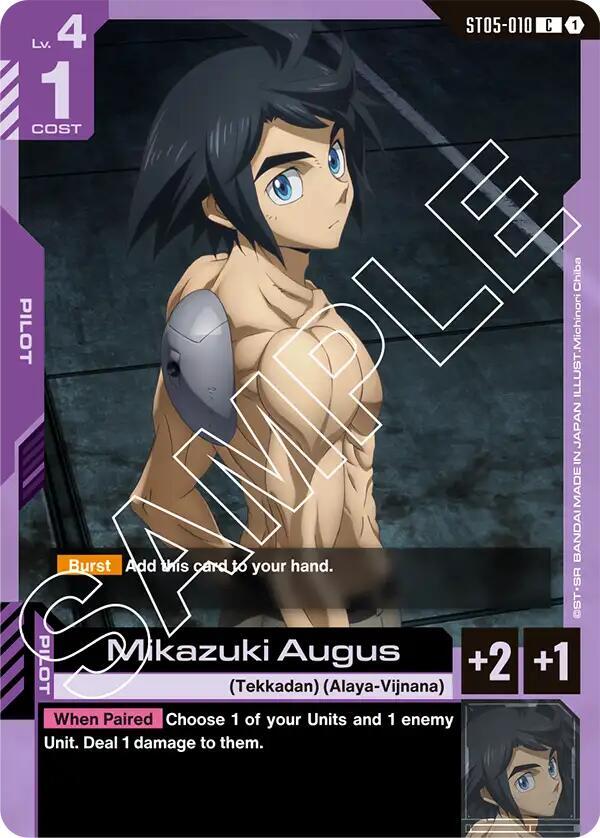
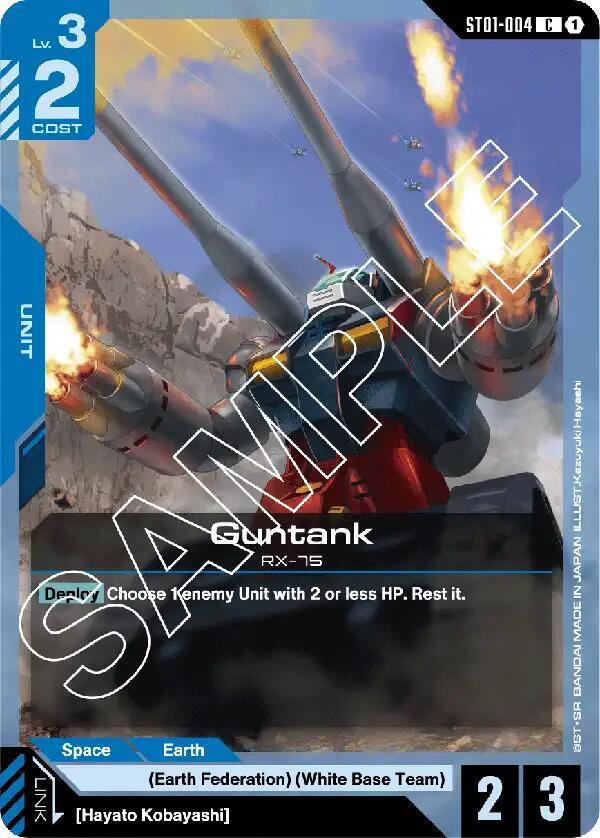
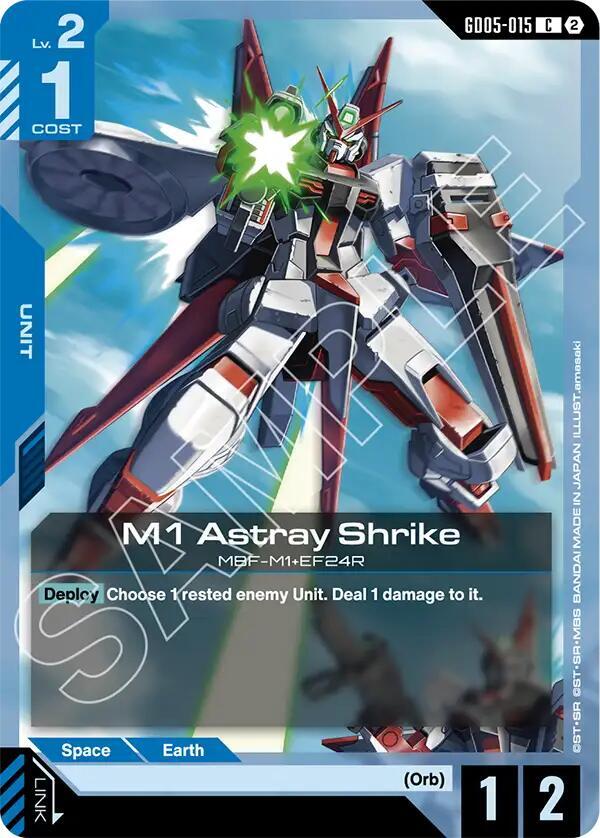
This is a genuinely new tool for Bandai, and it's worth understanding why they might reach for it instead of a straightforward restriction or ban. Banning or restricting a card affects every deck that wants to play it, for any reason. A Banned Pair is narrower — it only stops one specific combination, leaving each card free to do its own thing in every other context. If the underlying problem is a particular interaction between two cards rather than either card being overpowered on its own, a Banned Pair lets Bandai target that interaction directly instead of taking a broader swing that limits decks that were never part of the problem.
A Possible Rule Change on the Horizon
Alongside the July 2026 revision, Bandai flagged something bigger than any single card update: it said fast Blue/Purple and Blue/Green decks may need "something deeper in the game rules" to fully address, and that it's considering a more fundamental rule change to the format. That's as far as the confirmed detail goes — Bandai has hinted at, but not detailed, a possible future rule change, with no specifics announced about what such a change would actually involve or when it might arrive. Don't build your tournament plans around a rumor; there's nothing concrete yet to build around. But if you're tracking the competitive format long-term, it's worth knowing that Bandai itself has signaled the banlist alone may not be the last word on how it addresses deck speed here.
The Starter Deck Exception
Here's a nuance worth knowing, because it's the kind of thing that causes confusion at events. The Wings of Advance [ST02] starter deck contains three copies of Corsica Base — more than the restricted limit of 2.
Bandai explicitly addressed this: you can still use the ST02 starter deck in official and sanctioned tournaments, exactly as it comes, with all three copies — so long as you make no changes to its contents. The restriction applies to constructed decks you build yourself, not to the unmodified precon starter. This carve-out is unaffected by the July 2026 revision — it still applies exactly as before.
The practical takeaway: if you're a newer player who wants to bring the ST02 starter to a tournament as-is, you're fine — the three Corsica Bases are legal in that specific unmodified context. But the moment you start customizing the deck — swapping any cards in or out — it becomes a constructed deck and the Restricted (2) cap kicks in, meaning you'd have to cut down to 2 copies. Know which side of that line your deck is on.
Preparing for Your First Event
A practical checklist before you head to a sanctioned Gundam tournament:
- 1. Confirm the current banlist. Check the official website for the latest banned, restricted, and Banned Pair list. It's grown twice already in 2026, and Bandai has shown it's willing to move faster than its own six-month guidance suggests. Verify before you finalize your deck.
- 2. Double-check your deck counts. Exactly 50 main deck, exactly 10 Resource Deck, max 4 of any card (2 for Corsica Base, 0 for Anksha), no more than two colors, and no deck that combines both cards from a Banned Pair. Count twice — deck-list errors are an avoidable source of penalties.
- 3. Prepare your sideboard plan. Know which cards come in against which matchups, and confirm your deck-plus-sideboard counts respect all limits. Practice sideboarding before the event so you're not improvising under a clock.
- 4. Bring legal, unmarked sleeves. Use undamaged, unmarked sleeves — or be ready to use organizer-provided sleeves at premier events. Marked or damaged sleeves can draw penalties.
- 5. Know the event structure. Ask the organizer about round count, time limits, and top-cut format. Knowing whether rounds are timed changes how you pace your games — especially in best-of-three matches.
Common Tournament Mistakes
Mistake #1: Running 4 copies of a restricted card.
A recurring banlist error: building with 4 Corsica Base out of habit because that's the normal limit. It's restricted to 2. Check your count if your deck runs it.
Mistake #2: Forgetting the sideboard counts toward limits.
Restricted (2) means 2 across deck and sideboard combined — not 2 in each. Running two Corsica Base in the main and one more in the sideboard is three total, which is illegal. Add up both zones when checking restricted counts.
Mistake #3: Assuming a Banned Pair means both cards are individually banned.
Banned Pair is a new enough concept that it's an easy one to misread. Amuro Ray and Mikazuki Augus are each completely legal cards — you can run either one at up to 4 copies with no issue. What's illegal is running both of them in the same deck. Same story for Guntank and M1 Astray Shrike. Don't bench a perfectly legal card because you misremembered which designation applies to it — check whether it's actually banned, restricted, or just paired with something else.
Mistake #4: Customizing the ST02 starter without adjusting Corsica Base.
The unmodified ST02 starter is legal with all three Corsica Bases — but the moment you change anything in it, it's a constructed deck and the Restricted (2) cap applies. If you tweak the starter, cut Corsica Base down to 2.
Mistake #5: Assuming the banlist still hasn't changed.
It's tempting to remember "Gundam barely has a banlist" from earlier in 2026 and stop checking. That's no longer true — the list has been revised twice, gained its first ban, and added an entirely new Banned Pair category. If your last event was months ago, don't assume the list you remember is still current. Reconfirm before every event.
Mistake #6: Miscounting deck or Resource Deck size.
It's a 50-card main deck and a separate 10-card Resource Deck — both exact counts, not minimums. Bringing 49 or 51 main-deck cards, or forgetting the Resource Deck must be exactly 10, is a deck-registration error that can cost you. Count carefully before submitting your list.
FAQ & Quick Reference
- How many cards are banned in Gundam right now? One. As of the revision effective July 24, 2026, GD01-020 Anksha is banned outright — the game's first-ever ban. There's also one restricted card (ST02-016 Corsica Base, capped at 2) and two Banned Pairs that can't be combined in the same deck (Amuro Ray + Mikazuki Augus, and Guntank + M1 Astray Shrike). That's a bigger list than the format had for its first several months, but it's still short compared to older, more established TCGs.
- What exactly is a Banned Pair? It's a new banlist category introduced July 24, 2026. A Banned Pair names two specific cards that cannot both appear in the same deck — but each card remains fully legal to play on its own, at its normal copy limit. It's a restriction on a combination, not on either card individually.
- Where do I check the official banlist? The official Gundam Card Game website publishes the banned and restricted list and announces revisions there (and on the game's official social channels). Always treat the official site as the source of truth — third-party trackers can lag behind official announcements.
- Is there a sealed or draft tournament format? Constructed is the primary competitive format. Limited formats (sealed and draft) may appear at specific events or launch parties depending on organizer support and product availability, but the banned and restricted list and the bulk of competitive play center on constructed. Check with your local organizer for what they run.
- Can I use any printing of a card, including alt-arts? Yes — cards are identified by card number, and any printing of a given card number (including alternate-art versions) counts as that card for legality and copy limits. An alt-art Corsica Base still counts toward the Restricted (2) limit, and any printing of Anksha is banned regardless of art variant. A Banned Pair is likewise defined by card number, not artwork.
- Will the banlist keep growing as more sets release? It already has. What started as a single restriction in April 2026 grew, roughly three and a half months later, into a restriction, the format's first ban, and a brand-new Banned Pair category — faster than Bandai's own six-month guidance implied. The company has also hinted at a possible deeper rule change down the line (see above). Expect the list to keep evolving, and reconfirm it before every event rather than assuming it looks the way you remember.
- Format: Constructed — 50-card main deck + 10-card Resource Deck, up to 2 colors, max 4 copies per card number.
- Sideboard: used between games; restricted/banned limits apply across deck + sideboard combined.
- Matches: best two-out-of-three games; Swiss rounds into single-elimination top cut.
- Banned cards: GD01-020 Anksha (as of July 24, 2026) — the game's first-ever ban.
- Restricted cards: ST02-016 Corsica Base — Restricted (2).
- Banned Pairs: Amuro Ray + Mikazuki Augus; Guntank + M1 Astray Shrike — each card legal alone, not together.
- Revisions: April 1, 2026 (first) and July 24, 2026 (second) — stated cadence is roughly six months, but the second update arrived faster.
- On the horizon: Bandai has hinted at, but not detailed, a possible deeper rule change addressing fast Blue/Purple and Blue/Green decks.
- Starter exception: unmodified ST02 starter legal with 3 Corsica Base; customizing triggers the (2) cap.
- Source of truth: the official Gundam Card Game website.
A Format That No Longer Has a Blank Banlist.
Competitive Gundam is still an approachable tournament scene compared to older TCGs: a clean constructed format, familiar best-of-three matches, and a banned and restricted list you can still read in a couple of minutes. But it's no longer the wide-open, zero-bans environment it was for most of its first year. Two revisions in, the list carries a restriction, the format's first-ever ban, and an entirely new kind of entry in the Banned Pair — and Bandai has signaled there could be a deeper rule change still to come. None of that makes the format hard to prepare for. It just means "check the current list" is no longer a formality — it's the difference between a legal deck and a disqualification. Learn the structure, build your list against the current list, and the only thing left to worry about is winning your games.
© GEEKYDOMAIN.COM | Strategy Powered by Data