

Planeswalker decks have a reputation for being wallet-crushingly expensive. They don't have to be — War of the Spark printed a generation of powerful, dirt-cheap walkers, and the proliferate engine that ties them together costs even less.
Some links below are affiliate links. If you buy through them, we may earn a small commission at no extra cost to you. We only recommend cards we'd run ourselves.
Superfriends is the Commander archetype that says "what if my board were entirely planeswalkers?" You drop walker after walker, tick them up, use their abilities to control the board, and eventually bury opponents under so much incremental value that no one can keep up. It's a beautiful engine when it works — and it has a reputation for requiring a second mortgage to build.
That reputation is stuck in 2019. War of the Spark flooded the market with powerful uncommon planeswalkers that still sell for pocket change. The proliferate creatures that supercharge them are mostly uncommons too. And the best budget commander for the strategy — Carth the Lion — costs less than a coffee. The expensive superfriends cards (Doubling Season, The Chain Veil) are luxury upgrades, not load-bearing pillars.
What follows is a full deck blueprint for under $100 — not a watered-down version of an expensive list, but a genuine superfriends build that can dominate casual tables. Every card named here is real, verified, and chosen for the role it plays in the engine. Prices move, so always double-check before buying.
→ Short Version
Pick a commander that directly supports planeswalkers — Carth the Lion is the cheapest, Atraxa opens four colors. Fill the planeswalker slots with War of the Spark uncommons — Narset, Kiora, The Wanderer, and friends cost next to nothing and punch above their rarity. Add the proliferate engine (Evolution Sage, Flux Channeler, Thrummingbird) to tick loyalty counters up without activating. Protect with wraths and blockers, and skip Doubling Season — the deck works without it.
→ Expand Your Arsenal
In This Guide
What Makes Superfriends Tick
Every superfriends deck runs on the same three-part engine. First, you deploy planeswalkers — not one at a time, but in clusters, so the table can't answer all of them before your next turn. Second, you use proliferate effects to add loyalty counters without spending activations, pushing walkers toward their ultimates faster than they should get there. Third, you protect the board with wraths and blockers so your walkers survive long enough to bury opponents in incremental value.
The expensive version of this deck runs Doubling Season to instantly ultimate every walker the turn it lands. The budget version skips that shortcut and leans harder into the proliferate engine — you get to ultimates a turn or two slower, but the ride there generates enough value that you're usually winning before you even need an ultimate. Proliferate does the work Doubling Season does, just one tick at a time, and the proliferate cards cost almost nothing.
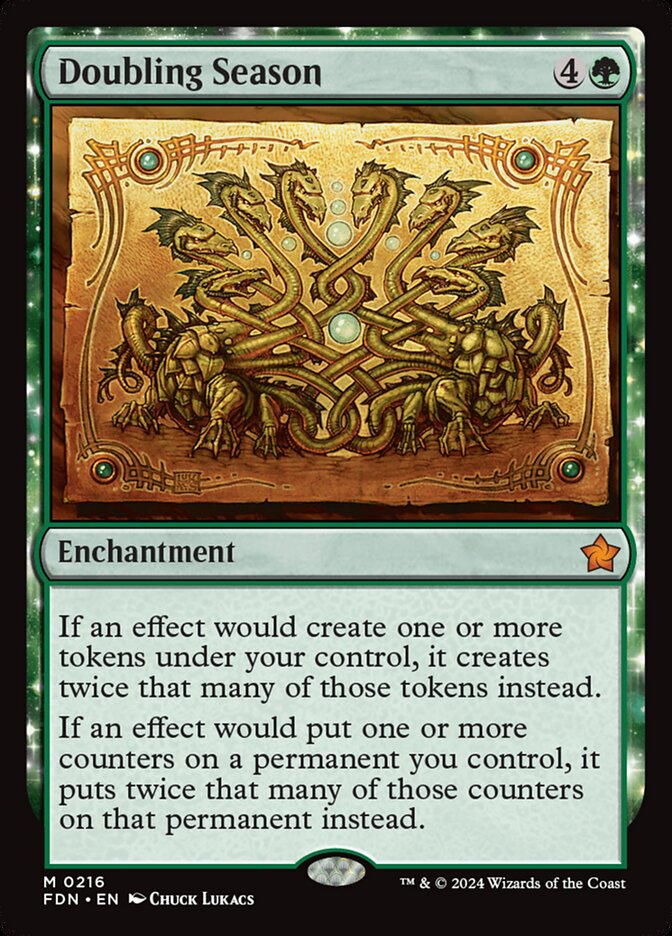
The key insight for budget builders: most of the deck's power comes from the engine, not from individual haymakers. A pile of cheap walkers that each generate small advantages every turn is more resilient than one expensive walker that eats a removal spell and leaves you with nothing.
Choosing Your Commander
Your commander choice determines your color pool and your deck's ceiling. Here are the three best budget options, from cheapest to most powerful.
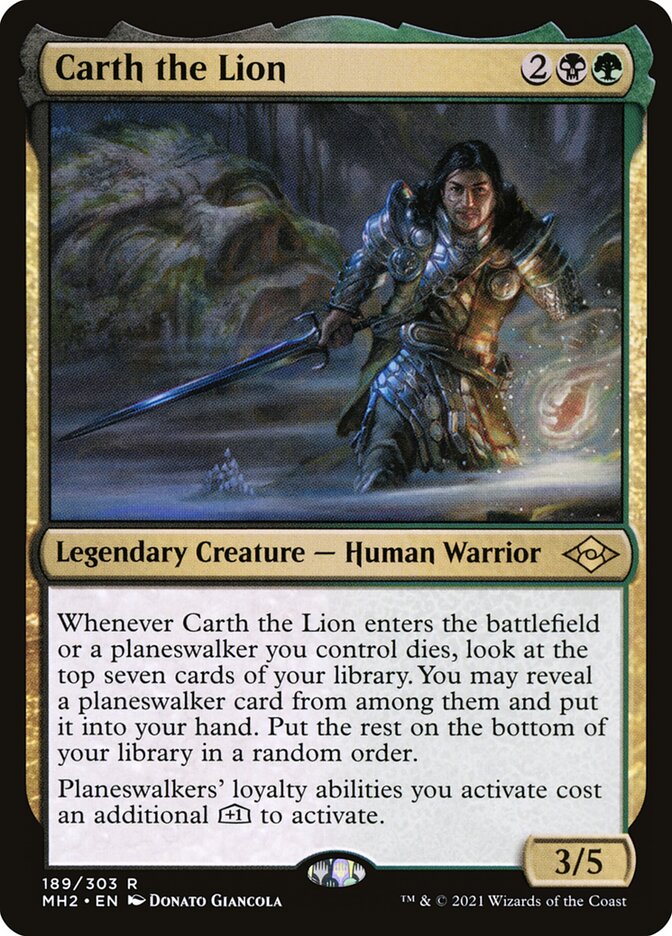
Carth the Lion
{2}{B}{G} — Legendary Creature. The cheapest dedicated superfriends commander available.
Why it wins: Carth does two things no other budget commander does: he makes your planeswalkers' loyalty abilities more efficient, and he digs for more walkers when he enters the battlefield or when one of yours dies. In practice, your plus abilities tick higher, your minus abilities cost less loyalty, and you refill your hand with planeswalkers instead of running out of gas. The limitation is Golgari — green and black only, no blue or white walkers — but that color pair has surprisingly deep planeswalker options (Vraska, Garruk, Nissa, Ob Nixilis) and green brings the best proliferate and ramp in the game.
Atraxa, Praetors' Voice
{G}{W}{U}{B} — Legendary Creature. The iconic superfriends commander — check current prices, as reprints have brought her down significantly.
Why it wins: Atraxa proliferates at the end of each of your turns for free — no mana, no tap, no extra card. Just a guaranteed loyalty bump across every planeswalker you control. She also comes with flying, vigilance, deathtouch, and lifelink, making her a formidable blocker that protects your walkers from combat damage. Four-color identity opens green, white, blue, and black planeswalkers — the deepest pool in the game. The only missing color is red, and you won't miss it. If her price fits your budget, she's the strongest foundation for the deck by a wide margin.
Ramos, Dragon Engine
{6} — Legendary Artifact Creature. Widely available and budget-friendly.
Why it wins: Five-color identity means every planeswalker in Magic is available to you. Ramos gets +1/+1 counters whenever you cast colored spells, and you can remove five counters to add two mana of each color — ten mana total. In a deck casting multicolored planeswalkers every turn, Ramos fuels itself into absurd mana generation. The six-mana casting cost is steep, but green ramp handles that, and once he lands, he pays for your next two walkers by himself. Choose Ramos if you want the widest possible card pool and don't mind a slower start.
Planeswalkers: Value Engines
A budget superfriends deck wants 12–18 planeswalkers. That sounds like a lot, but War of the Spark printed dozens of powerful uncommon walkers that now sell for less than a basic land in some cases. These are the value generators — the cards that keep your hand full and your engine running.
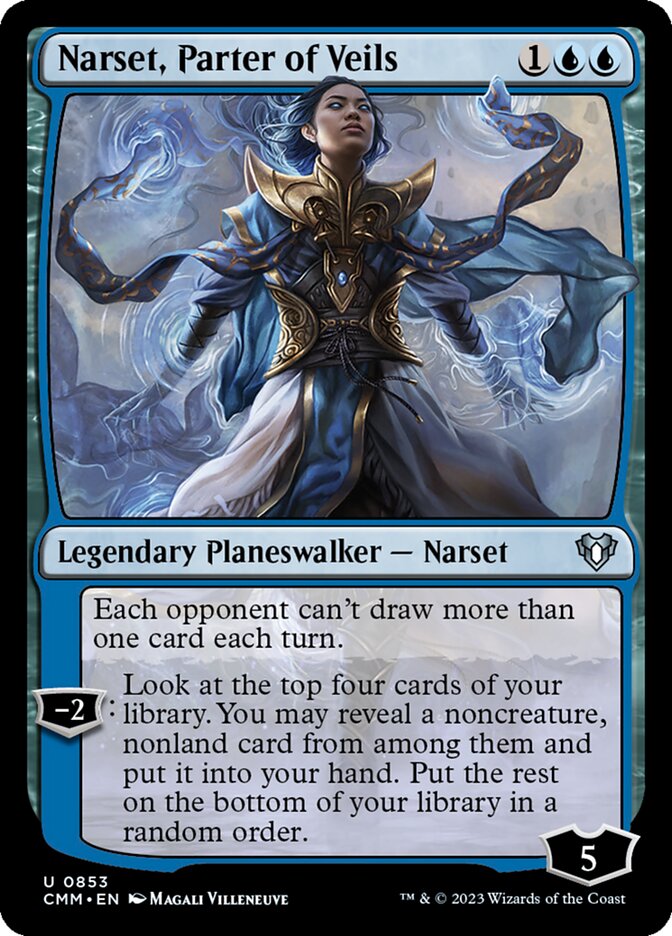
Narset, Parter of Veils
Three mana — Planeswalker (uncommon). Near-bulk pricing.
Why it wins: Narset digs four cards deep for a noncreature spell every time you minus her, and her static ability stops opponents from drawing more than one card per turn. In a multiplayer game, shutting down extra draw while you dig for answers is backbreaking — and she does it for three mana at uncommon rarity. She won't survive long, and that's fine. She already did her job the turn she came down.
Kiora, Behemoth Beckoner
Three mana — Planeswalker (uncommon). Dirt cheap.
Why it wins: Kiora untaps a permanent when you plus her — that's extra mana every turn from your best land or mana rock. She also draws you a card whenever a creature with power 4 or greater enters under your control, which matters more than it looks in a deck running Ramos or Atraxa as commander. She's quiet, efficient, and generates the kind of small advantage that compounds over multiple turns — the signature of a good superfriends piece.
Ob Nixilis Reignited
Five mana — Planeswalker. Cheap due to multiple reprints.
Why it wins: Plus to draw a card, minus to destroy a creature — that's the entire text that matters. Ob Nixilis is a self-contained value engine: he refills your hand when you're ahead and removes threats when you're behind. Five mana is a lot, but in a ramp-heavy green deck you'll cast him on turn three or four, and once he starts ticking up, every activation is pure card advantage. The ultimate is gravy — most games end before you need it.
Planeswalkers: Removal & Defense
These walkers double as your removal suite. Instead of running a separate pile of kill spells, let your planeswalkers do the work — they remove threats and stick around to generate more value afterward.
The Wanderer
Four mana — Planeswalker (uncommon). Near-bulk.
Why it wins: A static ability that prevents all noncombat damage to you and your other permanents — shielding your planeswalkers from burn and ping effects — plus a minus that exiles any creature with power 4 or greater. She comes in, kills the biggest thing on the board, and passively shields your team while she's there. Low starting loyalty means she won't stick around long, but one activation already paid for the card.
Ugin, the Ineffable
Six mana — Planeswalker. Colorless identity means he fits any commander.
Why it wins: Ugin reduces the cost of your colorless spells by two, exiles any permanent that's one or more colors with his minus, and creates 2/2 tokens that draw a card when they die with his plus. Every mode is relevant: cost reduction on mana rocks and artifact ramp, exile-based removal that handles anything colored, and tokens that block for your walkers while replacing themselves. His colorless identity means he works no matter which commander you chose — Carth, Atraxa, or Ramos.
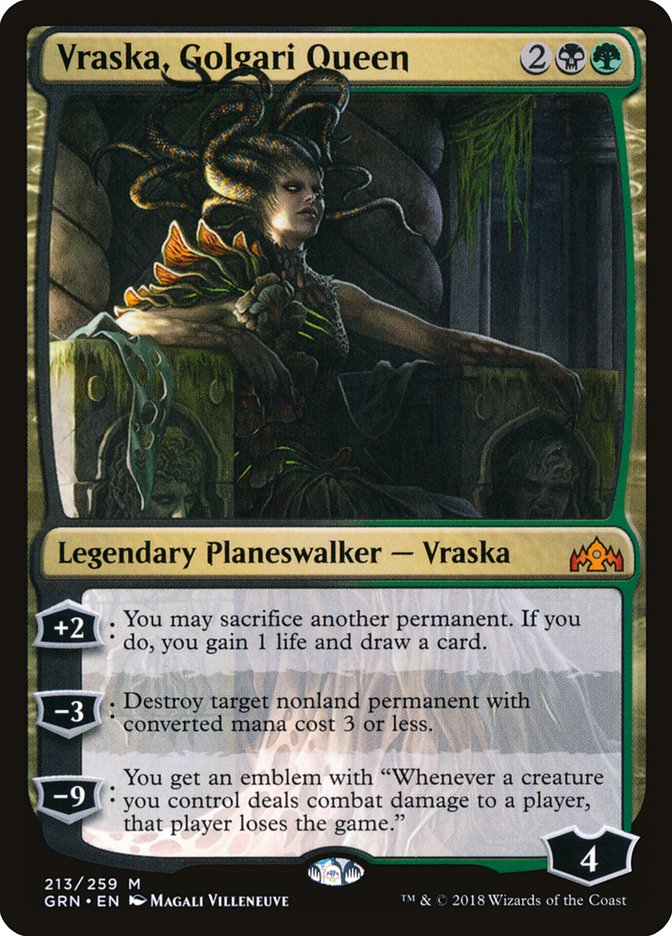
Vraska, Golgari Queen
Four mana — Planeswalker. Well-reprinted and cheap.
Why it wins: Vraska sacrifices a permanent you control — a spent token, a tapped-out mana dork, a Clue — to draw a card and gain a life on her plus. Her minus destroys any nonland permanent with mana value 3 or less, picking off the small utility creatures and mana rocks opponents rely on to keep their engines running. At four mana she comes down early and immediately starts trading resources into cards. The ultimate — making an opponent lose the game if they take any damage — is genuinely achievable with proliferate and extremely fun when it fires.
Beyond these six core picks, fill the remaining walker slots with whatever War of the Spark uncommons fit your commander's color identity. Saheeli, Sublime Artificer makes tokens on every noncreature cast. Kasmina, Enigmatic Mentor taxes removal aimed at your team. Tibalt, Rakish Instigator shuts off lifegain while making devil tokens. Davriel, Rogue Shadowmage punishes opponents for dumping their hands. Each costs almost nothing, and critical mass is the point — the more walkers on the field, the harder it is for the table to answer all of them.
The Proliferate Engine
Proliferate is the reason the budget version of this deck competes with the expensive one. Every proliferate trigger adds a loyalty counter to every planeswalker you control — so with three walkers on the field and two proliferate triggers in a turn cycle, you're adding six loyalty counters for free. These are the pieces that make the engine hum.
Evolution Sage
{2}{G} — Creature (uncommon). Near-bulk.
Why it wins: Proliferate on every landfall trigger. In a green deck running ramp spells like Cultivate and Kodama's Reach, you're triggering this multiple times per turn without spending any extra mana or cards. Drop a land, proliferate all your walkers. Cast Cultivate, put a land into play, proliferate again. It's the best non-rare proliferate creature in the game, and it costs almost nothing.

Flux Channeler
{2}{U} — Creature (uncommon). Cheap.
Why it wins: Proliferate whenever you cast a noncreature spell. In a deck packed with planeswalkers, instants, sorceries, and enchantments, Flux Channeler fires almost every turn. Cast a planeswalker, proliferate all the others. Cast a removal spell, proliferate. She turns every spell into a bonus loyalty tick across your entire board. Pair her with Evolution Sage and you'll be hitting ultimates by turn six.
Thrummingbird
{1}{U} — Creature (uncommon). Bulk.
Why it wins: A 1/1 flyer for two mana that proliferates whenever it deals combat damage to a player. In Commander, there's almost always an open player to peck at — someone with no flyers, someone who doesn't care about one damage. You're not attacking for damage; you're attacking for the proliferate trigger. Two mana for a repeatable, free proliferate effect is one of the best rates in the deck.
Contagion Clasp
{2} — Artifact (uncommon). Very cheap.
Why it wins: When it enters, it puts a -1/-1 counter on a creature — useful for picking off mana dorks and utility creatures. Then you can pay four mana and tap it to proliferate at any time. It's not efficient mana-wise, but it's repeatable, artifact-based, and sits there doing its job every turn without costing you a card. It's the proliferate effect you activate when you have nothing else to do with your mana — and in superfriends, there's always a reason to proliferate one more time.
Other proliferate pieces to consider: Grateful Apparition (a two-mana white flyer with combat-damage proliferate — Thrummingbird in white), Karn's Bastion (a land that proliferates for four mana — fits in a land slot, so it's essentially free), and Inexorable Tide (proliferate on every spell cast, for five mana). Run at least five dedicated proliferate effects; seven or eight is better. The more you have, the faster your walkers reach ultimates, and the less the deck relies on any single card.
Keeping Your Walkers Alive
Planeswalkers die to combat damage. If three opponents can each swing a creature at your walker every turn cycle, even a high-loyalty planeswalker won't survive. You need two things: board wipes to clear the threats, and blockers to absorb the attacks that get through.
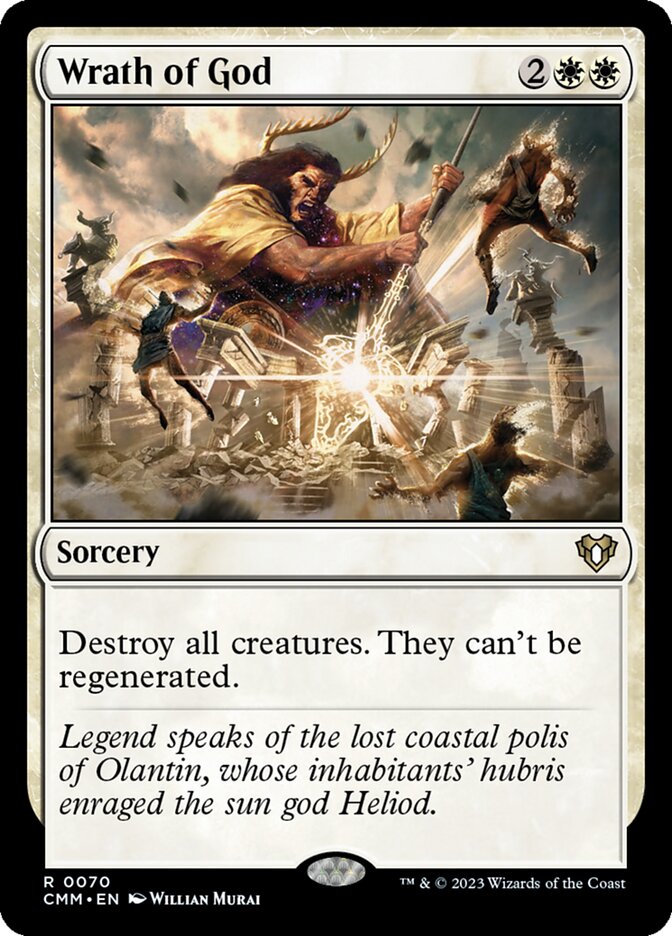
Wraths. Run three to four board wipes. Wrath of God and Day of Judgment are the clean four-mana resets in white. Blasphemous Act often costs a single red mana and clears everything (if you're in Ramos's five colors). In a budget Atraxa shell, the white wraths do the job. Wrath timing is critical — you want to clear the board right before deploying your walkers, not after, so they land on an empty field with no creatures ready to attack them.
Blockers and tokens. Several of the recommended planeswalkers create tokens — Saheeli makes servos, Ugin makes 2/2s, Vraska and Tibalt make bodies. These aren't your win condition; they're your defensive line. Block with them, trade them off, sacrifice them to Vraska's plus ability. They exist to absorb attacks so your important walkers survive another turn cycle. Prioritize making tokens with walkers that have already generated value — a Saheeli that's been ticking up for three turns and has six servos in play has already paid for herself many times over.
Spot removal. Run the budget staples from our $5 Staples Hub — Swords to Plowshares, Counterspell, Generous Gift. Your walker-based removal handles most threats, but instant-speed answers for the table's combo pieces are non-negotiable. Five to seven removal pieces alongside your walker-based removal gives you enough interaction to survive without over-investing in reactive cards.
The Deck Skeleton
Here's the slot allocation that keeps you under $100 while maintaining enough density in each category to fire reliably. Adjust numbers based on your commander's color identity and personal preference — but don't cut planeswalkers below 12 or proliferate below 5.
- Commander: 1 (Carth the Lion, Atraxa, or Ramos)
- Planeswalkers: 12–18 (the engine — prioritize WAR uncommons)
- Proliferate creatures & artifacts: 5–8 (Evolution Sage, Flux Channeler, Thrummingbird, Contagion Clasp, Grateful Apparition, Karn's Bastion)
- Ramp: 10–12 (Sol Ring, Arcane Signet, Cultivate, Kodama's Reach, Commander's Sphere, green mana dorks)
- Removal & counters: 5–7 (Swords to Plowshares, Counterspell, Generous Gift, Go for the Throat)
- Board wipes: 3–4 (Wrath of God, Day of Judgment, Blasphemous Act)
- Card draw (non-walker): 3–5 (Night's Whisper, Sign in Blood, Fact or Fiction)
- Lands: 36–38 (include Karn's Bastion; budget mana bases lean on basics and cheap dual lands)

The math matters: 15 walkers plus 7 proliferate pieces means you'll see both halves of the engine in your opening seven most games. Ramp is deliberately high because you need to deploy walkers ahead of curve — a superfriends deck that stumbles on mana loses before its engine comes online. Every turn you spend ramping instead of deploying is a turn the table has to build an army your walkers will have to fight through.
Deckbuilding Mistakes to Avoid
Running expensive planeswalkers instead of cheap multiples.
One flashy planeswalker does not outperform three cheap ones in this archetype. Superfriends wins through volume — three walkers on the field each generating small advantages is harder to answer and produces more total value than one big walker eating a removal spell. Proliferate makes every walker better, so quantity compounds faster than quality. Fill the deck with efficient uncommons and let the engine do the work.
Skimping on ramp to fit more walkers.
A hand full of four- and five-mana planeswalkers with no ramp is a hand that does nothing for four turns. Budget superfriends needs 10–12 ramp pieces minimum — Sol Ring, signets, Cultivate, Kodama's Reach, mana dorks. Deploy your walkers ahead of curve, not behind it. The proliferate engine needs walkers on the field to function; walkers stuck in your hand don't generate loyalty counters.
Deploying walkers into a full board without answers.
If every opponent has three creatures on the field and you drop a planeswalker with no blockers and no wrath in hand, it dies before your next turn. Sequence your wraths first — clear the board, then start deploying walkers onto an empty field. One wrath into two walkers is how you take control of a game. One walker into three opponents' worth of combat damage is how you waste a card.
Where to Buy the Pieces
Superfriends is a singles-driven deck — buying individual planeswalkers and proliferate pieces from a marketplace will always be cheaper than cracking packs. TCGplayer and Card Kingdom are the best stops for the uncommon walkers, which often sell for literal pennies. eBay is useful for bulk lots of War of the Spark planeswalkers — sellers regularly list bundles of 20+ uncommon walkers for a few dollars. Compare carts across sellers before checking out; prices on cheap cards vary more than you'd expect.
Superfriends Budget FAQ
- Do I really need Doubling Season? No. Doubling Season is a luxury upgrade that lets you instantly ultimate walkers the turn they enter, but the budget proliferate engine gets you to ultimates only a turn or two slower while generating value the entire way there. The deck functions perfectly without it — save it for the upgrade path.
- How many planeswalkers should I run? At least 12, ideally 15–18. You need to reliably see two to three in your opening hand or first few draws so the engine has something to proliferate. Running fewer than 12 means too many games where you draw proliferate pieces but no walkers to put counters on.
- Won't the table just attack my planeswalkers? They'll try — that's why wraths and token blockers are essential. But in a four-player game, opponents attacking your walkers means they're not attacking each other. You're effectively using planeswalker loyalty as a life-total buffer. When someone commits their board to killing your Narset, they leave themselves open to the other two players.
- Which commander is best for a first-time superfriends build? Carth the Lion if budget is the top priority — he's the cheapest and his abilities directly support the strategy. Atraxa if you can afford her — four colors and free proliferate every turn is the strongest foundation. Ramos if you want five-color access and big mana swings.
- Can this deck compete at high-power tables? Budget superfriends is built for casual and mid-power pods — power level 5–7. At competitive tables, the engine is too slow; cEDH games often end before turn six, and planeswalkers need multiple turn cycles to generate enough value. Within its intended power range, though, the deck puts up consistently strong results.
Loyalty Is Earned, Not Bought.
The superfriends archetype has always been about inevitability — deploy walkers, tick them up, bury the table in accumulated advantage. The expensive version shortcuts this with Doubling Season. The budget version does it just as reliably with the proliferate engine, and the ride is frankly more satisfying because you built the board state one counter at a time instead of skipping straight to an ultimate.
War of the Spark gave budget builders the deepest planeswalker bench in the game's history. Pair those cheap walkers with a handful of proliferate creatures that cost less than a booster pack, wrap them in green ramp and budget removal, and you have a deck that generates more value per dollar than almost anything else in Commander.
© GEEKYDOMAIN.COM | Strategy Powered by Data