

Best Budget Pillowfort / Group Hug Deck Under $100
Why fight the table when you can make attacking you the worst deal available? Pillowfort and group hug cards are cheap, political, and quietly devastating — because the player nobody attacks is usually the player who wins.
Some links below are affiliate links. If you buy through them, we may earn a small commission at no extra cost to you. We only recommend cards we'd run ourselves.
Pillowfort is the Commander archetype that says "you can attack me, but it's going to cost you." You stack effects that tax attackers — pay two mana per creature, pay life, lose resources — until swinging at you is so expensive that opponents turn on each other instead. Then you sit behind your fortress, accumulate value, and win when nobody's looking.
Group hug is the friendly version of the same idea: instead of taxing people for attacking you, you bribe them not to. Give everyone extra cards. Give everyone extra mana. Be the person at the table making everyone's deck better — and then, when the game has gone long enough and your opponents have used the resources you gave them to beat each other down, close the door with a win condition nobody saved removal for.
The best part? Both strategies are naturally cheap. Prison enchantments like Ghostly Prison and Propaganda are heavily reprinted commons and uncommons. Group hug staples like Howling Mine cost pocket change. And the win conditions that close the game — Approach of the Second Sun, Insurrection, Felidar Sovereign — are all budget picks. This is genuinely one of the cheapest competitive archetypes to build in Commander, and what follows is the full blueprint.
→ Short Version
Pick a commander that plays politics — Kynaios and Tiro gives everyone cards and lands, making you the table's best friend. Stack prison enchantments (Ghostly Prison, Propaganda, Sphere of Safety) so attacking you costs more mana than it's worth. Add group hug pieces (Howling Mine, Dictate of Kruphix) to keep everyone happy and pointing removal elsewhere. Win with haymakers nobody expects — Approach of the Second Sun, Insurrection, or Felidar Sovereign close games after you've outlasted the aggro players.
→ Expand Your Arsenal
In This Guide
The Strategy: Build a Castle, Win From Inside
Pillowfort and group hug are two sides of the same coin. Pillowfort is the stick: tax effects that punish anyone who attacks you. Group hug is the carrot: free resources that reward everyone for leaving you alone. Most successful builds use both — enough prison to make attacking you feel bad, enough generosity to make ignoring you feel good.
The key insight is that this deck doesn't win by attacking. It wins by surviving. You let the rest of the table fight each other — accelerated by the extra cards and mana you're handing everyone — while you sit behind Ghostly Prison and Propaganda drawing extra cards of your own. Then, in the late game, you close with a single haymaker win condition that nobody expected because you spent the whole game looking harmless.
This makes the deck inherently political. You choose who gets your group hug bonuses. You negotiate deals — "I won't tax your attacks if you target the combo player." You play the table, not just the cards. If you enjoy the social layer of Commander as much as the mechanical one, this is your archetype.
Choosing Your Commander
Your commander sets the political tone. Here are three budget options that range from all-in group hug to focused Azorius efficiency.
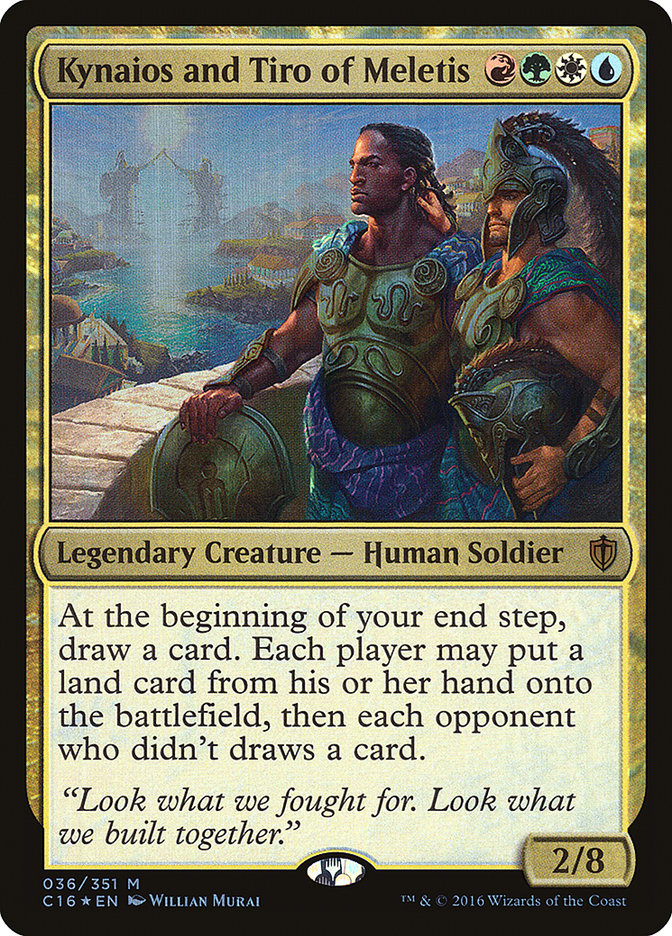
Kynaios and Tiro of Meletis
{R}{G}{W}{U} — Legendary Creature. Budget-friendly and available from Commander 2016 printings.
Why it wins: Four-color identity gives you access to everything the deck wants — white and blue for prison enchantments, green for ramp and enchantment synergy, red for haymaker finishers like Insurrection. The built-in ability gives each player extra cards and lands at the end of your turn, which does two critical things: it makes you the table's benefactor (nobody kills the person feeding them resources), and it accelerates the game toward the late stage where your win conditions shine. Kynaios and Tiro also comes as a 2/8, making it an excellent blocker that survives most combat and most damage-based removal.
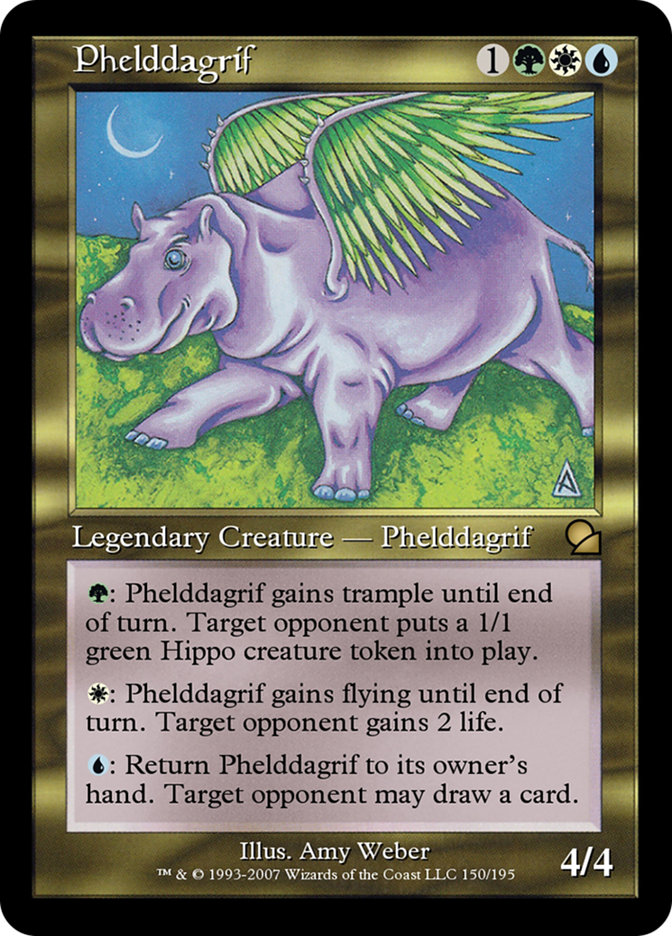
Phelddagrif
{1}{G}{W}{U} — Legendary Creature. A group hug classic, well-reprinted and cheap.
Why it wins: The original group hug commander. Phelddagrif has activated abilities that give opponents specific gifts — a token, life, or cards — while granting itself evasion in return. This gives you granular political control: you choose who gets what, turn by turn. Reward the player who helps you; starve the player who threatens you. The three-color Bant identity (green, white, blue) covers prison enchantments, ramp, and card draw without stretching your mana base. You miss red finishers like Insurrection, but white and blue have plenty of win conditions.
Kwain, Itinerant Meddler
{W}{U} — Legendary Creature. Very cheap.
Why it wins: Two-color identity keeps your mana base dead simple and your budget low. Kwain taps to let each player draw a card and gain life — a repeatable group hug effect stapled to your commander that's available from turn two. The life gain adds up fast and fuels win conditions like Felidar Sovereign. The downside is missing green (no ramp, no Rites of Flourishing) and red (no Insurrection), but Azorius has the strongest prison enchantments and the most reliable win conditions in the format. Choose Kwain if you want the leanest, cheapest version of the strategy.
The Prison Package
These are the cards that make attacking you a losing proposition. Each one independently taxes attackers; stacked together, they make combat against you functionally impossible. The beauty of prison effects is that they're all enchantments — they stay on the board, they stack multiplicatively, and they're harder to remove than creatures.
Ghostly Prison
{2}{W} — Enchantment. Heavily reprinted and dirt cheap.
Why it wins: Opponents must pay two mana per creature that attacks you. That's it — simple, brutal, and effective. With three opponents who each want to swing with multiple creatures, that tax adds up instantly. By turn three, attacking you already costs more mana than attacking someone else. Stack this with Propaganda and opponents need to pay four mana per creature just to look at you. Most aggro players will simply turn their army elsewhere, which is exactly the point.

Propaganda
{2}{U} — Enchantment. Heavily reprinted and budget.
Why it wins: The blue Ghostly Prison. Same effect, same cost — opponents pay two mana per creature attacking you. Running both means every creature that wants to hit you costs four mana total, which is the price of an entire spell. In a multiplayer game, opponents almost always have a softer target who isn't taxing them. Propaganda and Ghostly Prison together are the foundation of every pillowfort deck, and they're both cheap enough that the pair costs less than a booster pack.
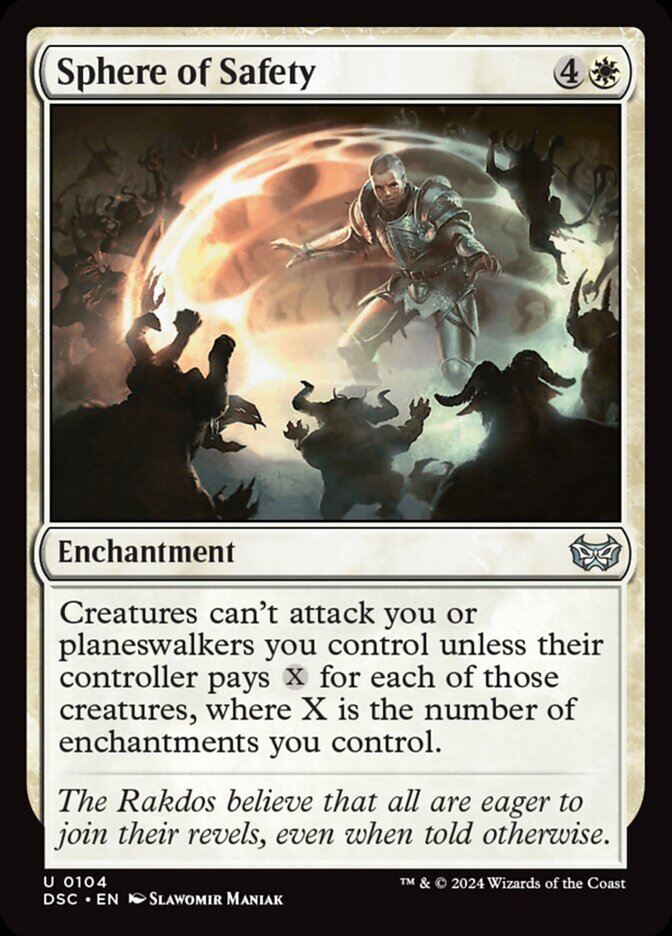
Sphere of Safety
{4}{W} — Enchantment. Affordable.
Why it wins: Opponents pay X mana per creature attacking you, where X is the number of enchantments you control. In a deck running 15+ enchantments — Ghostly Prison, Propaganda, group hug pieces, other utility enchantments — that tax quickly becomes unpayable. With five enchantments on the field, each creature costs five mana to attack you. With eight, it costs eight. This is the card that turns "expensive to attack" into "literally impossible to attack," and it gets stronger every time you cast another enchantment.
Crawlspace
{3} — Artifact. Very cheap.
Why it wins: No more than two creatures can attack you each combat. This doesn't tax mana — it hard-caps the number of bodies coming your way. The token-swarm player with 20 goblins? Two of them can attack you. Combined with Ghostly Prison and Propaganda, those two creatures also cost four mana each. Crawlspace is the safety valve for the scenarios where an opponent has enough mana to pay the tax on a full army — even if they can afford it, they're limited to two creatures at a time.
Other prison pieces to consider: Windborn Muse (a creature that creates a Ghostly Prison effect — redundancy on a body), Baird, Steward of Argive (legendary creature with the same tax), and Kazuul, Tyrant of the Cliffs (red — punishes attackers by creating 3/3 ogres if they don't pay the tax). Run at least four dedicated prison effects; six is better. The goal is to draw at least two in every game so the tax stacks high enough that opponents go elsewhere.
The Group Hug Engine
Group hug cards serve two purposes. First, they make you the table's friend — nobody wants to kill the person giving them free cards. Second, they accelerate the game, which benefits you more than anyone else because you're the only player at the table who isn't trying to kill people. While your opponents use the extra resources to fight each other, you use them to deploy more prison enchantments and dig for your win condition.
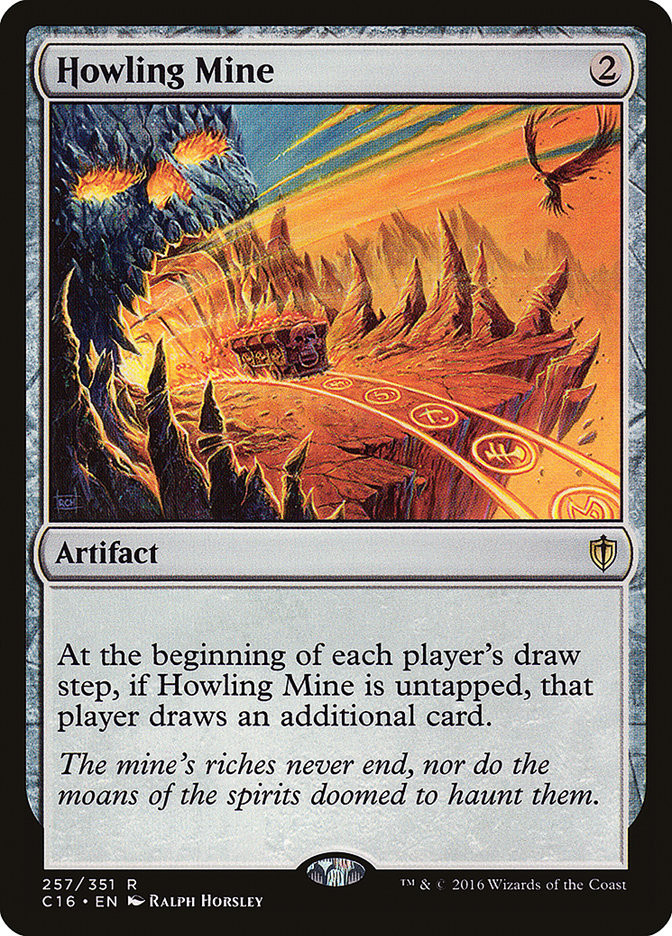
Howling Mine
{2} — Artifact. A classic that's been reprinted into the ground.
Why it wins: Each player draws an extra card during their draw step. Two mana for a symmetric draw engine that never stops generating goodwill. Opponents love free cards — and while they're drawing into threats they use against each other, you're drawing into prison enchantments and win conditions. The symmetry is a feature, not a bug: you're the player best positioned to leverage extra cards because your deck is built to survive, not race. Let everyone else use their extra cards to knock each other out.
Dictate of Kruphix
{1}{U}{U} — Enchantment. Cheap and counts toward your Sphere of Safety total.
Why it wins: Each player draws an extra card at the start of their draw step — Howling Mine as an enchantment, with flash. The flash is the key upgrade: you drop this at end of turn before your draw step, guaranteeing you're the first person to benefit from the extra draw. Being an enchantment also means it feeds Sphere of Safety's tax counter. Two group hug pieces that both make Sphere of Safety stronger is exactly the kind of synergy budget decks thrive on.
Rites of Flourishing
{2}{G} — Enchantment. Budget and available from multiple printings.
Why it wins: Each player draws an extra card and may play an additional land each turn. This is the group hug triple threat — extra cards, extra lands, and it's an enchantment for Sphere of Safety. The extra land drops accelerate the entire table, which sounds dangerous until you realize that your deck is built to survive a faster game and your opponents' decks are built to win a normal-speed one. You're playing a different game than everyone else, and Rites speeds up the game you want to play.
Other group hug options: Temple Bell (artifact, tap to let each player draw — repeatable and political since you choose when to activate it), Font of Mythos (each player draws two extra cards per turn — the nuclear option for card draw), and Humble Defector (draw two cards, then donate it to an opponent — generates goodwill and fuels deals). Run four to six group hug pieces alongside your commander's built-in effect. More than that risks giving opponents too many resources to fight through your prison.
Win Conditions — How You Actually Close Games
The most common criticism of pillowfort is "but how do you win?" The answer is: with specific, deliberate win conditions that end the game in one swing after you've outlasted the aggro and midrange players. You don't need many — two to three dedicated closers is enough, because your card draw will find them.
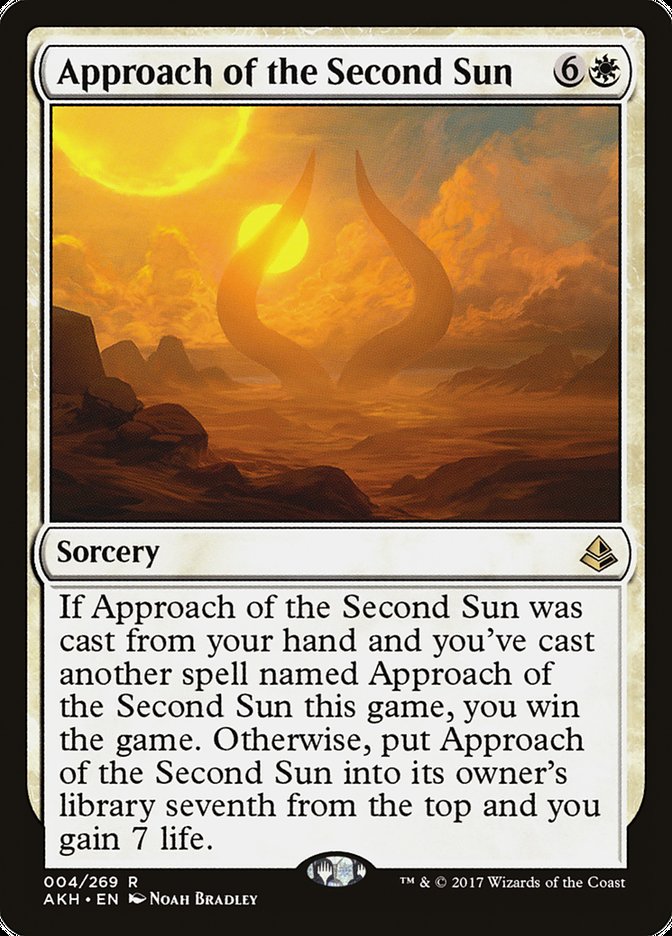
Approach of the Second Sun
{6}{W} — Sorcery. Budget.
Why it wins: Cast it once and it goes seventh from the top of your library. Cast it a second time and you win the game — no combat, no damage, no conditions beyond paying the mana twice. In a deck drawing two to three extra cards per turn from group hug effects, you'll find the second copy within three or four turns. The beauty is that opponents know it's coming but can't stop it with creature removal — they need a counterspell or discard effect, and you've been handing them extra cards full of creatures and threats they've been using against each other, not holding up answers for your sorcery.
Insurrection
Eight mana — Sorcery. Available and affordable from Commander reprints (requires red — Kynaios and Tiro builds).
Why it wins: Gain control of all creatures until end of turn, untap them, and they gain haste. In a group hug game where you've been handing everyone extra cards and mana for six turns, the board is stacked with creatures — creatures you've never had to deal with because they've been attacking each other behind your prison. One Insurrection in the late game usually represents 40+ damage swinging at whoever's left. It's the ultimate "I was never the threat — until now" moment, and in Kynaios and Tiro's four-color identity, you have the red to cast it.
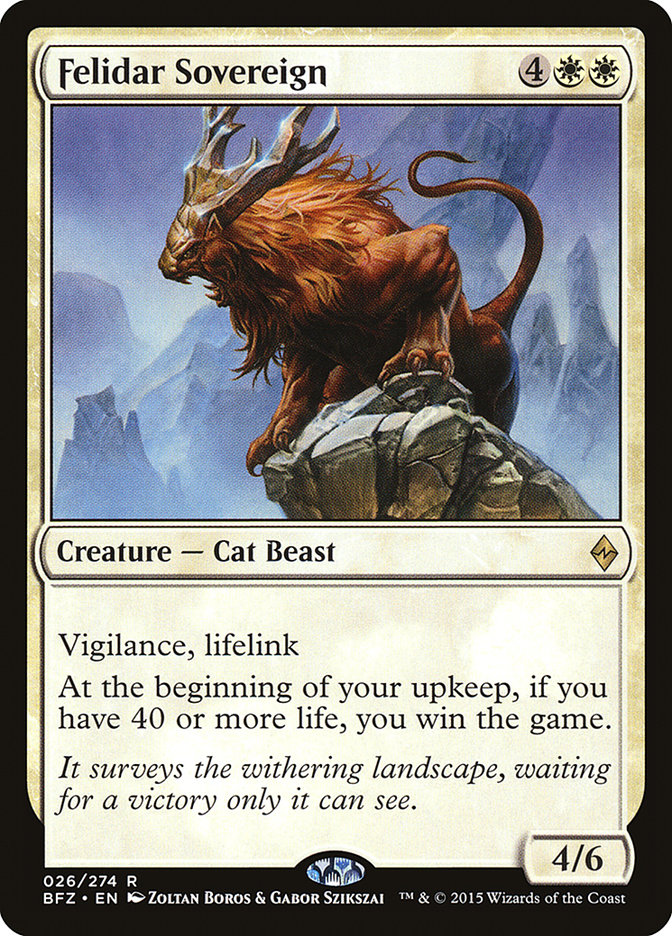
Felidar Sovereign
Six mana — Creature. Reprinted and cheap.
Why it wins: At the beginning of your upkeep, if your life total is 40 or greater, you win the game. In Commander you start at 40 life, and a pillowfort deck actively prevents damage while group hug effects like Kwain's ability gain you life along the way. Staying above 40 is not just possible — it's likely in most games. Drop Felidar Sovereign behind a Ghostly Prison and Propaganda, untap, and the game ends. The counterplay is removal, which is why you run counterspells — protecting Sovereign for one turn cycle is all you need.
The Deck Skeleton
Here's the slot allocation that keeps you under $100 while maintaining enough prison density to survive and enough draw to find your win conditions. Adjust based on your commander's color identity.
- Commander: 1 (Kynaios and Tiro, Phelddagrif, or Kwain)
- Prison enchantments & artifacts: 5–7 (Ghostly Prison, Propaganda, Sphere of Safety, Crawlspace, Windborn Muse, Baird)
- Group hug pieces: 4–6 (Howling Mine, Dictate of Kruphix, Rites of Flourishing, Temple Bell, Font of Mythos)
- Win conditions: 3–4 (Approach of the Second Sun, Insurrection, Felidar Sovereign, plus a backup)
- Ramp: 10–12 (Sol Ring, Arcane Signet, Cultivate, Kodama's Reach, Commander's Sphere, signets)
- Removal & counters: 6–8 (Swords to Plowshares, Counterspell, Generous Gift, Arcane Denial — counters protect your win conditions)
- Board wipes: 4–5 (Wrath of God, Day of Judgment, Blasphemous Act — you need more wraths than aggro decks since you can't race)
- Supplemental card draw: 2–4 (beyond your group hug effects — Fact or Fiction, Rhystic Study if budget allows)
- Lands: 36–37 (lean on basics; budget dual lands and a few utility lands)
The prison-to-hug ratio matters: too few prison pieces and you die to focused aggro; too many hug pieces and you arm your opponents faster than you can wall them out. The skeleton above prioritizes surviving (prison + wraths) slightly over accelerating (hug), which is the right bias for a budget build that needs time to set up.
Deckbuilding Mistakes to Avoid
Forgetting to include actual win conditions.
The number-one mistake in pillowfort deckbuilding is building a fortress with no plan to win from inside it. "I'll figure it out once I'm safe" leads to hour-long games where you're untouchable but can't close. Run three to four dedicated finishers and dig for them aggressively with your extra draw. If you can't name how the deck wins before you shuffle up, you need more closers.
Going all-in on group hug without enough prison.
Giving everyone free cards doesn't protect you — it arms them. If you're drawing each opponent an extra card per turn without Ghostly Prison or Propaganda on the field, you're just helping them kill you faster. Always deploy your prison pieces before your group hug effects. The tax makes the generosity safe; without it, the generosity is just charity.
Relying on politics alone to survive the early game.
Political goodwill doesn't stop a turn-four Craterhoof Behemoth. You need prison enchantments and wraths on the field before the social contract does its work. Turns one through four are about deploying ramp and your first prison piece — not about making deals. Once the fort is up, then you can play diplomat. Get the walls in place first.
Where to Buy the Pieces
Pillowfort is enchantment-heavy, so you're buying lots of cheap singles rather than a few expensive staples. TCGplayer and Card Kingdom are the best stops for the prison enchantments and group hug pieces, most of which sell for well under a dollar each. eBay is useful for bulk lots of Commander staples — search for "mtg pillowfort lot" or "commander enchantment lot" and you'll often find bundles that include several pieces from this list. Compare carts across sellers.
Pillowfort / Group Hug FAQ
- Won't people just remove my enchantments? Some will try — that's why redundancy matters. Running five to seven prison effects means losing one doesn't collapse your fort. White also has excellent enchantment recursion if your meta runs heavy removal. And remember: removing your Ghostly Prison costs an opponent a card and mana that they could have used against someone else. Make it a bad trade and they'll stop trying.
- Is group hug too slow for my meta? At casual to mid-power tables (power level 4–7), pillowfort is genuinely competitive. At higher power levels, combo decks can win before your prison is online. If your meta is fast, lean heavier on early ramp and cheap prison pieces (Ghostly Prison on turn two via Sol Ring) and lighter on the group hug cards that help your opponents race.
- Do I need Smothering Tithe? Smothering Tithe is incredible in this deck — you're giving everyone extra draws, which generates you extra Treasures — but it's not budget anymore. The deck works perfectly without it. Treat it as the first upgrade once you have the base list running.
- Does this deck make people hate playing against me? It depends on how you play it. A pillowfort deck that draws the game out for two hours without winning is miserable for the table. A pillowfort deck that gives everyone free resources, plays interesting political games, and then closes decisively with Insurrection or Approach is one of the most fun decks to play against. Run enough win conditions and close games when you can — don't stall for the sake of stalling.
- Which commander is best for a first build? Kynaios and Tiro if you want four colors and the widest card pool — the built-in group hug saves you deck slots. Kwain if you want the cheapest, simplest mana base. Phelddagrif if you want the most political control over who benefits from your generosity.
Everybody Wins. You Just Win Last.
Pillowfort is the rare Commander archetype where being nice is a strategy. You hand out free cards, free lands, free mana — and then, while everyone's busy using those gifts to fight each other, you build an untouchable fortress and wait for the moment to close. It's cheap because the cards are cheap. It's effective because nobody wastes removal on the person who's helping them.
Just remember the golden rule of group hug: if you're not working toward a win condition every turn, you're just prolonging the game for everyone. Build the fort, share the spoils, and when the time comes, end it decisively. The table will respect you more for closing than for stalling — and they'll want to play against you again.
Keep Learning:
© GEEKYDOMAIN.COM | Strategy Powered by Data