

Sun & Moon Era: Hidden Fates, Shinies & GX Chase Cards
The Sun & Moon era introduced GX attacks, Rainbow Rares, and Tag Team GX cards — then delivered Hidden Fates Shiny Vault as one of the most enduringly collectible sets in modern Pokémon TCG history.
The Sun & Moon era ran from 2017 to 2019 and represents the first fully modern Pokémon TCG era for many current collectors. GX cards, the era's primary mechanic, introduced a once-per-game "GX attack" that was often game-ending when deployed correctly — and the cards that carried these attacks became the era's chase pieces. The era also introduced the Rainbow Rare treatment, which applied a full gradient foil to Pokémon-GX cards for the most visually striking look the game had produced up to that point.
But the era's legacy in collecting circles is dominated by two things: the Shiny Charizard-GX from Hidden Fates Shiny Vault, which became arguably the most desired single card of the entire modern era, and Tag Team GX cards in the era's final sets, which paired two Pokémon on one card and introduced artwork and mechanics that pushed the format's ceiling higher than it had ever been.
This guide covers the SM era's structure, its key mechanics, the most important sets and cards for collectors, and how to approach buying into this corner of the hobby with clarity about what actually drives long-term value here.
→ Short Version
The Sun & Moon era (2017–2019) introduced GX cards — Pokémon with a once-per-game GX attack that required a dedicated Energy investment. Rainbow Rare applied a full gradient foil treatment to GX cards as the era's top visual tier. Tag Team GX (SM Team Up onward) paired two Pokémon on one card. Shining Legends featured Shining Charizard, Shining Mew, Shining Raichu. Hidden Fates Shiny Vault — particularly Shiny Charizard-GX — is the era's benchmark collector target and remains one of the most sought modern Pokémon cards.
→ Related Reading
In This Guide
| Set | Year | Key Collector Content |
|---|---|---|
| Sun & Moon base | 2017 | GX mechanic introduced; first Rainbow Rares |
| Shining Legends | 2017 | Shining Charizard, Shining Mew, Shining Raichu |
| Burning Shadows | 2017 | Charizard-GX Full Art and Rainbow Rare |
| Celestial Storm | 2018 | Rayquaza-GX; strong Full Art lineup |
| SM Team Up | 2019 | Tag Team GX introduced; Pikachu & Zekrom-GX |
| Hidden Fates | 2019 | Shiny Vault subset; Shiny Charizard-GX |
| Cosmic Eclipse | 2019 | Final SM set; largest Tag Team lineup; massive Full Art count |
Era Overview: 2017–2019
The Sun & Moon era launched in February 2017 and ran through November 2019 — twelve main sets plus several special sets (Shining Legends, Dragon Majesty, Hidden Fates). It covers the Alola Pokémon introduced in Pokémon Sun and Moon and Pokémon Ultra Sun and Ultra Moon, replacing the Kalos Pokédex of the XY era with a Hawaiian-inspired tropical setting.
This is the first era that a significant proportion of current adult collectors bought into as children or teenagers — which means nostalgia premium is beginning to accumulate in real time. GX cards, once the obvious modern product, are now a period-specific card type that will only be produced by this era. That transition from "current" to "historical" is where collector value solidifies.
The SM era also coincided with the first major wave of Pokémon TCG mainstream crossover — YouTube openings, influencer culture, and the 2021 pandemic-era boom all drew disproportionate attention to SM-era product. The result is an era that's been heavily opened and is simultaneously more culturally visible than most preceding eras.
GX Cards: The Once-Per-Game Mechanic
Pokémon-GX introduced a mechanic that immediately distinguished the format from the EX era that preceded it: each GX card had a GX attack — typically its most powerful attack — that could only be used once per game per player. Using your GX attack was a significant game event, often saving or winning the game at a critical moment.
Like Pokémon-EX, GX cards give up two Prize cards when Knocked Out. But the once-per-game GX attack constraint changed how players valued different GX cards: a GX attack that was "good enough at any moment" was worth more than one that required a specific board state, because you might only get one shot to use it all game.
Standard GX cards were the set's primary pull tier, with Full Art GX and Rainbow Rare GX sitting above them. The best GX cards by collector standards today combine strong species recognition (Charizard-GX, Mewtwo-GX, Rayquaza-GX) with high-quality artwork in the Full Art or Rainbow Rare treatment.
Rainbow Rare: The Era's Top Visual Tier
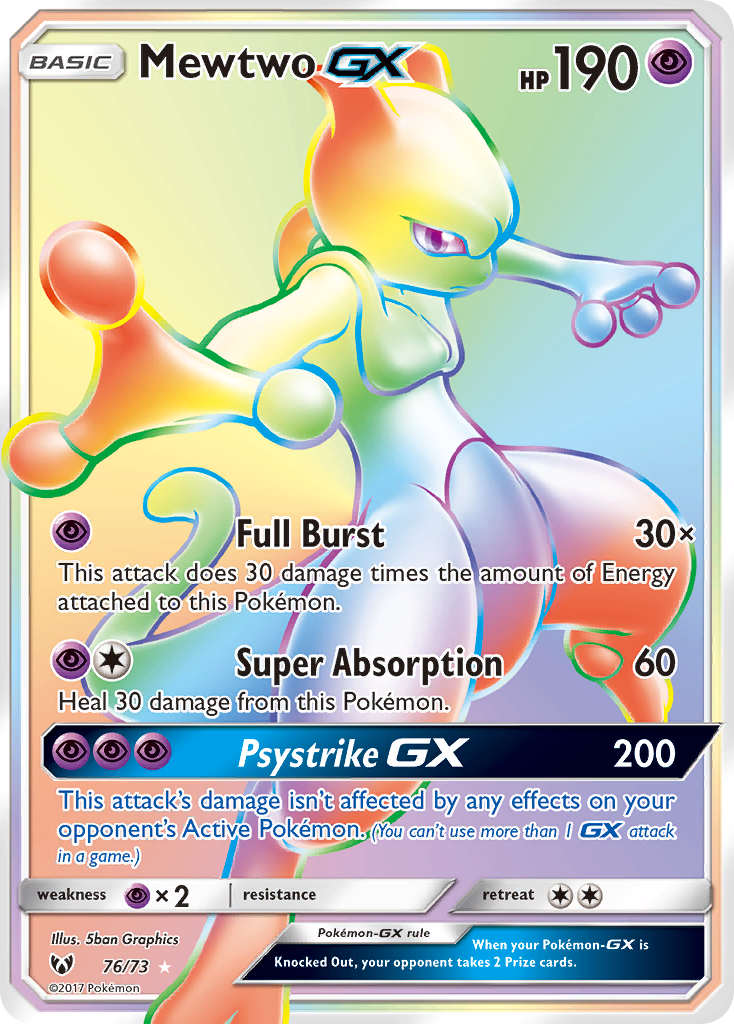
The Rainbow Rare treatment — a full-card gradient foil that cycles through multiple colors in a sweeping pattern — debuted in the SM era as the top rarity tier above Full Art. Every major GX card in each set typically had a corresponding Rainbow Rare version, numbered beyond the set's official count.
Rainbow Rares are divisive in collector circles: some love the maximalist visual impact; others find the uniform gradient treatment less visually interesting than the specific artwork compositions of Full Art cards. What's not divisive is their rarity — they pull at rates comparable to Secret Rare EX from earlier eras, making high-grade Rainbow Rares of popular Pokémon genuinely scarce.
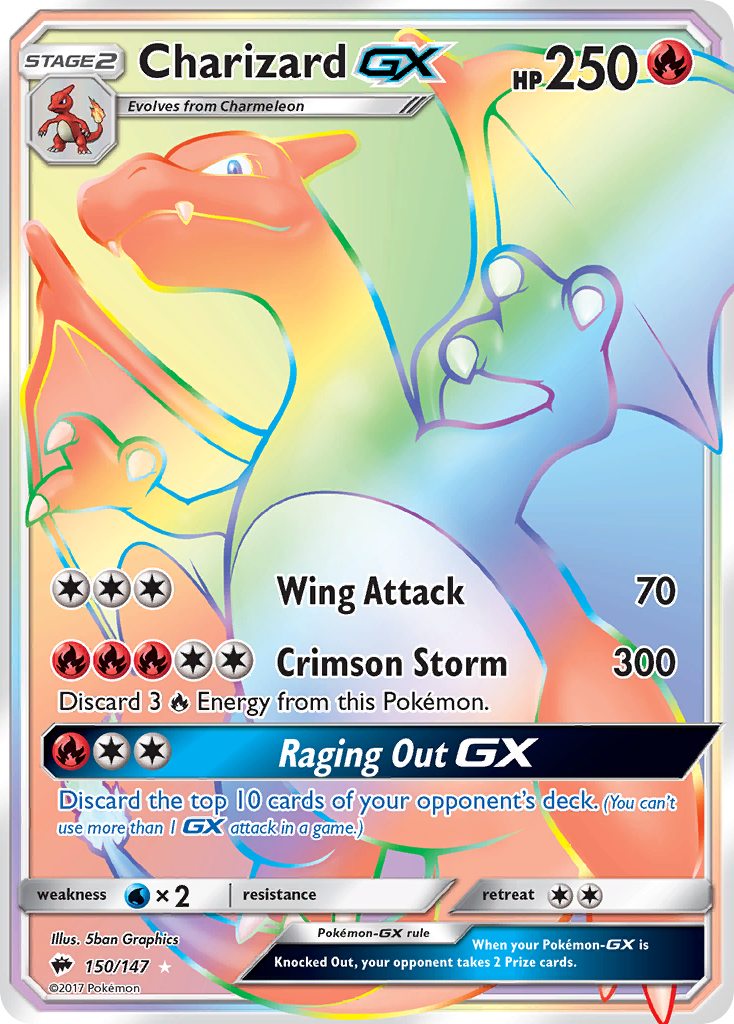
For collecting purposes, the question isn't Rainbow Rare vs Full Art as a universal preference — it's which treatment of a specific card you find more compelling. The Rainbow Rare Charizard-GX from Burning Shadows and the Full Art Charizard-GX from the same set are both significant collector targets; they serve different aesthetic preferences with similar levels of demand.
Tag Team GX: Two Pokémon, One Card
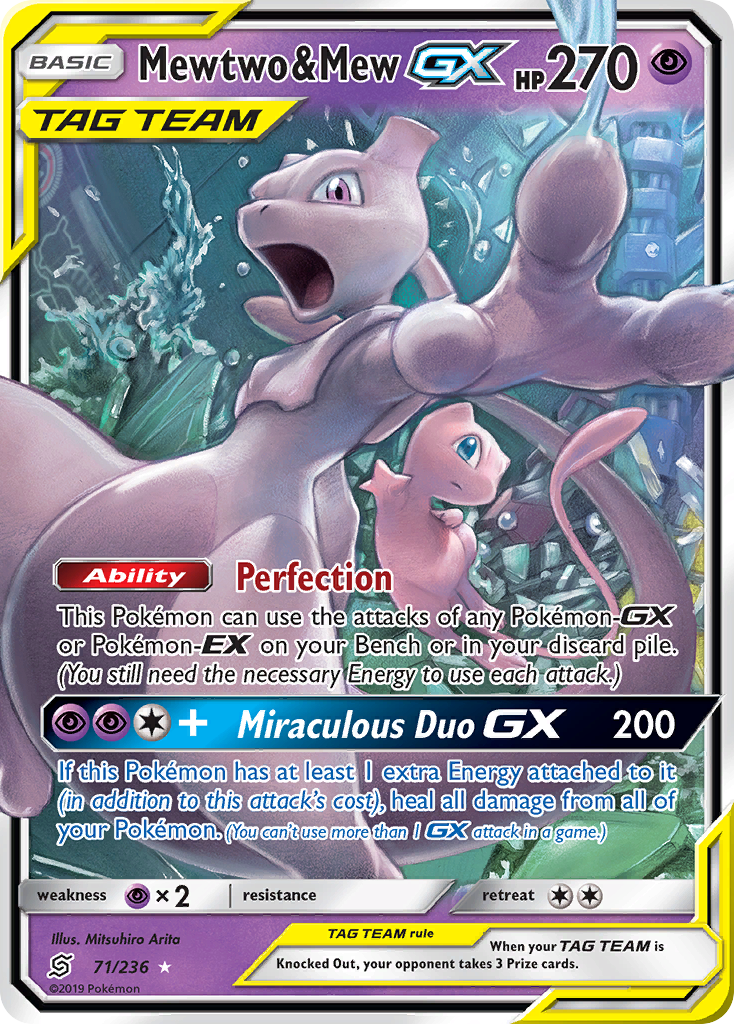
Introduced in SM Team Up (February 2019), Tag Team GX cards featured two Pokémon sharing a single card — depicted together in the artwork and providing combined attacks and a shared GX attack. The two-Prize rule was replaced by a three-Prize rule for Tag Team GX cards, reflecting their significantly higher power level.
Tag Team pairings were deliberately chosen for thematic resonance: Pikachu & Zekrom-GX, Gengar & Mimikyu-GX, Reshiram & Charizard-GX, Mewtwo & Mew-GX, Umbreon & Darkrai-GX. The Mewtwo & Mew-GX pairing was particularly powerful competitively — its Perfection Ability let it use the attacks of any Pokémon-GX or Pokémon-EX on your Bench or in your discard pile, making it adaptable in ways no previous card had been.
Cosmic Eclipse, the era's final set, had the largest Tag Team lineup and the era's most extensive Full Art and Rainbow Rare count. As the bookend of the GX era, Cosmic Eclipse occupies a historically significant position — the last set before the Sword & Shield era reset the card design language entirely.
Shining Legends
Shining Legends (October 2017) was a special mini-set distributed through specific retail and league channels rather than as a standard booster release, featuring Shining Pokémon — a callback to the Shining cards from the WOTC Neo era. Shining Charizard, Shining Mew, and Shining Raichu are the set's most recognized collector targets.
The limited distribution method and nostalgic card type make Shining Legends a natural scarcity play: less product was printed than a standard main-set release, and the Shining treatment's historical association with rare WOTC cards gives the SM era versions an immediate collector context that pure GX cards don't carry on their own.
Shining Legends is also a smaller set overall, which means the collection is more completable than a full main-line SM set — an appeal for set completionists who want to own a full visual unit without the commitment of tracking down every card in a 150+ card set.
Hidden Fates: The Shiny Vault
Hidden Fates (August 2019) is the most collector-significant set of the SM era — and arguably one of the most significant sets in modern Pokémon TCG history. The set itself has a standard card pool drawn from the Japanese SM7a/SM8 sets; what made Hidden Fates exceptional was its Shiny Vault subset: 94 additional cards depicting Shiny versions of Pokémon in a full-art format with a distinctive star-burst background texture.
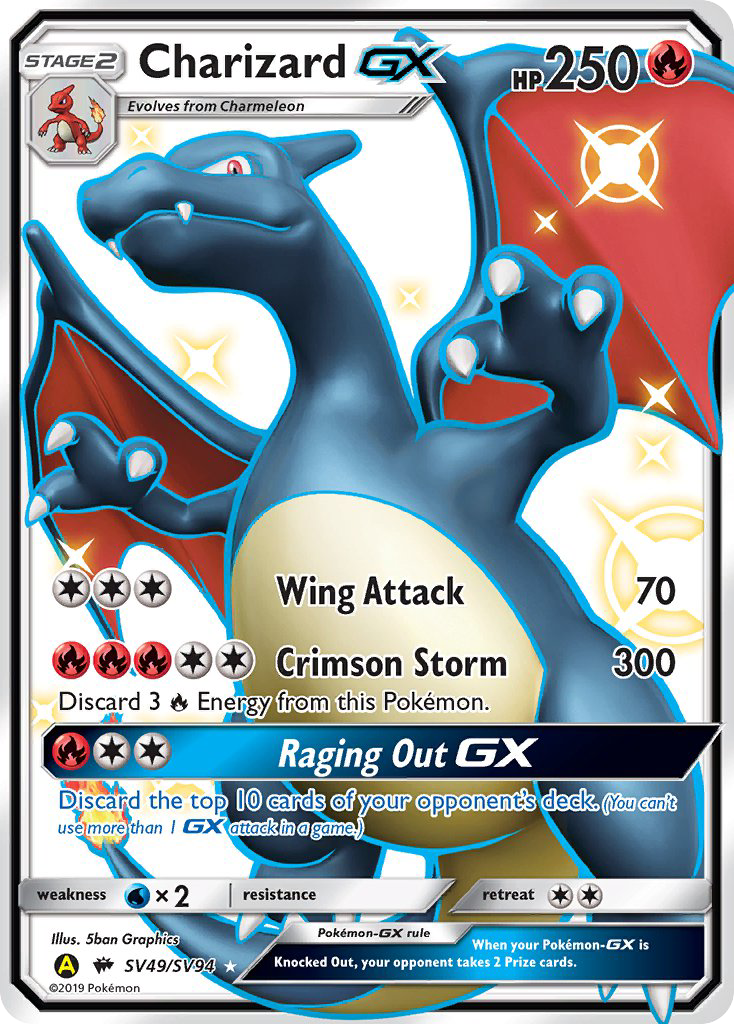
Shiny Vault pulls were significantly rarer than standard set pulls, and the subset included Shiny versions of many of the most popular Pokémon in the game. The headline card is Shiny Charizard-GX — a black-and-gold color scheme on Charizard in its GX form — which became the most in-demand modern Pokémon card for an extended period following the set's release and remains one of the most-searched Pokémon cards today.
Why Shiny Charizard-GX Sustains Demand
The card combines three separate demand drivers: Charizard's cross-generational recognition (the most consistently demanded species in the hobby), the Shiny variant visual — black and gold instead of orange — which is distinctive rather than just "nice art," and the GX era's status as the last modern era before Sword & Shield. Those three factors together create demand that doesn't depend on any single collector motivation, which is what makes it durable rather than just popular at a moment in time.
Key Sets for Collectors
- Hidden Fates (2019). The unambiguous top collector priority for this era. Shiny Charizard-GX is the headline, but the full Shiny Vault is worth understanding — Shiny Gyarados-GX, Shiny Rayquaza-GX, and Shiny Mewtwo-GX all carry meaningful demand beyond Charizard.
- Shining Legends (2017). The closest the SM era comes to a "prestige mini-set" — limited distribution, nostalgic card type, high recognition targets in Shining Charizard, Mew, and Raichu.
- Burning Shadows (2017). Contains Charizard-GX in Full Art and Rainbow Rare — both highly collected, both representing distinct aesthetic preferences among collectors who focus on Charizard completionism.
- Cosmic Eclipse (2019). The era's farewell set and the largest Tag Team lineup. Historically significant as the last GX-era set, which gives it a natural "end of an era" collector interest that typically appreciates over time.
Buying Into the SM Era
- Shiny Charizard-GX in grade is the clearest hold. Of all the SM era cards, this one has the most multi-dimensional demand base. A PSA 10 or BGS Black Label copy is a long-term store of value with the species recognition to sustain interest across multiple collecting cycles. See our grading guide for platform choice.
- Full Art vs Rainbow Rare depends on your preference. For the same Pokémon, Full Art typically shows more specific artwork composition while Rainbow Rare has the gradient foil treatment. Neither is objectively better for long-term collecting — choose based on which you'd rather display or hold.
- Sealed SM product has opened heavily — be realistic. The SM era was the first era to benefit from massive YouTube opening culture, which means sealed product was opened in very large volumes. Sealed boxes are available but their scarcity story is weaker than sealed product from pre-social media eras. Singles purchasing through a reliable marketplace is typically more efficient than cracking sealed product for specific cards.
Buying the chase singles
Acting on the above: Hidden Fates Shiny Charizard-GX (SV49) and the Burning Shadows Charizard-GX Rainbow Rare both trade mostly as graded slabs, where eBay carries the deepest supply. Raw copies of either are easier to price and compare on TCGplayer.
Buying raw with the intention of submitting? PSA wants the card in a semi-rigid Card Saver rather than a toploader, and a 35pt magnetic holder is the sensible home for anything you decide to keep ungraded.
As an Amazon Associate, Geeky Domain earns from qualifying purchases. eBay links are affiliate links; Geeky Domain may earn a commission at no extra cost to you.
FAQ
- Is Shiny Charizard-GX still worth pursuing, given how widely discussed it is? Wide discussion and sustained demand are the same thing, not opposites. Cards that remain well-known over time do so because their underlying demand drivers are real — species recognition, visual distinctiveness, scarcity. Shiny Charizard-GX in high grade retains its relevance precisely because those drivers haven't weakened.
- How do Tag Team GX cards compare as collector targets versus standard GX? Tag Team GX have the advantage of featuring two popular Pokémon together, which broadens the base of collectors interested in each card. Mewtwo & Mew-GX, for instance, appeals to Mewtwo collectors, Mew collectors, and competitive history collectors simultaneously — a wider audience than either card would reach alone.
- Is the SM era "vintage" yet? Not in the traditional sense. SM era cards are 2017–2019 product — old enough to carry real scarcity in perfect grades, but not old enough to carry the decade-plus nostalgia that drives WOTC-era premiums. The era is transitioning from "modern" to "modern classic" — which is the window when collector-grade acquisitions often make the most sense.
- How does the SM era compare to Sword & Shield for collecting? The SM era benefits from having a clearly defined mechanic (GX attacks once per game), a distinct visual language (Rainbow Rares, Shiny Vault), and a natural end point in Cosmic Eclipse. Sword & Shield introduced V and VMAX mechanics with much higher print runs. SM era cards typically have lower overall population in high grades, which supports their collector-grade values relative to the more heavily printed S&S era.
The Era That Produced the Modern Hobby's Most Iconic Card.
Hidden Fates Shiny Charizard-GX is not a hype card. It's a card with three distinct, real demand drivers that have remained intact since 2019 — and in high grade, it's a benchmark collector piece that any serious modern Pokémon collection should include. The rest of the SM era isn't just context for that card: Tag Team GX, Shining Legends, and Cosmic Eclipse all stand on their own merits as historically interesting and increasingly scarce collector targets.
The SM era is the first truly modern era. The collectors who understood that early and bought high-grade singles rather than sealed product to open are in a significantly different position than those who didn't. That lesson still applies to anyone entering the era now.
© GEEKYDOMAIN.COM | Strategy Powered by Data