

Precon vs Singles: What to Buy First
A practical breakdown of when a Commander preconstructed deck is the smarter first buy, and when building from singles actually pays off.
Some links below are affiliate links. If you buy through them, Geeky Domain may earn a small commission at no extra cost to you.
You've decided to build a Commander deck. Now you're weighing two paths: grab a preconstructed deck off the shelf and play tonight, or pull up singles listings and build something entirely your own. Both are valid ways in, and both carry real trade-offs that rarely get explained clearly before people spend money.
The confusion gets worse once you compare prices across sets. One precon from a recent release might run $39.99, another from the same release $59.99, and a brand new budget-focused line launching this fall prices its decks at $29.99. None of that is random — there are explainable reasons behind each number, and knowing them is the difference between buying with confidence and buying blind.
This guide covers what a precon gets you, where Commander deck pricing sits heading into late 2026, why one set can contain precons at wildly different price points, what's hiding inside the box that makes precons worth more than their sticker price, and when skipping the precon for singles is the better call. For the broader picture on deckbuilding strategy, start with our MTG Strategy Hub.
The Short Version
Standard-line Commander precons now carry an MSRP of $49.99, up from $44.99, and decks within one set can price differently by chase card — Tarkir: Dragonstorm's five precons ranged from $39.99 to $69.99. A new Foundations Commander Decks line launches October 2, 2026 at a lower $29.99 MSRP, the cheapest current entry point. Almost every Commander precon since 2011 ships with Sol Ring, plus mana rocks like Arcane Signet and Fellwar Stone, which carry real resale value alone. Buy a precon for a tuned, ready-to-play deck with useful staples included; build from singles once you know the exact strategy you want and it isn't on the shelf.
In This Guide
- → What a Precon Actually Gets You
- → Precon Pricing in 2026: What to Expect
- → Case Study: Why Tarkir Dragonstorm Precons Weren't Priced the Same
- → The Foundations Commander Decks: A Cheaper On-Ramp
- → What's Inside a Precon: The Hidden Value of Staples
- → Buying Singles: When It Makes Sense
- → Precon vs Singles: Side-by-Side Comparison
- → Common Mistakes
- → FAQ & Quick Reference
What a Precon Actually Gets You
Commander is a singleton format. Every deck needs exactly 100 cards — 99 unique cards plus one legendary creature serving as your commander, sitting in its own command zone. That baseline applies whether you build the deck card by card yourself or open a box that already meets it. A preconstructed deck is Wizards of the Coast's own answer to the requirement: a full 100-card list, already assembled, already legal, already built around a specific strategy tied to its commander.
That's the entire appeal. Open the box, sleeve the cards if you like, and you're sitting across from an opponent within the hour. No research phase, no guessing whether your curve is top-heavy. Wizards' own deckbuilders already made those calls, and precons are generally built to be reasonably matched against other precons from the same release, so a new player's first game isn't a blowout over which box they grabbed.
Set releases typically ship several precons at once, each built around a different commander and angle on the set's mechanics. Bloomburrow's 2024 release, for example, shipped four: Animated Army, Family Matters, Peace Offering, and Squirreled Away. Each plays differently despite launching together — you're not just buying "a deck," you're picking a strategy and personality for how you want to play.

Precon Pricing in 2026: What to Expect
If you've seen older forum posts quoting Commander precons at $30 to $40, update that number before you shop. As of 2026, the standard Commander precon line carries an MSRP of $49.99, up from a previous $44.99, part of a broader Wizards of the Coast price increase across sealed product. That's the baseline to expect for a mainline release going forward, not the older figure still circulating online.
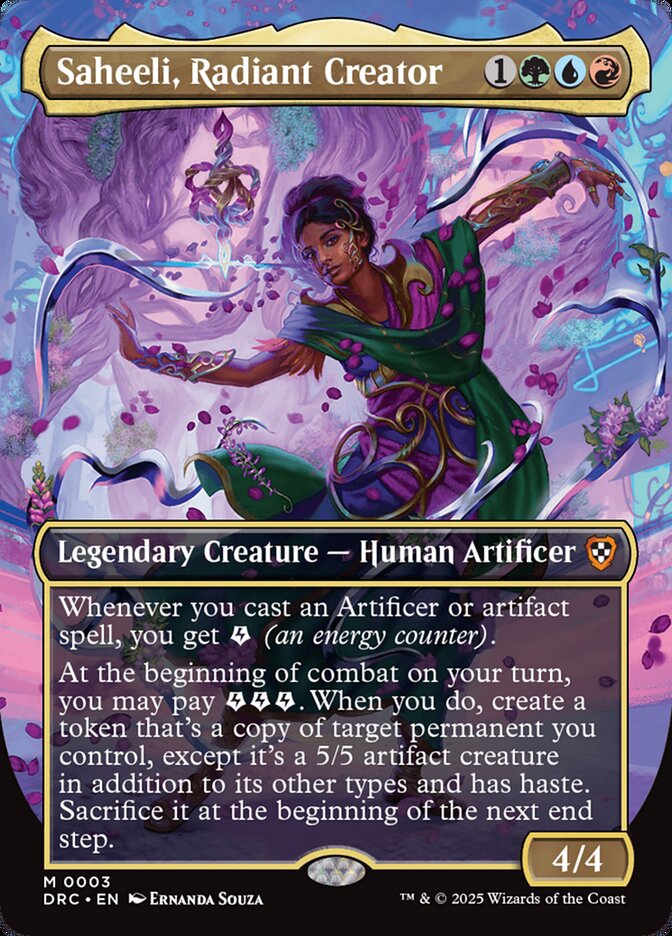
For a concrete reference point, the Aetherdrift set's Commander Deck launched at an official MSRP of $44.99, under Wizards' policy of listing MSRP directly rather than leaving pricing to retailers. That figure predates the increase to $49.99, giving a useful before-and-after: $44.99 was standard for a while, and $49.99 is where the line sits now.
The practical takeaway: budget closer to $45–$60 per precon from a standard mainline release, not $30–$40. It's still real money, so check the actual listed MSRP for whichever release you're eyeing rather than assuming an old number still holds.
Case Study: Why Tarkir Dragonstorm Precons Weren't Priced the Same
Here's where a lot of new buyers get caught off guard: not every precon in a set costs the same, even though they release together and look identical on the shelf. Tarkir: Dragonstorm's 2025 Commander deck lineup is the clearest recent example — retail listings across Card Kingdom, Mox Boarding House, and Walmart showed real spread across the five decks in that release.
| Tarkir: Dragonstorm Deck | Retail Price |
|---|---|
| Jeskai Striker | $39.99 |
| Mardu Surge | $49.99 |
| Abzan Armor | $59.99 |
| Sultai Arisen | $59.99 |
| Temur Roar | $69.99 |
That's a $30 gap between the cheapest and priciest decks in one simultaneous release. The reason comes down to what's inside each box: decks built around a more valuable chase card carry a higher price tag, even though every deck is still a complete, playable 100-card list. The retailer isn't charging more for a "better" deck in power level — it's pricing in the resale value of whatever rare card happens to be included.
Jeskai Striker, the cheapest of the five at $39.99, is worth a closer look because its full decklist was officially published. It ships with 100 total cards and includes staple reprints found across countless other Commander decks: Sol Ring, Arcane Signet, Azorius Signet, Boros Signet, Izzet Signet, Fellwar Stone, and Swords to Plowshares. Even at the lowest price in the lineup, it's not a stripped-down product — it's simply the deck without the chase card the pricier four carry.
The Foundations Commander Decks: A Cheaper On-Ramp
If the standard $45–$60 range still feels like a lot for a first purchase, there's a new option built for that concern. Wizards of the Coast launches a beginner-focused Foundations Commander Decks line on October 2, 2026, alongside the Reality Fracture set — a separate line from the standard precons, five 100-card decks priced noticeably lower at MSRP $29.99 each.
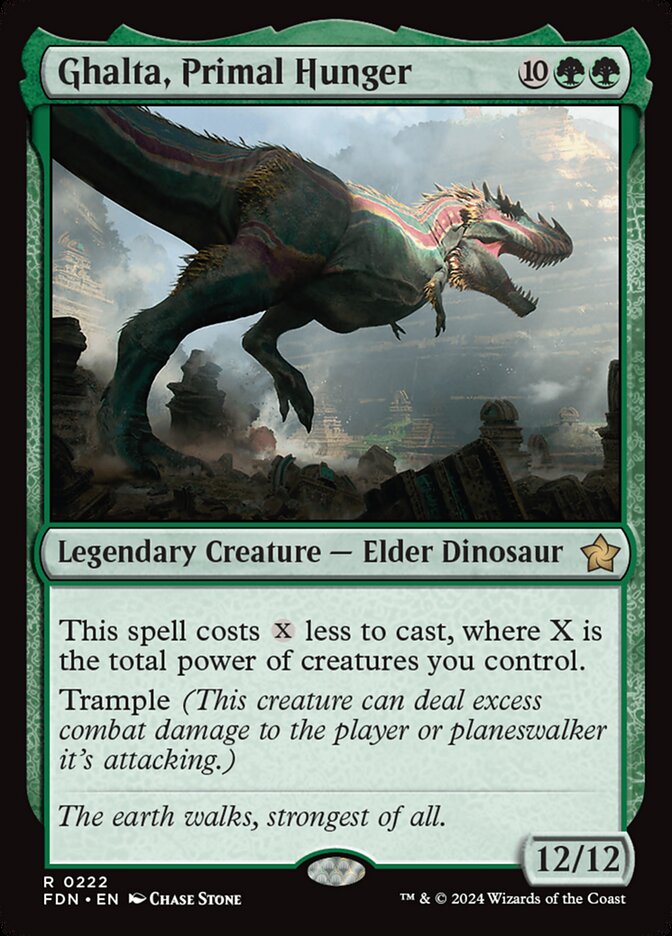
The five decks are Tramplesaurus Rex, led by the commander Ghalta, Primal Hunger; Reign of Dragons; Calling All Angels; Wretched Ranks; and Keen Engineering. The naming makes the intended strategy obvious at a glance, which fits the line's purpose — it's aimed at people picking up Commander for the first time and wanting a straightforward, thematically clear deck to start with, not players chasing a specific archetype.
At $29.99, this is currently the cheapest way to get a complete, official, tournament-legal Commander deck straight off the shelf. If budget is the main constraint on a first purchase, the Foundations line is worth seeking out over a pricier standard-line precon, especially if one of the five listed strategies already sounds fun to play.
What's Inside a Precon: The Hidden Value of Staples
Part of why precons are worth taking seriously, even at $50 or $60, is that the box isn't just a themed 100-card list — it's a delivery vehicle for cards you'd want in almost any Commander deck. Sol Ring is the clearest example: included in virtually every Commander precon since the format's original Commander 2011 decks, a deliberate design choice to keep every deck on an even playing field. The Dominaria United "Painbow" deck is a notable exception, rare enough to prove how consistent the inclusion otherwise is.

Beyond Sol Ring, precons routinely carry a spread of mana rocks and fixing pieces that see play across countless other decks, well outside whatever theme the precon is built around. Jeskai Striker's published decklist is a useful reference again: alongside Sol Ring, it includes Arcane Signet, three color-specific signets, and Fellwar Stone — a stack of ramp and fixing a player could pull straight into a future deck without buying any of it separately.

Efficient interaction shows up too. That same Jeskai Striker list includes Swords to Plowshares, one of the most reliably played white removal spells in the format regardless of what deck it lands in. Cards like this mean you're not just buying one deck — you're buying a small parts bin of reusable staples that resurface in whatever you build next (see our budget Commander staples under $5 list for more of them).

Enthusiast and market-watching sites lean on this pattern to argue precons often carry more cumulative singles-market value than their MSRP, framing it loosely as $50–$60 worth of individually valuable cards for a $40–$50 purchase. That comes from hobbyist coverage rather than an audited study, so treat it as directional, not a guaranteed math problem — but the underlying mechanism, real reusable staples bundled into the box, is well documented — it's part of why several boxes make our list of the best Commander precons of all time.
Precon or singles, a finished 99 deserves a real playmat and clean sleeves before it hits the table.
As an Amazon Associate, Geeky Domain earns from qualifying purchases. eBay links are affiliate links; Geeky Domain may earn a commission at no extra cost to you.
Buying Singles: When It Makes Sense
None of this means a precon is always the right call. Building from singles is the better path in a handful of specific situations, worth recognizing rather than defaulting to whichever option feels more exciting.
The clearest case is when you already know exactly which commander and strategy you want, and no current precon matches it. Precons are built around whatever commanders a given set happens to spotlight — if the deck you want doesn't line up with a recent release, no amount of shopping will find it pre-boxed, and singles are the only route in.
It also makes sense once you already own overlapping staples from previous decks. If your last precon gave you a Sol Ring, an Arcane Signet, and a handful of signets, buying an entirely new box mostly for duplicates is a worse use of money than picking up just the new cards your next deck needs. At that point you're really comparing "another full box" against "just the missing pieces," and the second is usually cheaper — our $50 Commander deck blueprint walks through exactly that kind of budget-conscious build.
Singles are also the right call if precise curve and mana base tuning matters from day one. A precon's mana base is built to be broadly functional, not optimized for your exact deck. Building from singles gets you full control of the 99 directly — it just takes more research and more time before the deck is finished, with no guarantee of the cohesion a Wizards-tuned decklist already has out of the box.
Precon vs Singles: Side-by-Side Comparison
| Factor | Precon | Singles |
|---|---|---|
| Upfront cost | Fixed, known in advance ($29.99–$69.99 depending on the line and deck) | Variable, depends entirely on card choices |
| Time to first game | Same day — open the box and play | Depends on shipping and sourcing every card |
| Research required | Minimal — the deck is already built | Significant — every card is your own decision |
| Deck cohesion out of the box | Tuned by Wizards' own deckbuilders | Depends entirely on your own build skill |
| Customization | Limited until you start swapping cards later | Fully custom from the very first card |
| Reusable staples included | Yes — Sol Ring, signets, and similar staples are typically bundled in | No — every staple is bought separately, but only the ones you actually need |
Neither column is universally "better." The comparison is really about what you value most for this specific purchase — speed and built-in cohesion, or full control over every card from the start.
Common Mistakes
Assuming every precon in a set costs the same. As the Tarkir: Dragonstorm lineup shows, decks in one release can range from $39.99 to $69.99 depending on the chase card inside. Check the specific deck's listed price, not just the set's general MSRP.
Treating "more card value than MSRP" as a guarantee. A precon's staples adding up to more resale value than the box costs is common enthusiast framing, not an audited figure. Treat it as a bonus, not the reason you bought it.
Buying singles to duplicate staples you already own. If a previous precon already gave you a Sol Ring or signets, check your binder before buying another full deck that mostly reprints what you have.
Overlooking the Foundations line if budget is the main concern. At $29.99 MSRP, it's the cheapest official entry point into Commander — worth checking before defaulting to a pricier precon out of habit.
Losing track of the 100-card requirement when mixing in singles. If you swap cards out of a precon, the deck still needs to land on exactly 100 cards — 99 plus your commander — to stay legal.
FAQ & Quick Reference
Are Commander precons still around $30–$40?
Not for the standard line. As of 2026 that line's MSRP moved to $49.99, up from $44.99. The $29.99 figure now belongs to the newer, beginner-focused Foundations Commander Decks line specifically.
Why did Tarkir: Dragonstorm's precons have different prices?
The chase-card value inside each box varied. Jeskai Striker retailed at $39.99, Mardu Surge at $49.99, Abzan Armor and Sultai Arisen both at $59.99, and Temur Roar at $69.99, reflecting the more sought-after card in each pricier deck.
Does every precon come with Sol Ring?
Almost every one since Commander 2011, a deliberate design choice to keep decks on an even footing. The Dominaria United "Painbow" deck is a known exception, so it's the overwhelming norm rather than an absolute guarantee.
What's the cheapest way to get into Commander right now?
The Foundations Commander Decks line, launching October 2, 2026 at $29.99 MSRP each — a lower-cost, beginner-friendly on-ramp compared to the standard precon line.
Should I buy singles instead of a precon for my first deck?
Depends on what you already know. A specific commander no precon covers, or wanting to optimize the mana base from the start, favors singles. Wanting something tuned and ready to play immediately favors a precon.
Do precons actually meet Commander's deck-building rules?
Yes. Commander requires a 100-card singleton deck — 99 cards plus one legendary commander — and every official precon satisfies that baseline out of the box.
Either Way, You End Up With 100 Cards.
Whichever route you pick, the goal is the same: a 100-card deck that's actually fun to sit down and play. A precon gets you there today with a built-in stack of staples; singles get you there on your own terms.
© GEEKYDOMAIN.COM | Strategy Powered by Data