

GD01 vs GD02 vs GD03 vs GD04 vs GD05: Set Comparison
Five booster sets, five different reasons to buy. Here's what's in each Gundam Card Game expansion, which series they added, what they're worth chasing, and which one belongs in your cart first.
The Gundam Card Game launched worldwide in July 2025 and has kept a roughly quarterly release cadence ever since — five booster sets deep as of late August 2026, with the newest, GD05 Freedom Ascension, doubling as the game's official 1st Anniversary release. For a new player or a returning collector, that raises an obvious question: with five sets on the shelf, which one do you actually open? They aren't interchangeable. Each set added different anime series, different mechanics, and a different chase structure, and the launch set carries a collector premium the later ones don't.
This guide breaks down all five boosters side by side — GD01 Newtype Rising, GD02 Dual Impact, GD03 Steel Requiem, GD04 Phantom Aria, and GD05 Freedom Ascension — so you can see exactly what separates them. We'll cover release dates, card counts, the series each one introduced, the standout mechanics, the cards worth chasing, and a clear recommendation for which set fits a player, a collector, or a budget-minded buyer.
One thing to keep in mind throughout: every set in this game is fully legal and fully playable. Unlike a rotating format, nothing here has aged out. So "which set is best" is really a question of what you want — the cheapest entry, the strongest deck support, the iconic launch cards, or the freshest mechanics.
→ Short Version
GD01 Newtype Rising is the launch set — iconic cards, the highest collector premium, and the foundation every archetype is built on. GD02 Dual Impact widened the game with new anime series and stronger two-color synergy. GD03 Steel Requiem deepened the existing card pool and introduced premium SP (Special Art) cards as a new chase tier. GD04 Phantom Aria debuted Victory Gundam and Turn A Gundam, a Parts-token mechanic, and "second-color" pilot reprints that open new strategies. GD05 Freedom Ascension is the newest set and the game's official 1st Anniversary release, adding four more debut series, a brand-new Link Rare parallel tier, and a record five LR++ chase cards. If you want iconic value, buy GD01; if you want proven modern deck support, buy GD04; if you want the newest cards and the anniversary chase, buy GD05; if you want the cheapest sealed entry, GD02 and GD03 are usually the value picks. All five are tournament-legal.
→ Related Reading
In This Guide
All Five Sets at a Glance
Here's the high-level comparison before we go set by set. Every booster shares the same pack structure — 12 cards plus one token/resource slot, 24 packs per box, $4.99 MSRP per pack — so the differences are in the card pool, the series, and the chase.
| Set | Released | Card Types | Best Known For |
|---|---|---|---|
| GD01 Newtype Rising | Jul 25, 2025 | 130 + 4 | Launch set; iconic cards; collector premium |
| GD02 Dual Impact | Oct 24, 2025 | ~130-tier | New series; expanded two-color synergy |
| GD03 Steel Requiem | Jan 30, 2026 | ~130-tier | Deeper card pool; SP (Special Art) debut |
| GD04 Phantom Aria | Apr 24, 2026 | 135 + 16 | Victory & Turn A debut; proven deck support |
| GD05 Freedom Ascension | Jul 24, 2026 | 138 + 10 | 1st Anniversary set; 4 new series; record 5 LR++ chase cards |
Card-type counts reflect base set sizes from official and retailer listings; exact GD02/GD03 totals sit in the same ~130-type range as GD01, and GD05's 138 base types are supplemented by 10 extra card types for 148 total distinct types (181 total printings once alt-art, SP, and parallel versions are counted). Pack/box configuration and $4.99 pack MSRP are consistent across all five, though GD05's real-world booster box prices ran well above the $119.76 MSRP-equivalent (24 packs per box) in the weeks after its anniversary launch, as early sellouts drove demand. Always confirm current sealed pricing before buying, since the secondary market moves.
GD01: Newtype Rising
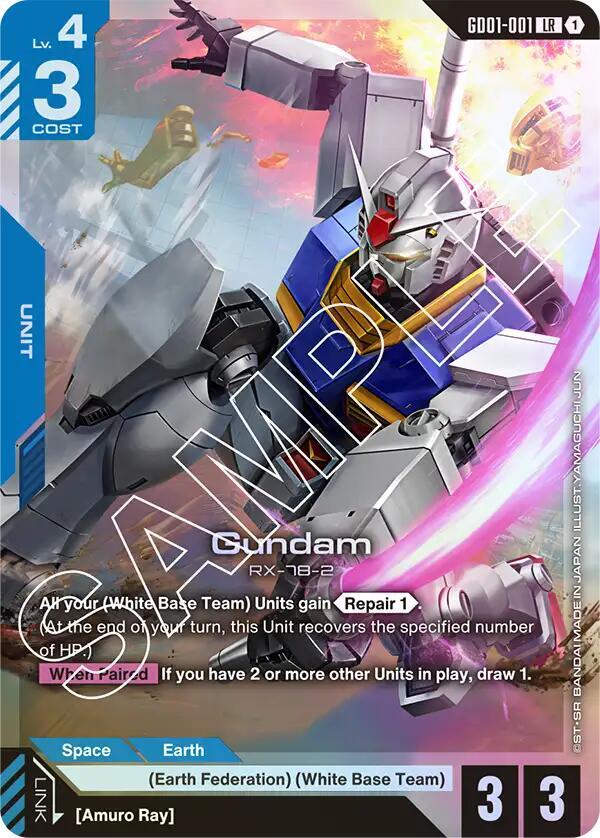
The set that started it all. Newtype Rising launched the Gundam Card Game on July 25, 2025, with 130 base card types (plus 4 tokens) and 47 alternate-art cards spread across the rarities. As the foundational set, it established the five-color system and the core archetypes the rest of the game builds on.
Its signature contribution was the introduction of Red cards — representing Zeon and Neo Zeon forces with the ability to deal direct damage to units, giving the color its aggressive identity. GD01 is the home of launch staples like Gundam Aerial, Char's Zaku II, and the original RX-78-2 Gundam.
- Why buy it: Iconic, foundational cards and the strongest long-term collector story. Launch-set first prints from a brand-new franchise almost always hold a premium over later printings, especially premium rarities featuring the original 1979 Mobile Suit Gundam cast.
- Watch the chase: Sought-after foils like Gundam Aerial and the high-rarity Char and Amuro cards. These are the pieces collectors point to first.
- The catch: Because it's the oldest and most desirable, sealed GD01 is often among the priciest of the five on the secondary market — though brand-new sets can spike above it in their own launch-week sellout window. You pay for the iconography.
GD02: Dual Impact
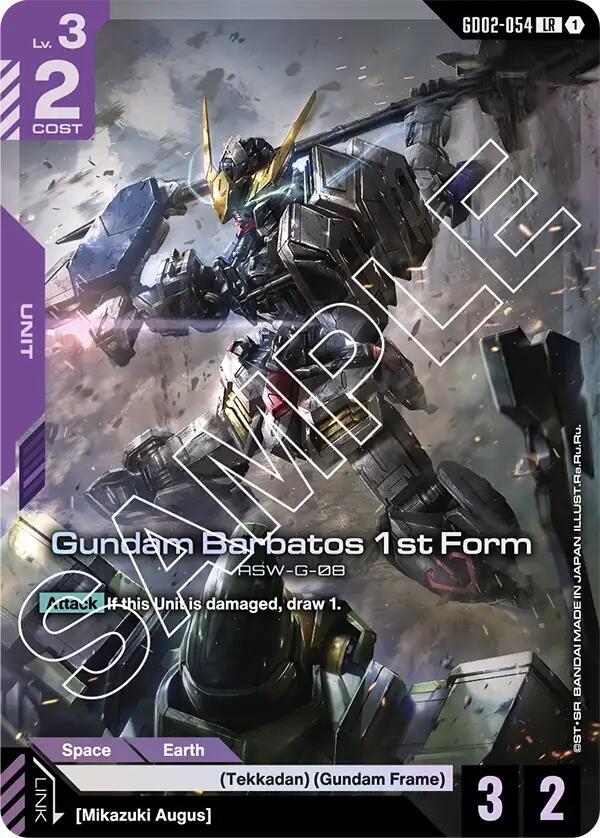
Dual Impact arrived October 24, 2025, and did exactly what its name implies — it widened the game's franchise footprint and leaned into multi-series and two-color strategies. It folded in additional anime series including Gundam X, Gundam AGE, and Iron-Blooded Orphans (Barbatos and friends), plus newer entries like the GQuuuuuuX line.
Where GD01 set the foundation, GD02 broadened it — giving more factions and more color pairs viable support, which made the deckbuilding landscape considerably richer. If you're building a two-color deck, GD02 is frequently where a chunk of the connective-tissue cards live.
- Why buy it: Best for players expanding into new series and two-color decks. It opened up archetypes that GD01 alone couldn't fully support.
- Watch the chase: Iron-Blooded Orphans fans chase the Barbatos line (the Gusion Rebake LR is a notable example), and the GQuuuuuuX foils have their own following.
- The value angle: As a mid-catalog set without GD01's launch premium, sealed Dual Impact is often one of the more affordable ways to crack packs while still pulling relevant playables.
GD03: Steel Requiem
![Steel Requiem [GD03] set key art](https://static.gundamcardlist.com/images/cards/670514.jpg)
Steel Requiem released January 30, 2026, and its job was depth rather than breadth. Instead of throwing in a pile of brand-new series, it reinforced and rounded out the existing card pool — adding more unit options, more pilots for established factions, and tightening up archetypes that GD01 and GD02 had started.
Its most important collector contribution was the debut of SP (Special Art) cards — a premium illustration treatment that became a new chase tier and has carried forward into later sets. Reviewers also noted Bandai subtly adjusted the box distribution starting with GD03, concentrating more of the value at the rare-and-above level.
- Why buy it: The best set for shoring up existing decks with consistency pieces, and the entry point for the SP card chase.
- Watch the chase: The Gundam Barbatos Lupus LR and the SP-treatment cards (such as Gundam Barbatos Adapt SP) are the standouts collectors hunt here.
- The catch: Because it's a depth set, the "wow factor" per pack is more about playables and SP hits than headline new series — great for players, slightly less flashy for pure collectors.
GD04: Phantom Aria
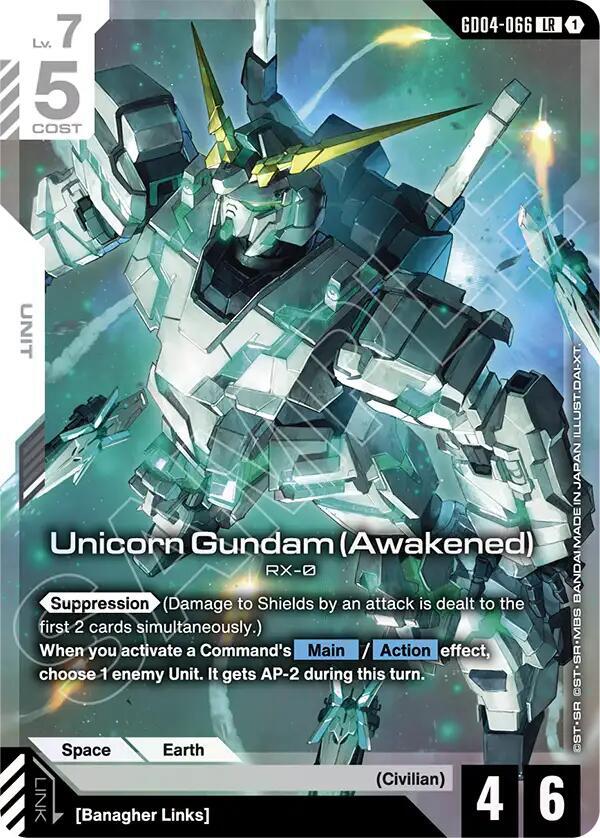
The set that held the "newest" title before GD05 arrived, and still the deepest card pool in the game. Phantom Aria launched April 24, 2026, with 135 base card types plus 16 Special cards, and 44 alternate-art cards. Its rarity breakdown is 50 Common, 36 Uncommon, 32 Rare, 12 Legend Rare, 5 Special, 6 Token, and 10 Resource.
The marquee draw is the debut of Mobile Suit Victory Gundam and Turn A Gundam, two long-requested series joining the game for the first time, alongside reinforcements for Mobile Suit Gundam and Gundam UC favorites. It also introduced two genuinely new gameplay wrinkles:
- Second-color pilot reprints. Established pilots return in new colors to enable fresh strategies — for example, Suletta Mercury (originally Blue/Purple) gets a Green card to support resource-acceleration in the "Academy" archetype. This opens deckbuilding lanes that didn't exist before.
- Victory's Parts tokens. Victory Gundam units like the V-Dash Gundam use Parts tokens to represent sacrificing components to sustain attacks or activate defensive abilities — a lore-accurate resource-management layer new to the game.
- Why buy it: Strong, proven deck support that's had time to establish itself. Victory and Turn A archetypes are mature, the card pool is deep, and prices have had months to settle since launch.
- Watch the chase: The Legend Rares of Victory Gundam and Penelope, the continuing SP unit cards, and the rare "++" case-hit variants with extremely difficult pull rates. (We keep a dedicated list — see the GD04 chase guide linked above.)
- The catch: Now several months past launch, most of GD04's launch-window pricing has settled — good for players buying to play, less exciting if you wanted the newest thing (that's GD05 now).
GD05: Freedom Ascension
The current set, and a milestone one. Freedom Ascension launched July 24, 2026 in a globally synchronized rollout, and it doubles as the Gundam Card Game's official 1st Anniversary set — the game itself launched worldwide in July 2025, so GD05 marks one full year. It carries 138 base card types plus 10 extra card types (148 total distinct types), and 181 total printings once alt-art, SP, and parallel versions are counted. The rarity spread is 50 Common, 36 Uncommon, 32 Rare, 12 Legend Rare, 8 Special, 2 Token, and 8 Special EX Resource cards.
Its headline contribution is series breadth: four anime series join the Gundam Card Game for the first time in GD05, per Bandai's official product page, which announces each one individually rather than lumping them together. Mobile Suit Gundam SEED Destiny arrives headlined by Strike Freedom Gundam (Blue). Mobile Fighter G Gundam brings Shining Gundam and pilot Domon Kasshu (White), a "Shining Finger" command card, and Master Gundam (Red). Mobile Suit Gundam Wing: Endless Waltz is headlined by Wing Gundam Zero EW (White). And Mobile Suit Gundam Char's Counterattack debuts with both Nu Gundam (Green) and Sazabi (Purple). (Some marketing copy rounds this down to "two series" — that's a looser summary; the specific per-series announcement list is the more precise count, and the one we're using here.)
- Link Rare, a brand-new rarity tier. GD05 debuts "Link Rare" parallel cards — special combined artwork pairing a Unit with its Pilot in a memorable combo. It's the first time the game has printed cards at this tier.
- SP Card EX Resources and 8 Pilot SP cards. As part of the anniversary celebration, GD05 introduces the first-ever EX Resource cards done in SP (special) treatment, illustrated with female characters, plus eight popular pilots each getting their own SP card version.
- A record five LR++ cards. GD05 sets a new high-water mark with five "LR++" cards — a tier above standard Legend Rare, one per color — more than any prior set has printed at once.
- Why buy it: It's the current set and the anniversary headline — four debuting series, a new Link Rare tier, and some of the highest-value chase cards the game has produced. If you want what's newest, this is it.
- Watch the chase: Five LR++ cards anchor the set, one per color, and as of shortly after release approximate TCGplayer market snapshots put them at: Wing Gundam Zero EW (GD05-067, White, ~$3,582) — currently the single most expensive chase card in the game's history outside the ultra-limited Beta print; Strike Freedom Gundam (GD05-002, Blue, ~$2,622), the face of the anniversary set; Nu Gundam (GD05-017, Green, ~$1,530), Amuro Ray's final machine; Sazabi (GD05-049, Purple, ~$1,231), Char Aznable's crimson flagship; and Master Gundam (GD05-033, Red, ~$1,228), which deals 5 damage to the top card of the opponent's Shield area. These are brand-new-set prices and will move — see our most valuable chase cards ranking for the current picture. Some retailers also report the standard (non-++) LR printing of Strike Freedom Gundam trading in the roughly $95–$113 range, and SP pilot cards like Kira Yamato and Heero Yuy in the roughly $40–$76 range.
- The catch: Booster boxes carry an approximate $119.76 MSRP-equivalent (24 packs at $4.99), but real-world listings swung widely in the weeks after launch — from close to MSRP to well over $200 — as early sellouts drove demand. As with any brand-new set, treat launch-week numbers as a snapshot, not a permanent price.
GD05 also shipped alongside a companion product built for exactly this moment: the Deck Build Box [SC01] (seen around $99.99 at US retail, though regional pricing varies), with 125 curated reprinted cards — 25 per color across all five colors — designed so two colors combine into an instant deck, plus 8 packs of Freedom Ascension boosters, Resource and Token cards, a playsheet, a half-storage box, and a bonus pack containing one of three random EX Base card types. It's a strong option if you'd rather build a deck outright than gamble on packs; see the beginner buyer's guide for more on where it fits.
How the Rarities & Packs Work
All five sets use the same skeleton, which makes cross-set buying decisions easier once you know it:
- Pack structure: 12 playable cards plus 1 token/resource slot ("12+1"), 24 packs per display box, 12 displays per case. MSRP is $4.99 per pack across all five sets.
- Core rarity ladder: Common (C) → Uncommon (U) → Rare (R) → Legend Rare (LR). Most sets share the same base spread (roughly 50C / 36U / 32R / 12LR).
- Premium treatments: Alt-art versions (the "+" variants) appear across rarities in every set. SP (Special Art) cards debuted in GD03 and continue through GD04 and GD05 as a top-tier chase, and GD05 added its own new tier on top — "Link Rare" combined Unit/Pilot parallel art. The "++" designation marks the hardest case-hit pulls, and GD05's five LR++ cards are a record for the game.
- Tokens & Resources: That last "+1" slot is functional, not flashy — Resource cards, EX tokens, or unit tokens you need for play. Don't judge a pack by it.
If you want the deeper breakdown of how alt-arts, foils, and pull rates work across Bandai's lineup, the rarity and pull-rate guide covers the framework in detail.
Which Set Should You Buy?
Pick the row that matches what you're actually trying to do. None of these is a wrong answer — they just optimize for different goals.
| If you want… | Buy | Why |
|---|---|---|
| Iconic cards & long-term value | GD01 | Launch-set premium, foundational staples |
| New series & two-color decks | GD02 | Broadest franchise expansion, affordable |
| Deck consistency & SP hunting | GD03 | Depth set, SP card debut, good value |
| The strongest current decks | GD04 | Proven support, fresh mechanics, Victory/Turn A |
| Newest cards & the anniversary chase | GD05 | 1st Anniversary set, 4 new series, record LR++ chase |
| Cheapest sealed entry | GD02 / GD03 | No launch premium, still relevant playables |
The One-Line Answer
New player building a competitive deck today? Start with GD04 for proven current support, then backfill staples from GD01. Collector chasing iconography? GD01. Want the newest cards, the four new series, and the anniversary chase? GD05. Budget buyer who just wants to rip packs and get playables? GD02 or GD03.
Where to buy each set
One route per row of the table above: GD05 Freedom Ascension for the newest cards, GD04 Phantom Aria for proven deck support, GD01 Newtype Rising for the iconic staples, the Deck Build Box [SC01] if you'd rather build a deck than gamble on packs, and an ST starter deck if this is your first Gundam product. Sealed GD01 is the hardest of the five to find new, so eBay is usually the better route there — and if it's one chase card you want (say Strike Freedom GD05-002), buy that single instead of a box.
As an Amazon Associate, Geeky Domain earns from qualifying purchases. eBay links are affiliate links; Geeky Domain may earn a commission at no extra cost to you.


Common Buying Mistakes
Mistake #1: Assuming the newest set is always the best buy.
GD05 is the newest set and the anniversary headline, but a lot of the cards that make decks function — staples, removal, key pilots — live in GD01–GD04. Buying only the newest set leaves you with shiny pieces and no foundation. Most real decks pull from multiple sets.
Mistake #2: Paying the GD01 premium when you just want to play.
If your goal is functional cards, not iconography, you're overpaying by cracking sealed GD01. The launch premium is a collector's cost. Players are usually better off buying GD01 singles for the specific staples they need and ripping cheaper sets for the rest.
Mistake #3: Confusing booster sets with starter decks.
The GD-prefixed products are boosters (randomized packs). The ST-prefixed products are starter decks (fixed, ready-to-play lists). A new player almost always wants to begin with a starter deck for a complete, legal deck, then add boosters — not open boosters hoping to assemble one from scratch.
Mistake #4: Buying sealed for a single chase card.
The "++" case hits and top SP/LR cards have brutal pull rates. If you specifically want one card, the math almost always favors buying that single outright over ripping boxes hoping to hit it. Sealed is for the experience and the spread; targeted singles are for the chase.
Mistake #5: Ignoring launch-window price volatility.
GD05's LR++ chase cards hit historic prices right out of the gate, and singles on any set run hottest in the first weeks after it drops. If you don't need a card immediately for a deck, waiting after a set's launch usually means paying less as supply catches up. Don't FOMO-buy at the peak — and treat any price you see for a set this new, GD05 included, as a snapshot that will keep moving.
FAQ & Quick Reference
- Are all five sets tournament-legal? Yes. The Gundam Card Game doesn't currently rotate, so GD01 through GD05 (and the ST starter decks) are all legal. Cards mix freely across sets in deckbuilding, subject only to the standard copy limits and any banlist.
- Which set has the best pull value? It depends on what you value. GD01 has the highest ceiling for iconic chase cards but the highest sealed cost. GD02 and GD03 tend to offer the best ratio of relevant playables to sealed price. GD04 has strong current deck support at prices that have mostly settled. GD05, the newest and 1st Anniversary set, has by far the highest ceiling of any set to date — its top LR++ chase card, Wing Gundam Zero (EW), is currently the single most expensive pull in the game's history outside its ultra-limited Beta print — but that also means its sealed prices ran hottest of any set at launch.
- What are SP cards? SP (Special Art) cards are a premium illustration treatment that debuted in GD03 Steel Requiem and continued through GD04 Phantom Aria and GD05 Freedom Ascension, where the 1st-anniversary release pushed the treatment further with the first-ever SP Card EX Resources (illustrated with female characters) and eight Pilot SP cards. They sit at the top of the chase alongside Legend Rares and the "++" case hits.
- I'm brand new — what do I actually buy first? Start with a starter deck (an ST product) or the new Deck Build Box [SC01] — a curated reprint box bundled with GD05 packs — for a complete, ready-to-play foundation, then add booster packs to customize. For boosters, GD05 gives you the newest cards and series; GD01 gives you foundational staples. See the beginner buyer's guide for specific product picks.
- Is GD05 the newest set, and will there be a GD06? Yes, GD05 Freedom Ascension (released July 24, 2026) is the newest booster and the game's official 1st Anniversary release. Bandai has kept a roughly quarterly cadence since launch (GD01 July 2025, GD02 October 2025, GD03 January 2026, GD04 April 2026, GD05 July 2026), so another release following that pattern is a reasonable expectation. Check official channels for confirmed dates before planning purchases around it.
- GD01 Newtype Rising (Jul 2025): launch set, iconic cards, Red cards debut, collector premium.
- GD02 Dual Impact (Oct 2025): new series (Gundam X, AGE, IBO), two-color support, value buy.
- GD03 Steel Requiem (Jan 2026): deeper pool, SP card debut, consistency pieces.
- GD04 Phantom Aria (Apr 2026): Victory & Turn A debut, Parts tokens, second-color pilots, proven support.
- GD05 Freedom Ascension (Jul 2026): 1st Anniversary set, four new series (SEED Destiny, G Gundam, Endless Waltz, Char's Counterattack), Link Rare debut, record 5 LR++ chase cards.
- Shared structure: 12+1 packs, 24/box, $4.99 MSRP, C/U/R/LR ladder + alt-arts, SP, and (as of GD05) Link Rare chase.
- All five: tournament-legal, mix freely in deckbuilding.
Buy for Your Goal, Not the Hype.
Five sets, five jobs. GD01 is the iconic foundation, GD02 broadened the world, GD03 deepened it and added the SP chase, GD04 brought Victory and Turn A along with new deckbuilding mechanics, and GD05 is the current set and 1st Anniversary release — four more debuting series, a new Link Rare tier, and the priciest chase cards the game has produced. Because nothing rotates, every set stays relevant — so the smartest buy is the one that matches what you're building toward, whether that's a competitive deck, a complete collection, or just the joy of cracking packs. Figure out your goal first; the set picks itself after that.
© GEEKYDOMAIN.COM | Strategy Powered by Data