

Centering, Print Lines & Whitening: What Graders See
The physical defects PSA, BGS, and CGC actually hunt for under a loupe -- and the real ratios and thresholds that separate a 10 from a 9.
Some links below are affiliate links. If you buy through them, Geeky Domain may earn a small commission at no extra cost to you.
The Short Version
Every major grading company scores a card on four physical factors -- centering, corners, edges, and surface -- and inspects all four under magnification, typically a 10x loupe. PSA's published standard for a Gem Mint 10 is roughly 55/45 or better on the front and 75/25 on the back, and that tolerance loosens step by step all the way down to 90/10 at the bottom of the scale. CGC's own grading-scale page confirms nearly identical numbers, and reserves its top "Pristine 10" for a card that's flawless under 10x magnification across all four categories, not just centering. Print lines -- thin streaks left by uneven pressure during the printing press run -- are one of the single most-cited reasons a modern card lands a 9 instead of a 10, and PSA has an official "PD" (Print Defect) qualifier for cases severe enough to matter. Corner and edge whitening is ink physically chipping or wearing away to expose the lighter card stock underneath, and it's judged as its own category, separate from print lines. None of this is reliably visible to the naked eye, which is exactly why a cheap loupe or UV flashlight earns its keep before you submit anything.
In This Guide
- → What Graders Actually Look For
- → Centering: The Real Ratios PSA, CGC, and BGS Use
- → Print Lines: The Defect That Blocks Perfect Grades
- → Corner and Edge Whitening
- → Diamond Cuts and Other Factory Miscuts
- → Why Foil Cards Like Lorcana Enchanted Grade Differently
- → What Each Defect Actually Costs You
- → FAQ & Quick Reference
What Graders Actually Look For
Every major grading company -- PSA, CGC, and Beckett (BGS) -- evaluates a submitted card against four physical criteria: centering, corners, edges, and surface. That framework is consistent enough across companies that it's worth memorizing, because it's the actual checklist a human grader is running through under a loupe, not a vibe. This is a different question from the one answered in our guide to card condition grades from NM to DMG -- that scale describes the end result of wear over time, while this article is about the specific physical defects a grader is hunting for to decide which condition bucket, or which numeric grade, a card actually lands in.
Where the companies diverge is in how much of that four-factor breakdown they actually show you. PSA's standard service prints a single overall number on the label and keeps the four individual scores internal, though PSA also offers optional premium add-on services that some hobby sources describe as printing individual 1-10 sub-grades for centering, corners, edges, and surface -- confirm current tiers and pricing directly with PSA before assuming a specific service is available, since these add-on offerings change over time. Beckett takes the opposite approach: BGS prints all four subgrades on every label by default, which is part of why serious collectors of expensive singles often gravitate toward BGS when they want to know exactly which category cost them the point. If you're still deciding which company to use in the first place, our PSA vs BGS vs CGC comparison goes deeper on turnaround times and pricing tiers; this piece stays focused on what the grader is physically looking for once your card is on the table.
Whether the tool going forward is worth the fee at all is a fair question before you get into the weeds of ratios and thresholds -- if you haven't settled that yet, our is grading worth it breakdown is the place to start. Assuming the answer is yes for the card in front of you, everything below is what actually determines the number that comes back.
Centering: The Real Ratios PSA, CGC, and BGS Use
Centering measures how evenly the printed border frames the card, checked as two independent ratios on the front -- left-to-right and top-to-bottom -- and again on the back, which typically gets a much looser tolerance since printers historically cared less about back-of-card alignment. A card can pass easily on one axis and fail badly on the other, which is why "it looks centered" is not the same thing as being centered.
PSA's standard, as summarized across multiple hobby and grading-reference sources, loosens in fairly predictable steps as the grade drops: a PSA 10 requires roughly 55/45 or better on the front and about 75/25 or better on the back; a PSA 9 allows about 60/40 front and 90/10 back; PSA 8 allows about 65/35 front with the same 90/10 back tolerance; PSA 7 allows about 70/30 on the front; PSA 6 allows about 80/20; PSA 5 and PSA 4 both allow about 85/15; and PSA 3 down through the 1.5 grade allow up to 90/10 on both sides. CGC's own published grading-scale page lines up closely with those numbers on the front: a "Pristine 10" requires a dead-even 50/50, a "Gem Mint 10" allows up to about 55/45 front and 75/25 on the reverse, a "Mint 9" allows 60/40 front and 90/10 back, "NM/Mint 8" allows 65/35, and "Near Mint 7" allows 70/30. CGC publishes these figures on its own grading-scale reference page, though its 9, 8, and 7 centering numbers are stated specifically for sports and non-sports cards -- only the Pristine 10 and Gem Mint 10 tolerances are given without that qualification -- so treat the mid-grade figures as a close guide rather than a TCG-specific rule.
Beckett's reported tolerances run a little tighter at the very top: multiple independent hobby sources describe BGS's Black Label 10 as requiring a true 50/50 front (with 60/40 or better on the back), a Gem Mint 9.5 allowing 50/50 one direction and 55/45 the other on the front, a Mint 9 allowing 55/45 both ways on the front, and an 8 allowing 60/40 or better. Beckett has not published as detailed a public breakdown of these exact figures, so treat those specific numbers as well-corroborated across several independent hobby sources rather than a direct quote from Beckett itself. If you're weighing PSA against the competition for a specific vintage Pokemon card, our CGC vs PSA for vintage Pokemon guide walks through how those centering differences actually play out in practice.
One PSA-specific wrinkle worth knowing: PSA publishes a 5% leeway on its front-centering minimum standards for cards grading PSA 7 or better, stated in the "OC" qualifier section of its own grading standards -- meaning a card measuring slightly worse than the stated ratio can still earn the higher grade if the rest of the card and overall eye appeal hold up. That leeway is discretionary, not automatic, and it only applies to the centering measurement itself.
A 10x loupe and a UV flashlight won't replace a grader's eye, but they'll catch the print lines, whitening, and off-center borders that could cost you a grade -- and a non-refundable grading fee -- after the fact.
As an Amazon Associate, Geeky Domain earns from qualifying purchases. eBay links are affiliate links; Geeky Domain may earn a commission at no extra cost to you.
Print Lines: The Defect That Blocks Perfect Grades
A print line is a manufacturing artifact, not damage from handling. It happens during the printing or press run itself -- a straight or slightly curved streak left behind when a printing roller applies uneven pressure, or when the card sheet moves through the press at an inconsistent speed. That distinction matters because it means a print line can show up on a card that has never left its factory-sealed pack, sitting right there in the box before anyone's hands have touched it.
PSA's published Gem Mint 10 standard does say "an allowance may be made for a slight printing imperfection" so long as it doesn't impair the card's overall appeal -- but beyond that slight-imperfection threshold, hobby and grading-prep sources are fairly consistent that PSA does not treat print lines as an excusable factory quirk. A print line visible in the card's image area is commonly cited as disqualifying a card from a PSA 10 outright, and it's frequently named as the single most common reason a modern card comes back as a PSA 9 instead of the perfect 10 its owner was hoping for. This is collector and grading-prep consensus rather than an official line-by-line PSA policy statement, but it's repeated often enough across independent sources to treat as a reliable rule of thumb.
PSA also has an official qualifier for this: "PD," short for Print Defect, covers print dots, print "snow" (white or light patches where ink failed to lay down evenly), and print lines severe enough to push a card below the minimum standard for its numeric grade. PD is optional -- a submitter can request it -- and collectors and dealers commonly value a PD-qualified card at roughly two grades lower, though that is a market rule of thumb rather than a figure PSA itself publishes. It's a genuinely useful term to know if you're ever staring at a slabbed card with "PD" printed under the grade and wondering what it means.
Print lines aren't evenly distributed across every set, either. The 2016 Pokemon TCG "XY: Evolutions" set is widely cited across hobby and collector circles as having had an unusually high rate of print-line and centering defects on its holographic cards, generally attributed to a rapid, high-volume print run. That reputation is why truly gem-mint Evolutions holos carry a price premium over similarly aged sets -- a genuinely clean copy is harder to find than the set's overall print run would suggest. If you're building out a vintage collection and want to understand how these kinds of manufacturing-era quirks affect authentication more broadly, our guide to authenticating vintage Pokemon slabs and packs covers the adjacent territory of spotting resealed or altered product, which is a different problem from a factory print defect but one collectors often confuse with it.
Corner and Edge Whitening
Whitening is physically distinct from print lines even though both can look like small pale marks to an untrained eye. Whitening is the printed color or ink layer chipping, splitting, or wearing away at a corner tip or along an edge, exposing the lighter, uncolored card stock underneath. It's scored under the "corners" and "edges" criteria respectively -- separate from the "surface" category that covers print lines and scratches. That separation matters in practice: a card can have a flawless surface and still lose points to a single whitened corner, because graders are checking each category independently rather than forming one holistic impression.
CGC's published grading scale explicitly folds surface-level print spots into its "surface" criterion, while noting that edge chipping and minor border discoloration first become allowed flaws at the Excellent+ 5.5 grade tier and below -- in other words, by the time a card has visible whitening, it's already well outside gem-mint territory. Whitening is also cumulative in a way print lines usually aren't: a single sleeve change or a card sliding loose in a binder pocket can start chipping a corner that a factory print run never touched. If you're trying to keep raw cards from developing whitening in the first place, our roundup of sleeves, binders, and toploaders covers the storage side of preventing exactly this kind of damage before it happens.
Diamond Cuts and Other Factory Miscuts
A less commonly discussed defect is the "diamond cut," also called a miscut in this context -- a factory cutting error where the card's edges are sliced off-register relative to the printed border, giving the finished card a slightly parallelogram or tilted-image look rather than a true rectangle. This happens at the cutting stage, after printing, when the sheet isn't perfectly aligned as it's sliced into individual cards.
This is one defect a grader does publish tolerances for: CGC's grading scale allows "a very slight diamond cut" at NM/Mint+ 8.5 and NM/Mint 8, "a slight diamond cut" at Near Mint+ 7.5 and 7, and "a moderate diamond cut" at Ex/NM+ 6.5 and 6, with no diamond-cut allowance stated at Mint 9 or above. Beckett has not published an equivalent ladder, and collector-forum discussion there is nuanced rather than absolute: a very slight diamond cut is described as compatible with a high grade, including a BGS 9.5, while a pronounced diamond cut caps the grade much lower regardless of how clean the rest of the card looks. The degree matters enormously here -- a card with a barely perceptible tilt is treated very differently from one where the miscut is obvious at a glance. It's also worth knowing that a genuine factory miscut is not the same thing as a counterfeit, even though both can look "off" to someone who hasn't seen either before. If you're ever unsure whether an oddly-cut card is a real factory quirk or something more concerning, our guide to spotting counterfeit cards covers the actual tells that separate the two.
Why Foil Cards Like Lorcana Enchanted Grade Differently
Disney Lorcana's "Enchanted" rarity is a useful case study for how these defect categories interact, because it flips the usual priority order. Enchanted cards use a borderless, full-art foil treatment -- sometimes called "rainbow foil" or Inkwash -- pullable only from a booster's foil slot. Because that foil layer is highly reflective, hobby and grading-prep sources report it shows micro-scratches and print defects far more readily than a standard non-foil card does. The practical result: surface condition, not centering, is the factor most often cited as capping an Enchanted card's grade. A copy can measure well within PSA's or CGC's centering thresholds and still miss a 10 because of a scuff that would be invisible on a matte card but catches the light on a foil one.
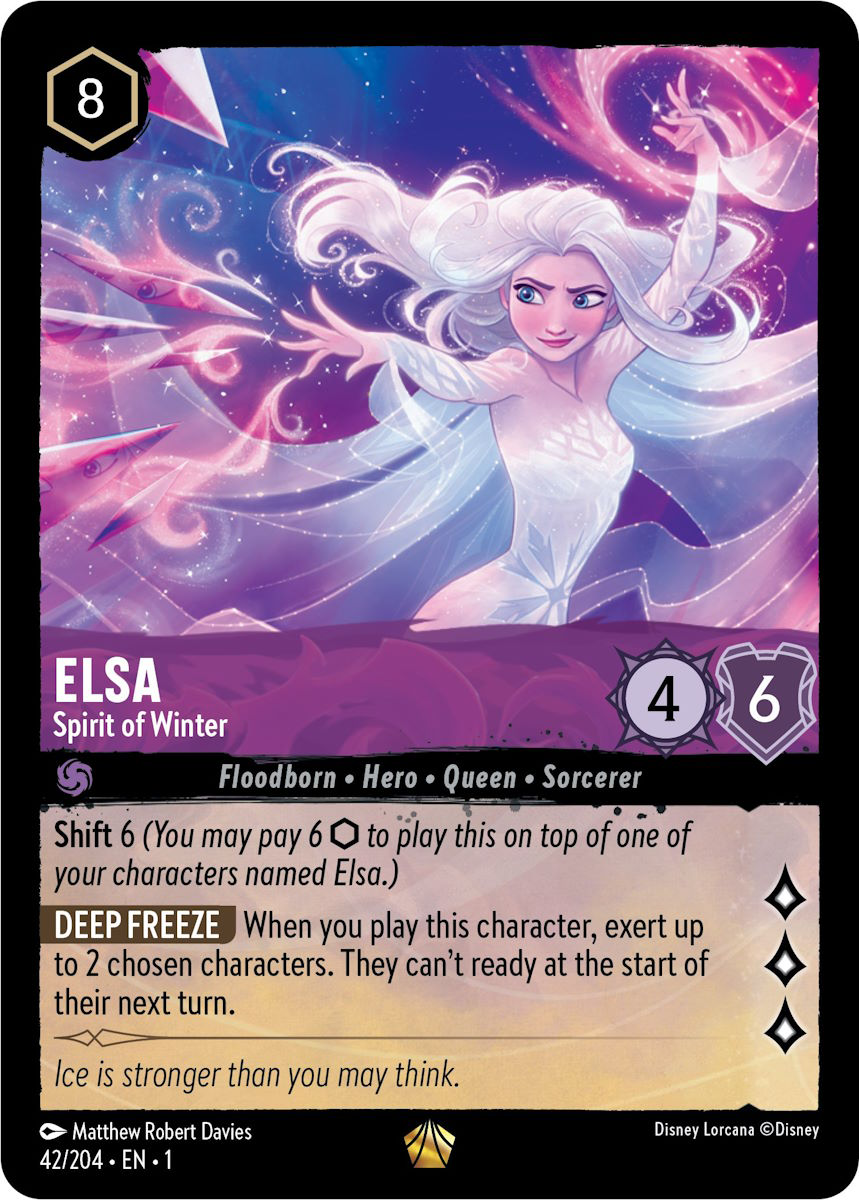
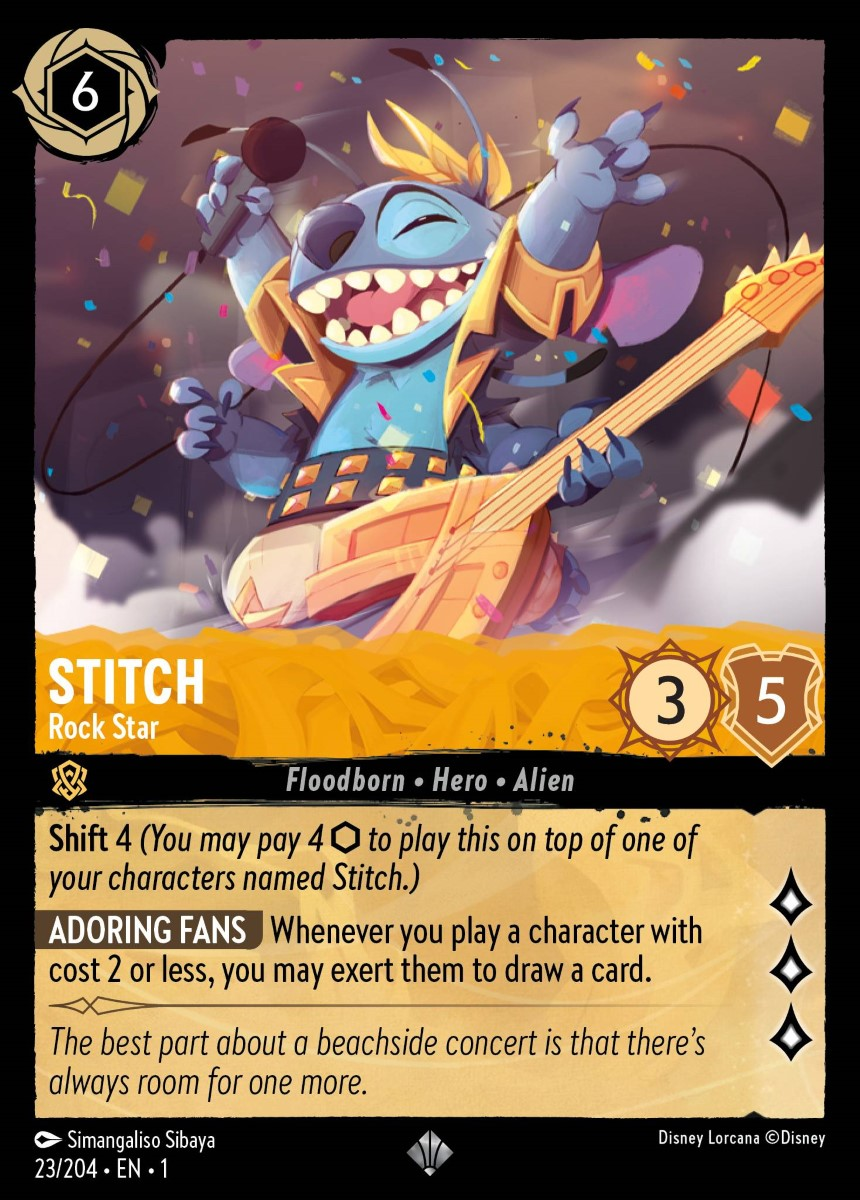
Two real examples make this concrete. "Elsa - Spirit of Winter," from The First Chapter set, is an 8-ink Floodborn Hero character with Shift 6, 4 Strength, 6 Willpower, and 3 Lore, carrying the ability "Deep Freeze" -- when played, she exerts up to two chosen characters, and they can't ready at the start of their next turn. "Stitch - Rock Star" is a 6-ink character with 3 Strength and 5 Willpower, Shift 4, and the ability "Adoring Fans," which lets you exert that newly played character to draw a card whenever you play a character with cost 2 or less. Elsa - Spirit of Winter has an Enchanted printing (card 207/204 in The First Chapter); Stitch - Rock Star does not -- the Enchanted Stitch in that set is Stitch - Carefree Surfer, 206/204 -- though Rock Star does exist in several foil promo printings. Enchanted copies in particular show up repeatedly in collector press coverage of Lorcana's most valuable cards -- specifically because their foil surfaces are so easy to scuff that a genuinely gem-mint copy is unusually hard to find. Exact resale figures for Enchanted cards move fast enough on the secondary market that any specific dollar number is worth re-checking against current TCGplayer or eBay sold listings rather than trusting a fixed price here.
PSA maintains public, per-set population reports for Disney Lorcana -- including a dedicated page for the 2023 "Rise of the Floodborn" set showing totals across the full 1-10 scale plus half-point grades and qualifier designations -- which confirms PSA actively grades Lorcana as its own tracked category, separate from Pokemon or Magic. If you're specifically weighing whether to send an Enchanted card to PSA or BGS, our Lorcana grading guide for Enchanted cards goes deeper on that specific decision, and our roundup of the most beautiful Enchanted card arts is worth a look if you're chasing a specific piece for the artwork rather than tournament play. And because miscuts, print defects, and genuine counterfeits can all superficially resemble each other on a Lorcana card, our Lorcana authentication guide is a good next stop before you assume the worst about an oddly-printed pull.
What Each Defect Actually Costs You
Put together, here's how the defects covered above typically translate into an actual grade outcome, based on the standards and qualifier rules described in the sections above. Treat the "typical cost" column as a directional guide rather than a guaranteed formula -- every grading company retains discretion, and eye appeal, technical measurements, and the card's overall condition all factor in together rather than as a strict checklist.
| Defect | What It Looks Like | Typical Cost to the Grade |
|---|---|---|
| Borderline off-center | Visible gap wider on one side once measured against a template -- not always obvious to the naked eye | Can be the exact difference between a 9 and a 10 or an 8 and a 9, since each grade tier has its own minimum ratio |
| Severely off-center | Border noticeably wider on one side, visible without measuring | Caps the straight numeric grade at PSA 6 or lower -- though a submitter can opt into PSA's "OC" (off-center) qualifier instead, which keeps the higher number on the label with "oc" appended, as in NM-MT 8oc, at a discount to resale value |
| Print line | Thin straight or slightly curved streak, often crossing the image or foil area | Widely cited as the top reason modern cards grade 9 instead of 10; severe cases can draw PSA's "PD" qualifier, roughly a 2-grade value deduction |
| Print snow / print dots | Small white or light patches where ink failed to lay down evenly | Also falls under PSA's PD qualifier when severe enough |
| Corner whitening | Ink chipped at a corner tip, exposing lighter card stock underneath | Scored under the "corners" category; visible whitening is generally incompatible with a gem-mint grade |
| Edge whitening | Ink worn away in a line along a border edge | Scored under "edges"; one of the more common reasons raw cards fall out of near-mint contention |
| Diamond cut / miscut | Card cut off-register from its printed border, giving a slight parallelogram appearance | A very slight instance can still land a high grade like BGS 9.5; a pronounced one caps the grade much lower |
FAQ & Quick Reference
What's the actual centering ratio required for a PSA 10? Roughly 55/45 or better on the front and about 75/25 or better on the back, measured as independent left-right and top-bottom ratios -- figures reported consistently across PSA-focused collector and grading-reference sources.
Are print lines factory defects or damage from handling? Print lines are a manufacturing artifact created during the printing press run, caused by uneven roller pressure or inconsistent sheet speed -- not a form of handling damage, and a card can carry one straight out of a factory-sealed pack.
What does PSA's "PD" qualifier mean on a slab? PD stands for Print Defect, PSA's official qualifier for print dots, print snow, or print lines severe enough to push a card below its numeric grade's minimum standard. It's optional -- submitters can request it -- and the market commonly values a PD-qualified card at roughly two grades lower, a collector rule of thumb rather than a PSA-published figure.
Is whitening the same thing as a print line? No. Whitening is ink physically chipping or wearing away at a corner or edge, scored under the "corners" and "edges" categories. Print lines are a surface-level defect, scored under the separate "surface" criterion.
Does BGS grade centering the same way PSA does? Both use a four-category framework of centering, corners, edges, and surface, but BGS's reported centering tolerances run tighter at the top end -- a true 50/50 is commonly cited for its Black Label 10, compared to PSA's roughly 55/45 for a Gem Mint 10. Beckett has not published as detailed a public breakdown of these exact figures, so treat the exact BGS numbers as well-corroborated across secondary sources rather than a direct company quote.
Why do Lorcana Enchanted cards sometimes grade lower than expected? Their borderless foil surface is highly reflective and shows micro-scratches far more readily than a standard card, so surface condition -- not centering -- is the factor most often cited as capping an Enchanted card's final grade.
What is a diamond cut, and does it ruin a card's grade? It's a factory cutting defect where the edges are sliced off-register from the printed border, giving the card a slight parallelogram look. A very slight instance can still be compatible with a high grade like BGS 9.5; a pronounced one caps the grade well below that.
Verdict: These Are Measurable Defects, Not Guesswork.
Centering, print lines, and whitening aren't subjective impressions -- they're specific, physically inspectable defects with published thresholds behind them, and every one of them is checkable with a loupe or a straightedge before you ever pay a grading fee. Know PSA's, CGC's, and BGS's approximate centering ratios by grade, understand that a print line is a factory flaw graders rarely forgive, and remember that whitening lives under corners and edges rather than surface -- and you'll walk into a submission with a realistic read on where your card actually lands.
© GEEKYDOMAIN.COM | Strategy Powered by Data