

Bloomburrow Animal Tribes: A Commander Buyer's Guide
Ten animal tribes, ten guild pairs, and the precons, legends, and lands worth chasing for your Commander deck.
Some links below are affiliate links. If you buy through them, Geeky Domain may earn a small commission at no extra cost to you.
Bloomburrow arrived on August 2, 2024, and it did something Magic: The Gathering hadn't quite done before: it built an entire world of anthropomorphic animals and then quietly used that world to teach a masterclass in two-color deckbuilding. Birds, Rats, Lizards, Raccoons, Rabbits, Bats, Otters, Squirrels, Mice, and Frogs each got their own corner of the set, and each corner turned out to correspond to one of Magic's ten established guild color pairs. For limited players, that made drafting intuitive. For Commander players, it made Bloomburrow a genuinely useful shopping list.
That's the angle this guide takes. Rather than walking through every card in the set, we're treating Bloomburrow the way a Commander buyer actually approaches a new release: which tribe matches which color identity, which of the four Commander precon decks are worth a look, which legendary creatures are pulling real deckbuilding weight, and which lands and support pieces are quietly good enough to slot into decks that have nothing to do with animals at all.
Along the way we'll flag the spots where it's easy to get tripped up -- tribes that look mono-colored but aren't, chase mythics whose prices move around, and a couple of assumptions worth double-checking before you build a decklist around them. By the end you should have a clear map of the set's Commander-relevant pieces and a sense of where your money is best spent. For the wider strategy picture, start with our MTG Strategy Hub.
The Short Version
Bloomburrow released August 2, 2024 as a 281-card Standard set (81 commons, 100 uncommons, 60 rares, 20 mythic rares, plus basic lands). Its ten animal tribes each map to one of the ten two-color Magic guild pairs -- Birds are Azorius (WU), Bats are Orzhov (WB), Otters are Izzet (UR), and so on -- which makes the set unusually easy to build Commander decks around. It shipped with four Commander precon decks (Animated Army, Family Matters, Peace Offering, and Squirreled Away), plus standout chase cards like the Bat-tribal Zoraline, Cosmos Caller and a cycle of powerful mythic "Calamity" beasts including Lumra, Bellow of the Woods. Utility lands Three Tree City and Fountainport are strong enough to see play well outside animal-tribal decks entirely.
In This Guide
- → What Is Bloomburrow, and Why It Matters for Commander
- → The Ten Animal Tribes and Their Guild Pairs
- → The Four Bloomburrow Commander Precons
- → Peace Offering: Two Commanders in One Box
- → Bat Tribal: Zoraline, Cosmos Caller
- → The Calamity Beasts and Other Chase Legends
- → Utility Lands and Support Cards Worth Adding
- → Common Mistakes When Buying Into Bloomburrow
- → FAQ & Quick Reference
What Is Bloomburrow, and Why It Matters for Commander
Bloomburrow is a Standard-legal Magic: The Gathering expansion that released on August 2, 2024, following a prerelease weekend running July 26 through August 1 and an MTG Arena release on July 30. The Standard set weighs in at 281 cards: 81 commons, 100 uncommons, 60 rares, and 20 mythic rares, on top of the usual complement of basic lands. That's a normal-sized main set, but the design premise behind it is what makes Bloomburrow stand out.
Every card in the set exists inside a single cohesive world populated entirely by animal-folk -- no humans, no humanoids, just Birds, Rats, Lizards, Raccoons, Rabbits, Bats, Otters, Squirrels, Mice, and Frogs going about their lives across a handful of named locations. It's a tonal shift from the multiverse-hopping crossover sets that had dominated recent years, and it reads more like a classic, self-contained Magic block.
For Commander deckbuilders specifically, the reason Bloomburrow matters isn't just the aesthetic -- it's that the ten animal tribes weren't distributed randomly across the color pie. Each one was deliberately built to occupy one of Magic's ten established two-color guild pairs, meaning a tribal shopping list and a Commander color-identity shopping list are, in this set, the exact same document. That overlap is rare enough that it's worth understanding in detail before you start buying singles, which is exactly what the next section covers.
The Ten Animal Tribes and Their Guild Pairs
According to Wizards' own design commentary on the set, the ten two-color draft archetypes in Bloomburrow were each built around a different animal from the start -- the tribe and the guild were designed together, not layered on afterward. That means if you already know Magic's guild color pairs, you already know Bloomburrow's tribal color pairs. Here's the full mapping:
| Animal Tribe | Guild | Colors |
|---|---|---|
| Birds | Azorius | White / Blue |
| Rats | Dimir | Blue / Black |
| Lizards | Rakdos | Black / Red |
| Raccoons | Gruul | Red / Green |
| Rabbits | Selesnya | Green / White |
| Bats | Orzhov | White / Black |
| Otters | Izzet | Blue / Red |
| Squirrels | Golgari | Black / Green |
| Mice | Boros | Red / White |
| Frogs | Simic | Green / Blue |
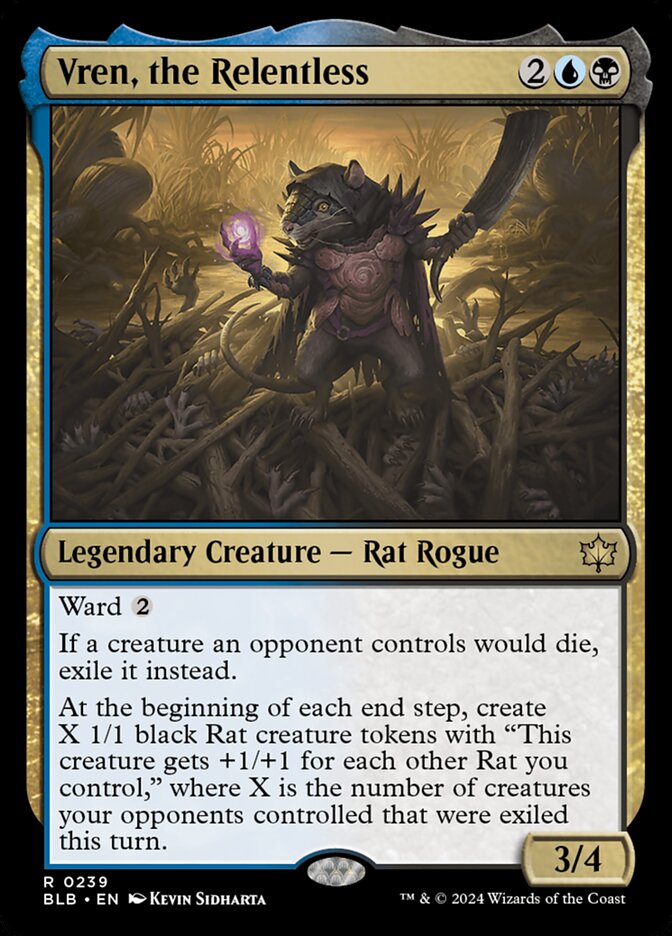
A couple of these are easy to misremember if you're going off vibes rather than the actual mapping -- Bats read as a black tribe because of the lifegain-and-death flavor, but they're Orzhov (white-black); Otters feel blue because of the tempo flavor, but they're Izzet (blue-red). Rats land in Dimir, the guild most associated with card advantage and graveyard value, which fits a scavenging rodent theme nicely. Vren, the Relentless is a good example of the pairing at work: a blue-black Rat commander built around punishing opponents' creatures for dying and building an army off the back of it, with Ward 2 to protect itself along the way.
The practical upshot for buyers: if you already know you want to build in a specific two-color pair, you now know exactly which tribe's singles to be searching for, and vice versa. Want a Boros aggro Commander deck with a tribal spine? Look at Mice. Want to lean into Simic ramp-and-value? Frogs are your tribe. Either one makes a solid foundation for our $50 Commander deck blueprint if you're building from singles instead of a precon.
The Four Bloomburrow Commander Precons
Alongside the main set, Wizards released four ready-built Commander decks under the product code BLC, also on August 2, 2024. Each one leans into a different tribal identity and, notably, none of the four sticks to a strict two-color guild pair -- the precons expand outward from a tribe's core colors to give each deck a bit more room to build. See our full breakdown of which Commander precon to buy for how these four stack up against the rest of the current lineup.
| Precon Deck | Colors | Commander |
|---|---|---|
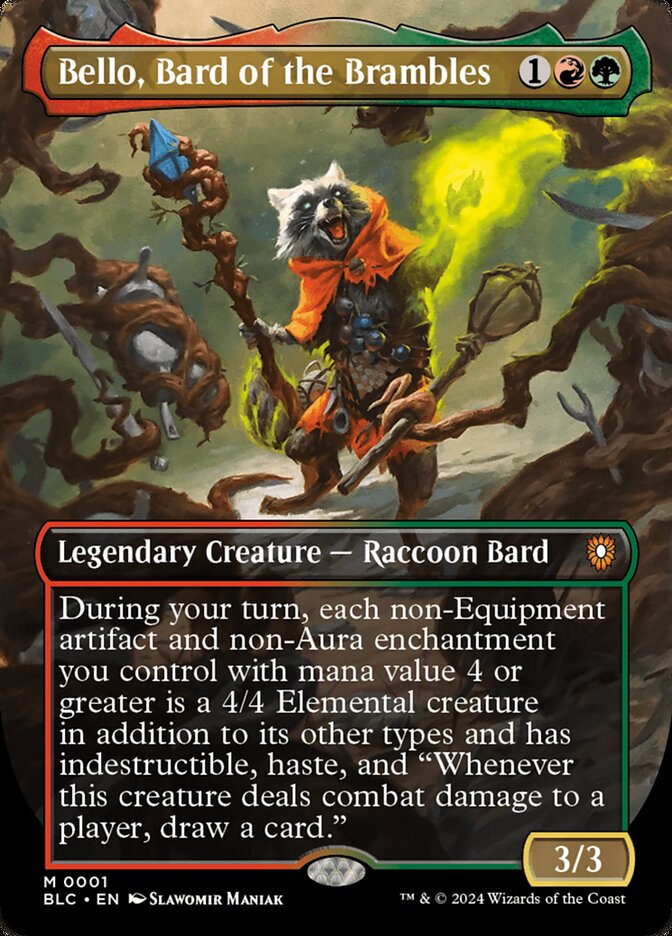
| Animated Army | Red / Green | Bello, Bard of the Brambles |
| Family Matters | Blue / Red / White | Zinnia, Valley's Voice |
| Peace Offering | Green / White / Blue | Ms. Bumbleflower / Mr. Foxglove |
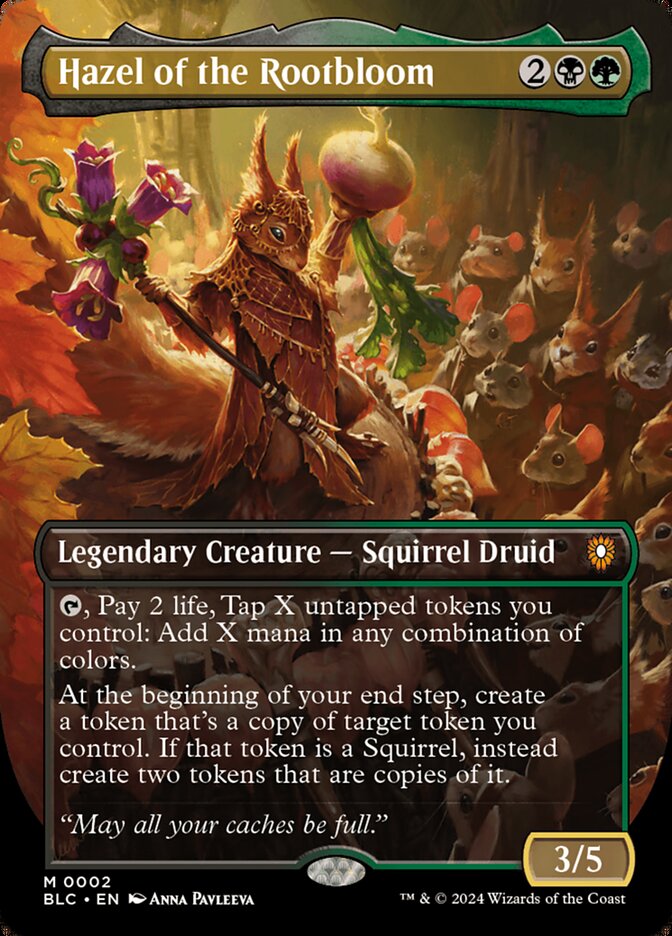
| Squirreled Away | Black / Green | Hazel of the Rootbloom |
Animated Army is the most tightly-focused of the four, staying in Gruul's red-green identity and building around Raccoons under Bello, Bard of the Brambles. Squirreled Away does the same job in Golgari black-green, with Hazel of the Rootbloom pulling Squirrel synergies together. Both are good entry points if you want a precon that plays exactly like its box art suggests, straight out of the sleeve.
Family Matters, led by Zinnia, Valley's Voice, pushes into a three-color Jeskai shell rather than staying inside a single tribe's guild pair, which makes it a slightly more advanced pickup if you're specifically chasing a clean two-tribe build. Peace Offering is the outlier of the four and deserves its own section, because it's the only precon built around two different possible commanders in the same box. It also holds up well against our list of the best Commander precons of all time.
All four Bloomburrow Commander decks in one place, plus a proper playmat to run them on.
As an Amazon Associate, Geeky Domain earns from qualifying purchases. eBay links are affiliate links; Geeky Domain may earn a commission at no extra cost to you.
Peace Offering: Two Commanders in One Box
Peace Offering ships with a choice most precons don't offer: two legendary creatures capable of leading the deck, giving buyers two different builds to try out of a single purchase. If you're only picking up one Bloomburrow precon and want maximum build flexibility, this is the one to look at closely.
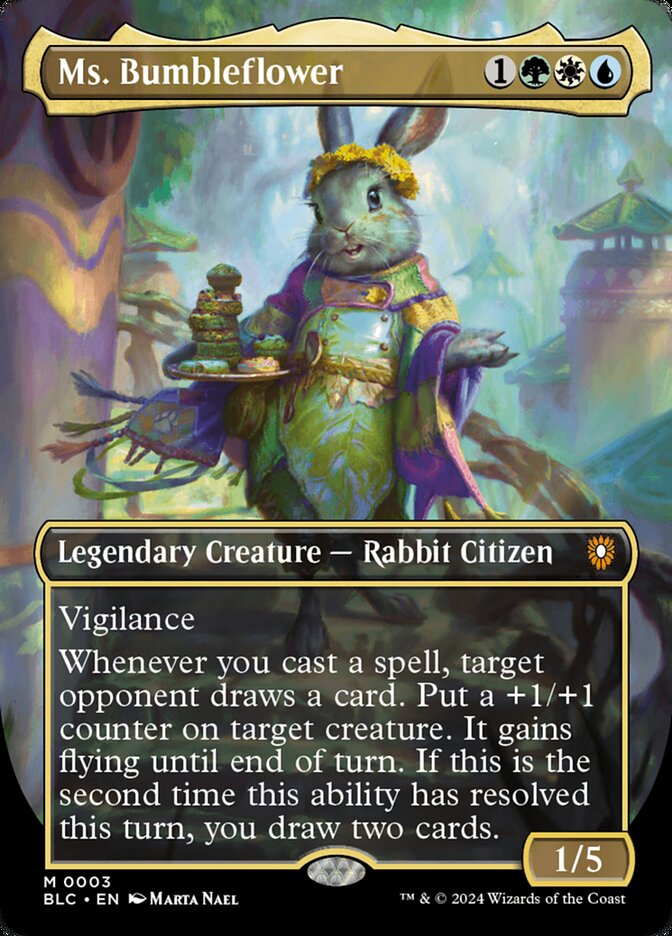
Ms. Bumbleflower is a Rabbit Citizen, a 1/5 for four mana with vigilance that rewards a spell-heavy turn: whenever you cast a spell, a targeted opponent draws a card and a targeted creature gets a +1/+1 counter and flying until end of turn -- and if that's the second time the ability has resolved in a turn, you also draw two cards on top of that. It's a build-around that wants a deck full of cheap spells and incidental payoffs rather than a top-heavy curve, which fits neatly with Rabbits' Selesnya-adjacent, go-wide instincts.
Mr. Foxglove, the deck's alternate commander, is a Fox Rogue -- a 3/5 with lifelink that draws you cards based on a hand-size comparison against an opponent when it attacks, or lets you cheat a creature into play instead. It's a much more aggressive, attack-focused build than Ms. Bumbleflower's spell-count engine, so the same box effectively gives you a value-and-tokens deck and a beatdown-with-upside deck depending on which legendary you build around.

Because the precon supports both builds out of the box, it's worth actually playing a few games with each commander before you commit to upgrading one over the other -- they pull the deck in genuinely different directions, and which one suits your table will depend more on your playgroup's pace than on raw power level.
Bat Tribal: Zoraline, Cosmos Caller
If there's a single Bloomburrow card that's become the default face of a tribal Commander archetype, it's Zoraline, Cosmos Caller. As a white-black legendary Bat Cleric, Zoraline sits squarely in the Orzhov guild that Bats occupy, and she's built to reward exactly the kind of lifegain-and-reanimation shell that color pair is known for.
Zoraline is a 3/3 flier with vigilance for three mana, and she gains you life whenever a Bat you control attacks -- a simple enough payoff for a tribal deck on its own. The more interesting piece is her activated ability: by paying white-black plus two life, either when she enters or when she attacks, you can reanimate a nonland permanent with mana value 3 or less directly onto the battlefield with a finality counter attached. That turns a straightforward Bat-tribal deck into one with a genuine value engine, pulling small but useful permanents back out of the graveyard turn after turn.
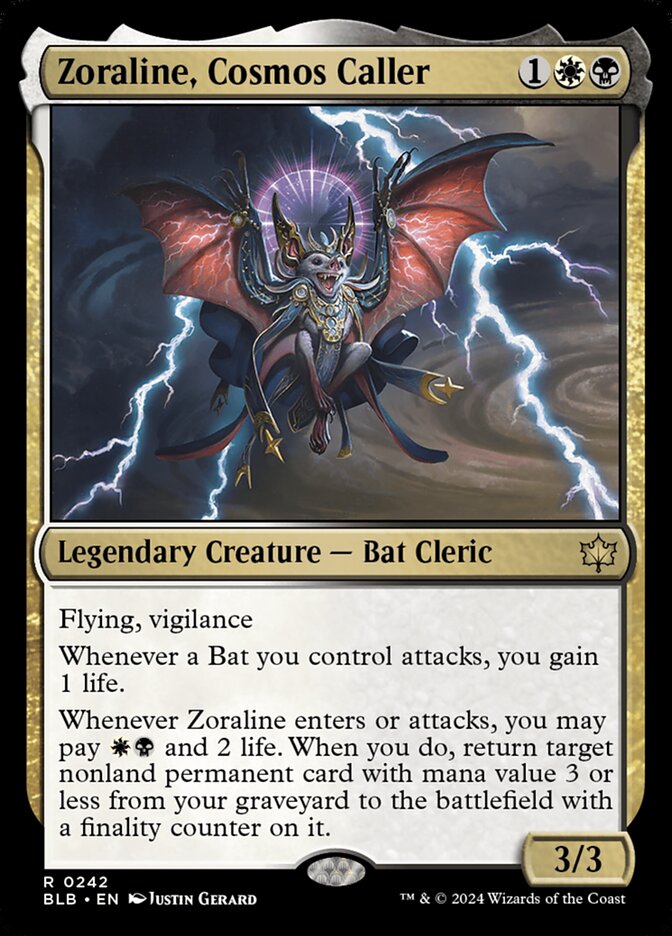
Because Zoraline's ability targets any nonland permanent under the mana-value threshold rather than just Bats, the deck built around her can branch out well beyond the tribe itself -- small value creatures, mana dorks, and cheap enchantments from across white and black are all fair game for the reanimation trigger. That flexibility, on top of a clean tribal payoff, is a big part of why she's become one of the set's most commonly built Commander cards.
The Calamity Beasts and Other Chase Legends
Beyond the tribal payoffs and the precon commanders, Bloomburrow's mythic slot includes a run of oversized legendary beasts commonly referred to as the "Calamity" cycle -- towering, powerful creatures that read more like ancient forces of nature than the cozy townsfolk found elsewhere in the set. Confirmed members include Lumra, Bellow of the Woods; Ygra, Eater of All; Maha, Its Feathers Night; Beza, the Bounding Spring; Eluge, the Shoreless Sea; and Wildsear, Scouring Maw. These have been consistently cited as some of the strongest and most in-demand mythics in the set for Commander deckbuilding.
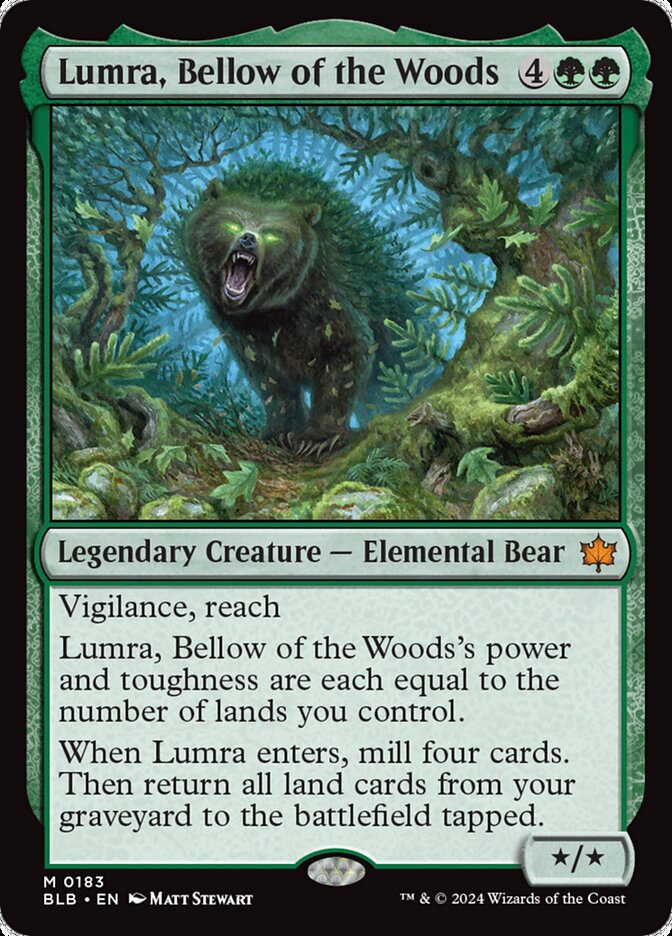
Worth noting for buyers: it isn't fully settled whether this is a closed five-card or six-card cycle, so treat each of those names as an individually strong pickup rather than assuming you need to complete a fixed set to "finish" the cycle. Beyond the Calamity beasts, Bloomburrow's broader cast of legendary characters is large -- names like Mabel, Heir to Cragflame; Glarb, Calamity's Augur; Helga, Skittish Seer; The Infamous Cruelclaw; Finneas, Ace Archer; and Wick, the Whorled Mind all show up across the set's various tribes and color pairs, giving nearly every guild multiple commander options to choose from rather than just one obvious build-around.
Utility Lands and Support Cards Worth Adding
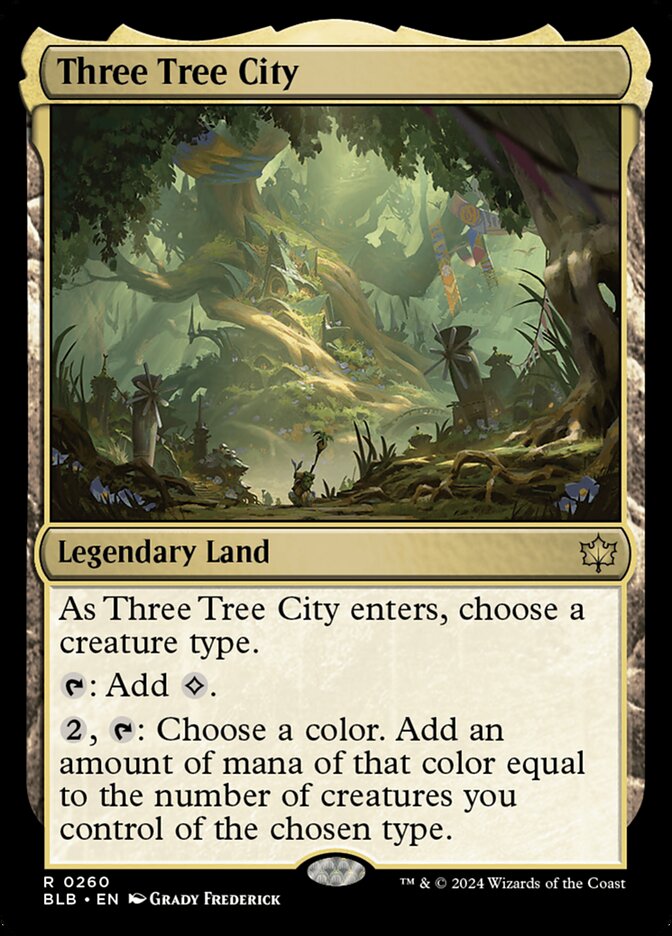
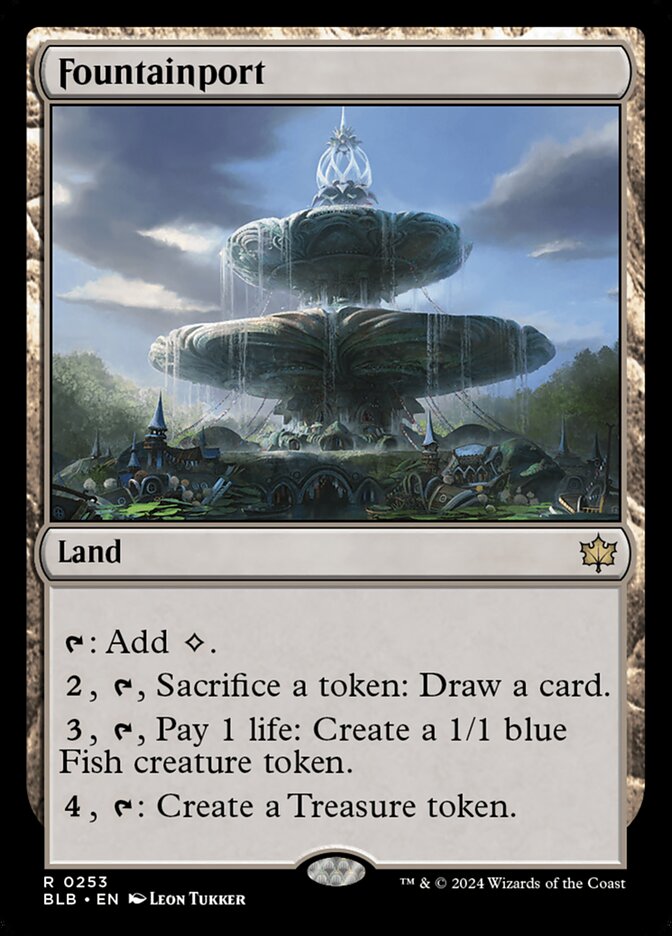
Not everything worth pulling from Bloomburrow is tribal, and this is the section to pay attention to if you already have Commander decks running and just want to slot in a few genuinely strong new pieces. Two lands in particular have been quickly adopted as staples: Three Tree City and Fountainport.
Three Tree City is a legendary land that lets you name a creature type when it enters, taps for a generic mana on its own, or taps (with an extra generic cost) to add mana of a chosen color equal to the number of creatures you control of that named type -- functionally similar to Nykthos, Shrine to Nyx, but built around creature typal synergy rather than devotion, and the mana it produces isn't restricted to spending on that type. In a tribal Commander deck of almost any kind, not just an animal-tribal one, that's a land that can both fix your mana and ramp you into a big typal payoff in the same slot.
Fountainport taps for colorless mana on its own, but its real value is the ability to sacrifice tokens for card draw, or to generate Fish or Treasure tokens as needed -- a flexible utility land in the mold of Trading Post, giving colorless-friendly decks a way to convert extra tokens into cards or fixing depending on what the game state calls for.
On the spell side, Bloomburrow also introduced a modal mythic "Season" cycle -- one per color: Season of the Burrow (white), Season of Weaving (blue), Season of Loss (black), Season of the Bold (red), and Season of Gathering (green) -- which spend a "paw print" resource to let you choose from a menu of effects rather than committing to just one. There's also a cycle of rare Class-style "Talent" enchantments; Caretaker's Talent, the white entry, draws you a card the first time you create a token each turn, with higher levels adding token-copying and an anthem effect as the game goes on. Both cycles are worth a look if you're after efficient, flexible value pieces rather than splashy tribal payoffs.
Common Mistakes When Buying Into Bloomburrow
The single most common mistake new buyers make with this set is assuming a tribe's color identity from vibes rather than checking the actual guild pair. Bats feel like a black tribe because of the lifegain-and-death flavor, but they're white-black. Otters feel blue, but they're blue-red. Squirrels feel green, but they're black-green. If you're building a Commander deck around a specific tribe, confirm its real two-color identity from the table earlier in this guide before you start buying singles -- it's a quick check that saves you from picking up cards in the wrong colors entirely.
A second mistake is treating the four precons as finished products rather than starting points. They're fully functional out of the box, but like any preconstructed Commander deck, their power level benefits from targeted upgrades -- better mana fixing, a handful of format staples, and a tighter curve will all go a long way without requiring a full rebuild.
FAQ & Quick Reference
When did Bloomburrow release? The set released on August 2, 2024, following a prerelease weekend from July 26 to August 1, with an MTG Arena release on July 30, 2024.
How many cards are in the Bloomburrow set? The Standard set contains 281 cards: 81 commons, 100 uncommons, 60 rares, and 20 mythic rares, plus basic lands.
How many Commander precons did Bloomburrow get? Four: Animated Army (red-green), Family Matters (blue-red-white), Peace Offering (green-white-blue), and Squirreled Away (black-green).
Do all ten animal tribes really map to two-color guild pairs? Yes -- this was confirmed directly in Wizards' own design commentary on the set, and it holds for all ten tribes without exception.
What's the best Bat-tribal Commander card from Bloomburrow? Zoraline, Cosmos Caller is the clear standout, combining a Bat-attack lifegain trigger with a repeatable low-cost reanimation ability.
Are the Bloomburrow utility lands worth adding to decks with no animal theme at all? Yes -- Three Tree City functions like a typal-focused Nykthos, Shrine to Nyx, and Fountainport plays like a flexible Trading Post, and both are useful in plenty of Commander decks that have nothing to do with Bloomburrow's tribes.
Ten Tribes, One Easy Shopping List.
Bloomburrow turned an animal-tribal gimmick into one of the cleanest Commander shopping maps Magic has printed in years -- ten tribes, ten guilds, four precons, and a handful of chase legends worth building around.
© GEEKYDOMAIN.COM | Strategy Powered by Data