

Best Budget +1/+1 Counters Deck Under $100
Snowball a board of small creatures into something monstrous — and do it for the price of one expensive card. A budget Commander deck-building guide.
Some links below are affiliate links. If you buy through them, we may earn a small commission at no extra cost to you. We only recommend products we'd use ourselves.
+1/+1 counters are one of the most satisfying things you can build a Commander deck around. You start with a board of unassuming little creatures, and a few well-sequenced triggers later they're towering threats that close games out of nowhere. Better still, it's one of the most budget-friendly archetypes in the format: the engine pieces that make it sing are mostly cheap commons and uncommons, and the strategy snowballs hard enough that you don't need expensive bombs to win.
This guide is a build-it-yourself blueprint for a counters deck that comes in comfortably under $100. Rather than hand you a rigid 99-card list to copy, we'll build it by roles — the commander, the counter sources, the multipliers, the proliferate package, the payoffs, and the support — so you can slot in what you own, tune to your budget, and adapt as the deck grows. That's how you actually learn an archetype instead of just netdecking it.
If you've read our budget Voltron deck-tech, this is its sibling: same under-$100 philosophy, completely different feel. Voltron loads one threat; counters spread power across a growing board. Both prove you don't need a big wallet to build a deck that wins.
The Short Version
Pick a counters commander in green-based colors — Selesnya, Simic, Abzan, and Bant get the most support. Strong budget options include Ghave, Guru of Spores (tokens + counters), Ezuri, Claw of Progress (experience counters that survive removal), and Sovereign Okinec Ahau (Selesnya snowball). Build by role: cheap counter sources, multipliers like Hardened Scales, Branching Evolution, and Corpsejack Menace, a proliferate package to add counters everywhere at once, and payoffs that turn counters into damage or card advantage. The engine is mostly commons and uncommons, so the deck stays cheap while snowballing into a genuine threat. Tune counts to your meta — this is a skeleton, not a fixed list.
→ Related MTG Guides
In This Guide
Why Counters on a Budget
Most powerful Commander archetypes get expensive fast because their best cards are chase rares. Counters are different: the cards that make the deck work — the ones that turn a single counter into three, or copy a counter onto every creature you own — are overwhelmingly cheap commons and uncommons that have been printed and reprinted for years.
The archetype also rewards synergy over raw power. A counters deck doesn't win because it has the biggest individual card; it wins because its cheap pieces multiply each other. Stack two or three multipliers and a proliferate effect, and a one-mana enabler suddenly does the work of a bomb. That synergy-over-stats math is exactly what makes the deck so budget-friendly — you're buying interactions, not price tags.
It's a recognized budget staple for that reason: dedicated budget counters lists are everywhere, and the strategy holds up at a casual-to-mid-power table without spending big. Under $100 is genuinely comfortable here, not a stretch.
Picking Your Commander
Counter support lives mostly in green and green-adjacent colors — Selesnya, Simic, Abzan, and Bant have the deepest pools. A few excellent budget-friendly commanders, each giving the deck a different shape:
- Ghave, Guru of Spores (Abzan). A token-and-counters engine that turns mana into creatures and counters into more creatures. Famously the heart of budget counter-token builds, and flexible enough to go wide or combo-ish as you upgrade.
- Ezuri, Claw of Progress (Simic). Accumulates experience counters that stay with you even if Ezuri dies — killing him doesn't undo your progress, and Simic's deep proliferate roots let you snowball those counters relentlessly. A resilient, grindy choice.
- Sovereign Okinec Ahau (Selesnya). A popular Selesnya counters commander built for snowballing counters across your board, with ward to help it stick and connect. Great if you want a straightforward go-wide-and-grow plan.
- Lae'zel, Vlaakith's Champion (Bant background). Effectively gives you a counter-doubling effect right in the command zone, and "choose a background" lets you bolt on a support partner. A strong engine-from-turn-one option in the best counter colors.
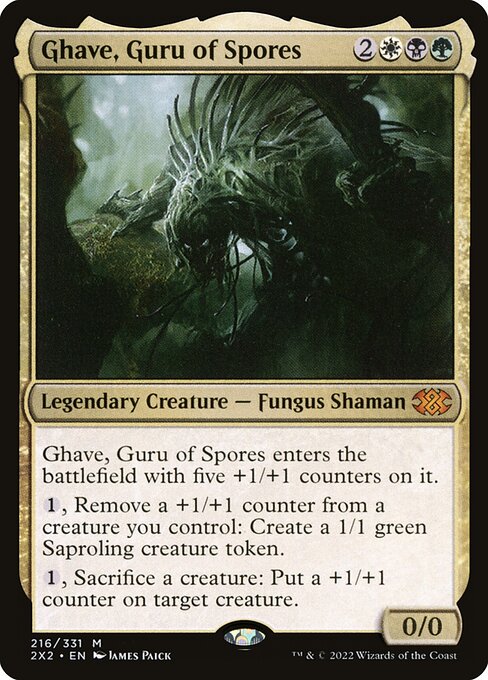
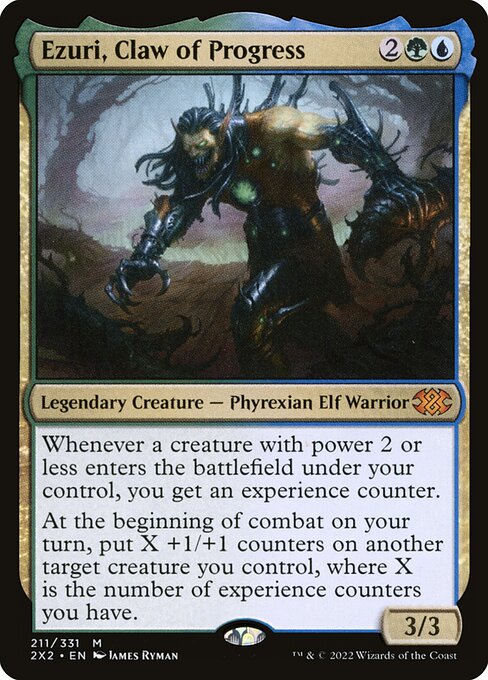
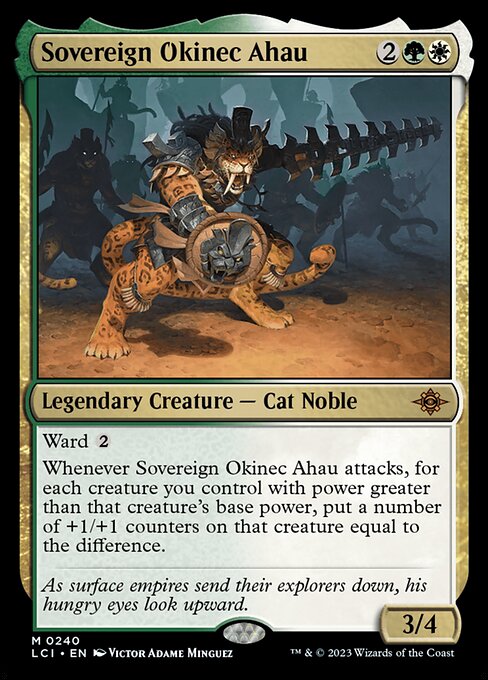

Any of these anchors the same skeleton below — pick the colors and play pattern you like, and the role-based build adapts around your choice.
The Deck Skeleton by Role
Think of the 99 as a set of jobs to fill, not a fixed list. Aim for roughly these proportions and tune to your meta and collection:
- Counter sources (the engine's fuel). Creatures and spells that put counters on things — cheap creatures that enter with counters, "distribute counters" effects, and your commander. This is the largest payoff-feeding group; you want a steady supply every turn.
- Multipliers (the force amplifiers). Cards that increase or double how many counters you place — the heart of the deck. A handful of these is what separates a counters deck from a pile of small creatures (full list in the next section).
- Proliferate (board-wide growth). A package of effects that add another counter to everything already counting — the cheapest way to scale your whole board at once.
- Payoffs (turning counters into wins). Cards that convert all those counters into something lethal — trample/evasion to push damage, "draw cards based on counters" engines, or effects that ping opponents when counters land. Without payoffs you have big creatures and no plan; include several.
- Interaction & protection. Budget removal by color and a couple of protective pieces so your built-up board doesn't evaporate to one wrath. Counters decks invest heavily in the battlefield, so a little insurance matters.
- Ramp + a solid mana base. Cheap green ramp to power out your engine early, on a consistent land base. See our budget mana base guide for how to count sources and land totals.
The Multiplier Engine
These are the cards that make the whole strategy tick — and the good news is the best ones are cheap. Each one increases the counters you place; stack two or three and your numbers explode:
- Hardened Scales. A one-mana enchantment that adds an extra +1/+1 counter whenever you'd place one. A near-mandatory include in any green counters deck, and one of the cheapest power-per-dollar cards in the format.
- Branching Evolution. Doubles the number of +1/+1 counters you put on your creatures. A clean, powerful doubler that turns every counter source into twice the payoff.
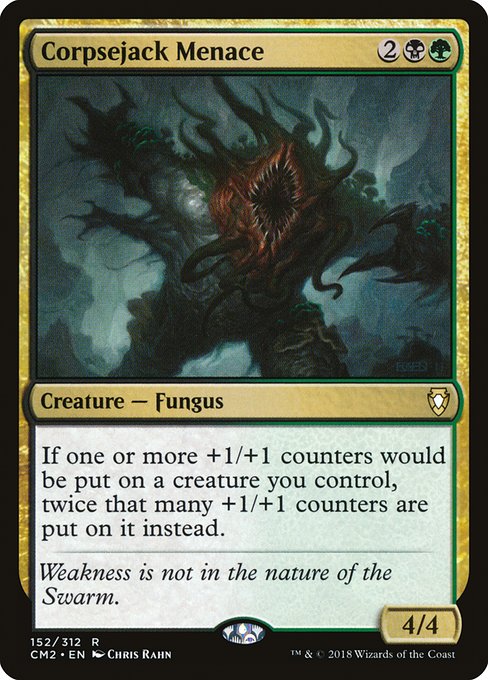
- Corpsejack Menace. A Golgari-colored creature that doubles the +1/+1 counters placed on your creatures — a doubling effect attached to a body, so it advances your board while it amplifies.
- Ozolith, the Shattered Spire. Adds an extra counter each time you place counters (and can pump for more). Another cheap "scales-style" amplifier that stacks with the others.
- Forgotten Ancient. One of the most-played counter creatures in Commander — it banks counters as spells are cast and lets you move them onto your team, acting as both a counter source and a snowballing engine.

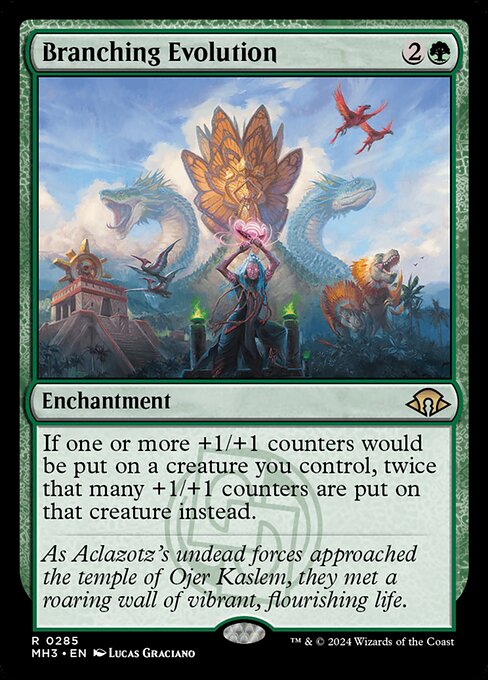
A key sequencing note: these stack multiplicatively when they're "add an extra" effects and they all apply to the same counter event. Two or three multipliers plus a single counter source can produce a frankly silly number of counters — that's the deck's ceiling, and it's reachable on a budget.
The Proliferate Package
Proliferate — "for each permanent or player with a counter, you may add another of a counter it already has" — has been a backbone of counter strategies since it debuted in Scars of Mirrodin. It's the most efficient way to grow your entire board at once, and it's almost all cheap:
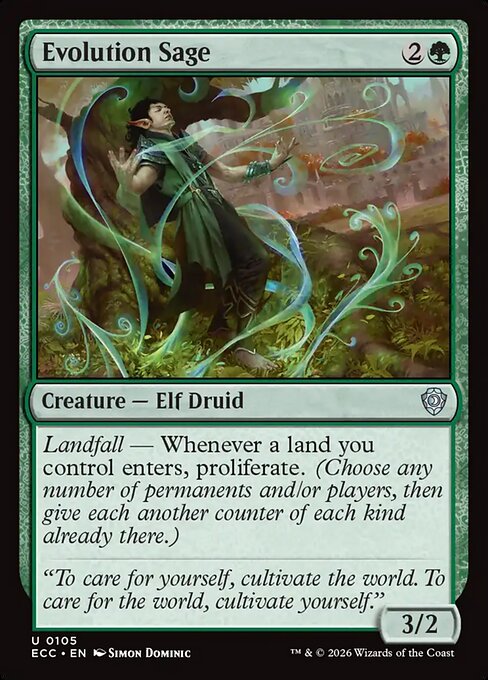
- Repeatable proliferate engines. Cards like Evolution Sage, which proliferates whenever a land enters under your control — pair it with any fetch or extra-land effect and you proliferate constantly, growing every creature you own each turn.
- One-shot proliferate spells. Cheap instants and sorceries that proliferate once are fine inclusions — flexible, and they also grow any other counters in play (experience, loyalty, even your commander's).
- Synergy with your multipliers. Proliferate adds counters, so your Hardened Scales-style amplifiers trigger off it too — another layer of multiplication for a one-mana investment.
Playing the Deck
Counters is a build-up deck — it wants a turn or two to assemble before it takes over. A rough game plan:
- Early: ramp and land a multiplier. Use cheap ramp to get ahead on mana and prioritize resolving a Hardened Scales-type amplifier — everything downstream is better once one's in play.
- Mid: stack the engine. Add counter sources and a second multiplier, and start proliferating. This is where the snowball begins — each turn your board grows faster than the last.
- Protect the engine, not every creature. Your multipliers are the deck; a removed creature is recoverable, a removed Branching Evolution hurts. Hold up protection for the pieces that matter and don't overextend into an obvious wrath.
- Close with a payoff. Once your board is oversized, push it through with trample/evasion or convert counters into damage or cards via a payoff. Don't just sit on big creatures — have the finisher ready.
Upgrade Path
As budget allows, the counters archetype upgrades smoothly without changing its core:
- Premium doublers. The format's marquee counter-doubler enchantment is a natural eventual addition — it does what your budget multipliers do, harder. Add it when you're ready to invest, not before; the deck functions without it.
- Mana base. The cheapest real consistency gain is upgrading lands and ramp over time — better fixing means your engine comes online a turn sooner, more reliably.
- A combo finish. If you like a more decisive ending, counters decks pair well with a compact combo win. See our budget combo win conditions guide for options that fit green-based shells.
Common Mistakes
Too many counter sources, not enough payoffs.
A board of big creatures isn't a win condition by itself. If your creatures keep getting chump-blocked, you're short on payoffs — add trample, evasion, or counter-to-damage effects.
Skimping on multipliers.
The multipliers are the deck. One isn't enough to carry the strategy — run a healthy handful so you reliably draw into the snowball, since they're cheap anyway.
Overextending into a board wipe.
Counters decks commit hard to the battlefield, which makes them wrath-vulnerable. Hold a little back and keep protection up once you've built a lead, rather than dumping your whole hand.
Ignoring proliferate.
Proliferate is the cheapest board-wide scaling you'll find and it grows your commander's counters too. Leaving it out is leaving the easiest multiplication in the archetype on the table.
FAQ
- Can this really come in under $100? Yes — comfortably, at casual-to-mid power. The engine pieces are mostly cheap commons and uncommons, and the synergy does the heavy lifting, so you're not reliant on expensive bombs. Your mana base is usually the biggest spend, and even that can be kept budget.
- What colors should I play? Green is essential — it has by far the most counter support. From there, Selesnya, Simic, Abzan, and Bant give you the deepest pools of payoffs and multipliers. Your commander choice sets your exact colors.
- Is it competitive? It's a strong casual-to-mid-power archetype. It snowballs fast and can dominate a table, but it's battlefield-dependent and vulnerable to wraths, so at high power you'd lean harder on protection and a combo finish. For most pods, it's a great, satisfying deck.
- How is this different from the Voltron deck? Voltron pours everything into one big threat; counters spreads growth across a whole board. Counters is more resilient to single-target removal (you have many threats) but more vulnerable to board wipes. Different risk profiles, same budget ethos.
Quick Reference
- Colors: green-based — Selesnya, Simic, Abzan, Bant have the most support.
- Commanders: Ghave, Ezuri (Claw of Progress), Sovereign Okinec Ahau, Lae'zel.
- Multipliers: Hardened Scales, Branching Evolution, Corpsejack Menace, Ozolith, Forgotten Ancient.
- Proliferate: Evolution Sage + cheap one-shots — cheapest board-wide growth.
- Build by role: counter sources, multipliers, proliferate, payoffs, interaction, ramp.
- Win: snowball the board, then push through with a payoff — don't just sit on big creatures.
- Biggest pitfall: too few payoffs and too few multipliers — run a healthy count of both.
Where to Buy the Pieces
Buy the engine first and leave the mana base for last, since that's the biggest spend. Hardened Scales, Branching Evolution, Corpsejack Menace, Forgotten Ancient and Evolution Sage are mostly commons and uncommons: TCGplayer and Card Kingdom are usually cheapest on those, and eBay is worth a price check on the doublers and on whichever commander you settled on. One TCGplayer want-list takes all five names in a single pass; the eBay search below covers the three doublers plus both commanders, Ghave, Guru of Spores and Ezuri, Claw of Progress. If you would rather start from a shell than buy singles one at a time, a green Commander precon is the cheapest 100 cards in one box.
Singles marketplaces — compare both carts:
Secondary — what a 100-card build also needs:
As an Amazon Associate, Geeky Domain earns from qualifying purchases. eBay links are affiliate links; Geeky Domain may earn a commission at no extra cost to you.

Small Counters, Big Swings.
+1/+1 counters is proof that a great Commander deck doesn't need a great budget — just good synergy. Build it by role, lean on cheap multipliers and proliferate, keep enough payoffs to actually close, and protect the engine rather than every creature. Do that and a board of little green guys turns into a game-ending wave, all for the price of a single fancy card.
Stack the triggers, grow the board, and watch it snowball.
© GEEKYDOMAIN.COM | Strategy Powered by Data