

One Piece Goes Worldwide-Simultaneous: What OP-17 Changes for Collectors
For four years, Japan got new One Piece cards months before everyone else. OP-17 just ended that -- and quietly debuted a rarity tier that says a lot about where Bandai thinks this game is headed.
Some links below are affiliate links. If you buy through them, Geeky Domain may earn a small commission at no extra cost to you.
→ Short Version
OP-17, "The World's Strongest Warriors," released in Japan on August 22, 2026 and in English worldwide on August 28, 2026 -- the first One Piece Card Game set launched under a globally simultaneous release schedule. Under the old model, Japanese sets typically released roughly two to three months ahead of their English counterparts. Bandai's official English account confirmed the August 28 date back on June 13, 2026, so this was a planned, telegraphed shift. OP-17 also introduces Treasure Rare, a brand-new rarity sitting above Secret Rare for the first time in the game's four-year history -- the English set's Treasure Rare is Edward Newgate (Whitebeard), card OP17-040, while Japan's printing uses a different card in that same slot, Lucky Roux at OP17-033. The set totals 131 cards plus 4 additional prints (135 unique cards) across 6 Leaders, per Bandai's official product listing.
→ Related Reading
- One Piece TCG Strategy Hub
- OP-17 Set Review: The World's Strongest Warriors, Explained
- One Piece Card Game Rarity Guide -- for the full rarity ladder Treasure Rare now sits atop
- MTG Strategy Hub
In This Guide
- → What Actually Changed With OP-17
- → Why Bandai Likely Made the Move
- → What Happens to the Import Market
- → Treasure Rare: A New Rarity Tier Debuts
- → What Treasure Rare Signals About the English Market
- → Part of a Bigger Competitive Push?
- → What This Means for Collectors
- → What This Means for Players
- → Verdict
What Actually Changed With OP-17
OP-17, subtitled "The World's Strongest Warriors," is the One Piece Card Game's fourth anniversary set, and on paper it looks like any other release -- new Leaders, new archetypes, a fresh wave of chase cards. What makes it different has almost nothing to do with what's printed on the cards and everything to do with when they showed up on shelves.
OP-17 released in Japan on August 22, 2026. The English-language version followed on August 28, 2026 -- just six days later, worldwide. That gap is the story. For the first three-plus years of the One Piece Card Game's life, the English release of a given set trailed its Japanese counterpart by something closer to two to three months. It was long enough that the phrase "the JP meta" became a genuinely useful shorthand in English-language discussion, because Japan really was playing a meaningfully different, more advanced format than everyone else for a stretch of every set's life cycle.
OP-17 is the first set to break that pattern entirely. Bandai has moved the One Piece Card Game onto a globally-aligned simultaneous release schedule, and this set is the proof of concept. Six days between Japan and the rest of the world is not "simultaneous" in the most literal sense, but it is a different universe from the two-to-three-month runway English-speaking players and collectors had gotten used to treating as normal.
Why Bandai Likely Made the Move
Here's the honest caveat up front: nothing in Bandai's own communications spells out an explicit, stated reason for closing the release gap. There's no press release quote to point to that says "we did this because X." So take everything in this section as informed reading of the situation rather than a confirmed corporate rationale, because that's exactly what it is.
With that said, the shift reads less like a sudden strategic pivot and more like a natural next step for a card game that's outgrown its original release infrastructure. The One Piece Card Game launched, in its early years, as, functionally, a Japan-first product with an English version that existed but ran on its own clock. In the years since, and with a fourth-anniversary set now behind it, the English-language player base, tournament scene, and secondary market are all considerably larger and more established than they were at launch. A release cadence built around "Japan gets it first, everyone else waits" makes sense for a product still finding its legs in a new market. It makes a lot less sense once that market has its own organized play scene, its own competitive results, and its own collector demand that no longer wants to run several months behind.
What we can say with confidence is that this wasn't a rushed decision. Bandai's official English account confirmed the August 28, 2026 release date back on June 13, 2026 -- more than two months in advance. That's a planned, telegraphed rollout, not a scramble to react to something. Whatever the internal reasoning, the execution suggests a company treating its English-language release as a first-class product rather than an afterthought riding on Japan's timetable.
What Happens to the Import Market
The most immediate practical question for a lot of readers is going to be about imports. Under the old model, a real segment of English-speaking players and collectors made a habit of buying Japanese product early -- Japanese boosters, Japanese singles, sometimes full Japanese decks -- specifically to get a look at a set two or three months before it existed in English at all. That behavior served a few different purposes at once: previewing the metagame before English tournaments had to deal with it, picking up chase cards before English-market speculation caught up to Japanese pricing, and, for some collectors, simply wanting the cards in hand as early as possible regardless of language.
A six-day gap does not really support any of that anymore, at least not for sets that go through this new simultaneous model. If you're buying OP-17 in Japanese the week of August 22 specifically to get ahead of the English release, you're getting less than a week of lead time -- not enough to meaningfully preview a metagame, not enough for a serious pricing-arbitrage window, and not enough to matter for most competitive prep. The core value proposition of "import early, know things before everyone else" has largely evaporated for future sets released this way.
It's worth being precise about what doesn't change, though. Japanese and English cards remain different physical products -- different language, and potentially other regional differences depending on the specific format or event you're playing in, which is worth confirming with your local organizer rather than assuming. Collectors who specifically want Japanese-language copies, or who play in Japanese-only formats, still have reasons to buy Japanese product on its own merits. What's gone is the informational and timing edge that used to come bundled with that purchase. Buying Japanese OP-17 today gets you Japanese-language cards; it doesn't get you a multi-month preview of anything anymore.
Treasure Rare: A New Rarity Tier Debuts
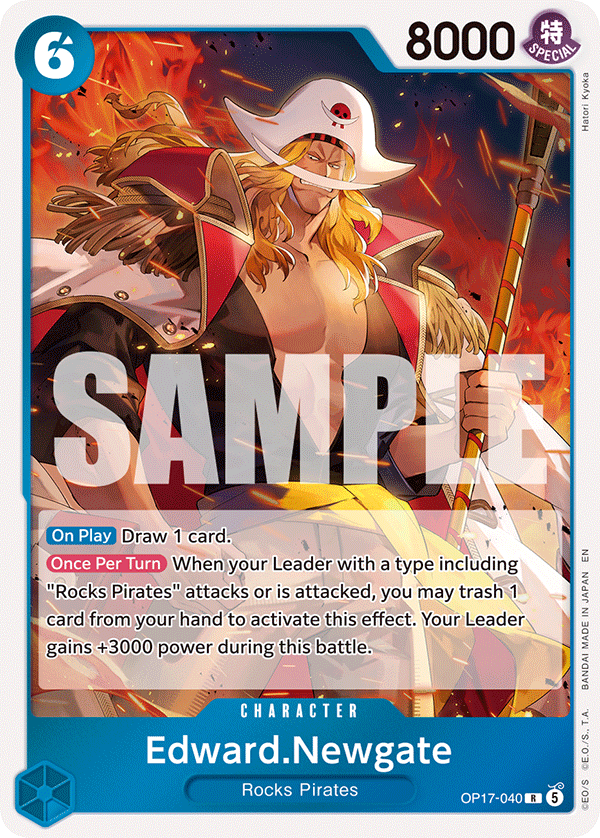
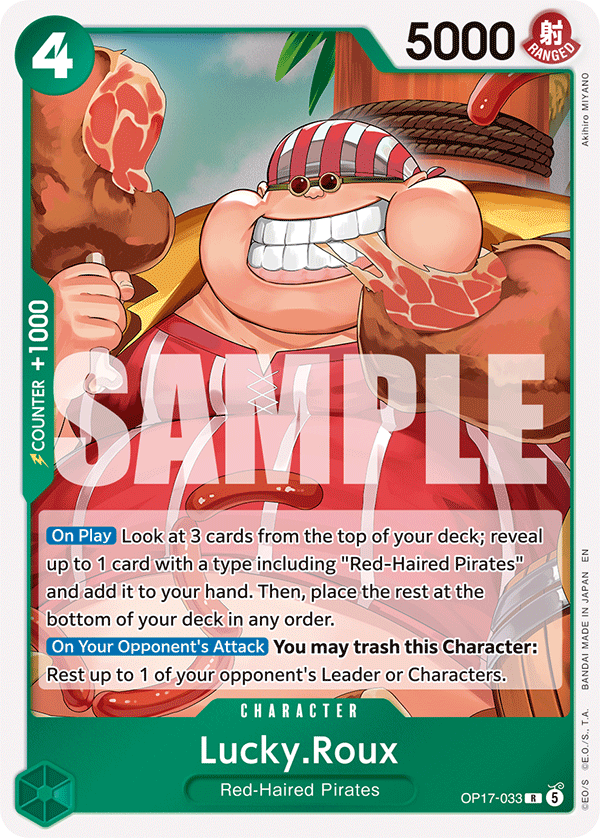
The release-model change is the headline, but OP-17 also did something structurally new to the game itself: it introduced Treasure Rare, a rarity that sits above Secret Rare for the first time in the One Piece Card Game's four-year history. Since launch, Secret Rare has functioned as the game's top chase-card tier -- the rarity collectors and players alike treated as the ceiling. OP-17 raises that ceiling.
The English set's confirmed Treasure Rare is Edward Newgate, better known as Whitebeard, card number OP17-040. That confirmation comes from Bandai's own official product page for the set, which also lays out the set's full scope: 131 cards plus 4 additional prints, for 135 unique cards total, spread across 6 Leaders. Worth flagging directly: the Japanese printing's Treasure Rare is a different card entirely, Lucky Roux at OP17-033 -- Bandai assigned the region-exclusive top rarity to two different characters rather than printing the same card in both languages, which is itself consistent with how the company has varied top-tier prints between Japanese and English releases in the past. A new top-of-pyramid rarity showing up in a fourth-anniversary set, alongside two of the series' recognizable characters, is not a subtle choice -- anniversary sets are exactly where a publisher would introduce a new flagship tier if it wanted that tier to carry some weight from the moment it exists.
It's the kind of move other maturing trading card games have made at similar points in their life cycles: once a game has been running long enough that "Secret Rare" or its equivalent no longer feels rare enough to anchor the top of the market, a new tier gets introduced to reset expectations and give the chase-card conversation somewhere new to go.
What Treasure Rare Signals About the English Market
What makes Treasure Rare relevant to this specific article, rather than just a note for a set review, is the timing. Because OP-17 is the first set on the simultaneous release schedule, Treasure Rare as a rarity tier didn't debut in Japan first and arrive in English months later as old news with an already-established secondary-market price. It launched worldwide, effectively together, even though each region got its own distinct chase card. English-speaking collectors got to watch -- and participate in -- the debut of the game's new top rarity on essentially the same footing and the same timeline as Japanese collectors, rather than reading about it after the fact and importing a copy that had already been priced for months.
Read that as a symbolic marker as much as a mechanical one. Pairing the introduction of a brand-new, above-Secret-Rare tier with the very first worldwide-simultaneous release is the kind of alignment that, intentionally or not, sends a message about how the English-language market is being treated going forward: not as a delayed echo of the "real" Japanese release, but as a market that gets to experience the game's biggest moments in real time. Again, that's this site's reading of what the timing implies -- Bandai hasn't framed it that way in so many words -- but the coincidence of "first simultaneous set" and "first-ever rarity above Secret Rare" landing in the same release is hard to read as purely accidental.
Part of a Bigger Competitive Push?
It's worth placing this release-model shift inside a broader conversation that's been building around the One Piece Card Game for a while now: whether it, alongside newer entrants like Riftbound, is starting to genuinely close the gap with Magic: The Gathering as a competitive-play option. That question has come up explicitly on outside coverage -- an MTGGoldfish podcast episode touched on it -- but it's important to be clear about what that actually establishes. A podcast discussing the question is evidence that the conversation exists and that One Piece's competitive profile is rising enough to be worth talking about in Magic-adjacent spaces. It is not evidence that the question has been settled one way or the other, and this article isn't going to pretend otherwise.
What worldwide-simultaneous release does add to that conversation is a concrete, structural data point rather than a vibes-based one. A game moving its release model onto equal footing across regions is the kind of infrastructure decision that competitive-format games with genuine global ambitions tend to make. It doesn't prove One Piece has caught up to Magic in competitive depth or tournament infrastructure -- that's a much larger claim resting on a lot more than a release calendar -- but it is consistent with a publisher treating the game as a serious, global competitive product rather than a regional hobby release with an English tie-in.
Picking Up OP-17
Whether you're chasing the new Treasure Rare or just want the set that kicked off the worldwide-simultaneous era, here's where to look for OP-17 product.
What This Means for Collectors
For collectors specifically, the practical effects of worldwide-simultaneous release are mostly about timing and price discovery rather than anything dramatic. Under the old system, a set's Japanese secondary-market pricing would often settle before the English version even existed, giving English-market buyers and sellers a rough price benchmark to work from once their own version launched. That benchmark showed up months ahead of the English release, which shaped a lot of pre-release speculation.
With Japan and English releasing six days apart, that lead time is essentially gone. English-market pricing on the cards both regions actually share is discovering itself in real time, close to alongside Japan's, rather than inheriting a pricing story that's already two months old by the time English boosters hit shelves. Treasure Rare Whitebeard is a partial exception worth noting -- since it's an English-exclusive print (Japan has its own separate Treasure Rare in Lucky Roux), there's no Japanese benchmark to watch for that specific card at all, which is itself a new wrinkle collectors haven't had to navigate with prior sets.
It also means set-completion timelines and grading submission windows line up more closely across regions than they used to, since there's no longer a structural two-to-three-month offset between when Japanese and English collectors are working with the same set. Whether that ends up mattering much in practice is something that'll only become clear as more sets go through this model -- OP-17 is the first data point, not a settled trend.
What This Means for Players
For players, the change cuts even closer to the game itself. The old two-to-three-month gap meant the English metagame was, in a real sense, always playing catch-up to a Japanese metagame that had already had a full set's worth of tournament results, deck tech, and refinement before English players ever got to touch the cards. Serious competitive players leaned on that: importing early, following Japanese tournament results, and showing up to English events with decklists that had effectively been playtested by an entire region ahead of time.
That advantage doesn't disappear overnight, but it's structurally much smaller now. With only six days between releases, there isn't a meaningful window for a mature, tournament-tested Japanese metagame to exist before English players are already building and playing with the same cards. The metagame for OP-17 is developing in something much closer to real time, worldwide, rather than in a Japan-first sequence that English players eventually catch up to.
The honest caveat here is that OP-17 is the very first set to go through this process, so there's no track record yet for how a One Piece metagame actually develops without that Japan-first head start. It's a genuinely open question whether the format settles into shape faster, slower, or just differently without a mature Japanese metagame to reference in the early days. That's something worth watching over the next set or two rather than something this article can claim to already know the answer to.
Verdict
OP-17 is going to get talked about for its cards -- a fourth-anniversary set headlined by a new Treasure Rare Whitebeard is going to get talked about no matter what. But the more consequential story here is the release model underneath it. Ending the two-to-three-month Japan-first lead time is the kind of structural change that reshapes how collectors and players actually engage with the game going forward, well after OP-17 itself has rotated out of the spotlight.
The practical takeaways are straightforward. The early-import advantage that used to reward players and collectors willing to buy Japanese product ahead of the English release has largely closed for sets released this way. Price discovery, metagame development, and set completion now move on roughly the same clock across regions instead of Japan setting the pace months in advance. And the decision to debut the game's first-ever above-Secret-Rare tier in this exact set is hard not to read as a signal about how seriously the English-language market is now being treated -- even if Bandai hasn't spelled that reasoning out directly.
Whether this becomes the permanent model for every future set, or gets adjusted after Bandai sees how OP-17's rollout actually went, isn't something this article can answer yet. What's clear is that the four-year-old pattern of "Japan first, everyone else waits" is, for now, over.
Keep Reading
- For deck strategy, tier lists, and everything else OP-17 related, visit our One Piece TCG strategy hub.
- Tracking the "is One Piece catching Magic" conversation? Our MTG strategy hub is a good place to see the comparison from the other side.
© GEEKYDOMAIN.COM | Strategy Powered by Data