

Gundam Card Game by Anime Series: A Player's Series Guide
The Gundam Card Game pulls from decades of anime history — here's exactly which series you'll find in each set, and where to start if you're chasing your favorite show specifically.
The Gundam franchise spans more than four decades of anime across dozens of distinct series, and the Gundam Card Game draws from a genuinely wide slice of that history rather than focusing narrowly on one or two shows. If you're coming to the game as a fan of a specific series first and a card game player second, knowing which sets actually feature your favorite show matters a lot for where you should start collecting or building.
Each main set has drawn from a different combination of series, with some sets leaning heavily into one particular show and others spreading their card pool across several. This guide maps out exactly what's in each release so far.
Here's the Gundam Card Game, organized by anime series rather than by set number.
→ Short Version
GD01 (Newtype Rising) launched the game with five series: the original Mobile Suit Gundam, Gundam Unicorn, Gundam Wing, Gundam SEED, and The Witch from Mercury. GD02 (Dual Impact) expanded into Gundam X, Gundam AGE, and Iron-Blooded Orphans. GD03 (Steel Requiem) leans heavily into Iron-Blooded Orphans alongside material from 0080: War in the Pocket. GD04 (Phantom Aria) brought in ∀ Gundam and Mobile Suit Victory Gundam for the first time, plus Gundam 00 and Hathaway's Flash content, alongside continued original-series and Unicorn support. GD05 (Freedom Ascension), the game's 1st Anniversary set, went further still — debuting four series in one release: Mobile Suit Gundam SEED Destiny, Mobile Fighter G Gundam, Mobile Suit Gundam Wing: Endless Waltz, and Mobile Suit Gundam Char's Counterattack.
→ Related Reading
In This Guide
| Set | Series Featured |
|---|---|
| GD01 — Newtype Rising | Mobile Suit Gundam (original), Gundam Unicorn, Gundam Wing, Gundam SEED, The Witch from Mercury |
| GD02 — Dual Impact | Adds Gundam X, Gundam AGE, Iron-Blooded Orphans |
| GD03 — Steel Requiem | Heavy Iron-Blooded Orphans focus; also 0080: War in the Pocket |
| GD04 — Phantom Aria | ∀ Gundam and Mobile Suit Victory Gundam debut; also Gundam 00, Hathaway's Flash, continued original series & Unicorn support |
| GD05 — Freedom Ascension | Debuts four series at once: Gundam SEED Destiny, Mobile Fighter G Gundam, Gundam Wing: Endless Waltz, Mobile Suit Gundam Char's Counterattack |
Find Your Series
| Anime Series | GD01 | GD02 | GD03 | GD04 | GD05 | Best Starting Set |
|---|---|---|---|---|---|---|
| Mobile Suit Gundam (0079) | ✓ | — | — | ✓ | — | GD01 |
| Gundam Unicorn | ✓ | — | — | ✓ | — | GD01 |
| Gundam Wing | ✓ | — | — | — | — | GD01 |
| Gundam SEED | ✓ | — | — | — | — | GD01 |
| The Witch from Mercury | ✓ | — | — | — | — | GD01 |
| Gundam X | — | ✓ | — | — | — | GD02 |
| Gundam AGE | — | ✓ | — | — | — | GD02 |
| Iron-Blooded Orphans | — | ✓ | ✓✓ | — | — | GD03 (deepest) |
| 0080: War in the Pocket | — | — | ✓ | — | — | GD03 |
| ∀ Gundam (Turn A) | — | — | — | ✓ | — | GD04 (only set) |
| Victory Gundam | — | — | — | ✓ | — | GD04 (only set) |
| Gundam 00 | — | — | — | ✓ | — | GD04 |
| Hathaway's Flash | — | — | — | ✓ | — | GD04 |
| Gundam SEED Destiny | — | — | — | — | ✓ | GD05 (only set) |
| Mobile Fighter G Gundam | — | — | — | — | ✓ | GD05 (only set) |
| Gundam Wing: Endless Waltz | — | — | — | — | ✓ | GD05 (only set) |
| Char's Counterattack | — | — | — | — | ✓ | GD05 (only set) |
GD01: Newtype Rising — The Founding Five
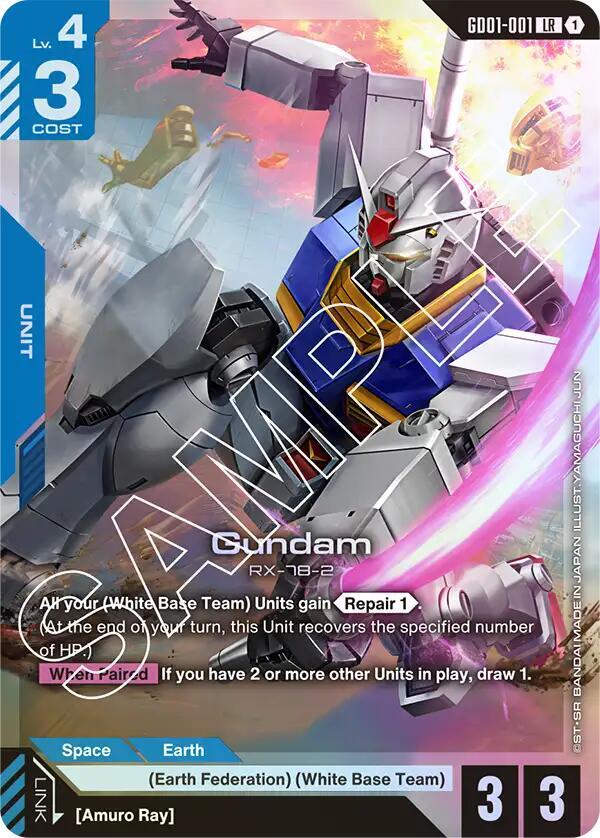
The game launched by drawing from five series at once — the original 1979 Mobile Suit Gundam, Gundam Unicorn, Gundam Wing, Gundam SEED, and The Witch from Mercury — giving it immediate broad appeal across different eras of Gundam fandom. If your favorite series is one of these five, GD01 is where the deepest and earliest card support lives, and it remains foundational to the format regardless of which later sets you pick up.
The choice to launch with five series simultaneously was a deliberate strategic move — it ensured that the game's initial card pool could support multiple competitive archetypes from day one rather than forcing every player into the same narrow set of strategies. It also meant that fans of different eras of Gundam all had a reason to pay attention at launch, rather than waiting for a later set to feature their series.
For collectors, GD01 booster boxes carry the additional significance of being the game's first print run. First-set singles from any TCG tend to hold collector value well beyond their competitive relevance, and GD01's combination of iconic series and foundational staples gives it both gameplay and collector appeal that later sets don't automatically replicate.
GD02: Dual Impact — Expanding the Roster
The second set brought three new series into the card pool — Gundam X, Gundam AGE, and Iron-Blooded Orphans — expanding coverage well beyond the game's most internationally famous entries. Iron-Blooded Orphans fans in particular got their first real card support here, ahead of the much deeper focus that series would receive in GD03.
Gundam X and Gundam AGE are both series with passionate but comparatively smaller Western fanbases, so their inclusion in GD02 was a meaningful signal that the card game intended to cover the franchise broadly rather than focusing only on the most commercially popular shows. For fans of these series, GD02 is currently their only point of representation in the game — making it a must-buy for anyone collecting around either show specifically.
From a gameplay perspective, GD02 also introduced mechanical diversity that the launch set lacked. The new series brought distinct playstyles that pushed deckbuilding in directions GD01's card pool could not support on its own, giving players who had explored every viable GD01 strategy fresh angles to pursue without waiting for the third set. That mechanical expansion is part of what makes GD02 age well even as later sets arrive.
GD03: Steel Requiem — Iron-Blooded Orphans Takes the Spotlight
Steel Requiem gives Iron-Blooded Orphans its deepest card support to date, alongside material from 0080: War in the Pocket — one of the franchise's earlier and more grounded entries. If IBO is the series that brought you to Gundam, this is currently the single most important set to prioritize.
The heavy IBO focus in GD03 means this set functions almost as a dedicated IBO expansion, with enough series-specific cards to build thematic decks that lean heavily into Iron-Blooded Orphans characters and mobile suits. For players who care about series flavor in their deckbuilding as much as competitive strength, GD03 offers a depth of thematic options that earlier sets' more spread-out approach doesn't match.
The inclusion of 0080: War in the Pocket content alongside IBO is an interesting pairing — both series share a grittier, more grounded tone compared to much of the Gundam franchise, and the card design reflects that thematic overlap. Players who gravitate toward Gundam's more militaristic and less super-robot-flavored entries will find GD03's overall aesthetic cohesive in a way that the broader multi-series sets are not.
GD04: Phantom Aria — Two Franchise Debuts
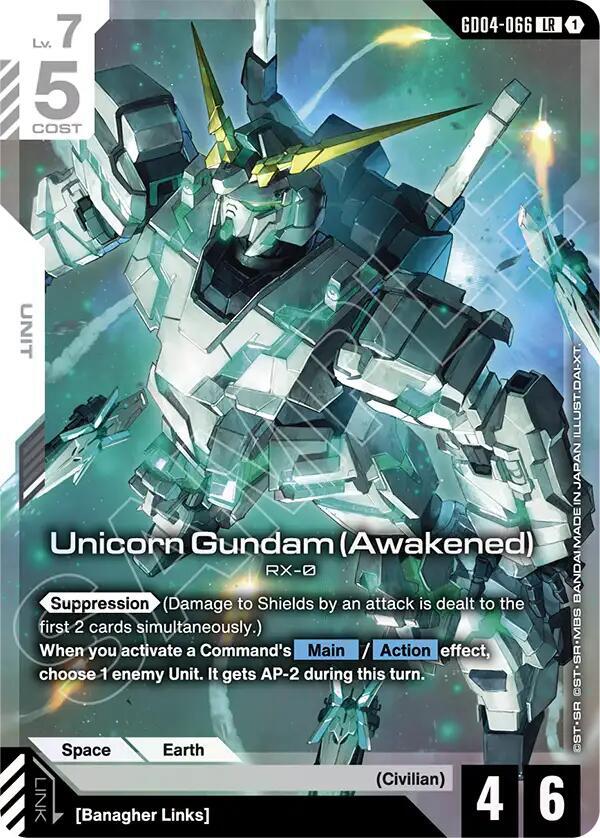
Phantom Aria brought ∀ Gundam (Turn A) and Mobile Suit Victory Gundam into the card game for the first time, alongside Gundam 00, Hathaway's Flash, and continued original-series and Unicorn support — making it one of the broadest single-set spreads so far. If you're a Turn A or Victory Gundam fan specifically, this is currently their only point of entry into the game.
The breadth of GD04's series coverage also makes it an interesting set for players who want variety in a single purchase. Opening GD04 packs can yield cards from six or more distinct shows, which gives it a different feel from GD03's focused approach. For collectors building across the franchise rather than within a single series, GD04 offers the widest cross-section of Gundam history in a single booster box.
Turn A Gundam's debut in the card game is particularly noteworthy because the series occupies a unique place in the franchise — it was directed by Yoshiyuki Tomino as a deliberate bridge across all Gundam timelines, and the card game's inclusion of Turn A alongside Universal Century and alternate-universe content mirrors that connective intent. For longtime franchise fans, Turn A cards carry a symbolic weight that goes beyond their gameplay utility.
GD05: Freedom Ascension — Four Series at Once
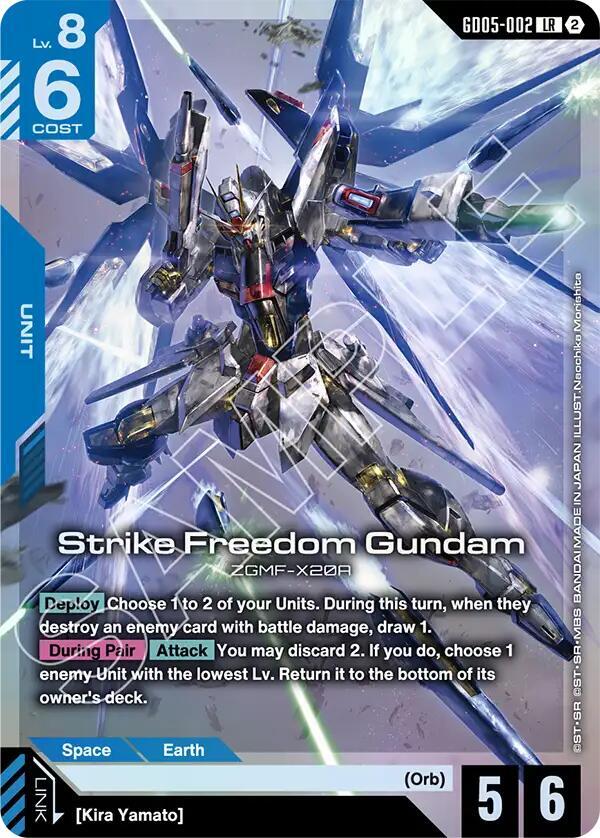
Freedom Ascension is the Gundam Card Game's fifth booster set and its official 1st Anniversary release, launched July 24, 2026 — one year to the month after the game's global debut in July 2025. Rather than folding new material into series the game had already established, GD05 debuts four series simultaneously: Mobile Suit Gundam SEED Destiny, Mobile Fighter G Gundam, Mobile Suit Gundam Wing: Endless Waltz, and Mobile Suit Gundam Char's Counterattack. Bandai's own product page gives each of the four its own explicit "joins the game" callout, which makes this a genuine four-series debut — not the looser "two series" shorthand that's floated around in some secondary marketing summaries of the set.
Each debuting series arrives with an unmistakable headline unit to build around. SEED Destiny is fronted by Strike Freedom Gundam; G Gundam brings Shining Gundam and its pilot Domon Kasshu, along with a Shining Finger command card and Master Gundam; Gundam Wing: Endless Waltz is led by Wing Gundam Zero EW; and Char's Counterattack — the only one of the four to get two headline machines rather than one — is anchored by both Nu Gundam and Sazabi. If any of those six names is the reason you picked up a Gundam card in the first place, GD05 is currently the only set that carries any support for that series at all.
The anniversary framing carries into the rarity structure too. GD05 introduces several treatments that had never appeared in the game before, including a brand-new "Link Rare" parallel tier and a record five "LR++" chase cards — one anchoring each of the four new series, with Char's Counterattack claiming two (Nu Gundam and Sazabi). Early post-release pricing on those cards has been dramatic and volatile; Wing Gundam Zero EW in particular is currently the single most expensive chase card in the game's history outside of the ultra-limited Beta print, though as with any brand-new set those numbers should keep moving as the market settles. Bandai also released a companion SC01 Deck Build Box alongside GD05, built around reprinted cards across all five colors rather than the four new series specifically, for players who'd rather deckbuild immediately than chase singles.
Picking a Starting Point by Series
If you're building a collection or a deck around a specific series rather than the strongest competitive strategy available, start with whichever set gives that series its deepest support rather than simply buying the newest release. A Turn A Gundam fan gets far more value focusing on GD04 than starting with GD01, even though GD01 is the game's foundational set.
That same logic now extends to GD05. If Gundam SEED Destiny, Mobile Fighter G Gundam, Gundam Wing: Endless Waltz, or Char's Counterattack is the series that hooked you, Freedom Ascension is currently the only set carrying any cards for it — there's no earlier release to weigh it against the way there is for, say, the original Mobile Suit Gundam spread across GD01 and GD04.
Keep in mind that competitive deckbuilding and series-based collecting are two different goals that sometimes align and sometimes don't. The strongest competitive deck at any given moment might pull cards from three or four different sets regardless of which series those cards depict — color identity and game mechanics matter more for competitive viability than series flavor. If you want both a thematic deck and a competitive one, you may end up building two separate lists, which is a perfectly normal approach in a game that draws from this many source properties.
As new sets release and older series receive additional card support, the landscape for series-based collecting will continue to shift. A series that currently exists in only one set may receive expanded support in a future release, which could either reinforce that set's value or reduce its exclusivity as a collecting target. Keeping an eye on Bandai's set announcements helps you anticipate which series will grow their card pool next, allowing you to plan purchases rather than react to them after the fact.
Our full set comparison covers the buying considerations for each release beyond just series content, if you're weighing multiple factors at once.
Buying the set your series is in
Once the table above points you at a set, that set's booster box is the purchase — Amazon is the first place to check for GD01, GD04 and GD05, while the earlier GD02 and GD03 print runs mostly surface on eBay now. If you'd rather chase one card than open a box, GD05's five LR++ cards (Wing Gundam Zero EW, Nu Gundam, Sazabi, Strike Freedom and Shining Gundam) sell individually.
As an Amazon Associate, Geeky Domain earns from qualifying purchases. eBay links are affiliate links; Geeky Domain may earn a commission at no extra cost to you.
GD01 — Newtype Rising
| Series Count | 5 |
| Standout Series | Original MSG, SEED, Wing |
| Best For | New players; broadest starting point |
| Collector Appeal | High — foundational set |
GD02 — Dual Impact
| New Series | 3 (X, AGE, IBO) |
| Standout Series | Iron-Blooded Orphans debut |
| Best For | IBO fans; roster expansion |
| Collector Appeal | Moderate |
GD03 — Steel Requiem
| New Series | 1 (0080: War in the Pocket) |
| Standout Series | IBO deep support |
| Best For | IBO mains; 0080 fans |
| Collector Appeal | Moderate — focused |
GD04 — Phantom Aria
| New Series | 2 (∀ Gundam, Victory Gundam) |
| Standout Series | ∀ Gundam & Victory debut |
| Best For | Turn A/Victory fans; broadest spread |
| Collector Appeal | High — franchise debuts |
GD05 — Freedom Ascension
| New Series | 4 (SEED Destiny, G Gundam, Wing: Endless Waltz, Char's Counterattack) |
| Standout Series | Four series debut at once — a record for a single set; 1st Anniversary release |
| Best For | SEED Destiny/G Gundam/Wing EW/CCA fans; chase-card collectors |
| Collector Appeal | Very High — record LR++ count, anniversary rarities |
Do This
- Start with the set that features your favorite series most deeply
- Use the series-to-set table above to check before buying boosters
- Mix sets freely in deckbuilding — color matters, not series origin
- Follow new set announcements for upcoming series debuts
Avoid This
- Buying only the newest set if your series debuted in an earlier one
- Assuming series coverage is complete — new sets may add deeper support later
- Ignoring sets where your series has minor representation
- Expecting deckbuilding to be restricted to a single series
FAQ
- Which set has the most series represented? GD05 (Freedom Ascension) now holds the record for series debuts in a single set — four series joining at once (Gundam SEED Destiny, Mobile Fighter G Gundam, Gundam Wing: Endless Waltz, and Char's Counterattack). GD04 (Phantom Aria) still holds the widest overall single-set spread, since it paired two franchise debuts with continued support for several earlier series.
- Is my favorite Gundam series guaranteed to eventually get cards? There's no guarantee, but the game's pattern so far has been steady expansion into new series with each release, so continued growth in series coverage is a reasonable expectation based on the trend — GD05's four-series debut in a single set is the most recent evidence of that pattern.
- Do cards from different series interact in deckbuilding, or are they separate? Deckbuilding in the Gundam Card Game is organized by color rather than by series, so cards from different anime series can and often do appear in the same competitive deck. Series is a collecting and flavor dimension more than a deckbuilding restriction.
- Is GD05 (Freedom Ascension) a good starting point for a new player? It's a strong one if any of its four new series is what drew you to the game, since it's currently the only set carrying cards for Gundam SEED Destiny, Mobile Fighter G Gundam, Gundam Wing: Endless Waltz, or Char's Counterattack. Players who don't care about series and just want the broadest possible starting card pool should still weigh it against GD01 and GD04 using our set comparison guide.
- Which set should a new player who doesn't care about series start with? See our set comparison guide for a buying recommendation based on competitive relevance and current availability rather than series preference.
Five Sets, a Genuine Franchise Cross-Section.
The Gundam Card Game has covered real ground across the franchise's history in five main sets now — from the original 1979 series through Iron-Blooded Orphans, Turn A Gundam, and Victory Gundam, and now Gundam SEED Destiny, Mobile Fighter G Gundam, Gundam Wing: Endless Waltz, and Char's Counterattack all at once in GD05. Whatever era of Gundam brought you to the franchise, there's very likely a set that speaks to it directly. Start with the set that features your series, and let the rest of the card pool follow from there.
© GEEKYDOMAIN.COM | Strategy Powered by Data