

Jungle & Fossil: The Forgotten Vintage Sets
Base Set gets all the attention, but the two sets that followed it in 1999 introduced the conventions, errors, and chase cards that still define vintage Pokémon collecting. Here's what to know about Jungle and Fossil.
Ask a casual collector to name a 1999 Pokémon set and they'll say Base Set. Ask them about the next two and you'll get a shrug. Jungle and Fossil — released within four months of each other in the back half of 1999 — sit permanently in Base Set's shadow despite being more interesting in several ways. They have lower print runs in places, more famous error cards, the first English Eeveelutions, the first holo Snorlax, the prerelease Aerodactyl, and printing conventions that quietly shaped every Pokémon set that followed.
For collectors who've already worked through Base Set, Jungle and Fossil are where vintage Pokémon gets interesting. The values are more nuanced, the error variants are richer, and a smart collector can find genuinely scarce cards at prices that haven't fully caught up to the demand. They're also where you start needing to know what you're looking at — the difference between a $20 card and a $200 card on the same Pokémon often comes down to a stamp, a symbol, or a holo pattern most people miss.
This guide covers what's actually in each set, the famous errors and variants worth knowing, the chase cards that drive demand, and how Jungle and Fossil fit into a vintage collection alongside Base Set. Prices in vintage Pokémon shift constantly and high — treat any specific figure as directional and always check live comps before buying.
The Short Version
Jungle (June 1999, 64 cards, 16 holos) and Fossil (October 1999, 62 cards, 15 holos) followed Base Set in 1999 and introduced the holo/non-holo duplicate-rarity convention. Both have 1st Edition and Unlimited printings — 1st Edition is meaningfully scarcer. Famous variants include Jungle's "No Symbol" holos (Unlimited error), the "d" Edition Butterfree, and the Base Set art Electrode error; Fossil's headliners are the Prerelease Aerodactyl (gold or brown stamp) and the Cosmos Holofoil employee variants. Top chase cards include Jolteon, Snorlax, Pidgeot, and Vileplume from Jungle, and Aerodactyl, Lapras, and Dragonite from Fossil. Both sets share Jungle's "silvering" holo issue — condition is everything.
→ More Pokémon & Vintage Guides
In This Guide
- → Why These Sets Get Forgotten
- → The Two Sets at a Glance
- → Jungle: The Set That Set the Pattern
- → Jungle's Famous Errors & Variants
- → Fossil: The Prehistoric Set
- → Fossil's Prereleases & Variants
- → The Chase Cards
- → Condition & the Silvering Problem
- → How to Buy Smart
- → Common Collector Mistakes
- → FAQ & Quick Reference
Why These Sets Get Forgotten
Jungle and Fossil aren't actually forgotten by serious collectors — they're forgotten by the wider hobby because Base Set dominates the headlines and the nostalgia. Base Set has Charizard. Jungle has Jolteon. Fossil has Aerodactyl. There's no contest in pop culture — but for collectors, the gap is far narrower than the public attention suggests.
Three reasons the under-attention persists:
- No Charizard. The single most famous card in the hobby anchors Base Set's value and visibility. No card in Jungle or Fossil has anywhere near that pop-culture pull, even though several have comparable scarcity or aesthetic merit.
- Higher print runs at peak Pokémania. Jungle and Fossil released into the height of the 1999 craze, when print quantities scaled up to meet demand. That means Unlimited copies are genuinely common in many cases — which suppresses prices on non-chase cards and reinforces the "less valuable" perception.
- Base Set absorbed the brand. For most casual collectors, "1999 Pokémon" means Base Set. Jungle and Fossil get lumped into "old Pokémon" with sets like Base Set 2 and Team Rocket — even though they actually predate or run alongside the most valuable Base Set printings.
The opportunity for collectors who pay attention: 1st Edition Jungle and Fossil cards are genuinely scarcer than most Unlimited Base Set cards, but priced as if they were less significant. That's a real inefficiency in the vintage market — and the kind of thing that rewards collectors who know the details.
The Two Sets at a Glance
| Jungle | Fossil | |
|---|---|---|
| Released | June 16, 1999 | October 10, 1999 |
| Card count | 64 cards | 62 cards |
| Holos | 16 (#1–16) | 15 (#1–15) |
| Set symbol | Flower/vine | Aerodactyl-style skeletal hand |
| Pack wrappers | Scyther, Wigglytuff, Flareon | Aerodactyl, Zapdos, Lapras |
| Printings | 1st Edition, Unlimited | 1st Edition, Unlimited, Prerelease |
| Famous variant | "No Symbol" Unlimited holos | Prerelease Aerodactyl (gold/brown stamp) |
| Headliner | Jolteon, Snorlax, Pidgeot, Vileplume | Aerodactyl, Lapras, Dragonite |
Jungle: The Set That Set the Pattern
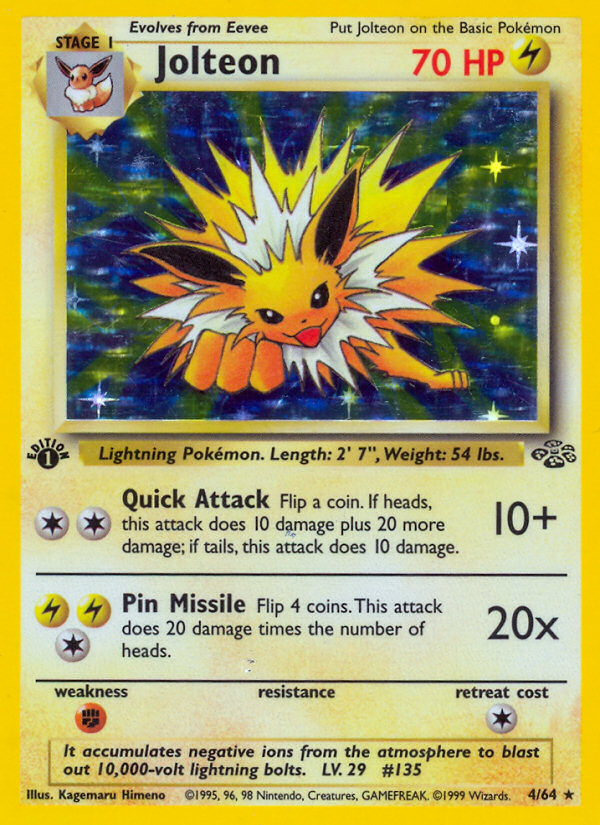
Jungle was the first expansion to the Pokémon TCG and introduced a convention that defined every English set after it: each holographic rare was also printed as a non-holo version with a different card number. Holos run #1–16; the same Pokémon also appear as non-holos at #17–32 (Jolteon holo is #4/64, non-holo Jolteon is #20/64). This duplicate-rarity structure became standard, but Jungle was where it started.
The set was originally slated for August 1999, but Wizards of the Coast moved the release up to June 16, 1999 when they learned Topps was launching competing Pokémon cards. That sped-up timeline shows in the printing — Jungle has more documented errors and quality-control issues than any other 1999 set.
Other Jungle facts worth knowing:
- Three pack wrappers: Scyther, Wigglytuff, and Flareon. Collectors of sealed product often try to assemble the full art set.
- First English Eeveelutions and Snorlax holos. Jolteon, Flareon, and Snorlax made their English debuts here as holographic rares — foundational cards for any vintage Eevee or Snorlax collection.
- Only two Pokémon appear in both Base Set and Jungle: Pikachu and Electrode (with fresh Jungle artwork — or at least, that was the plan; the error version is a major Jungle story, see below).
- 11-card booster packs: 7 commons, 3 uncommons, 1 rare. Holos appeared in roughly 1 in 3 packs.
- Rounded corners and back-border chipping: Wizards rounded Jungle's corners (and Fossil's after it) to help prevent corner wear — but the blue back border is notoriously prone to chipping, which is the #1 condition issue on Jungle cards.
Jungle's Famous Errors & Variants
Jungle is the most error-rich vintage Pokémon set, and its variants are a real collector category. The most important ones:
- "No Symbol" Unlimited holos. The most famous Jungle variant: in early Unlimited printings, a number of holo cards were printed without the Jungle flower set symbol. Collectors call them "No Symbol" holos. They sell at a modest premium over their symbol-bearing counterparts and assembling the complete No Symbol set is a popular sub-goal. Warning: they're often confused with Base Set cards by newer collectors, because Base Set never had a set symbol either.
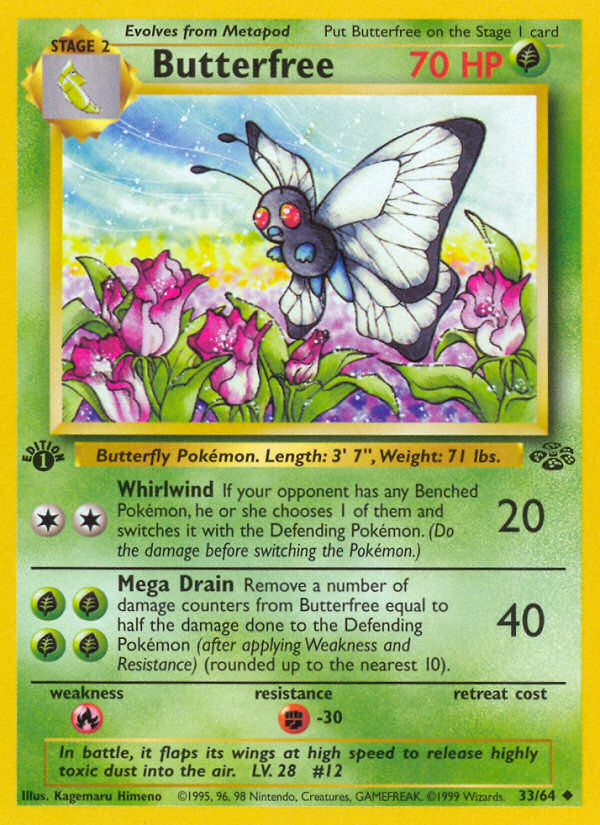
- "d" Edition Butterfree (#33). Some 1st Edition Butterfree cards have an ink bubble in the "Edition 1" stamp that makes it appear to read "Edition d" instead. It's scarcer than the standard 1st Edition Butterfree and carries a premium — one of the more well-documented stamp anomalies in vintage Pokémon.
- Base Set artwork Electrode. The 1st Edition non-holo Electrode in Jungle was mistakenly printed with the artwork from Base Set Electrode rather than the new Jungle illustration. The error wasn't corrected in 1st Edition, making the wrong-art version the only 1st Edition non-holo Electrode option for the Jungle set — a curiosity rather than a premium card, but a piece of trivia every Jungle collector should know.
- Prerelease cards. Jungle had limited prerelease distribution, though it didn't produce a famous single like Fossil's Prerelease Aerodactyl. Prerelease promos from this era exist but are less central to Jungle collecting.
The "No Symbol" trap: A new collector sees a Jungle holo without a set symbol, thinks they've found a misfiled Base Set card, and either overpays (thinking it's rarer Base Set) or underpays (treating it as damaged). It's neither — it's a documented Jungle error printing, and worth a modest premium over regular Jungle. Always check the card number against the Jungle list before assuming anything.
Fossil: The Prehistoric Set
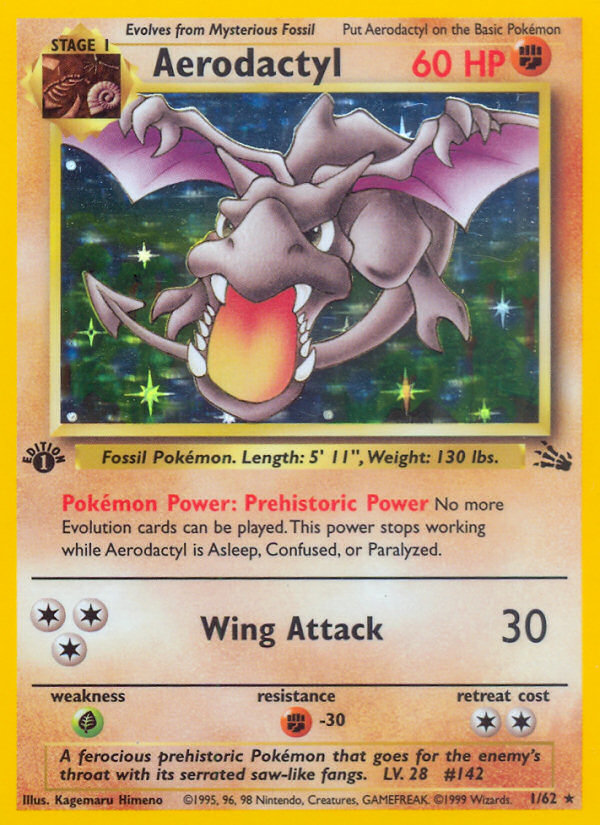
Fossil arrived October 10, 1999 — about four months after Jungle — and continued the duplicate-rarity convention with a prehistoric theme. The set has 62 cards rather than Jungle's 64 because Mew, who was a holo in the Japanese Fossil set, was cut from the English release. The skeletal-hand set symbol references Aerodactyl, the card on the box and the set's signature Pokémon.
Key Fossil facts:
- Last set to use Galaxy Star Holofoil. Base Set, Jungle, and Fossil all used the same "Galaxy Star" holographic pattern. Fossil was its swan song — subsequent sets moved to different holo patterns, making the Galaxy Star a unifying visual marker of the original 1999 trio.
- Three pack wrappers: Aerodactyl, Zapdos, and Lapras — the three "signature" Fossil Pokémon. 36 packs per booster box.
- 11-card pack composition: Same as Jungle — 7 commons, 3 uncommons, 1 rare. Holo rates also similar.
- First English appearances: Aerodactyl, Lapras, Articuno, Moltres, Zapdos, Ditto, Hitmonlee, Hypno, and the Mr. Fuji trainer card — foundational vintage debuts for several beloved Pokémon.
- The deck product: Fossil released alongside the Thunderstorm and Tempest preconstructed theme decks — sealed preconstructed product that's its own collecting target for sealed enthusiasts.
Fossil's Prereleases & Variants
Fossil has fewer error cards than Jungle but a richer prerelease story. The variants every Fossil collector should know:
- Prerelease Aerodactyl. The most famous Fossil card and one of the most famous prereleases in vintage Pokémon. Distributed at Pokémon League events in July 1999 — three months before Fossil officially released — the Prerelease Aerodactyl has a "PRERELEASE" stamp in the lower right of the illustration box. The U.S. version uses the Galaxy Star Holofoil pattern; the European version uses Cosmos Holofoil.
- Gold vs. brown Prerelease stamps. The Prerelease stamp itself comes in two color variants — brown and gold — with the gold stamp version notably scarcer and more valuable. If you're buying a Prerelease Aerodactyl, the stamp color is a meaningful price driver.
- Cosmos Holofoil variants. A small number (reportedly around 15 cards) of Fossil holos exist with the Cosmos Holofoil pattern instead of the standard Galaxy Star — these were reportedly Wizards of the Coast employee gift cards. They're genuinely rare and command significant premiums when they appear, which is infrequent.
- Incomplete holo errors. Several Fossil holos exist with documented holo printing errors — Dragonite "incomplete holo" is among the most notable. Specialty error category, smaller market but real demand.
Why the Prerelease Aerodactyl matters: It's the only widely-known prerelease card from the 1999 sets, distributed before its parent set even existed publicly. That makes it both a Fossil card and a piece of pre-Fossil promotional history — collectors value it as both. The gold-stamp version in high grade is one of the genuinely scarce 1999 cards.
The Chase Cards
If you're prioritizing where to spend, these are the cards that anchor each set's value:
Jungle headliners:
- Jolteon (4/64) & Snorlax (11/64) — the two most-chased Jungle holos. Jolteon is the Eeveelution flagship; Snorlax is iconic and beloved. Both 1st Edition versions are genuinely scarce in high grade.
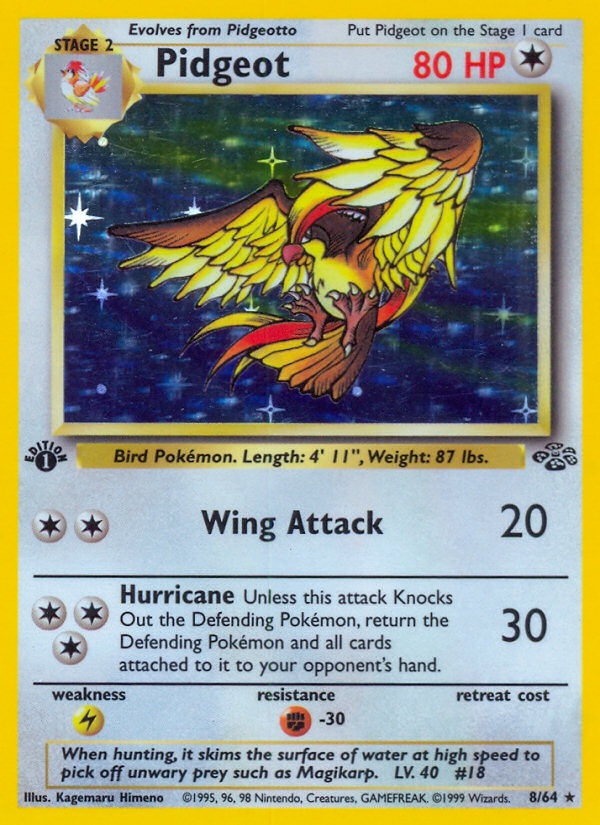
- Pidgeot (8/64) & Vileplume (15/64) — aesthetic favorites, with Pidgeot in particular drawing strong collector demand for the artwork. Solid mid-tier Jungle pulls.
- "No Symbol" holos and "d" Edition Butterfree — the error variants. Modest premium individually; assembling a complete No Symbol holo set is a meaningful project.
Fossil headliners:
- Prerelease Aerodactyl (1/62) — the marquee Fossil chase. The gold-stamp 1st Edition Prerelease in high grade is one of the genuinely rare 1999 cards.
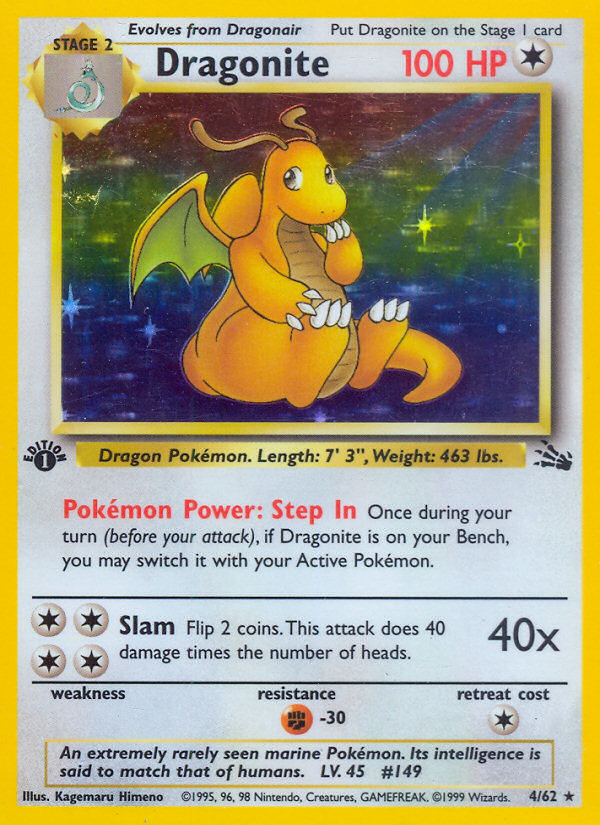
- Dragonite (4/62), Lapras (10/62), Gengar (5/62) — the most-loved Fossil holos. Dragonite in particular has durable popularity; Lapras is a fan favorite from the anime era.
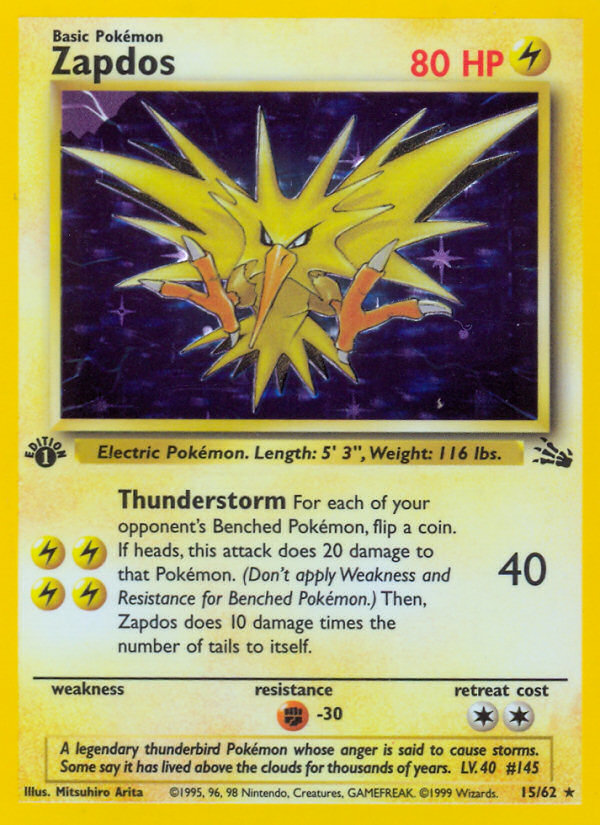
- Articuno (2/62), Zapdos (15/62), Moltres (12/62) — the legendary birds, all in Fossil. Strong condition-sensitive demand — collectors aim for complete-trio displays.
- Cosmos Holofoil variants — the employee-gift rarities. Hard to find, expensive when they appear, very much a specialist target.
Condition & the Silvering Problem
Both Jungle and Fossil have a notorious condition issue: holo silvering. The holographic foil on many cards from these sets was prone to scratching, scuffing, and a "silvered" cloudy appearance even on cards that came straight out of packs. It's not damage from handling — it's a factory-era quality issue that affected the holos before they reached collectors.
What this means in practice:
- High grades are genuinely rare. PSA 10s on Jungle and Fossil holos are scarcer than the print runs would suggest, because the factory silvering alone often caps cards at PSA 8 or 9. That makes top grades more valuable than naive print-run math implies.
- Inspect under bright light. Silvering shows up as cloudy or scratchy patches on the holo area, often most visible at an angle. Always inspect raw holos in good light before buying.
- Back-border chipping is the other big issue. The blue back borders chip easily — sometimes from handling, sometimes from poor early storage. Look at the back corners and edges before grading.
- Buy graded for high-value pieces. Given both issues, raw Jungle and Fossil holos in claimed "mint" condition often disappoint at grading. Buying already-graded copies eliminates the surprise — see our grading guide for the math on when to grade and when to buy graded.
How to Buy Smart
Vintage Pokémon is high-value, counterfeit-prone, and condition-sensitive. The buying discipline that protects you:
- Confirm the printing before paying. Same stamp/shadow logic as Base Set applies in spirit: check for the 1st Edition stamp (lower-left of art), check the set symbol on Jungle (flower) or Fossil (skeletal hand), and verify the card number against the set list. A listing that doesn't show these clearly is one to question.
- For high-value cards, buy graded. Counterfeits exist for marquee Jungle and Fossil holos. A reputable grade authenticates and locks in condition. See our vintage Pokémon slab and pack authentication guide for spotting fake slabs.
- Inspect for silvering in raw holos. If a seller can't or won't provide angled-light photos of the holo, walk away on anything significant. Silvering is the single biggest hidden defect on these sets.
- Watch for misidentified variants. Listings frequently mislabel cards — "Jungle Reverse Holo" (doesn't exist; Jungle had standard holos and non-holos only) or mixing card numbers across holo and non-holo versions of the same Pokémon. Verify the card number against the set list.
- Check live comps. Pricing on vintage shifts constantly. Look up recent sold listings for the exact card, printing, variant, and grade before committing — old price guides are unreliable on 27-year-old cards.
Buying the chase cards
Because silvering caps so many raw holos from these two sets, the headliners — Jungle Jolteon 4/64, Jungle Snorlax 11/64, the gold-stamp prerelease Aerodactyl and Fossil Dragonite 4/62 — are the cards to buy already graded, and if you are inspecting raw copies yourself, you need magnification that actually shows the foil surface. One search covering the graded chase cards, plus the loupe and the sleeves this section's advice implies:
For the number check, TCGplayer lists every printing of a card as its own entry: Jolteon separates the 4/64 holo from the 20/64 non-holo, and Dragonite separates the Fossil 4/62 from its later reprints.
Building the 1999 trio as a display set? Our Vintage Pull Holo playmat is original art drawn from the 90s pull-a-holo era these sets defined — tournament-standard 24"×14", stitched edges.
As an Amazon Associate, Geeky Domain earns from qualifying purchases. eBay links are affiliate links; Geeky Domain may earn a commission at no extra cost to you.
Common Collector Mistakes
Mistake #1: Confusing Jungle "No Symbol" holos with Base Set.
Base Set had no set symbol because it was the first English set; some Jungle Unlimited holos accidentally lack the symbol due to a printing error. They look similar — but a holo of a Pokémon that's only in Jungle (Vileplume, Pidgeot, Jolteon, etc.) is a Jungle "No Symbol" error, not a misfiled Base Set card. Check the card number on the bottom right of the artwork to confirm.
Mistake #2: Buying "reverse holo" Jungle or Fossil cards.
There's no such thing — reverse holos didn't exist in English Pokémon until years later (introduced with Legendary Collection in 2002). Any listing claiming a "1999 Jungle Reverse Holo" is mislabeled, period. Either the card is a regular holo, a regular non-holo, or it's something else entirely (sometimes counterfeits).
Mistake #3: Ignoring the holo/non-holo number split.
Jolteon 4/64 (holo) and Jolteon 20/64 (non-holo) are dramatically different in value. A listing showing one Jolteon and quoting the other's prices is one of the most common (and costly) misidentifications in vintage Pokémon. Always confirm the card number, not just the Pokémon's name.
Mistake #4: Not checking Prerelease Aerodactyl stamp color.
The Prerelease Aerodactyl exists with brown or gold stamps, and the gold version is notably scarcer and more valuable. A listing that just says "Prerelease Aerodactyl" without specifying the stamp color isn't telling you enough — ask, or look for a clear photo, before paying.
Mistake #5: Buying raw holos without inspecting for silvering.
A Jungle or Fossil holo that "looks great" in a flat-light photo can have ruinous silvering visible only at an angle. Insist on angled-light photos or buy already-graded. Surface defects from silvering are the single biggest factor that drops a "pack-fresh" raw holo from PSA 9/10 to PSA 7 or worse.
FAQ & Quick Reference
- Is Jungle or Fossil more valuable? Jungle's top chase cards (Jolteon, Snorlax) tend to outpace Fossil's top non-prerelease holos. But Fossil's Prerelease Aerodactyl in high grade is one of the most valuable non-Base-Set 1999 cards. Both sets have real ceiling pieces; the headliner mix is just different.
- Should I collect 1st Edition or Unlimited? For a serious collection, 1st Edition is the standard target — scarcer, more prestigious, holds value better. For an affordable display collection, Unlimited gives you the same artwork and gameplay nostalgia at a fraction of the cost. Both are valid; pick based on budget and goals.
- What about Base Set 2? Base Set 2 (released February 2000) is a reprint set combining cards from Base Set and Jungle into one product, with a "2" symbol added. It's not generally a high-value set — it's most useful as a reprint reference. Some collectors want it for completeness, but it's not in the same league as Jungle or Fossil originals.
- Are these sets safer to buy raw than Base Set? Authentication-wise, similar risk — the same counterfeit production techniques apply. Condition-wise, Jungle and Fossil holos are actually more condition-sensitive than Base Set holos because of the silvering issue and the chipping-prone back borders. If anything, buying graded matters more here.
- How do these sets fit alongside Base Set? Most serious vintage Pokémon collections include all three — Base Set, Jungle, and Fossil — as the foundational 1999 trio. They share the Galaxy Star holofoil, the same era, and the same cultural moment. Building all three at a comfortable level is a far more interesting collection than maxing out Base Set alone. Our Base Set collecting guide covers the first set in depth.
Check Before You Buy
Vintage Pokémon prices move constantly, and value varies dramatically by printing, variant, and grade. Before any significant purchase, confirm the card number, printing, and variant (1st Edition vs. Unlimited, holo vs. non-holo, stamp color on Prereleases), inspect for silvering, and check live sold-listing comps for that exact configuration. A few minutes of due diligence is the difference between a great pickup and an expensive regret.
- Jungle: June 1999, 64 cards (16 holos), flower symbol, first set with holo/non-holo duplicates.
- Fossil: October 1999, 62 cards (15 holos), skeletal-hand symbol, last set with Galaxy Star holofoil.
- Jungle errors: No Symbol holos, "d" Edition Butterfree, Base Set art Electrode.
- Fossil variants: Prerelease Aerodactyl (brown vs gold stamp), Cosmos Holofoil employee variants.
- Headliners: Jolteon/Snorlax/Pidgeot/Vileplume (Jungle); Aerodactyl/Lapras/Dragonite (Fossil).
- Watch: silvering on holos, back-border chipping, mis-numbered listings, fake "reverse holos."
- Always: verify card number; inspect for silvering; buy graded on high-value pieces.
The Other Half of 1999.
Base Set may have the Charizard, but Jungle and Fossil have the conventions, the errors, and the prereleases that make vintage Pokémon a real collecting puzzle. Learn the variants, respect the silvering, verify every card number, and you'll find the kind of nuance that separates a casual collector from someone who genuinely knows the era.
© GEEKYDOMAIN.COM | Strategy Powered by Data