

Locations Explained: How & When to Use Them
Disney Lorcana's quietest card type generates lore while you do something else — if you can keep it alive. Here's exactly how locations work, and the strategic timing that separates a free engine from a wasted card.
Most of Lorcana happens through characters — questing, challenging, singing. Locations are the exception, and they're the card type newer players understand least. They don't attack, they don't quest, and they sit sideways on the table doing what looks like nothing. Yet a well-timed location quietly ticks up your lore every single turn without ever putting a character at risk.
The catch is that locations are fragile and a little unintuitive. They can be challenged the moment they hit the table, they never get to "rest" and protect themselves, and — despite what your instincts from other games might say — they don't shield the characters standing on them. Play one at the wrong moment and you've handed your opponent a free target. Play it at the right moment and it's some of the most efficient lore in the game.
This guide breaks down precisely how location cards work, the rules people get wrong most often, and the strategic question that matters more than any other: when should you actually play one? Everything here follows Lorcana's official rules — and as always, a card's own text overrides the defaults.
The Short Version
Locations are permanent cards that sit in play sideways. If a location has a Lore value, you gain that lore automatically at the start of your turn — no character required — but not on the turn you played it. You can pay a location's move cost to move a character onto it (which doesn't exert the character or use its turn), usually to trigger a buff or ability. Locations have Willpower but no Strength, so they can be challenged and banished but never fight back — and they do not protect the characters stationed there. The whole skill is timing: only play a location you can reasonably expect to survive at least one turn, or you've spent ink for nothing.
→ Keep Learning Lorcana
In This Guide
What a Location Actually Is
Locations arrived in the game's third set, Into the Inklands, as a brand-new card type — a way to bring the worlds of Disney to the table, from Pride Rock to Maleficent's Castle. Mechanically, a location is a permanent card, much like an item: you pay its ink cost to play it, and it stays in your play area until it's banished. Some locations are inkable and some aren't, just like characters.
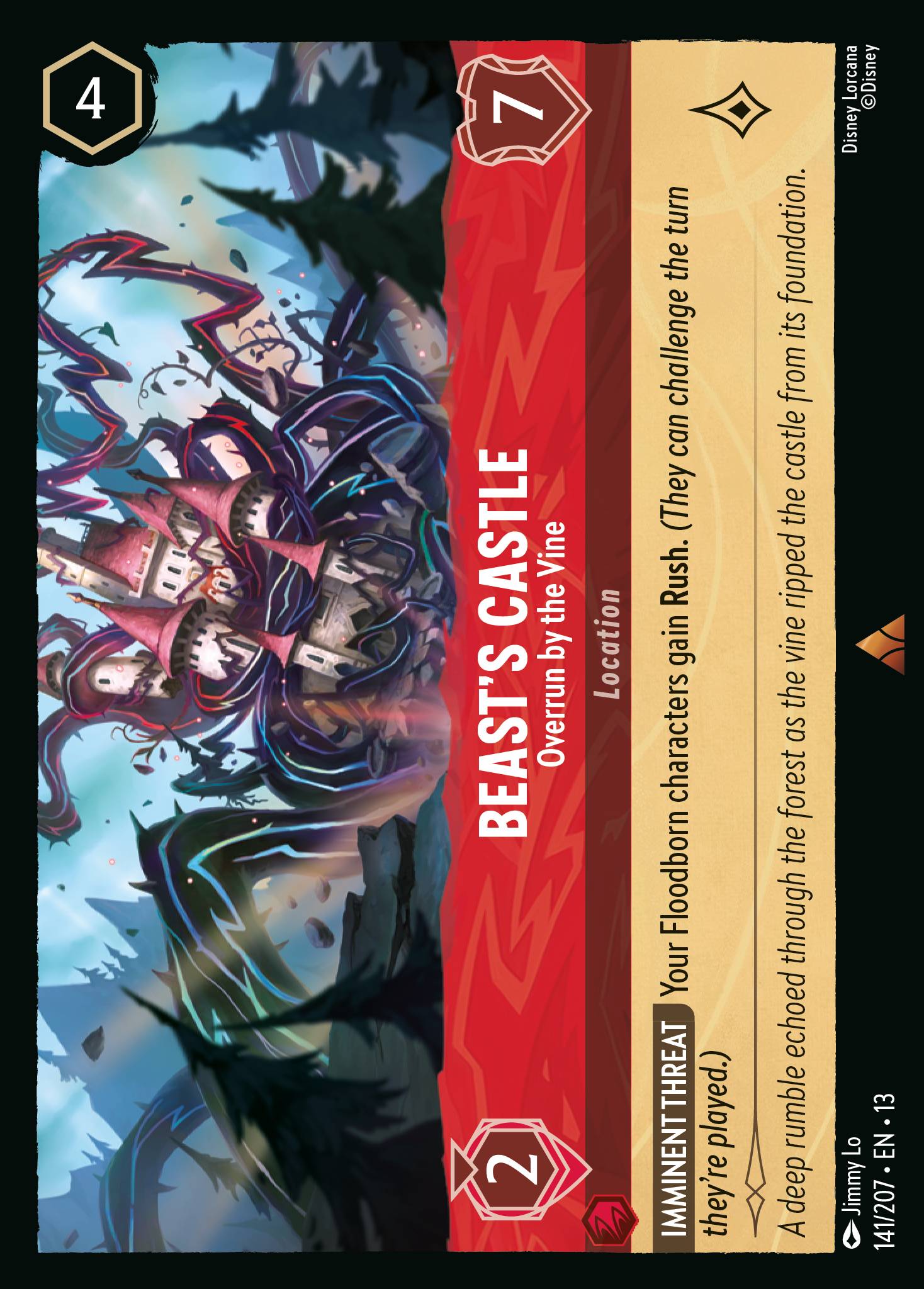
The first thing you'll notice is that locations are played sideways (landscape). That orientation isn't just for the artwork — it signals that a location is permanently in an "exerted" state. Locations never ready and never exert during the game; they simply sit there horizontally from the moment they enter play until they leave it. That single quirk drives a lot of their strategic personality, as we'll see.
A location card carries up to five pieces of information, and learning to read them at a glance is most of the battle:
- Ink cost — what you pay to play the location, top-left like any card.
- Move cost — the ink you pay to move one of your characters onto the location.
- Willpower — its durability. Accumulate damage equal to or greater than this number and the location is banished.
- Lore — optional. If present, this is how much lore the location generates passively each turn.
- Ability text — optional. Many locations buff characters stationed there, or trigger effects when characters move in or act.
Notice what's missing: locations have no Strength. They can never deal damage, which means they can't challenge anything and never punish a character that challenges them. A location is purely a board fixture — an engine or an enabler, never an attacker.
The Passive Lore Engine
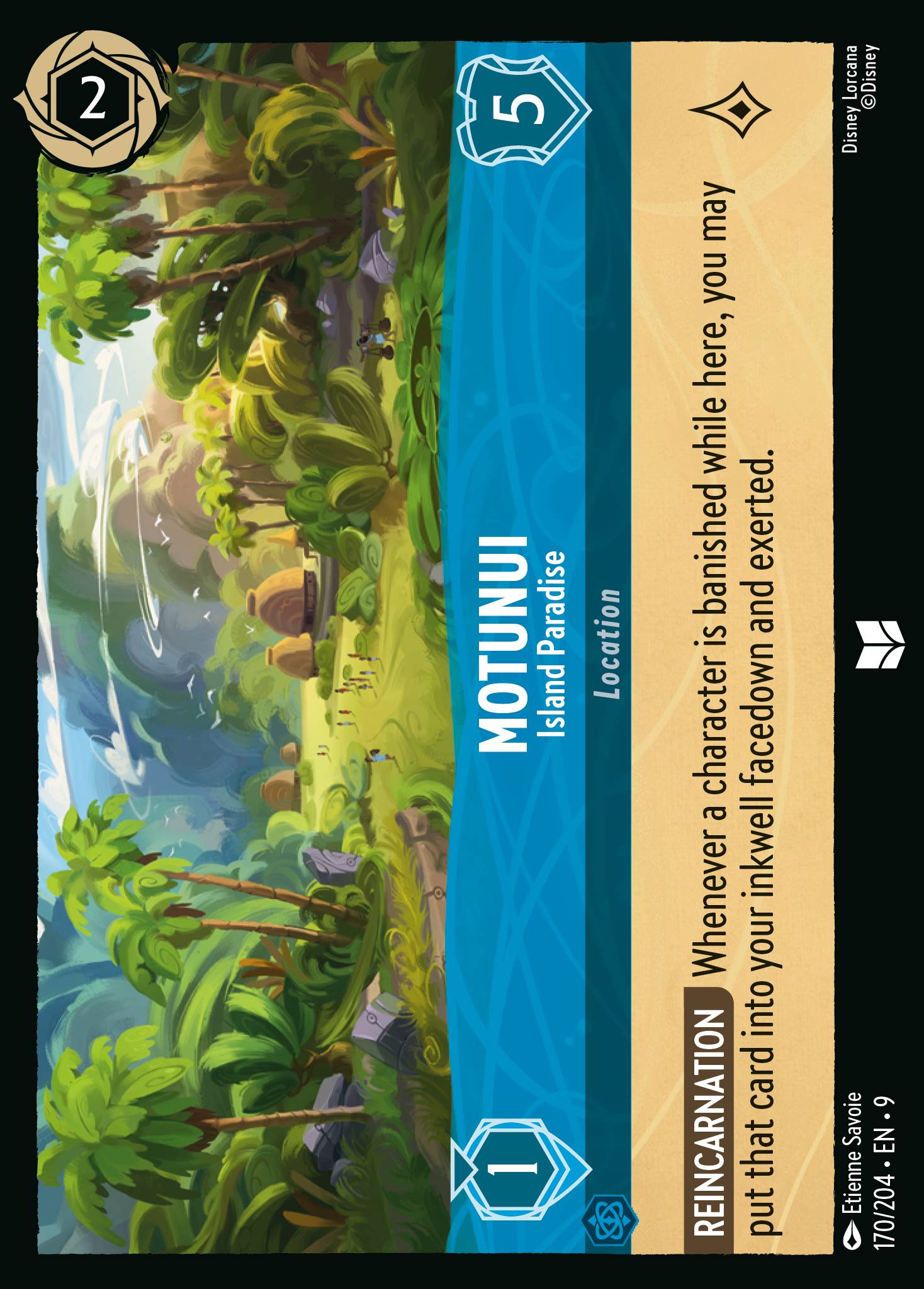
The headline reason to play a location is lore you don't have to work for. If a location has a Lore value, you gain that amount automatically at the start of your turn — specifically during the Set step of your Beginning Phase, before you've done anything else. You don't need a character standing on it, you don't exert it, and you don't risk anything to collect. It just pays out.
Compare that to a character. A character gains you lore by questing, but questing exerts it — leaving it tapped down and open to a challenge on your opponent's turn. A location sidesteps that entirely. It's lore with no exposure for the character you would otherwise have sent out to quest, which is exactly why locations shine in grindier, board-controlling decks that want to accumulate lore safely while answering threats.
The Rule Everyone Forgets
You do not gain a location's lore on the turn you play it. The first payout comes at the start of your next turn. That delay is the whole reason timing matters so much — a location has to survive a full round of your opponent's turn before it earns you a single point. Play one that gets challenged down immediately and you've gained nothing at all for your ink.
The flip side is that locations stack. There's no limit to how many you can have in play, so two or three lore-generating locations can quietly produce a meaningful chunk of your lore total every turn — all while your characters are free to challenge, block, or quest on top of it. That compounding is what makes a resilient location board so frustrating to race against.
Moving Characters: How It Works
Beyond passive lore, many locations reward you for moving characters onto them. The mechanics here are more generous than people expect, and understanding them unlocks a lot of value:
- Pay the move cost. Moving is a main-phase action: pay the location's move cost in ink to move one of your characters onto one of your own locations. You can only move your own characters to your own locations unless a card says otherwise.
- Moving doesn't exert the character. This is the key. A moved character stays ready, so after arriving it can still quest, challenge, sing, or use abilities that same turn. Moving costs you ink, not the character's action.
- It works the turn a character is played. Even a freshly played character can be moved immediately — the "drying" restriction that stops new characters from questing or challenging doesn't apply to moving.
- No crowd limit. Any number of characters can be stationed at a single location at once.
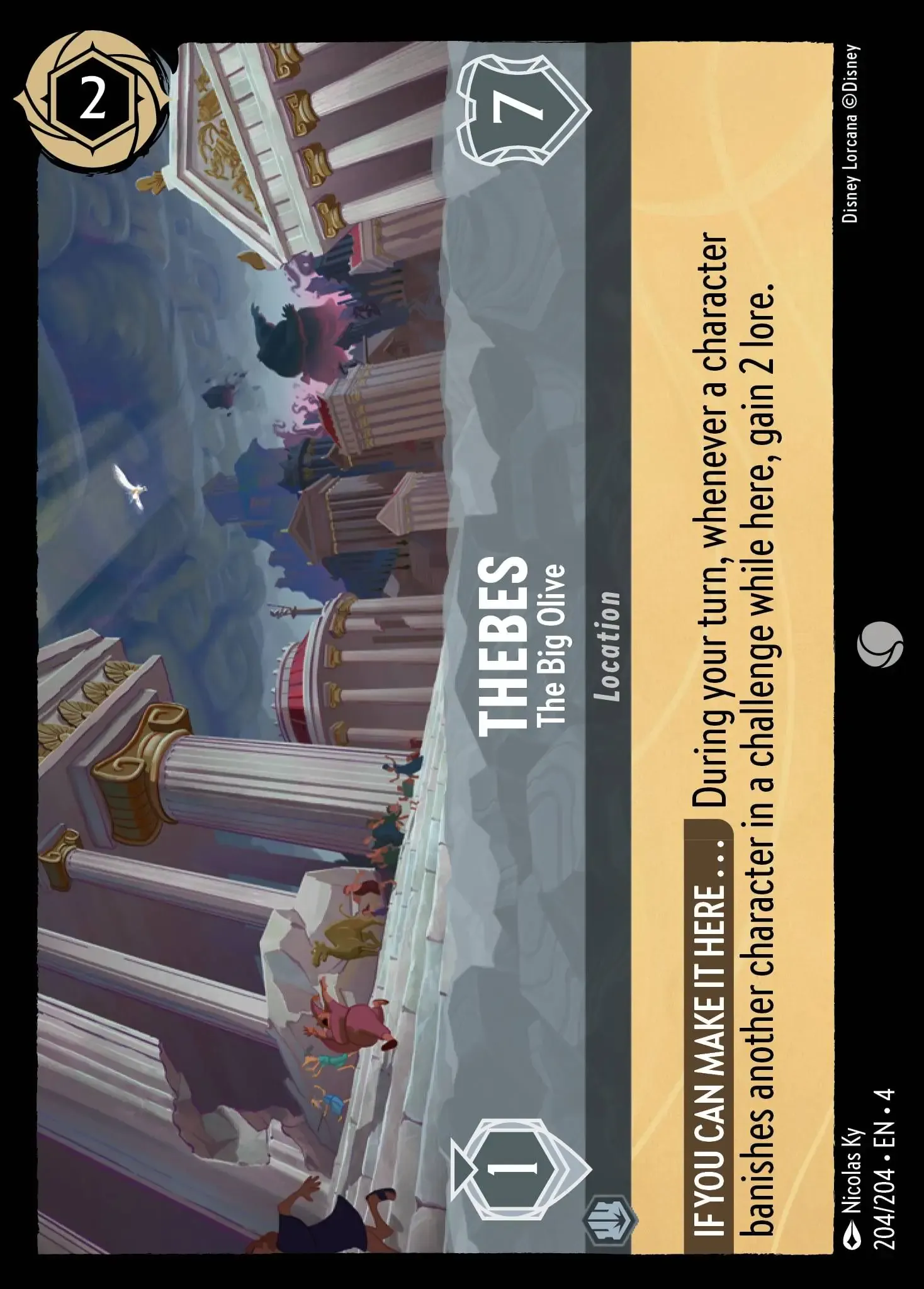
Why bother moving at all? Because of what the location does for characters there. A location like Thebes – The Big Olive, for example, hands you extra lore whenever a character stationed at it wins a challenge — turning your combat into bonus points. Others grant stat boosts, protection-style effects, or trigger abilities on arrival. The best locations pair this kind of character payoff with a lore value, doing two jobs at once.
Myth: Locations Protect Your Characters
This is the most common misconception, probably because similar "zones" shield units in other games. In Lorcana, a character stationed at a location is not protected or shielded in any way — it can be challenged exactly as if it were standing in the open. And if the location itself gets banished while characters are on it, those characters are perfectly fine; they aren't banished alongside it (unless a card specifically says so). Moving a character to a location is about gaining a benefit, never about hiding it.
Locations Are Vulnerable
For all their efficiency, locations come with real downsides that you have to respect. Because a location is permanently sideways and never readies, it behaves like a character that's always exerted — which means it can be challenged at any time, including the very turn you play it. There's no window where it's "safe."
Challenging a location works just like challenging a character: your opponent declares a character as the attacker and the location as the target, then deals damage equal to that character's Strength. Damage accumulates on the location, and once it equals or exceeds the location's Willpower, the location is banished to the discard pile. The difference is that, with no Strength of its own, the location deals zero damage back — your opponent attacks it completely for free, never losing or even damaging the character they used.
There is one silver lining on the removal front: not every removal effect can touch a location. Damage and banish effects only hit locations if they explicitly say so — typically the wording "characters and locations." Plenty of removal that targets "a chosen character" can't touch your locations at all, which makes a location a safe place to park lore against decks built around character removal.
Still, the honest summary is this: a location is an undefended target that can't fight back. Its survival depends entirely on whether your opponent has a character free to spend swinging at it — and on whether you've made attacking it look more appealing than attacking you.
When to Play a Location
All of the above funnels into the one decision that actually matters: timing. Because a location costs ink now but only pays off starting next turn, the core question before you ever play one is simple — "Is this going to survive at least a full turn?" If the answer is no, you're usually better off doing something else with your ink.
Here's how to think it through at the table:
- Read the opponent's board. If they have ready high-Strength characters — or threaten Rush characters that can enter and challenge immediately — a location you drop is likely to be banished before it ever pays out. Against an empty or low-pressure board, it's far safer.
- Favor high Willpower in dangerous spots. A location with 2 lore and a chunky Willpower forces your opponent to commit multiple attacks to remove it — attacks they aren't using to quest or pressure you. The harder it is to kill, the more value it banks.
- Create a dilemma. A location that also has a useful ability makes your opponent think harder — do they spend resources killing the location, or deal with your characters? Every turn they hesitate is a turn it earns lore. Even a location they "should" remove buys you tempo if removing it costs them their whole turn.
- Treat it as an investment, not a tempo play. Locations reward patience. They're at their best when you're ahead or stable on board and can afford to bank future lore, not when you're scrambling and need an immediate impact this turn.
The ideal moment is when you have enough board presence that your opponent can't profitably peel a character off to swing at your location — so it sits there, untouched, paying you lore turn after turn while the rest of the game plays out around it.
Common Mistakes
- Playing it into open removal. Dropping a fragile location when your opponent has ready attackers or Rush threats just gifts them a free banish. Wait for a safer window.
- Expecting it to protect characters. Stationing a character at a location does nothing to shield it. Move characters for the benefit, never for cover.
- Forgetting the one-turn delay. Counting on a location's lore the same turn you play it leads to miscounted lethal turns. The clock starts next turn.
- Over-investing ink you can't defend. A pricey location you can't keep alive is worse than the character or removal you could have played instead. Match the investment to how safe the board is.
Deckbuilding with Locations
Locations compete with characters and songs for both deck slots and ink, so they need to earn their place. As a rule of thumb, the strongest locations do more than one thing — pairing a lore value with a character payoff so they're worth playing even when you don't get full use of the ability.
They fit best in decks that actually want a slow, safe lore engine: control and midrange shells that grind games out, stabilize the board, and are happy to bank lore over many turns rather than race. A pure aggro deck usually has better uses for its ink and its turns. If your plan is to win fast, a location's delayed payoff often won't come online before the game is decided.
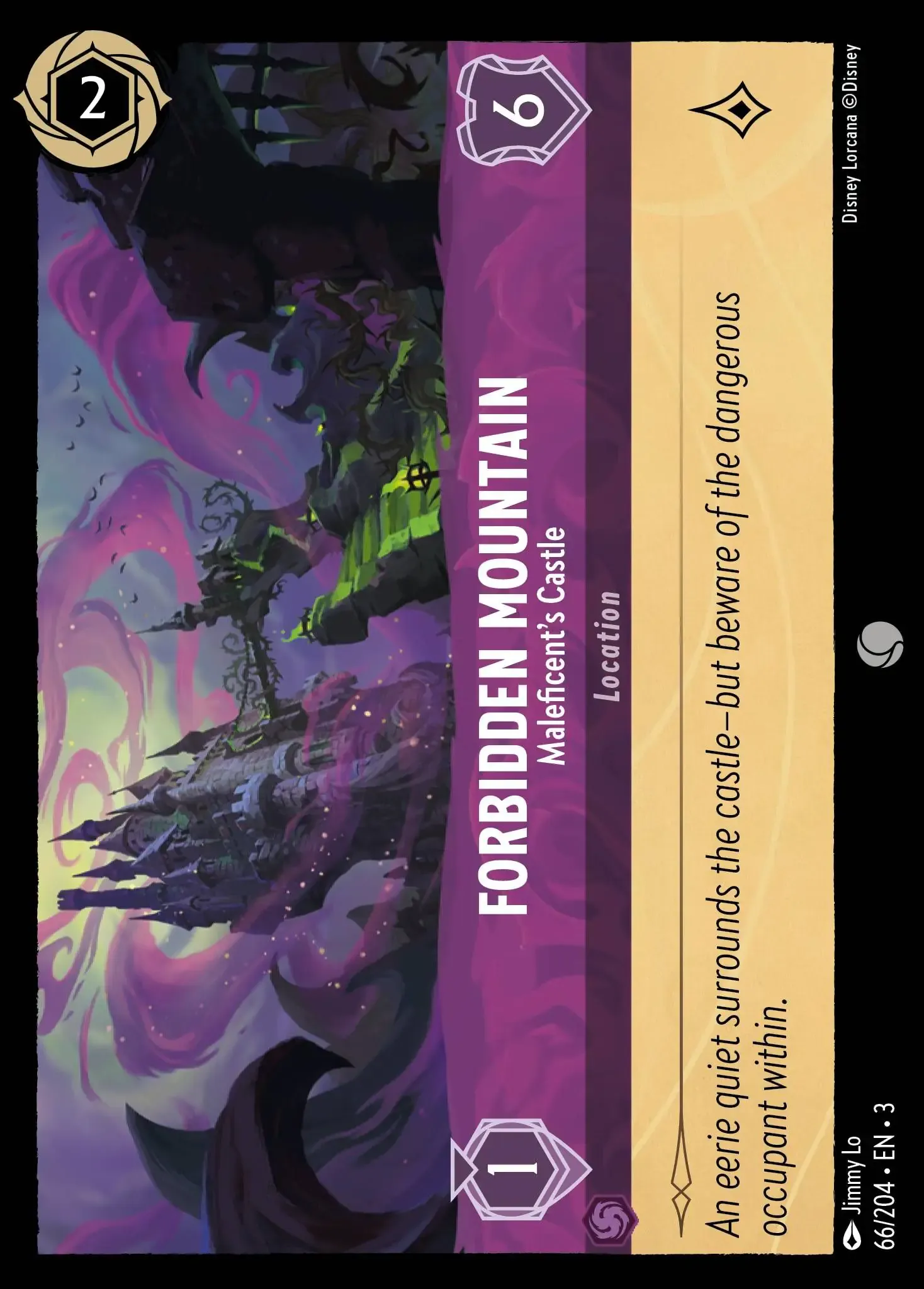
You also don't have to go all-in. Many decks run just one or two flexible locations as a supplementary lore source, while dedicated location-themed builds lean into move-cost synergies and stacking multiple lore-generators. Either way, ask the same question you'd ask of any card: does this get me closer to 20 lore more reliably than the alternative? If a location survives, the answer is often a resounding yes.
Quick Reference
- Permanent & sideways — stays in play, never readies or exerts.
- Lore — gained automatically at the start of your turn; not the turn you play it.
- No character needed — lore generates whether or not anyone's stationed there.
- Move cost — pay it to move your character onto your location; doesn't exert the character.
- Still active after moving — a moved character can quest, challenge, or sing.
- No protection — stationed characters can still be challenged normally.
- Willpower, no Strength — can be challenged and banished, never deals damage back.
- Challengeable immediately — including the turn it's played.
- Removal must say "locations" — character-only effects can't touch them.
- Timing is everything — only play one you can keep alive a full turn.
Quiet, Patient, and Powerful.
Locations won't win you a game on the turn you play them, and they'll never swing at anything. What they do is generate lore safely, turn after turn, while your characters get on with the fight — provided you protect them with timing rather than hope. Learn to read whether a location will survive, favor the ones that both make lore and reward your characters, and slot them into decks patient enough to cash in.
Get the timing right and a humble sideways card becomes one of the most efficient paths to 20 lore in the whole game.
Build Around Locations:
© GEEKYDOMAIN.COM | Strategy Powered by Data